Genetic Information
Gene & Transcript Details
| ID | Status | Details |
|---|---|---|
| NM_024675.4 | MANE Select | 4008 nt | 154–3714 |
| NM_024675.3 | RefSeq Select | 4069 nt | 201–3761 |
Variant Details
Clinical & Population Data
Population Frequency
gnomADClinVar
OpenThis variant is considered likely benign. This variant is strongly associated with less severe personal and family histories of cancer, typical for individuals without pathogenic variants in this gene [PMID: 25085752].
This alteration is classified as likely benign based on a combination of the following: seen in unaffected individuals, population frequency, intact protein function, lack of segregation with disease, co-occurrence, RNA analysis, in silico models, amino acid conservation, lack of disease association in case-control studies, and/or the mechanism of disease or impacted region is inconsistent with a known cause of pathogenicity.
This submission and the accompanying classification are no longer maintained by the submitter. For more information on current observations and classification, please contact variantquestions@myriad.com.
The PALB2 c.194C>T (p.Pro65Leu) variant has been reported in the published literature in individuals with breast cancer (PMID: 29522266 (2018), 28779002 (2017), 26564480 (2015)), ovarian cancer (PMID: 32546565 (2021), 26315354 (2015)), uterine cancer (PMID: 34326862 (2021)), pancreatic cancer (PMID: 25356972 (2015)), Lynch syndrome (PMID: 25980754 (2015)), and Brazilian individuals with breast cancer (PMID: 35264596 (2022)). This variant has also been observed in reportedly healthy individuals (PMID: 28779002 (2017), 26283626 (2015)), in a cohort of reportedly healthy individuals under the age of 50 (PMID: 24728327 (2014)) and in a large scale breast cancer association study, with breast cancer cases and reportedly healthy individuals (PMID: 33471991 (2021), see also LOVD (http://databases.lovd.nl/shared)). Functional studies demonstrated that this variant is not damaging to protein function (PMID: 33314489 (2012)) and it has benign/likely benign effects in saturation genome editing assays measuring DNA repair-dependent cell survival (PMIDs: 39779848 (2025), 39779857 (2025)). The frequency of this variant in the general population (Genome Aggregation Database, http://gnomad.broadinstitute.org) is uninformative in the assessment of its pathogenicity. Analysis of this variant using bioinformatics tools for the prediction of the effect of amino acid changes on protein structure and function yielded predictions that this variant is benign. Based on the available information, we are unable to determine the clinical significance of this variant.
Curators: Marc Tischkowitz, Arleen D. Auerbach. Submitter to LOVD: Marc Tischkowitz.
"This variant has been reported in ClinVar as Likely benign (8 clinical laboratories) and as Uncertain significance (9 clinical laboratories)."
COSMIC Somatic Evidence
Open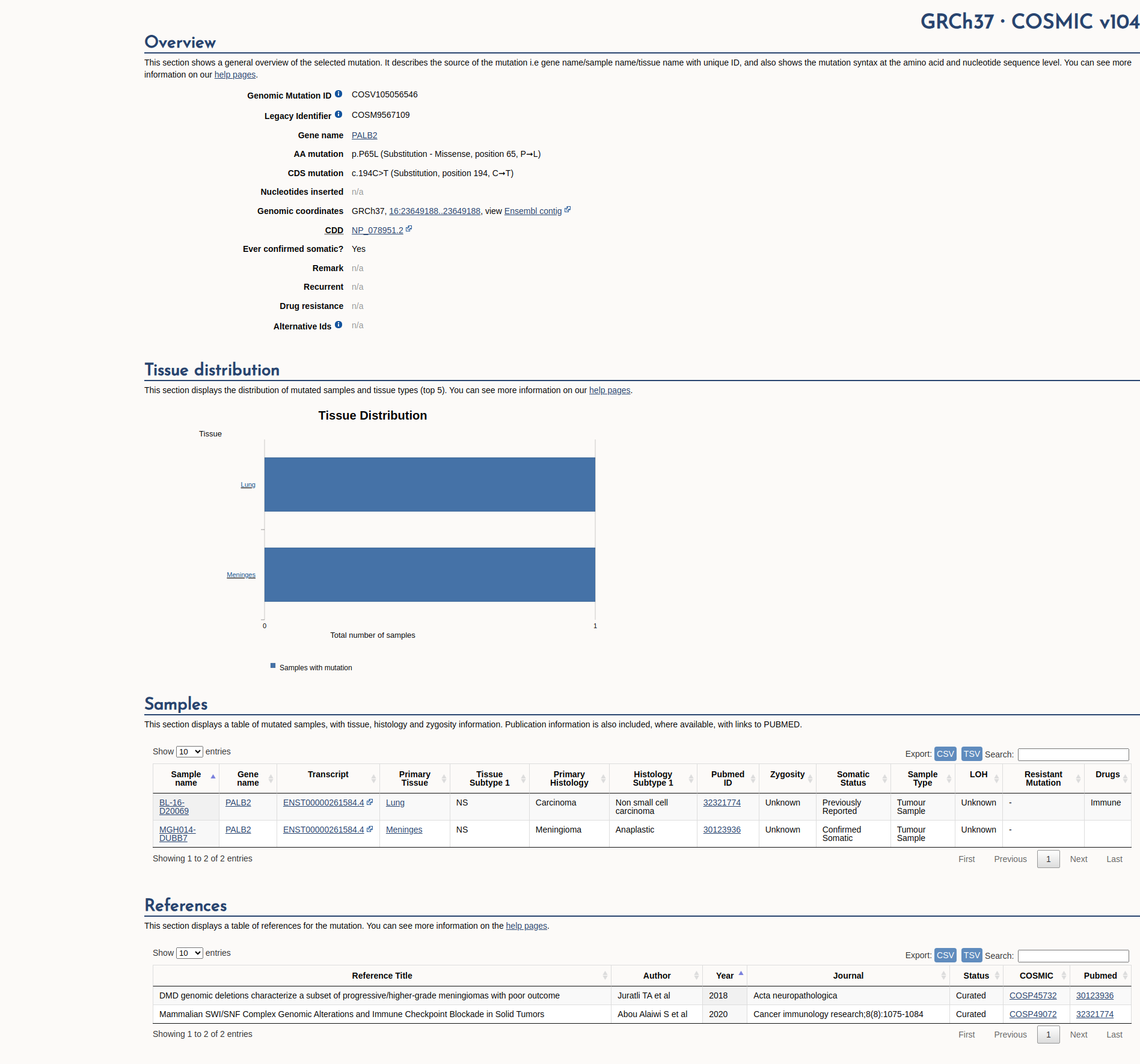
Functional Impact & Domains
Functional Domain
The PALB2 P65L variant has been functionally characterized and demonstrates BRCA1 binding similar to the wild-type protein in a mammalian two-hybrid assay. Additionally, it rescues PARP inhibitor sensitivity in PALB2-null cells, indicating that this variant is predicted to have no effect on Palb2 protein function.
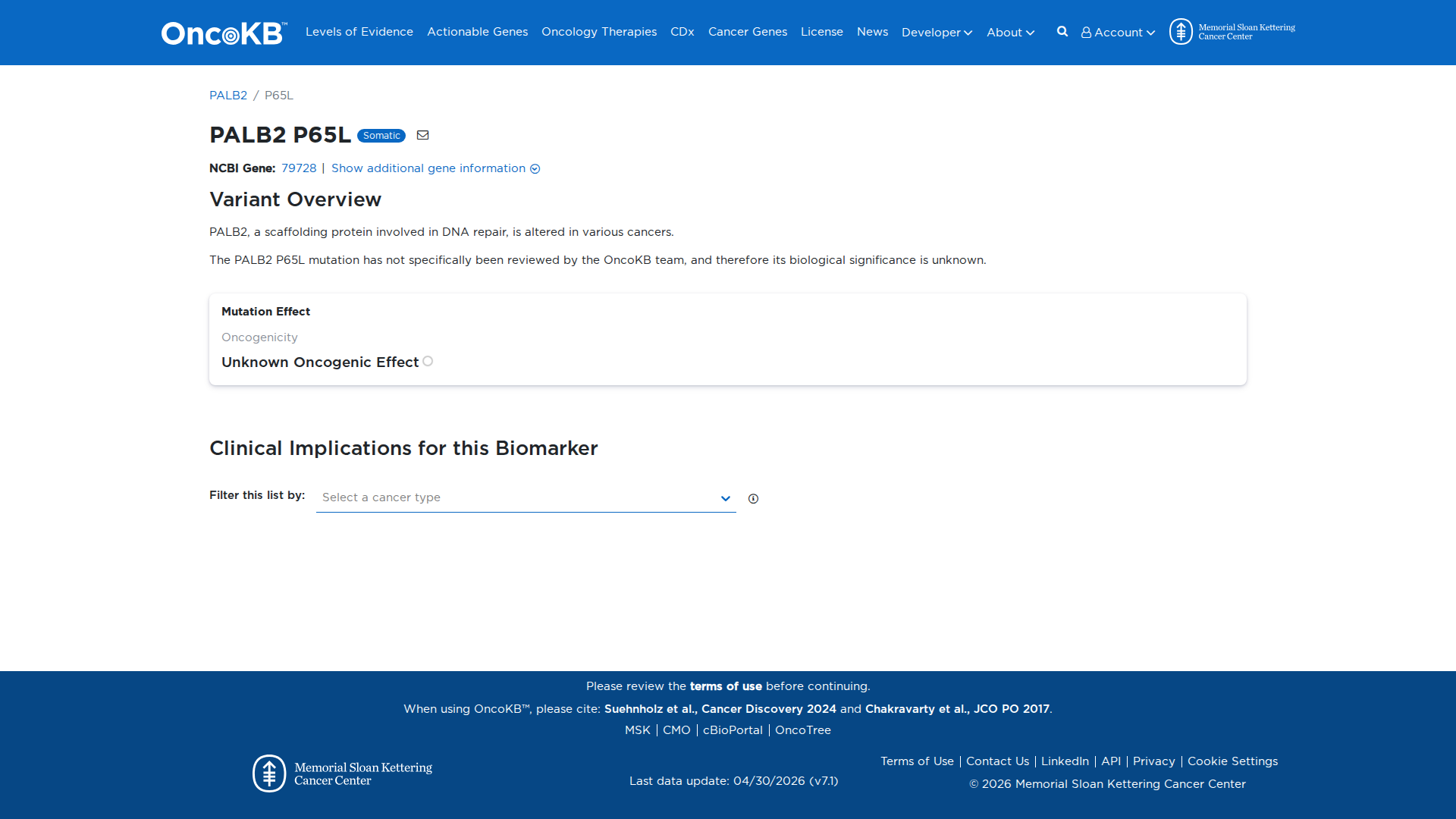
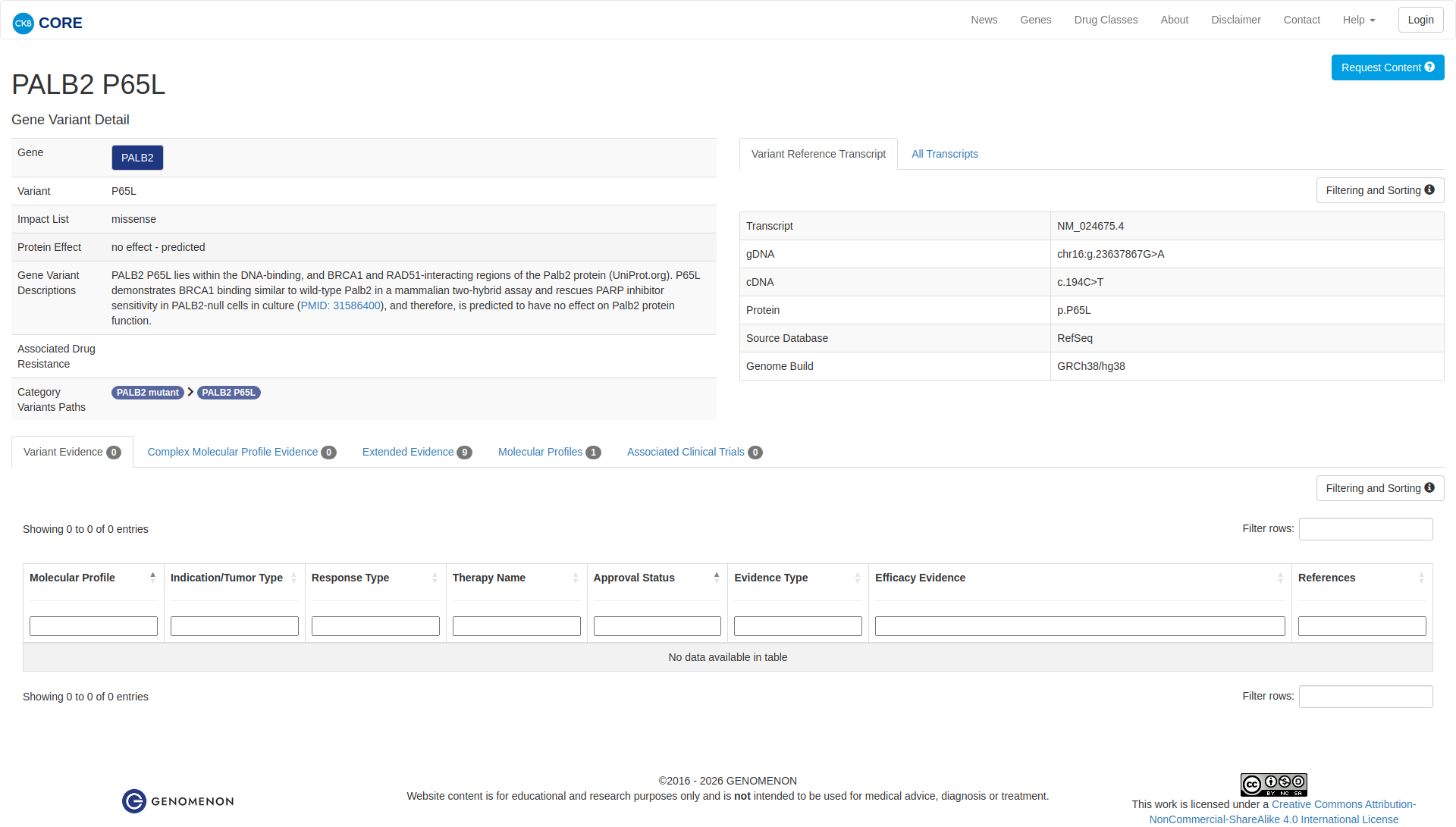
Click on previews to view full database entries. External databases may require institutional access.
Computational Analysis
Pathogenicity Predictions
SpliceAISpliceAI Scores
Window: ±500bp| Effect Type | Score | Position |
|---|---|---|
| Acceptor Loss (AL) | 0.0 | 85 bp |
| Donor Loss (DL) | 0.0 | -17 bp |
| Acceptor Gain (AG) | 0.0 | 288 bp |
| Donor Gain (DG) | 0.0 | -65 bp |
VCEP Guidelines
Applied ACMG/AMP Criteria (VCEP Specific)
PVS1 (Not Applied)
According to VCEP guidelines, the rule for PVS1 is: 'Use PALB2 PVS1 Decision Tree Modification Type: Gene-specific,Strength'. The evidence for this variant shows: it is a missense change (p.P65L) and not a null variant. Therefore, this criterion is not applied.
PS1 (Not Applied)
According to standard ACMG guidelines, the rule for PS1 is: 'Same amino acid change as a previously established pathogenic variant regardless of nucleotide change'. The evidence for this variant shows: no known pathogenic variant results in the same p.P65L change. Therefore, this criterion is not applied.
PS2 (Not Applied)
According to standard ACMG guidelines, the rule for PS2 is: 'De novo (both maternity and paternity confirmed) in a patient with the disease and no family history'. The evidence for this variant shows: no de novo testing data available. Therefore, this criterion is not applied.
PS3 (Not Applied)
According to standard ACMG guidelines, the rule for PS3 is: 'Well-established in vitro or in vivo functional studies show a damaging effect on protein function'. The evidence for this variant shows: functional assays demonstrate BRCA1 binding similar to wild-type and rescue of PARP inhibitor sensitivity in PALB2-null cells, indicating no damaging effect. Therefore, this criterion is not applied.
PS4 (Not Applied)
According to standard ACMG guidelines, the rule for PS4 is: 'Prevalence in affected individuals statistically increased over controls'. The evidence for this variant shows: no case-control data. Therefore, this criterion is not applied.
PM1 (Not Applied)
According to standard ACMG guidelines, the rule for PM1 is: 'Located in a mutational hot spot and/or critical and well-established functional domain'. The evidence for this variant shows: position p.P65 is not known to be in a mutational hot spot or critical domain. Therefore, this criterion is not applied.
PM2 (Not Applied)
According to VCEP guidelines, the rule for PM2 is: 'Variant absent in gnomAD or present in ≤1/300,000 alleles (Supporting strength)'. The evidence for this variant shows: present in gnomAD at 13/282,876 alleles (MAF=0.0046%), exceeding the threshold. Therefore, this criterion is not applied.
PM3 (Not Applied)
According to standard ACMG guidelines, the rule for PM3 is: 'For recessive disorders, detected in trans with a pathogenic variant'. The evidence for this variant shows: no data on phase or trans configuration. Therefore, this criterion is not applied.
PM4 (Not Applied)
According to standard ACMG guidelines, the rule for PM4 is: 'Protein length changes due to in-frame indels or stop-loss variants'. The evidence for this variant shows: it is a missense substitution with no change in protein length. Therefore, this criterion is not applied.
PM5 (Not Applied)
According to VCEP guidelines, the rule for PM5 is: 'Apply to frameshifting or truncating variants with premature termination codons upstream of p.Tyr1183 (Supporting)'. The evidence for this variant shows: it is a missense substitution. Therefore, this criterion is not applied.
PM6 (Not Applied)
According to standard ACMG guidelines, the rule for PM6 is: 'Assumed de novo without confirmation'. The evidence for this variant shows: no de novo data. Therefore, this criterion is not applied.
PP1 (Not Applied)
According to VCEP guidelines, the rule for PP1 is: 'LOD ≥0.3 or Bayes Factor ≥2:1 (Supporting)'. The evidence for this variant shows: no family segregation data. Therefore, this criterion is not applied.
PP2 (Not Applied)
According to standard ACMG guidelines, the rule for PP2 is: 'Missense variant in a gene with a low rate of benign missense variation'. The evidence for this variant shows: PALB2 has both benign and pathogenic missense variants and no specific evidence of low benign missense rate. Therefore, this criterion is not applied.
PP3 (Not Applied)
According to VCEP guidelines, the rule for PP3 is: 'RNA: At least one well-established in silico predictor shows impact on splicing (Supporting)'. The evidence for this variant shows: SpliceAI predicts no impact on splicing. Therefore, this criterion is not applied.
PP4 (Not Applied)
According to standard ACMG guidelines, the rule for PP4 is: 'Patient’s phenotype or family history is highly specific for a disease with a single genetic etiology'. The evidence for this variant shows: phenotype data not provided. Therefore, this criterion is not applied.
PP5 (Not Applied)
According to standard ACMG guidelines, the rule for PP5 is: 'Reputable source recently reports variant as pathogenic'. The evidence for this variant shows: ClinVar reports VUS and Likely benign; no reputable pathogenic assertion. Therefore, this criterion is not applied.
BA1 (Not Applied)
According to VCEP guidelines, the rule for BA1 is: 'Allele frequency >0.1% in gnomAD (Stand Alone)'. The evidence for this variant shows: MAF=0.0046%, below threshold. Therefore, this criterion is not applied.
BS1 (Not Applied)
According to VCEP guidelines, the rule for BS1 is: 'GnomAD Filtering Allele Frequency >0.01% (Strong)'. The evidence for this variant shows: MAF=0.0046%, below threshold. Therefore, this criterion is not applied.
BS2 (Not Applied)
According to VCEP guidelines, the rule for BS2 is: 'Per Fanconi Anemia BS2 tables (Strong/Moderate/Supporting)'. The evidence for this variant shows: no data on healthy adult carriers with confirmed phenotype. Therefore, this criterion is not applied.
BS3 (Strong)
According to standard ACMG guidelines, the rule for BS3 is: 'Well-established in vitro or in vivo functional studies show no damaging effect on protein function'. The evidence for this variant shows: functional assays demonstrate wild-type BRCA1 binding and rescue of PARP inhibitor sensitivity. Therefore, this criterion is applied at Strong strength.
BS4 (Not Applied)
According to VCEP guidelines, the rule for BS4 is: 'LOD ≤ -1.28 or Bayes Factor ≤0.053:1 (Strong)'. The evidence for this variant shows: no segregation data in unaffected individuals. Therefore, this criterion is not applied.
BP1 (Supporting)
According to VCEP guidelines, the rule for BP1 is: 'Apply to all missense variants (Supporting)'. The evidence for this variant shows: it is a missense substitution (p.P65L). Therefore, this criterion is applied at Supporting strength.
BP2 (Not Applied)
According to standard ACMG guidelines, the rule for BP2 is: 'Observed in trans with a pathogenic variant for a fully penetrant dominant disorder'. The evidence for this variant shows: no data on trans observation. Therefore, this criterion is not applied.
BP3 (Not Applied)
According to standard ACMG guidelines, the rule for BP3 is: 'In-frame deletions/insertions in repetitive regions without a known function'. The evidence for this variant shows: it is a missense substitution. Therefore, this criterion is not applied.
BP4 (Supporting)
According to VCEP guidelines, the rule for BP4 is: 'RNA: At least one well-established in silico predictor (e.g., SpliceAI) shows no impact on splicing (Supporting)'. The evidence for this variant shows: SpliceAI predicts no splicing impact. Therefore, this criterion is applied at Supporting strength.
BP5 (Not Applied)
According to standard ACMG guidelines, the rule for BP5 is: 'Variant found in a case with an alternate molecular basis for disease'. The evidence for this variant shows: no such case data. Therefore, this criterion is not applied.
BP6 (Not Applied)
According to standard ACMG guidelines, the rule for BP6 is: 'Reputable source reports variant as benign without evidence'. The evidence for this variant shows: ClinVar assertions are VUS and Likely benign but no independent evaluation. Therefore, this criterion is not applied.
BP7 (Not Applied)
According to standard ACMG guidelines, the rule for BP7 is: 'Synonymous or deep intronic variants with no splicing impact'. The evidence for this variant shows: it is a missense substitution. Therefore, this criterion is not applied.