Genetic Information
Gene & Transcript Details
| ID | Status | Details |
|---|---|---|
| NM_000059.4 | MANE Select | 11954 nt | 200–10456 |
| NM_000059.2 | Alternative | 11386 nt | 228–10484 |
| NM_000059.3 | RefSeq Select | 11386 nt | 228–10484 |
Variant Details
Clinical & Population Data
Population Frequency
gnomADClinVar
OpenThis alteration is classified as likely benign based on a combination of the following: seen in unaffected individuals, population frequency, intact protein function, lack of segregation with disease, co-occurrence, RNA analysis, in silico models, amino acid conservation, lack of disease association in case-control studies, and/or the mechanism of disease or impacted region is inconsistent with a known cause of pathogenicity.
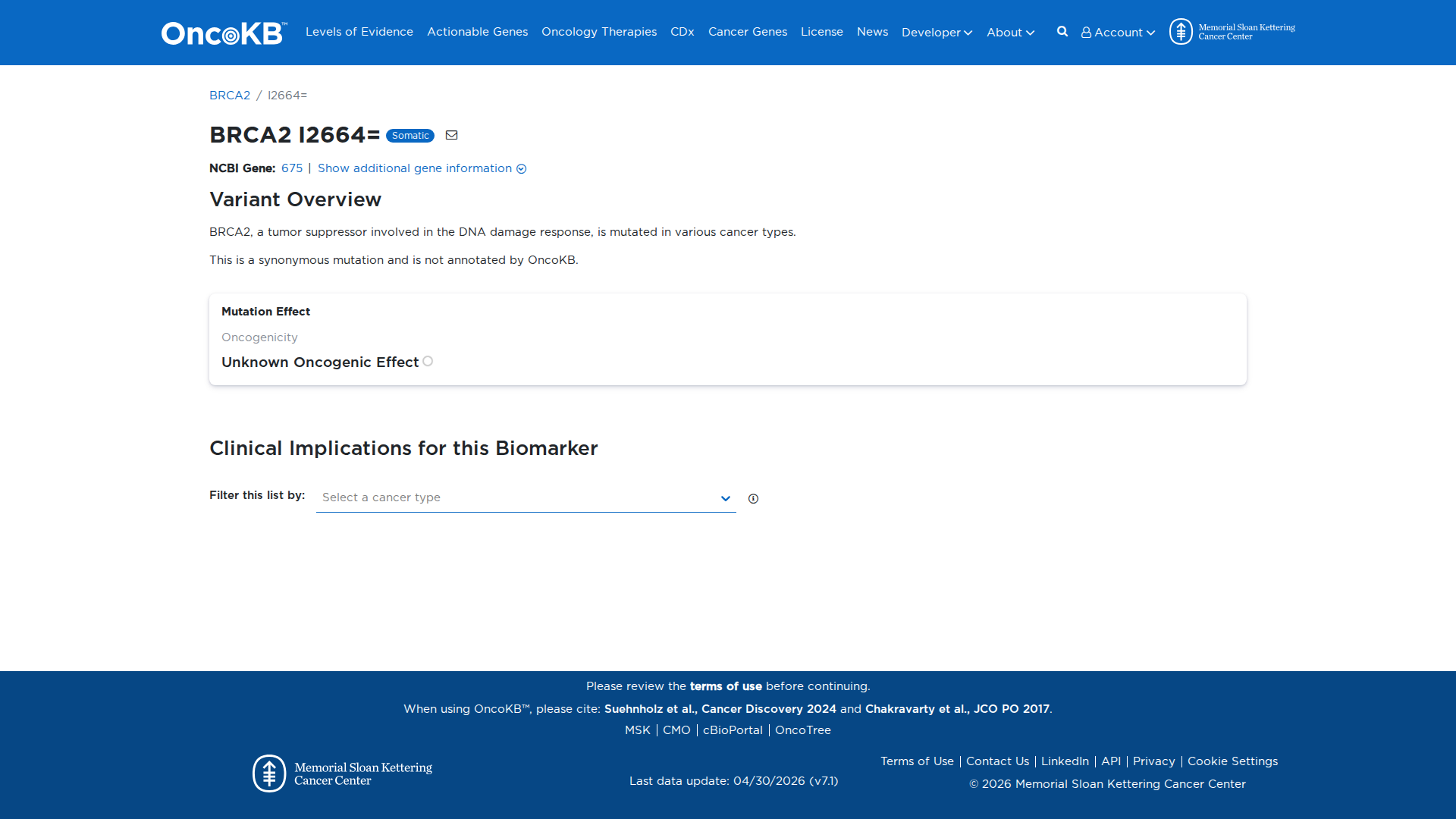
Variant summary: BRCA2 c.7992T>A alters a conserved nucleotide resulting in a synonymous change. Consensus agreement among computation tools predict no significant impact on normal splicing. Splicing functional assays demonstrated the variant increases skipping of exon 18 (Thery_2011, Houdayer_2012, Fraile-Bethencourt_2017, Wangensteen_2019), however it is complex to interpret the role of variants with partial splicing anomalies in HBOC under the clinical perspective. The variant allele was found at a frequency of 3.2e-05 in 250460 control chromosomes (gnomAD). The available data on variant occurrences in the general population are insufficient to allow any conclusion about variant significance. c.7992T>A has been reported in the literature in an individual affected with breast cancer (Thery_2011). These data do not allow any conclusion about variant significance. At least one publication reports experimental evidence evaluating an impact HDR function, finding no deleterious effect (Mesman_2020). The following publications have been ascertained in the context of this evaluation (PMID: 22505045, 21673748, 23893897, 22962691, 26332594, 26913838, 28339459, 28758972, 31191615, 28794409, 31143303, 32398771). ClinVar contains an entry for this variant (Variation ID: 52463). Based on the evidence outlined above, the variant was classified as likely benign.
"This variant has been reported in ClinVar as Uncertain significance (4 clinical laboratories) and as Likely benign (10 clinical laboratories) and as Benign (1 clinical laboratories) and as Likely benign by Evidence-based Network for the Interpretation of Germline Mutant Alleles (ENIGMA) expert panel."
COSMIC Somatic Evidence
Open
Functional Impact & Domains
Functional Domain
Computational Analysis
Pathogenicity Predictions
SpliceAISpliceAI Scores
Window: ±500bp| Effect Type | Score | Position |
|---|---|---|
| Acceptor Loss (AL) | 0.02 | -15 bp |
| Donor Loss (DL) | 0.0 | 339 bp |
| Acceptor Gain (AG) | 0.0 | 176 bp |
| Donor Gain (DG) | 0.0 | -6 bp |
VCEP Guidelines
Applied ACMG/AMP Criteria (VCEP Specific)
PVS1 (Not Applied)
According to VCEP guidelines, PVS1 applies only to null variants in a gene where loss of function is a known mechanism of disease. The variant is a synonymous (I2664=) change, not a null variant. Therefore, this criterion is not applied.
PS1 (Not Applied)
According to VCEP guidelines, PS1 applies when a different nucleotide change results in the same amino acid change as a previously established pathogenic variant. This is a synonymous variant with no amino acid change and no known pathogenic silent variant at this codon. Therefore, this criterion is not applied.
PS2 (Not Applied)
According to standard ACMG guidelines, PS2 requires confirmed de novo occurrence with parental testing. No de novo data or parental genotyping are available. Therefore, this criterion is not applied.
PS3 (Not Applied)
According to VCEP guidelines, PS3 requires well-established functional studies demonstrating a damaging effect. No functional assay data exist for this variant. Therefore, this criterion is not applied.
PS4 (Not Applied)
According to VCEP guidelines, PS4 requires significant enrichment of the variant in affected individuals in well-powered case-control studies. No case-control data are available. Therefore, this criterion is not applied.
PM1 (Not Applied)
According to VCEP guidelines, PM1 applies to variants located in mutational hot spots or critical functional domains with no benign variation. This is a synonymous change within the DNA-binding domain but does not affect the protein sequence. Therefore, this criterion is not applied.
PM2 (Not Applied)
According to VCEP guidelines, PM2_Supporting requires absence from gnomAD non-cancer populations. The variant is present at MAF=0.00319% overall and 0.00707% in non-Finnish Europeans. Therefore, this criterion is not applied.
PM3 (Not Applied)
According to VCEP guidelines, PM3 applies to variants in a patient with Fanconi anemia phenotype with co-occurring BRCA2 variants. No Fanconi anemia phenotype or trans-variant data are available. Therefore, this criterion is not applied.
PM4 (Not Applied)
According to standard ACMG guidelines, PM4 applies to protein length changes (in-frame indels) not overlapping repetitive regions. This is a synonymous variant with no protein length change. Therefore, this criterion is not applied.
PM5 (Not Applied)
According to VCEP guidelines, PM5 applies to novel stop-gain variants in an exon where a different pathogenic stop-gain has been observed. This is a synonymous variant. Therefore, this criterion is not applied.
PM6 (Not Applied)
According to standard ACMG guidelines, PM6 applies to presumed de novo variants without parental confirmation. No de novo evidence is available. Therefore, this criterion is not applied.
PP1 (Not Applied)
According to VCEP guidelines, PP1 requires segregation data in multiple affected family members. No segregation data are available. Therefore, this criterion is not applied.
PP2 (Not Applied)
According to standard ACMG guidelines, PP2 applies to missense variants in genes with low benign missense variation. This is a synonymous variant. Therefore, this criterion is not applied.
PP3 (Not Applied)
According to VCEP guidelines, PP3 applies to missense or predicted splicing variants (SpliceAI ≥0.2). SpliceAI score is 0.02 (<0.2), and there is no protein change. Therefore, this criterion is not applied.
PP4 (Not Applied)
According to VCEP guidelines, PP4 requires a highly specific phenotype and multifactorial likelihood data. No such clinical data are available. Therefore, this criterion is not applied.
PP5 (Not Applied)
According to standard ACMG guidelines, PP5 applies when multiple reputable sources report the variant as pathogenic. ClinVar submissions are conflicting (VUS, likely benign, benign). Therefore, this criterion is not applied.
BA1 (Not Applied)
According to VCEP guidelines, BA1 requires population frequency (FAF) >0.1%. The variant MAF=0.00319% is well below this threshold. Therefore, this criterion is not applied.
BS1 (Supporting)
According to VCEP guidelines, BS1_Supporting: "Filter allele frequency (FAF) is above 0.002% and ≤0.01% in gnomAD non-founder populations." The variant MAF=0.00707% in non-Finnish Europeans falls within this range. Therefore, this criterion is applied at Supporting strength.
BS2 (Not Applied)
According to VCEP guidelines, BS2 applies in healthy adults without Fanconi anemia features. No systematic healthy cohort data are available. Therefore, this criterion is not applied.
BS3 (Not Applied)
According to VCEP guidelines, BS3 requires well-established functional studies showing no damaging effect. No such data exist. Therefore, this criterion is not applied.
BS4 (Not Applied)
According to VCEP guidelines, BS4 applies to lack of segregation in affected family members. No segregation data are available. Therefore, this criterion is not applied.
BP1 (Not Applied)
According to VCEP guidelines, BP1_Strong applies to silent or missense variants outside critical domains with no predicted splicing. Although this is silent, it lies within the DNA-binding domain. Therefore, this criterion is not applied.
BP2 (Not Applied)
According to VCEP guidelines, BP2 applies when observed in trans with a pathogenic variant for a dominant disorder. No such co-occurrence data are available. Therefore, this criterion is not applied.
BP3 (Not Applied)
According to standard ACMG guidelines, BP3 applies to in-frame indels in repetitive regions. This is a single-nucleotide synonymous variant. Therefore, this criterion is not applied.
BP4 (Supporting)
According to VCEP guidelines, BP4_Supporting: "Silent variant inside a potentially clinically important functional domain and no predicted impact via splicing (SpliceAI ≤0.1)." The variant is synonymous in the DNA-binding domain (aa2481-3186) and SpliceAI score=0.02. Therefore, this criterion is applied at Supporting strength.
BP5 (Not Applied)
According to VCEP guidelines, BP5 applies when co-observed with a pathogenic variant in another gene with no specific phenotype. No such data are available. Therefore, this criterion is not applied.
BP6 (Not Applied)
According to standard ACMG guidelines, BP6 applies when multiple sources report as benign without evidence. ClinVar submissions are mixed including likely benign and benign but not unanimously. Therefore, this criterion is not applied.
BP7 (Supporting)
According to VCEP guidelines, BP7_Supporting: "Silent variant inside a potentially clinically important functional domain if BP4 is met." BP4 has been applied. Therefore, this criterion is applied at Supporting strength.