Genetic Information
Gene & Transcript Details
| ID | Status | Details |
|---|---|---|
| NM_000535.6 | Alternative | 5156 nt | 88–2676 |
| NM_000535.4 | Alternative | 2836 nt | 88–2676 |
| NM_000535.7 | MANE Select | 5093 nt | 31–2619 |
| NM_000535.3 | Alternative | 2820 nt | 57–2645 |
| NM_000535.5 | Alternative | 2851 nt | 88–2676 |
Variant Details
Clinical & Population Data
Population Frequency
gnomADClinVar
OpenVariant summary: PMS2 c.241G>A (p.Glu81Lys) results in a conservative amino acid change located in the DNA mismatch repair protein family, N-terminal and Histidine kinase/HSP90-like ATPase domains of the encoded protein sequence. Three of five in-silico tools predict a damaging effect of the variant on protein function. The variant allele was found at a frequency of 1.6e-05 in 245818 control chromosomes (gnomAD). The available data on variant occurrences in the general population are insufficient to allow any conclusion about variant significance. The variant, c.241G>A, has been reported in the literature in individuals affected with HBOC (Cock-Rada_2017, Goodfellow_2015). These reports do not provide unequivocal conclusions about association of the variant with Lynch Syndrome. Co-occurrences with other pathogenic variant(s) have been reported (PALB2 c.1240C>T, p.Arg414X), providing supporting evidence for a benign role. In addition, one patient was indicated to have IHC defects consistent with an MSH2 mutation (absent MSH2 and MSH6)(Goodfellow_2015)To our knowledge, no experimental evidence demonstrating an impact on protein function has been reported. Five ClinVar submissions from clinical diagnostic laboratories (evaluation after 2014) cites the variant as uncertain significance. Based on the evidence outlined above, the variant was classified as uncertain significance.
This submission and the accompanying classification are no longer maintained by the submitter. For more information on current observations and classification, please contact variantquestions@myriad.com.
The p.E81K variant (also known as c.241G>A), located in coding exon 3 of the PMS2 gene, results from a G to A substitution at nucleotide position 241. The glutamic acid at codon 81 is replaced by lysine, an amino acid with similar properties. This alteration has been reported multiple individuals diagnosed with endometrial cancer (Goodfellow PJ et al. J Clin Oncol. 2015 Dec 20;33(36):4301-8; Wang Q et al. J Med Genet, 2020 07;57:487-499). This alteration was detected in a cohort of unrelated individuals diagnosed with breast cancer (Sandoval RL et al. PLoS One, 2021 Feb;16:e0247363), and has also been reported in conjunction with a pathogenic PALB2 mutation in an individual meeting hereditary breast/ovarian cancer testing guidelines (Cock-Rada AM et al. Fam Cancer. 2017 May 20). This amino acid position is well conserved in available vertebrate species. In addition, the in silico prediction for this alteration is inconclusive. Based on the available evidence, the clinical significance of this variant remains unclear.
This missense variant replaces glutamic acid with lysine at codon 81 of the PMS2 protein. Computational prediction tool is inconclusive regarding the impact of this variant on protein structure and function. To our knowledge, functional studies have not been performed for this variant. This variant has been reported in an individuals affected with endometrial cancer (PMID: 26552419, 31992580), an individual affected with pancreatic cancer (PMID: 32980694), in individuals affected with breast or ovarian cancer (PMID: 28528518, 33471991), as well as in unaffected individuals (PMID: 32980694, 33471991). This variant has been identified in 4/250820 chromosomes in the general population by the Genome Aggregation Database (gnomAD) and in a healthy control individual (PMID: 32980694). The available evidence is insufficient to determine the role of this variant in disease conclusively. Therefore, this variant is classified as a Variant of Uncertain Significance.
"This variant has been reported in ClinVar as Uncertain significance (13 clinical laboratories) and as Benign (1 clinical laboratories) and as Uncertain Significance (1 clinical laboratories)."
COSMIC Somatic Evidence
Open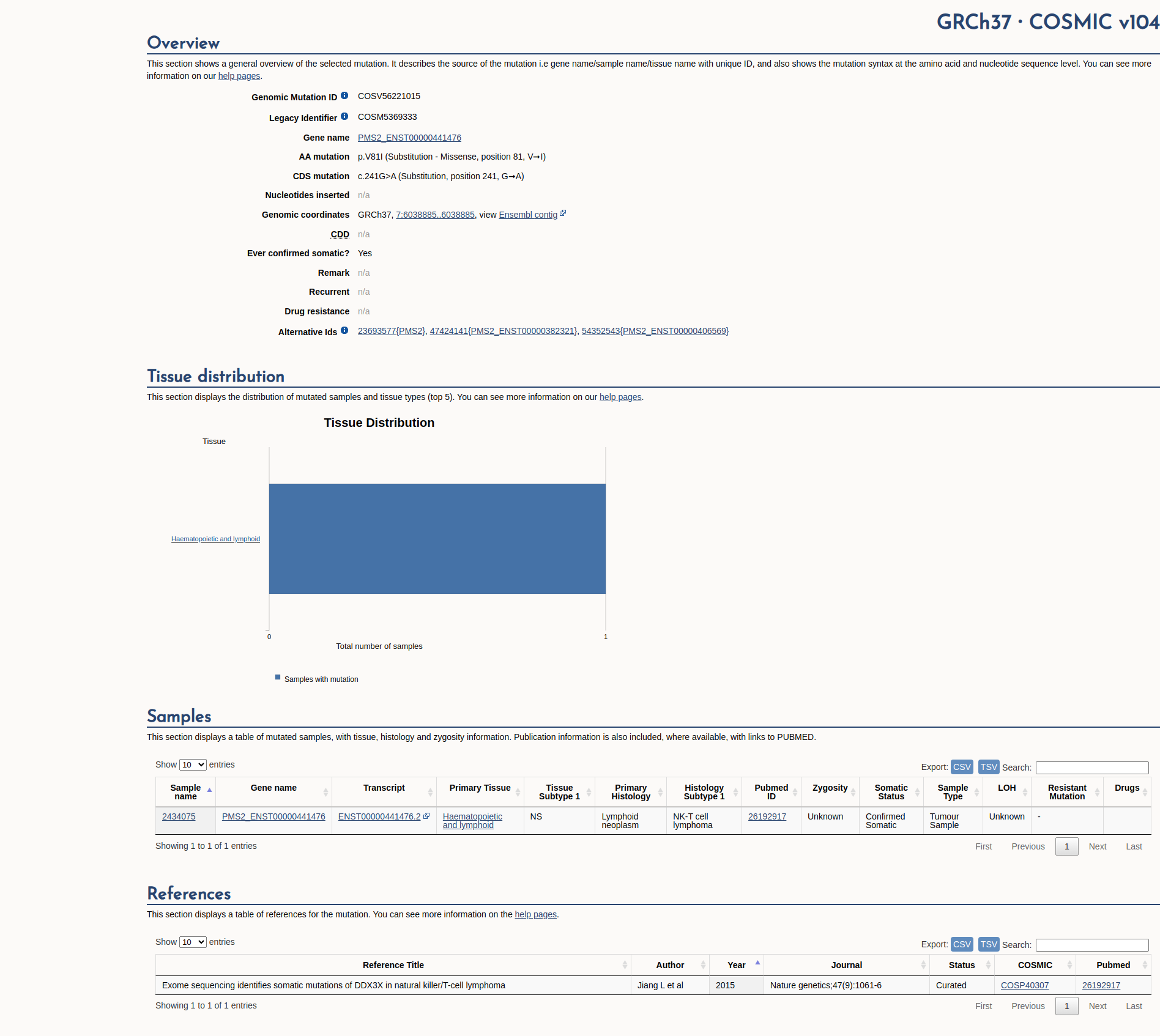
Functional Impact & Domains
Functional Domain
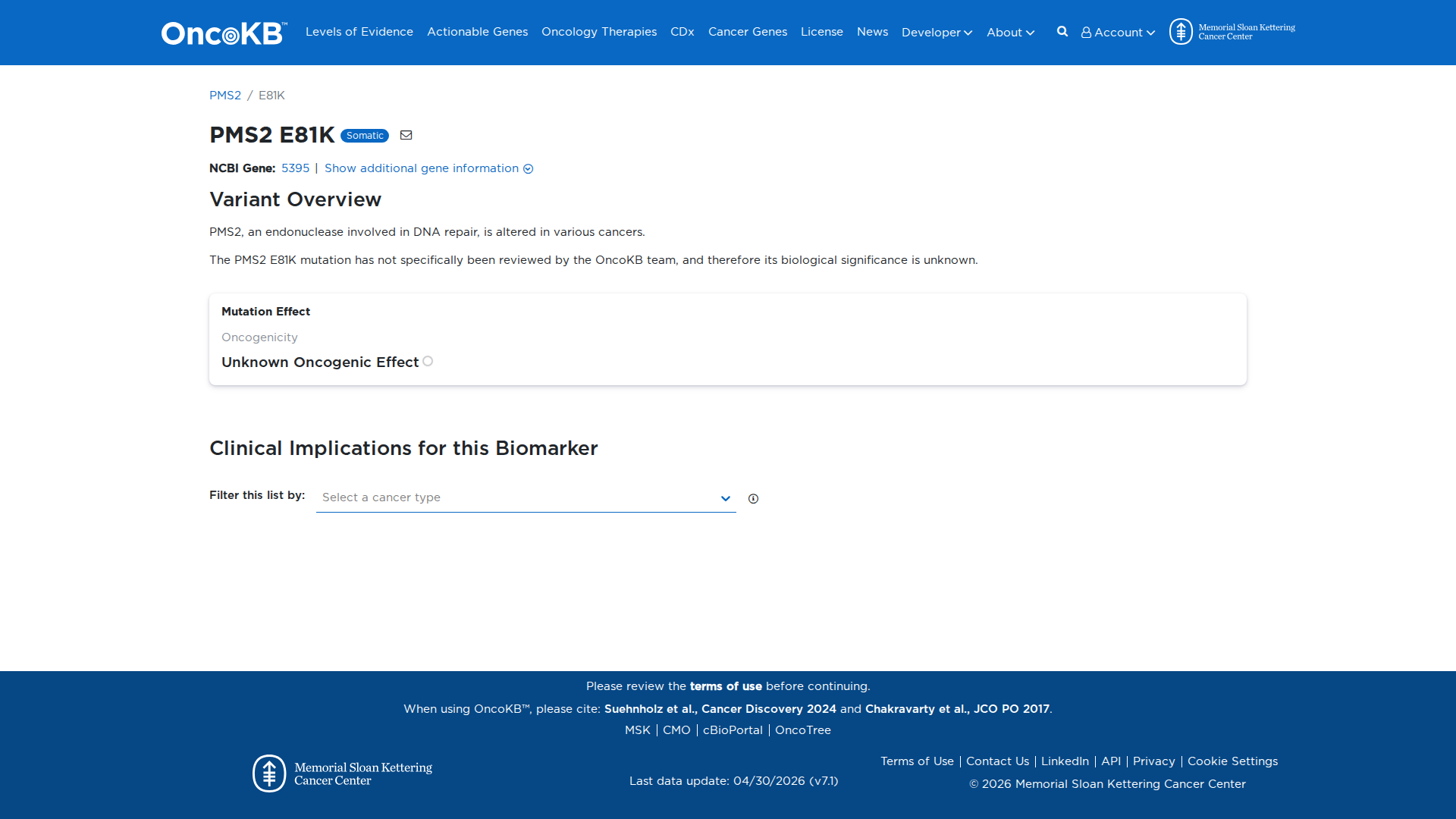
Computational Analysis
Pathogenicity Predictions
SpliceAISpliceAI Scores
Window: ±500bp| Effect Type | Score | Position |
|---|---|---|
| Acceptor Loss (AL) | 0.0 | 38 bp |
| Donor Loss (DL) | 0.0 | 185 bp |
| Acceptor Gain (AG) | 0.0 | -189 bp |
| Donor Gain (DG) | 0.0 | -291 bp |
VCEP Guidelines
Applied ACMG/AMP Criteria (VCEP Specific)
PVS1 (Not Applied)
According to VCEP guidelines, the rule for PVS1 is: "Very Strong nonsense/frameshift variant introducing PTC ≤ codon 798 in PMS2 ...". The evidence for this variant shows: NM_000535.7:c.241G>A is a missense (E81K) substitution, not a null variant. Therefore, this criterion is not applied because the variant does not introduce a premature stop codon or affect splicing at IVS±1/2.
PS1 (Not Applied)
According to VCEP guidelines, the rule for PS1 is: "A predicted missense substitution that encodes the same amino acid change with a different underlying nucleotide change previously established by this VCEP as Pathogenic." The evidence for this variant shows: E81K has no previously established pathogenic variant encoding the same amino acid change. Therefore, this criterion is not applied.
PS2 (Not Applied)
According to VCEP guidelines, the rule for PS2 is: "De novo points based on confirmed maternity/paternity." The evidence for this variant shows: no de novo occurrence has been reported. Therefore, this criterion is not applied.
PS3 (Not Applied)
According to VCEP guidelines, the rule for PS3 is: "Strong calibrated functional assays with odds for Pathogenicity >18.7; moderate if >4.3≤18.7, supporting if >2.08≤4.3." The evidence for this variant shows: no functional assay data are available for E81K. Therefore, this criterion is not applied.
PS4 (Not Applied)
According to standard ACMG guidelines, the rule for PS4 is: "The prevalence of the variant in affected individuals is significantly increased compared with controls." The evidence for this variant shows: no case-control or case series data demonstrating enrichment in affected individuals. Therefore, this criterion is not applied.
PM1 (Not Applied)
According to standard ACMG guidelines, the rule for PM1 is: "Located in a mutational hot spot and/or critical and well-established functional domain without benign variation." The evidence for this variant shows: the location and functional domain context of residue E81 in PMS2 are not defined. Therefore, this criterion is not applied.
PM2 (Supporting)
According to VCEP guidelines, the rule for PM2 is: "Absent/extremely rare (<1 in 50,000 alleles) in gnomAD v4 dataset." The evidence for this variant shows: MAF = 0.00159% (4/250,820 alleles), corresponding to 1.59 per 100,000 alleles, which meets the rarity threshold. Therefore, this criterion is applied at Supporting strength because the variant is absent or extremely rare in population databases.
PM3 (Not Applied)
According to VCEP guidelines, the rule for PM3 is: "Recessive inheritance observational points in trans with a pathogenic variant." The evidence for this variant shows: no observations in trans with a known pathogenic PMS2 variant. Therefore, this criterion is not applied.
PM4 (Not Applied)
According to standard ACMG guidelines, the rule for PM4 is: "Protein length changes due to in-frame deletions/insertions in a non-repeat region or stop loss." The evidence for this variant shows: E81K is a missense substitution without length change. Therefore, this criterion is not applied.
PM5 (Not Applied)
According to VCEP guidelines, the rule for PM5 is: "Missense change at an amino acid residue where a different missense change was classified as Pathogenic by this VCEP." The evidence for this variant shows: no other missense at residue 81 has been classified as Pathogenic. Therefore, this criterion is not applied.
PM6 (Not Applied)
According to VCEP guidelines, the rule for PM6 is: "Assumed de novo without confirmation of paternity and maternity." The evidence for this variant shows: no de novo reports. Therefore, this criterion is not applied.
PP1 (Not Applied)
According to VCEP guidelines, the rule for PP1 is: "Segregation with disease in pedigree(s) meeting defined LRs." The evidence for this variant shows: no segregation data reported. Therefore, this criterion is not applied.
PP2 (Not Applied)
According to standard ACMG guidelines, the rule for PP2 is: "Missense variant in a gene with low rate of benign missense variation and where missense is a common mechanism of disease." The evidence for this variant shows: no gene-specific missense constraint data are provided. Therefore, this criterion is not applied.
PP3 (Not Applied)
According to VCEP guidelines, the rule for PP3 is: "Missense variant with HCI prior probability >0.81 or splice prediction delta ≥0.2." The evidence for this variant shows: computational predictions are mixed and SpliceAI delta scores <0.1, not meeting the VCEP thresholds. Therefore, this criterion is not applied.
PP4 (Not Applied)
According to VCEP guidelines, the rule for PP4 is: "Tumor MSI-H or loss of MMR expression consistent with variant in ≥1 tumors." The evidence for this variant shows: no tumor or phenotypic data. Therefore, this criterion is not applied.
PP5 (Not Applied)
According to standard ACMG guidelines, the rule for PP5 is: "Reputable source reports variant as pathogenic." The evidence for this variant shows: ClinVar entries are VUS or Benign, not Pathogenic. Therefore, this criterion is not applied.
BA1 (Not Applied)
According to VCEP guidelines, the rule for BA1 is: "GnomAD v4 Grpmax filtering allele frequency ≥0.0028 (0.28%)." The evidence for this variant shows: MAF = 0.00159%, below the BA1 threshold. Therefore, this criterion is not applied.
BS1 (Not Applied)
According to VCEP guidelines, the rule for BS1 is: "GnomAD v4 Grpmax filtering allele frequency ≥0.0001 and <0.001 (0.01–0.1%)." The evidence for this variant shows: MAF = 0.00159% (0.00159 as fraction), which is below 0.01%. Therefore, this criterion is not applied.
BS2 (Not Applied)
According to VCEP guidelines, the rule for BS2 is: "Co-occurrence in trans with a known pathogenic PMS2 variant in a patient without CMMRD manifestations." The evidence for this variant shows: no such co-occurrence reported. Therefore, this criterion is not applied.
BS3 (Not Applied)
According to VCEP guidelines, the rule for BS3 is: "Strong calibrated functional assays showing no functional impact or synonymous/intronic variant with no mRNA aberration." The evidence for this variant shows: no functional assay data. Therefore, this criterion is not applied.
BS4 (Not Applied)
According to VCEP guidelines, the rule for BS4 is: "Lack of segregation with disease (Bayes LR <0.05)." The evidence for this variant shows: no segregation studies. Therefore, this criterion is not applied.
BP1 (Not Applied)
According to standard ACMG guidelines, the rule for BP1 is: "Missense variant in a gene for which only truncating variants cause disease." The evidence for this variant shows: PMS2 has known pathogenic missense variants. Therefore, this criterion is not applied.
BP2 (Not Applied)
According to standard ACMG guidelines, the rule for BP2 is: "Observed in cis with a pathogenic variant or in trans for a dominant disorder without phenotype." The evidence for this variant shows: no such observations. Therefore, this criterion is not applied.
BP3 (Not Applied)
According to standard ACMG guidelines, the rule for BP3 is: "In-frame deletions/insertions in a repetitive region without a known function." The evidence for this variant shows: E81K is a missense change, not an indel. Therefore, this criterion is not applied.
BP4 (Supporting)
According to standard ACMG guidelines, the rule for BP4 is: "Multiple lines of computational evidence suggest no impact on gene or gene product (conservation, evolutionary, splicing impact, etc.)." The evidence for this variant shows: SpliceAI predicts no impact on splicing, CADD, MetaSVM, MetaLR, PrimateAI, Deogen2 predict benign, with only PolyPhen predicting 'probably damaging'. Therefore, this criterion is applied at Supporting strength because the majority of computational tools predict no damaging effect.
BP5 (Not Applied)
According to VCEP guidelines, the rule for BP5 is: "Tumor data inconsistent with pathogenicity in multiple LS spectrum tumors or BRAF/MLH1 methylation cases." The evidence for this variant shows: no relevant tumor data. Therefore, this criterion is not applied.
BP6 (Not Applied)
According to standard ACMG guidelines, the rule for BP6 is: "Reputable source reports variant as benign." The evidence for this variant shows: no reputable source exclusively reports E81K as benign. Therefore, this criterion is not applied.
BP7 (Not Applied)
According to VCEP guidelines, the rule for BP7 is: "Synonymous or intronic variant at or beyond -21/+7 with no splicing impact." The evidence for this variant shows: E81K is a missense change. Therefore, this criterion is not applied.