Genetic Information
Gene & Transcript Details
| ID | Status | Details |
|---|---|---|
| NM_000546.5 | RefSeq Select | 2591 nt | 203–1384 |
| NM_000546.3 | Alternative | 2640 nt | 252–1433 |
| NM_000546.6 | MANE Select | 2512 nt | 143–1324 |
| NM_000546.4 | Alternative | 2586 nt | 198–1379 |
| NM_000546.2 | Alternative | 2629 nt | 252–1433 |
Variant Details
Clinical & Population Data
Population Frequency
gnomADClinVar
OpenThis variant is not present in population databases (ExAC no frequency). This variant has not been reported in the literature in individuals affected with TP53-related conditions. ClinVar contains an entry for this variant (Variation ID: 822085). Algorithms developed to predict the effect of missense changes on protein structure and function are either unavailable or do not agree on the potential impact of this missense change (SIFT: "Tolerated"; PolyPhen-2: "Possibly Damaging"; Align-GVGD: "Class C0"). Experimental studies are conflicting or provide insufficient evidence to determine the effect of this variant on TP53 protein function (PMID: 12826609, 21953469). In summary, the available evidence is currently insufficient to determine the role of this variant in disease. Therefore, it has been classified as a Variant of Uncertain Significance. This sequence change replaces lysine with asparagine at codon 351 of the TP53 protein (p.Lys351Asn). The lysine residue is moderately conserved and there is a moderate physicochemical difference between lysine and asparagine.
"This variant has been reported in ClinVar as Uncertain significance (4 clinical laboratories)."
COSMIC Somatic Evidence
Open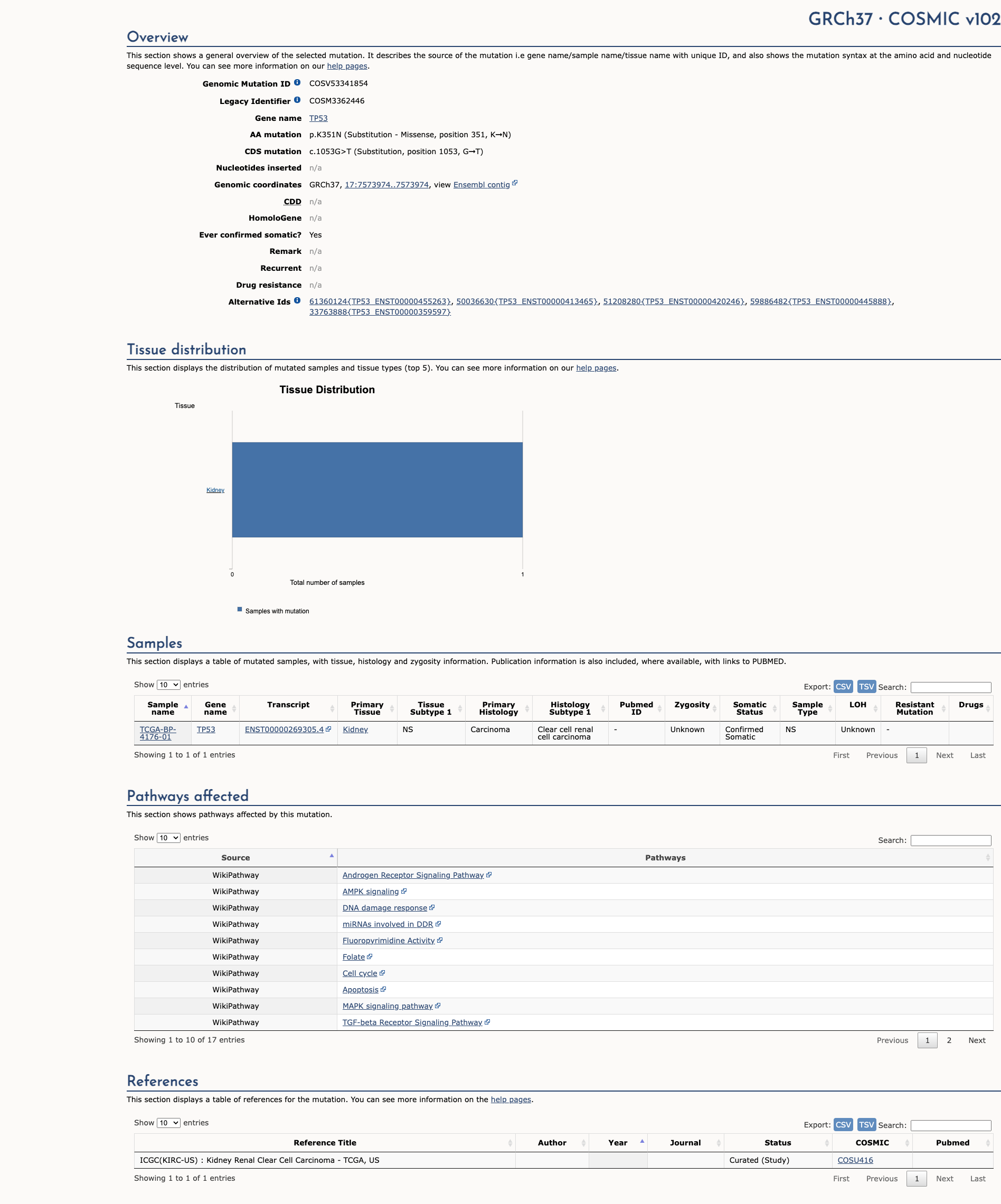
Functional Impact & Domains
Functional Domain
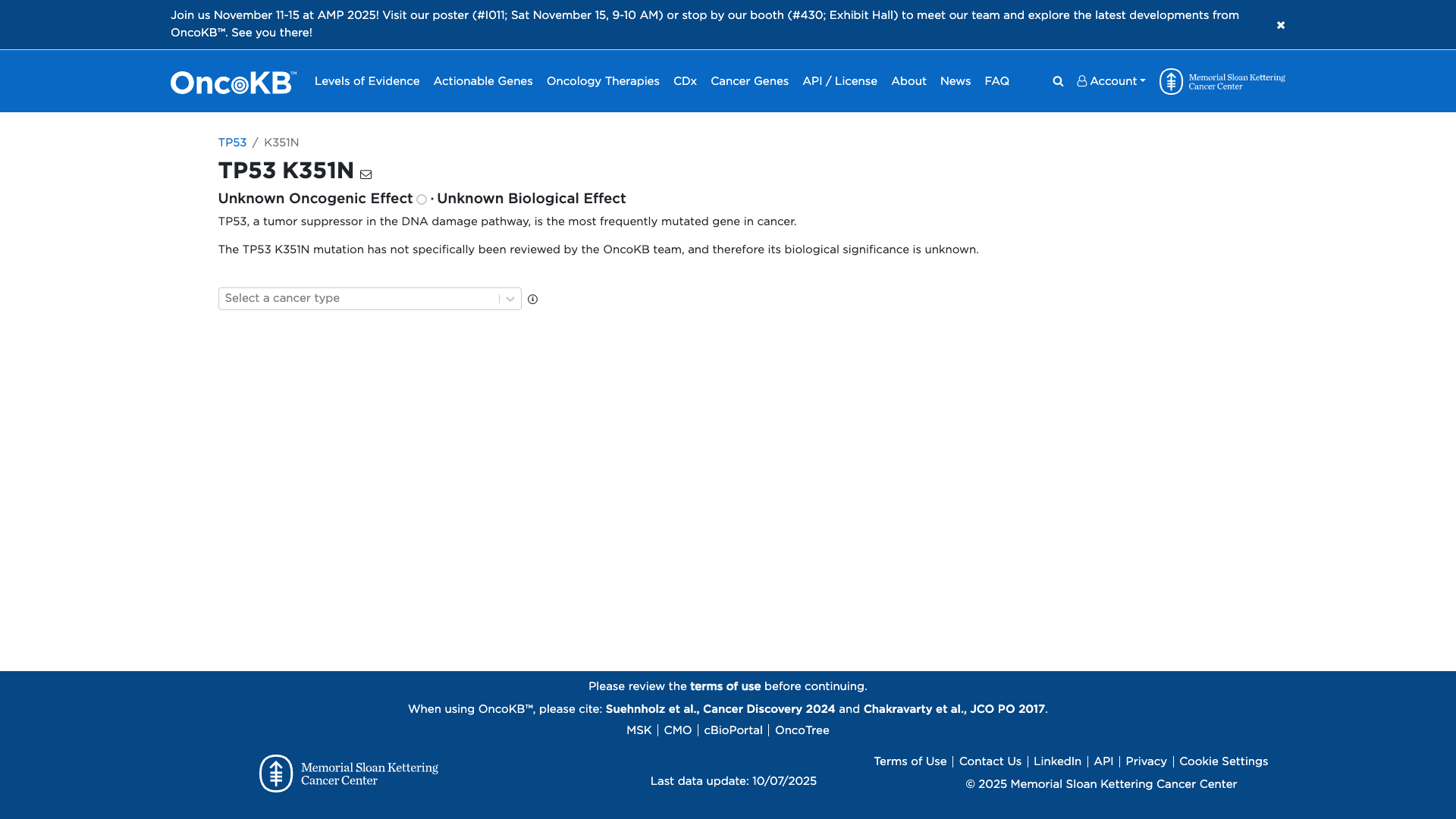

Computational Analysis
Pathogenicity Predictions
SpliceAISpliceAI Scores
Window: ±500bp| Effect Type | Score | Position |
|---|---|---|
| Acceptor Loss (AL) | 0.0 | -235 bp |
| Donor Loss (DL) | 0.0 | 194 bp |
| Acceptor Gain (AG) | 0.0 | 103 bp |
| Donor Gain (DG) | 0.0 | -371 bp |
VCEP Guidelines
Applied ACMG/AMP Criteria (VCEP Specific)
PVS1 (Not Applied)
According to VCEP guidelines, PVS1 applies only to null variants (nonsense, frameshift, canonical splice, initiation codon, or deletions) in TP53; this is a missense variant. Therefore, PVS1 is not applied.
PS1 (Not Applied)
According to VCEP guidelines, PS1 requires the same amino acid change as a previously established pathogenic variant. There are no reported pathogenic variants resulting in K351N. Therefore, PS1 is not applied.
PS2 (Not Applied)
According to VCEP guidelines, PS2 requires confirmed de novo occurrence with maternity and paternity confirmed. No de novo data are available. Therefore, PS2 is not applied.
PS3 (Not Applied)
According to VCEP guidelines, PS3 applies to functional assays demonstrating loss of function. No functional characterization is available for K351N. Therefore, PS3 is not applied.
PS4 (Not Applied)
According to VCEP guidelines, PS4 requires case‐level or proband point totals meeting thresholds. No case data or proband counts are available. Therefore, PS4 is not applied.
PM1 (Not Applied)
According to VCEP guidelines, PM1 applies to missense variants within known mutational hotspots (codons 175, 245, 248, 249, 273, 282) or ≥10 somatic occurrences at the same residue. K351 is outside these hotspots. Therefore, PM1 is not applied.
PM2 (Supporting)
According to VCEP guidelines, PM2_Supporting: allele frequency <0.00003 in gnomAD. The variant is absent from gnomAD. Therefore, PM2 is applied at Supporting strength.
PM3 (Not Applied)
According to standard ACMG guidelines, PM3 applies to recessive disorders with variants observed in trans. TP53‐related disease is autosomal dominant and no trans data exist. Therefore, PM3 is not applied.
PM4 (Not Applied)
According to standard ACMG guidelines, PM4 applies to protein length–altering variants (inframe indels, stop-loss). This is a missense change. Therefore, PM4 is not applied.
PM5 (Not Applied)
According to VCEP guidelines, PM5 applies to a missense at a residue with ≥1 known pathogenic missense. No other pathogenic variants at K351 are reported. Therefore, PM5 is not applied.
PM6 (Not Applied)
According to VCEP guidelines, PM6 applies to unconfirmed de novo events. No parental data are available. Therefore, PM6 is not applied.
PP1 (Not Applied)
According to VCEP guidelines, PP1 requires segregation data (3–4 meioses for Supporting). No family segregation data are available. Therefore, PP1 is not applied.
PP2 (Not Applied)
According to standard ACMG guidelines, PP2 applies when missense variants are a common mechanism and gene is constrained for missense. TP53 has both missense and truncating disease mechanisms and is not clearly constrained. Therefore, PP2 is not applied.
PP3 (Not Applied)
According to VCEP guidelines, PP3 requires aGVGD C65 and BayesDel ≥0.16 or SpliceAI ≥0.2 for splicing. BayesDel not provided and SpliceAI predicts no splicing effect. Therefore, PP3 is not applied.
PP4 (Not Applied)
According to standard ACMG guidelines, PP4 requires a specific phenotype or family history highly specific to TP53-related disorder. No phenotype data are provided. Therefore, PP4 is not applied.
PP5 (Not Applied)
According to standard ACMG guidelines, PP5 applies when a reputable source classifies the variant as pathogenic. ClinVar reports this variant as VUS. Therefore, PP5 is not applied.
BA1 (Not Applied)
According to standard ACMG guidelines, BA1 applies to allele frequency ≥5% in controls. The variant is absent from gnomAD. Therefore, BA1 is not applied.
BS1 (Not Applied)
According to VCEP guidelines, BS1 applies when filtering allele frequency ≥0.0003. The variant is absent from gnomAD. Therefore, BS1 is not applied.
BS2 (Not Applied)
According to VCEP guidelines, BS2 requires ≥2 unrelated females ≥60 years old without cancer. No such data exist. Therefore, BS2 is not applied.
BS3 (Not Applied)
According to VCEP guidelines, BS3 requires functional assays showing no loss of function. No functional data are available. Therefore, BS3 is not applied.
BS4 (Not Applied)
According to VCEP guidelines, BS4 requires lack of segregation in affected family members. No segregation data exist. Therefore, BS4 is not applied.
BP1 (Not Applied)
According to standard ACMG guidelines, BP1 applies to missense in a gene where only truncating variants cause disease. TP53 has many pathogenic missense variants. Therefore, BP1 is not applied.
BP2 (Not Applied)
According to standard ACMG guidelines, BP2 applies when variant observed in trans with a pathogenic variant in a dominant disorder. No such data exist. Therefore, BP2 is not applied.
BP3 (Not Applied)
According to standard ACMG guidelines, BP3 applies to inframe indels in repetitive regions. This is a missense change. Therefore, BP3 is not applied.
BP4 (Supporting)
According to standard ACMG guidelines, BP4: multiple lines of computational evidence suggest no impact on gene or gene product. In silico predictors are mixed but SpliceAI predicts no splicing impact, supporting a benign interpretation. Therefore, BP4 is applied at Supporting strength.
BP5 (Not Applied)
According to standard ACMG guidelines, BP5 applies when variant found in a case with an alternate molecular cause. No such data exist. Therefore, BP5 is not applied.
BP6 (Not Applied)
According to standard ACMG guidelines, BP6 applies when a reputable source classifies the variant as benign. No benign assertions exist. Therefore, BP6 is not applied.
BP7 (Not Applied)
According to VCEP guidelines, BP7 applies only to synonymous or intronic variants with no splicing impact. This is a missense variant. Therefore, BP7 is not applied.