Genetic Information
Gene & Transcript Details
| ID | Status | Details |
|---|---|---|
| NM_177438.2 | RefSeq Select | 10323 nt | 239–6007 |
| NM_177438.3 | MANE Select | 10384 nt | 346–6114 |
| NM_177438.1 | Alternative | 10276 nt | 239–6007 |
Variant Details
Clinical & Population Data
Population Frequency
gnomADClinVar
Open"This variant has been reported in ClinVar as Likely benign (6 clinical laboratories) and as Benign (10 clinical laboratories)."
COSMIC Somatic Evidence
Open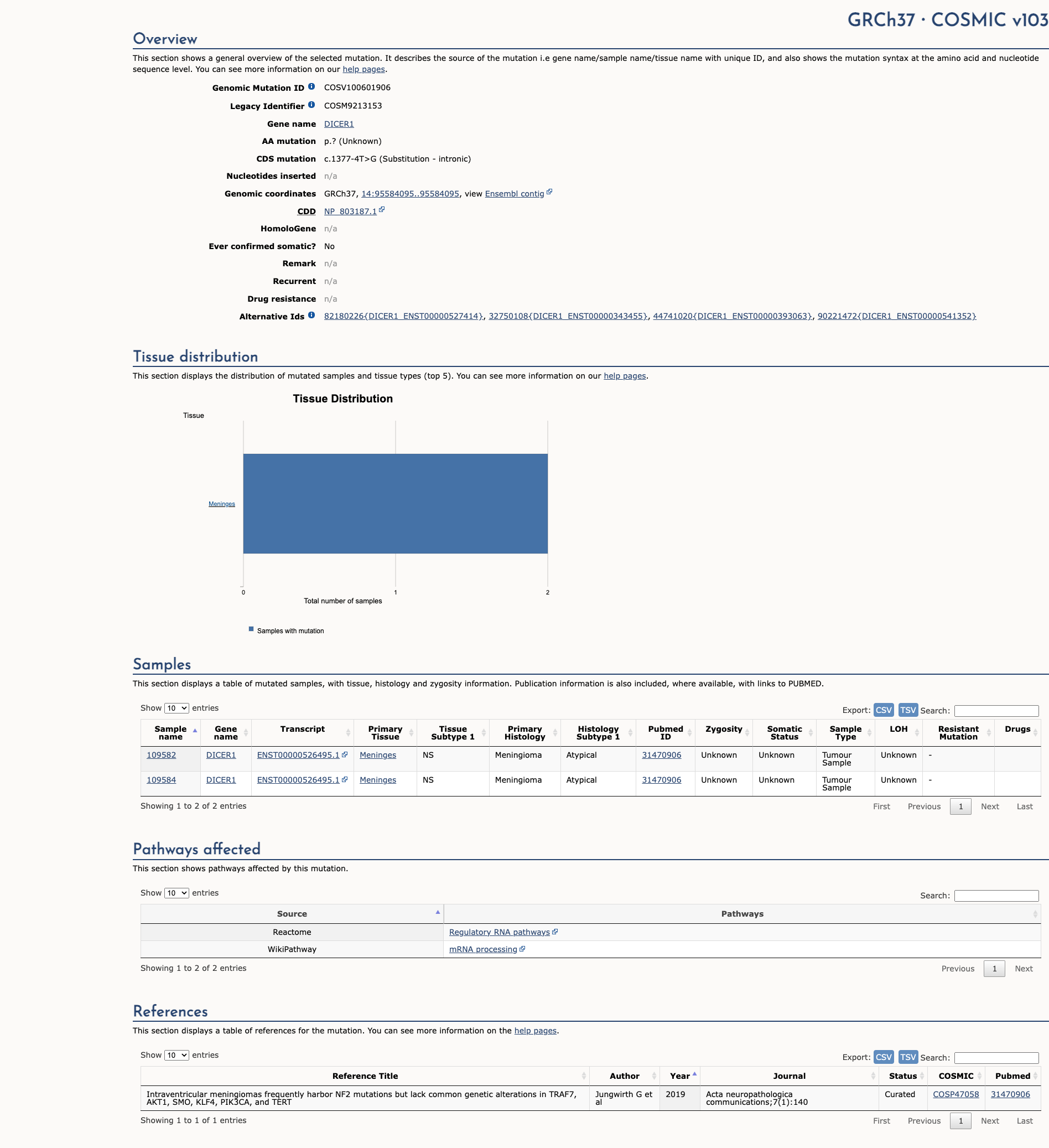
Functional Impact & Domains
Functional Domain
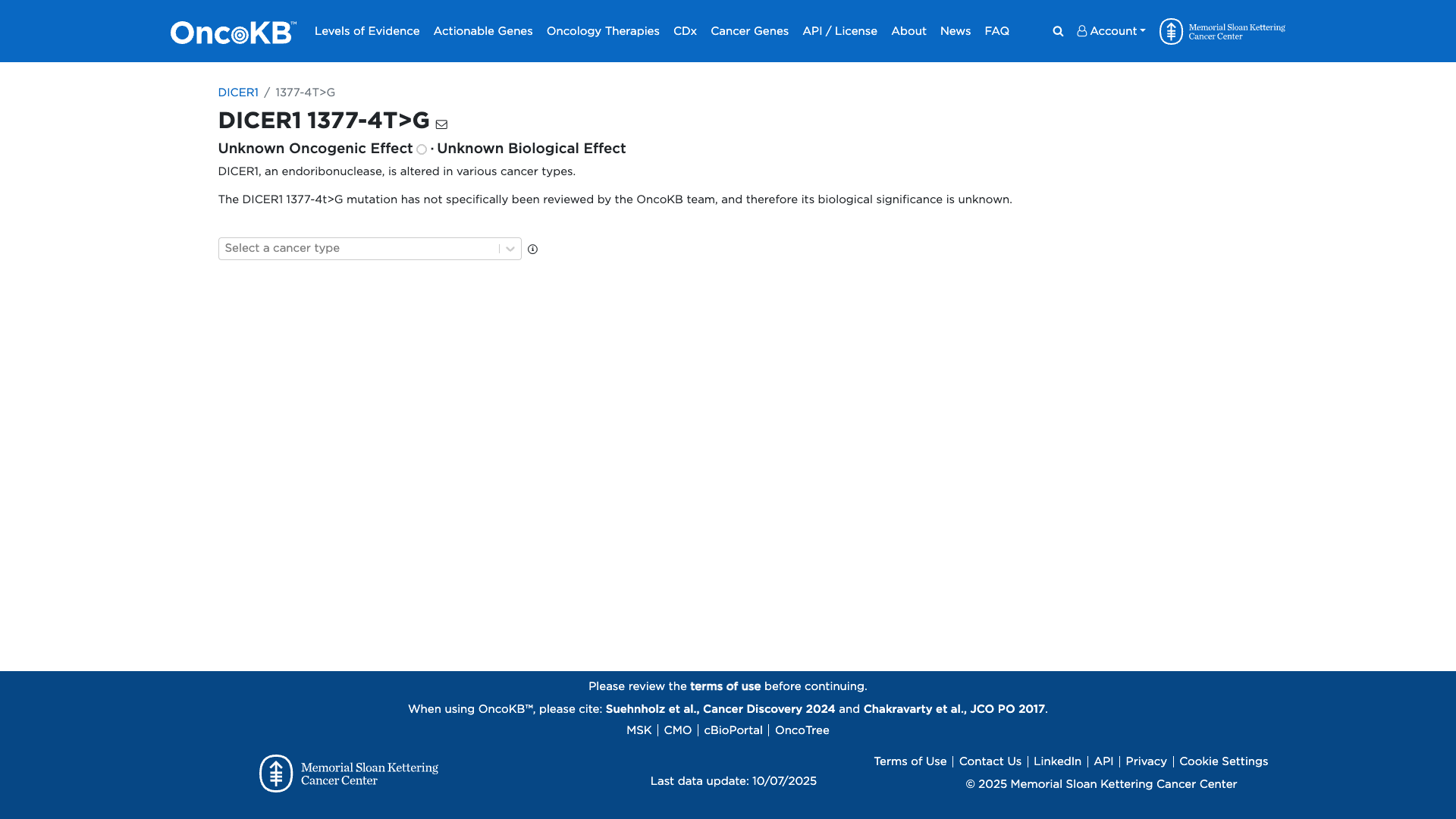
The DICER1 1377-4T>G variant has not been functionally characterized, and its biological significance remains unknown.
Click on previews to view full database entries. External databases may require institutional access.
Computational Analysis
Pathogenicity Predictions
SpliceAISpliceAI Scores
Window: ±500bp| Effect Type | Score | Position |
|---|---|---|
| Acceptor Loss (AL) | 0.0 | 178 bp |
| Donor Loss (DL) | 0.03 | 105 bp |
| Acceptor Gain (AG) | 0.02 | 32 bp |
| Donor Gain (DG) | 0.01 | 249 bp |
VCEP Guidelines
Applied ACMG/AMP Criteria (VCEP Specific)
PVS1 (Not Applied)
According to VCEP guidelines, the rule for PVS1 is: "Nonsense or frameshift variants predicted to result in NMD; canonical splice variants (+/-1,2 intronic positions)". The evidence for this variant shows: NM_177438.3:c.1377-4T>G is an intronic variant at the -4 position, outside the canonical +/-1,2 splice sites and does not introduce a premature stop codon. Therefore, this criterion is not applied.
PS1 (Not Applied)
According to VCEP guidelines, the rule for PS1 is: "Same amino acid change as a previously established pathogenic variant, with no difference in splicing impact". The evidence for this variant shows: NM_177438.3:c.1377-4T>G is an intronic change and does not alter an amino acid. Therefore, this criterion is not applied.
PS2 (Not Applied)
According to standard ACMG guidelines, the rule for PS2 is: "De novo (both maternity and paternity confirmed) in a patient with the disease and no family history". The evidence for this variant shows: No de novo data are available. Therefore, this criterion is not applied.
PS3 (Not Applied)
According to standard ACMG guidelines, the rule for PS3 is: "Well-established functional studies supportive of a damaging effect on the gene or gene product". The evidence for this variant shows: No functional splicing or in vitro assays have been performed. Therefore, this criterion is not applied.
PS4 (Not Applied)
According to standard ACMG guidelines, the rule for PS4 is: "Prevalence in affected individuals statistically increased over controls". The evidence for this variant shows: No case–control or phenotype point data are available. Therefore, this criterion is not applied.
PM1 (Not Applied)
According to VCEP guidelines, the rule for PM1 is: "Putative missense variants at metal ion-binding residues or RNase IIIb domain". The evidence for this variant shows: NM_177438.3:c.1377-4T>G is an intronic variant not affecting a protein-coding residue. Therefore, this criterion is not applied.
PM2 (Not Applied)
According to VCEP guidelines, the rule for PM2 is: "Allele frequency <0.000005 across gnomAD". The evidence for this variant shows: MAF = 0.00327 (0.327%) in gnomAD, which exceeds the threshold. Therefore, this criterion is not applied.
PM3 (Not Applied)
According to standard ACMG guidelines, the rule for PM3 is: "For recessive disorders, detected in trans with a pathogenic variant". The evidence for this variant shows: No data on trans observations with a P/LP variant. Therefore, this criterion is not applied.
PM4 (Not Applied)
According to standard ACMG guidelines, the rule for PM4 is: "Protein length changes due to in-frame indels or stop-loss variants". The evidence for this variant shows: NM_177438.3:c.1377-4T>G is not an in-frame indel or stop-loss. Therefore, this criterion is not applied.
PM5 (Not Applied)
According to VCEP guidelines, the rule for PM5 is: "Different missense change at same residue with equal or worse Grantham score, splicing ruled out". The evidence for this variant shows: NM_177438.3:c.1377-4T>G is intronic and does not alter an amino acid. Therefore, this criterion is not applied.
PM6 (Not Applied)
According to standard ACMG guidelines, the rule for PM6 is: "Assumed de novo, without confirmation of paternity and maternity". The evidence for this variant shows: No de novo data. Therefore, this criterion is not applied.
PP1 (Not Applied)
According to VCEP guidelines, the rule for PP1 is: "Segregation in multiple affected family members". The evidence for this variant shows: No segregation data are available. Therefore, this criterion is not applied.
PP2 (Not Applied)
According to standard ACMG guidelines, the rule for PP2 is: "Missense variant in a gene with low rate of benign missense variation". The evidence for this variant shows: It is intronic and not a missense change. Therefore, this criterion is not applied.
PP3 (Not Applied)
According to VCEP guidelines, the rule for PP3 is: "For splicing variants, concordance of MaxEntScan and SpliceAI predicts a splicing effect". The evidence for this variant shows: SpliceAI predicts no impact (0.03) but MaxEntScan data are not available to confirm concordance. Therefore, this criterion is not applied.
PP4 (Not Applied)
According to VCEP guidelines, the rule for PP4 is: "Somatic tumor testing identifies a hotspot second hit with retention of germline variant". The evidence for this variant shows: No tumor somatic data are available. Therefore, this criterion is not applied.
PP5 (Not Applied)
According to standard ACMG guidelines, the rule for PP5 is: "Reputable source recently reports variant as pathogenic but evidence unavailable". The evidence for this variant shows: No reputable source reports this variant as pathogenic. Therefore, this criterion is not applied.
BA1 (Stand Alone)
According to VCEP guidelines, the rule for BA1 is: "Frequency >0.003 (0.3%) in gnomAD subpopulations with >2,000 alleles tested and ≥5 alleles present". The evidence for this variant shows: MAF = 0.327% in gnomAD overall and 1.07% in Ashkenazi Jewish, satisfying thresholds. Therefore, this criterion is applied at Stand Alone strength.
BS1 (Not Applied)
According to VCEP guidelines, the rule for BS1 is: "Frequency >0.0003 (0.03%) in gnomAD subpopulations". The evidence for this variant shows: MAF = 0.327%, which would meet BS1, but BA1 is applied as a stand-alone criterion and supersedes BS1. Therefore, BS1 is not applied.
BS2 (Strong)
According to VCEP guidelines, the rule for BS2 is: "≥2 observations of homozygosity in healthy individuals". The evidence for this variant shows: 3 homozygotes observed in gnomAD. Therefore, this criterion is applied at Strong strength.
BS3 (Not Applied)
According to VCEP guidelines, the rule for BS3 is: "No splicing impact observed via RNA assay". The evidence for this variant shows: No RNA splicing assays have been performed. Therefore, this criterion is not applied.
BS4 (Not Applied)
According to standard ACMG guidelines, the rule for BS4 is: "Non-segregation with disease in affected family members". The evidence for this variant shows: No family segregation data are available. Therefore, this criterion is not applied.
BP1 (Not Applied)
According to standard ACMG guidelines, the rule for BP1 is: "Missense variant in a gene where only loss-of-function causes disease". The evidence for this variant shows: It is intronic, not missense. Therefore, this criterion is not applied.
BP2 (Not Applied)
According to VCEP guidelines, the rule for BP2 is: "Observation in trans with P/LP variant or in cis with multiple P/LP variants". The evidence for this variant shows: No such observations. Therefore, this criterion is not applied.
BP3 (Not Applied)
According to standard ACMG guidelines, the rule for BP3 is: "In-frame indels in repetitive regions without functional importance". The evidence for this variant shows: It is a single-nucleotide change. Therefore, this criterion is not applied.
BP4 (Not Applied)
According to VCEP guidelines, the rule for BP4 is: "For intronic variants, concordance of MaxEntScan and SpliceAI predicts no splicing effect". The evidence for this variant shows: SpliceAI predicts no impact but MaxEntScan data are unavailable to confirm concordance. Therefore, this criterion is not applied.
BP5 (Not Applied)
According to standard ACMG guidelines, the rule for BP5 is: "Variant found in a case with an alternate molecular cause". The evidence for this variant shows: No alternate molecular cause data. Therefore, this criterion is not applied.
BP6 (Supporting)
According to standard ACMG guidelines, the rule for BP6 is: "Reputable source reports variant as benign but evidence unavailable". The evidence for this variant shows: ClinVar entries include 6 laboratories classifying as Likely benign and 10 as Benign without underlying evidence. Therefore, this criterion is applied at Supporting strength.
BP7 (Not Applied)
According to standard ACMG guidelines, the rule for BP7 is: "Intronic variant at or beyond +7 to -21 positions with no predicted impact". The evidence for this variant shows: Position is -4, which is within the splice-region window. Therefore, this criterion is not applied.