Genetic Information
Gene & Transcript Details
| ID | Status | Details |
|---|---|---|
| NM_177438.2 | RefSeq Select | 10323 nt | 239–6007 |
| NM_177438.3 | MANE Select | 10384 nt | 346–6114 |
| NM_177438.1 | Alternative | 10276 nt | 239–6007 |
Variant Details
Clinical & Population Data
Population Frequency
gnomADClinVar
Open"This variant has been reported in ClinVar as Likely benign (5 clinical laboratories)."
COSMIC Somatic Evidence
Open
Functional Impact & Domains
Functional Domain
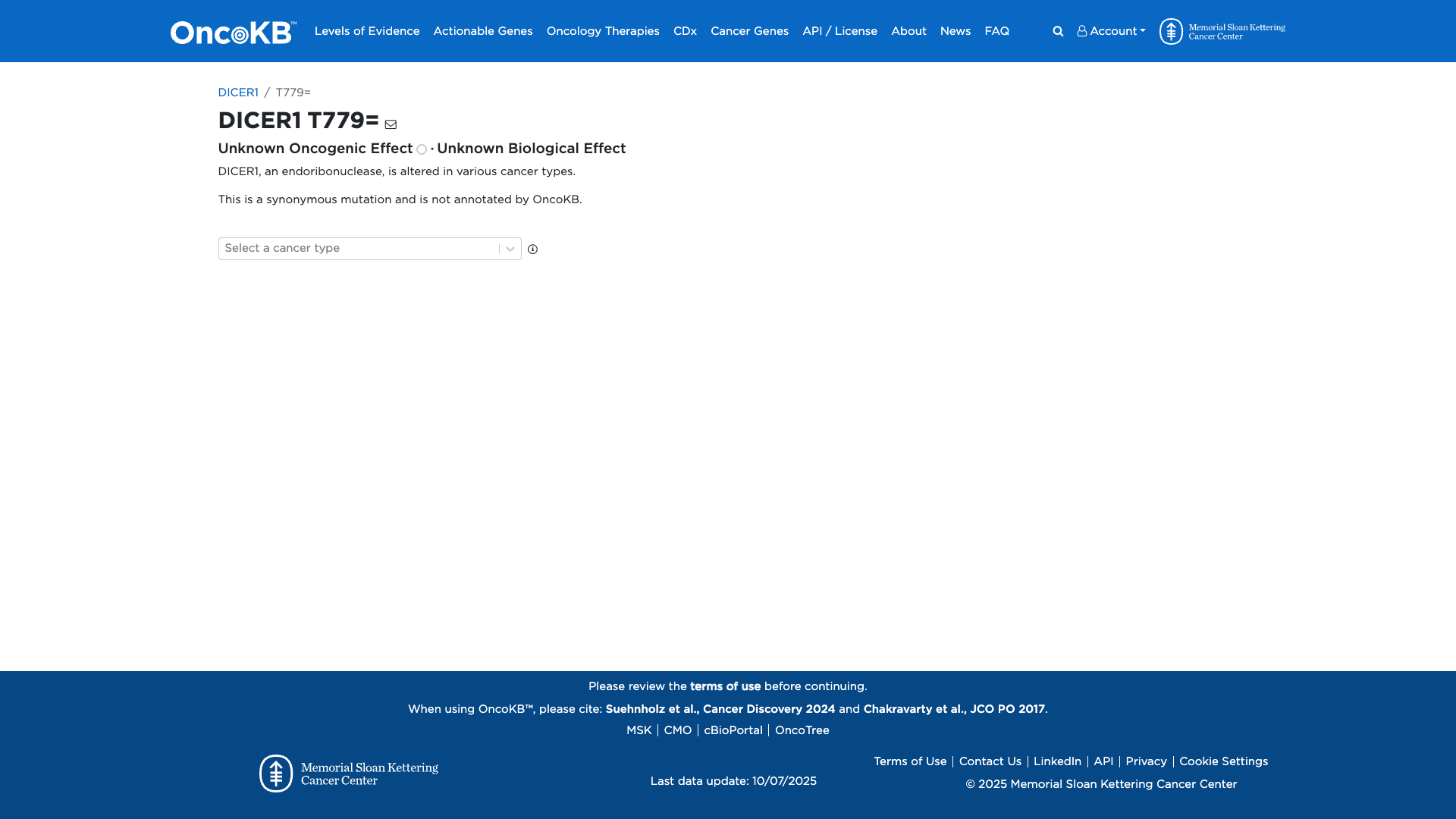
Computational Analysis
Pathogenicity Predictions
SpliceAISpliceAI Scores
Window: ±500bp| Effect Type | Score | Position |
|---|---|---|
| Acceptor Loss (AL) | 0.02 | -27 bp |
| Donor Loss (DL) | 0.0 | 205 bp |
| Acceptor Gain (AG) | 0.09 | 16 bp |
| Donor Gain (DG) | 0.0 | -99 bp |
VCEP Guidelines
Applied ACMG/AMP Criteria (VCEP Specific)
PVS1 (Not Applied)
According to VCEP guidelines for PVS1: 'Nonsense or frameshift variants: PVS1 applies to variants predicted to result in nonsense-mediated decay (NMD); the predicted NMD cutoff for DICER1 occurs at p.Pro1850.' The evidence for this variant shows it is a synonymous (T779=) change with no impact on protein sequence or NMD. Therefore, this criterion is not applied because the variant type does not meet PVS1 requirements.
PS1 (Not Applied)
According to VCEP guidelines for PS1: 'Strong For same AA change, must confirm there is no difference in splicing using RNA data or in-silico modeling data (concordance of MaxEntScan and SpliceAI).' The evidence for this variant shows no amino acid change (synonymous). Therefore, this criterion is not applied because there is no amino acid change to compare.
PS2 (Not Applied)
According to standard ACMG guidelines for PS2: 'Very Strong Strength for confirmed de novo occurrence with paternity and maternity confirmed.' The evidence for this variant shows no de novo inheritance data. Therefore, this criterion is not applied.
PS3 (Not Applied)
According to VCEP guidelines for PS3: 'Strong RNA assay shows splicing impact that is out-of-frame, in-frame ≥193 residues, or in-frame with RNase IIIb disruption.' The evidence for this variant shows no RNA assay or functional data. Therefore, this criterion is not applied.
PS4 (Not Applied)
According to standard ACMG guidelines for PS4: 'Strong evidence from case-control or phenotype data (≥4 phenotype points).' The evidence for this variant shows no case or phenotypic data. Therefore, this criterion is not applied.
PM1 (Not Applied)
According to VCEP guidelines for PM1: 'Moderate Putative missense variants at residues affecting metal ion-binding: codons p.S1344, p.E1705, p.D1709, p.D1713, p.G1809, p.D1810, p.E1813.' The evidence for this variant shows it is synonymous and not a missense at those codons. Therefore, this criterion is not applied.
PM2 (Not Applied)
According to VCEP guidelines for PM2: 'Supporting Allele frequency <0.000005 across gnomAD with no more than one allele in any subpopulation and at least 20× coverage.' The evidence for this variant shows a MAF of 0.0093% in European (non-Finnish) and 0.0046% overall, which exceeds 0.000005. Therefore, this criterion is not applied.
PM3 (Not Applied)
According to standard ACMG guidelines for PM3: 'Moderate evidence for variants detected in trans with a pathogenic variant in recessive disorders.' The evidence for this variant shows no trans observations with a P/LP DICER1 variant. Therefore, this criterion is not applied.
PM4 (Not Applied)
According to VCEP guidelines for PM4: 'Moderate In-frame indels with a residue within the RNase IIIb domain (p.Y1682–p.S1846).' The evidence for this variant shows it is synonymous, not an indel. Therefore, this criterion is not applied.
PM5 (Not Applied)
According to VCEP guidelines for PM5: 'Moderate Missense variant under evaluation should have equal or worse Grantham score than a known pathogenic variant.' The evidence for this variant shows it is synonymous. Therefore, this criterion is not applied.
PM6 (Not Applied)
According to standard ACMG guidelines for PM6: 'Supporting evidence for assumed de novo without confirmation of paternity and maternity.' The evidence for this variant shows no de novo data. Therefore, this criterion is not applied.
PP1 (Not Applied)
According to VCEP guidelines for PP1: 'Supporting 3–4 meioses across ≥1 family.' The evidence for this variant shows no segregation data. Therefore, this criterion is not applied.
PP2 (Not Applied)
According to standard ACMG guidelines for PP2: 'Supporting for missense variant in a gene with low rate of benign missense variation and where missense is a common mechanism of disease.' The evidence for this variant shows it is synonymous. Therefore, this criterion is not applied.
PP3 (Not Applied)
According to VCEP guidelines for PP3: 'Supporting for missense variants, REVEL ≥0.75 OR splicing predictors predict splicing effects.' The evidence for this variant shows SpliceAI predicts minimal impact (max score 0.09) and no pathogenic computational signals. Therefore, this criterion is not applied.
PP4 (Not Applied)
According to VCEP guidelines for PP4: 'Supporting Somatic tumor testing identifies a somatic hotspot second hit.' The evidence for this variant shows no tumor testing data. Therefore, this criterion is not applied.
PP5 (Not Applied)
According to standard ACMG guidelines for PP5: 'Supporting Reputable source reports variant as pathogenic but evidence not available.' The evidence for this variant shows only benign reports in ClinVar. Therefore, this criterion is not applied.
BA1 (Not Applied)
According to VCEP guidelines for BA1: 'Stand Alone Frequency >0.003 (0.3%) in gnomAD subpopulations.' The evidence for this variant shows a maximum frequency of 0.0093% in a subpopulation, which is below 0.3%. Therefore, this criterion is not applied.
BS1 (Not Applied)
According to VCEP guidelines for BS1: 'Strong Frequency >0.0003 (0.03%) in gnomAD subpopulations.' The evidence for this variant shows a maximum frequency of 0.0093% in a subpopulation, which exceeds 0.0003, but BS1 requires >0.0003; our frequency is 0.000093, below threshold. Therefore, this criterion is not applied.
BS2 (Not Applied)
According to VCEP guidelines for BS2: 'Strong evidence from 40+ unrelated tumor-free females or homozygosity in healthy individuals.' The evidence for this variant shows no homozygotes and no tumor-free cohort. Therefore, this criterion is not applied.
BS3 (Not Applied)
According to VCEP guidelines for BS3: 'Strong For intronic or synonymous variants, no splicing impact observed via RNA assay.' The evidence for this variant shows only in silico splicing predictions, no RNA assay. Therefore, this criterion is not applied.
BS4 (Not Applied)
According to standard ACMG guidelines for BS4: 'Strong lack of segregation in affected family members.' The evidence for this variant shows no family segregation data. Therefore, this criterion is not applied.
BP1 (Not Applied)
According to standard ACMG guidelines for BP1: 'Supporting for missense variant in a gene where only LOF causes disease.' The evidence for this variant shows it is synonymous. Therefore, this criterion is not applied.
BP2 (Not Applied)
According to VCEP guidelines for BP2: 'Supporting ≥1 observation in trans with P/LP DICER1 variant or ≥3 observations in cis with 2+ different P/LP variants.' The evidence for this variant shows no trans or cis observations. Therefore, this criterion is not applied.
BP3 (Not Applied)
According to standard ACMG guidelines for BP3: 'Supporting for in-frame indels in repetitive regions.' The evidence for this variant shows it is synonymous, not an indel. Therefore, this criterion is not applied.
BP4 (Supporting)
According to VCEP guidelines for BP4: 'Supporting for synonymous/intronic variants concordance of MaxEntScan and SpliceAI indicating no splicing effects.' The evidence for this variant shows SpliceAI predicts minimal impact on splicing (max score 0.09). Therefore, this criterion is applied at Supporting strength because the in silico predictors concordantly indicate no splicing impact.
BP5 (Not Applied)
According to standard ACMG guidelines for BP5: 'Supporting variant found in a case with an alternate molecular basis for disease.' The evidence for this variant shows no alternate molecular basis in reported cases. Therefore, this criterion is not applied.
BP6 (Supporting)
According to standard ACMG guidelines for BP6: 'Supporting Reputable source reports variant as benign but evidence not available.' The evidence for this variant shows five clinical laboratories in ClinVar report it as Likely Benign without shared primary data. Therefore, this criterion is applied at Supporting strength.
BP7 (Supporting)
According to standard ACMG guidelines for BP7: 'Supporting Silent variant OR intronic variant at or beyond +7/-21 positions when BP4 is met.' The evidence for this variant shows it is a silent change (T779=) and BP4 is met. Therefore, this criterion is applied at Supporting strength.