Genetic Information
Gene & Transcript Details
| ID | Status | Details |
|---|---|---|
| NM_024675.4 | MANE Select | 4008 nt | 154–3714 |
| NM_024675.3 | RefSeq Select | 4069 nt | 201–3761 |
Variant Details
Clinical & Population Data
Population Frequency
gnomADClinVar
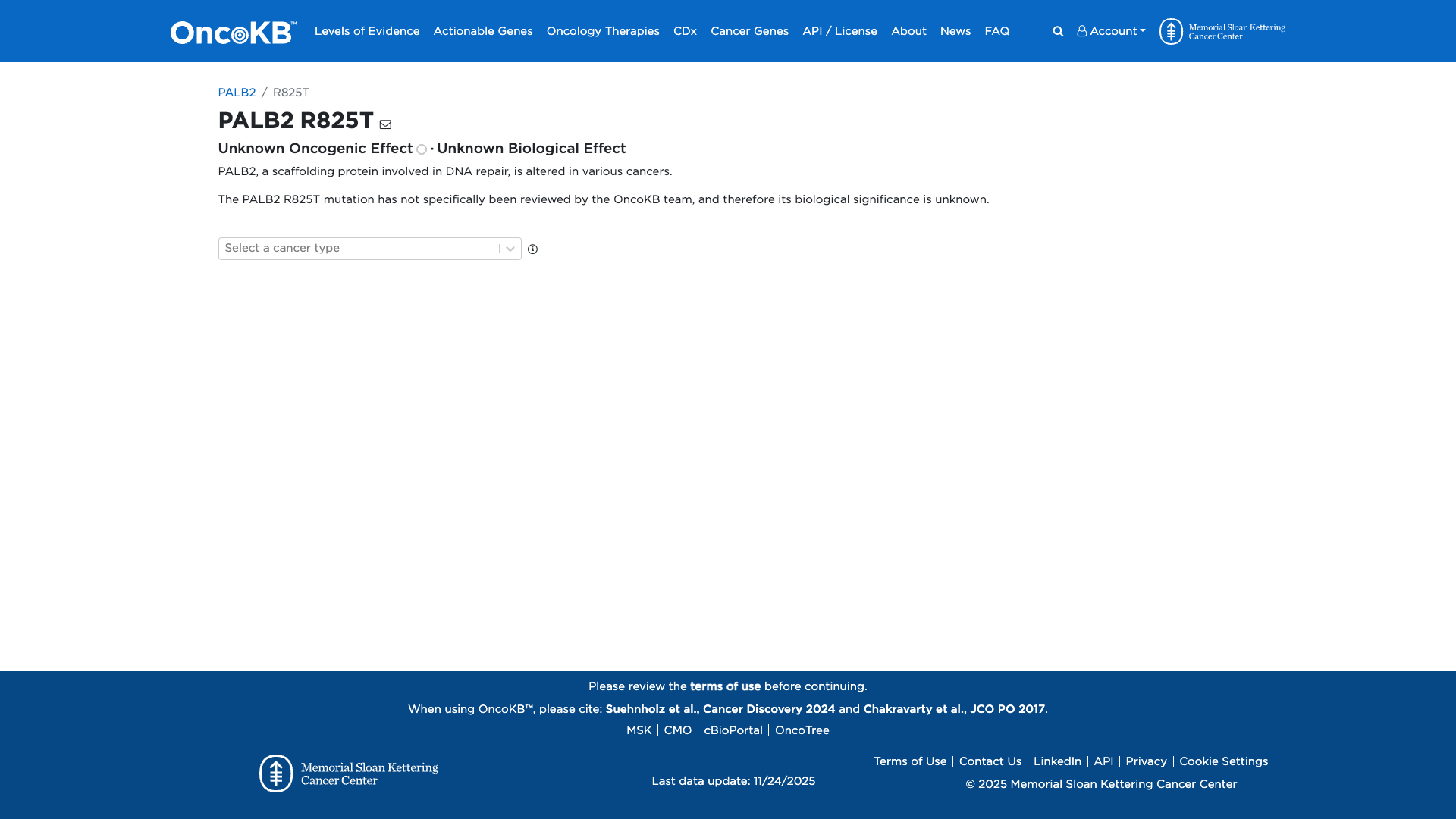
OpenVariant summary: PALB2 c.2474G>C (p.Arg825Thr) results in a non-conservative amino acid change in the encoded protein sequence. Four of five in-silico tools predict a benign effect of the variant on protein function. The variant allele was found at a frequency of 0.00016 in 251430 control chromosomes, predominantly at a frequency of 0.0022 within the East Asian subpopulation in the gnomAD database. The observed variant frequency within East Asian control individuals in the gnomAD database is approximately 14.079 fold of the estimated maximal expected allele frequency for a pathogenic variant in PALB2 causing Hereditary Breast And Ovarian Cancer Syndrome phenotype (0.00016), strongly suggesting that the variant is a benign polymorphism found primarily in populations of East Asian origin. c.2474G>C has been reported in the literature in individuals affected with various types of cancers includin leiomyosarcoma, stomach adenocarcinoma, breast cancer and urothelial carcinoma, all without strong evidence for causality (Yang_2015, Lu_2015, Kwong_2020, Xie_2018, Yang_2021). These reports do not provide unequivocal conclusions about association of the variant with Hereditary Breast And Ovarian Cancer Syndrome. To our knowledge, no experimental evidence demonstrating an impact on protein function has been reported. Eight clinical diagnostic laboratories have submitted clinical-significance assessments for this variant to ClinVar after 2014 without evidence for independent evaluation; four classified as VUS while four classified as likely benign. Based on the evidence outlined above, the variant was classified as likely benign.
This variant is considered likely benign. This variant is strongly associated with less severe personal and family histories of cancer, typical for individuals without pathogenic variants in this gene [PMID: 25085752].
"This variant has been reported in ClinVar as Uncertain significance (3 clinical laboratories) and as Likely benign (9 clinical laboratories)."
COSMIC Somatic Evidence
Open
Functional Impact & Domains
Functional Domain
Computational Analysis
Pathogenicity Predictions
SpliceAISpliceAI Scores
Window: ±500bp| Effect Type | Score | Position |
|---|---|---|
| Acceptor Loss (AL) | 0.0 | -405 bp |
| Donor Loss (DL) | 0.01 | -40 bp |
| Acceptor Gain (AG) | 0.0 | 279 bp |
| Donor Gain (DG) | 0.01 | -146 bp |
VCEP Guidelines
Applied ACMG/AMP Criteria (VCEP Specific)
PVS1 (Not Applied)
According to VCEP guidelines, PVS1 is for null variants in PALB2 per the PVS1 decision tree. The rule for PVS1 is: "Very Strong Use PALB2 PVS1 Decision Tree". The evidence shows this variant is a missense change (p.R825T), not a null variant. Therefore, this criterion is not applied.
PS1 (Not Applied)
According to VCEP guidelines, PS1 applies when the same amino acid change as a previously established pathogenic variant is observed. The rule for PS1 is: "Strong: Same amino acid change as a previously established pathogenic variant regardless of nucleotide change". No such pathogenic R825T change has been reported. Therefore, this criterion is not applied.
PS2 (Not Applied)
According to standard ACMG guidelines, PS2 applies for confirmed de novo occurrences. There is no de novo evidence. Therefore, this criterion is not applied.
PS3 (Not Applied)
According to standard ACMG guidelines, PS3 requires well-established functional studies showing a deleterious effect. No functional data are available for p.R825T. Therefore, this criterion is not applied.
PS4 (Not Applied)
According to VCEP guidelines, PS4 requires case-control studies meeting specific statistical thresholds. There are no such data for p.R825T. Therefore, this criterion is not applied.
PM1 (Not Applied)
According to standard ACMG guidelines, PM1 applies to variants in mutational hotspots or critical functional domains. No evidence places R825 in a known hotspot or domain. Therefore, this criterion is not applied.
PM2 (Not Applied)
According to VCEP guidelines, PM2_Supporting requires absence or ≤1/300,000 alleles in gnomAD. The rule: "Supporting: Variant absent in gnomAD or present in ≤1/300,000 alleles". The observed global MAF is 0.0163% (46/282,834), exceeding the threshold. Therefore, this criterion is not applied.
PM3 (Not Applied)
According to VCEP guidelines, PM3 applies to variants in trans with a pathogenic variant for recessive disorders. No evidence of trans occurrence is available. Therefore, this criterion is not applied.
PM4 (Not Applied)
According to standard ACMG guidelines, PM4 applies to protein length changes due to in‐frame indels or stop-loss. The variant is a missense change. Therefore, this criterion is not applied.
PM5 (Not Applied)
According to VCEP guidelines, PM5_Supporting applies to frameshifting or truncating variants upstream of p.Tyr1183. The rule: "Supporting: Apply to frameshifting or truncating variants with premature termination codons upstream of p.Tyr1183". p.R825T is a missense variant. Therefore, this criterion is not applied.
PM6 (Not Applied)
According to standard ACMG guidelines, PM6 applies to assumed de novo occurrences without confirmation. No de novo evidence is available. Therefore, this criterion is not applied.
PP1 (Not Applied)
According to VCEP guidelines, PP1 applies for segregation evidence. No family segregation data are available. Therefore, this criterion is not applied.
PP2 (Not Applied)
According to standard ACMG guidelines, PP2 applies to missense variants in genes with low rates of benign missense and where missense is a common disease mechanism. PALB2 pathogenesis is primarily loss‐of‐function; missense contribution is unclear. Therefore, this criterion is not applied.
PP3 (Not Applied)
According to VCEP guidelines, PP3 for protein predictions is not used; for RNA, it requires impact on splicing. The SpliceAI score is 0.01 (no impact). Therefore, PP3 is not applied.
PP4 (Not Applied)
According to standard ACMG guidelines, PP4 applies to highly specific phenotype–genotype correlations. No phenotype data are provided. Therefore, this criterion is not applied.
PP5 (Not Applied)
According to standard ACMG guidelines, PP5 (reputable source) is discouraged. Although ClinVar includes Likely benign assertions, ACMG recommends not applying PP5. Therefore, this criterion is not applied.
BA1 (Not Applied)
According to VCEP guidelines, BA1 requires filtering allele frequency >0.1%. The observed MAF is 0.0163%, below 0.1%. Therefore, this criterion is not applied.
BS1 (Strong)
According to VCEP guidelines, BS1_Strong: "GnomAD Filtering Allele Frequency greater than expected for disease >0.01%". The observed global MAF is 0.0163%, which is >0.01%. Therefore, this criterion is applied at Strong strength.
BS2 (Not Applied)
According to VCEP guidelines, BS2 applies when observed in healthy adult individuals for dominant disorders. No such data are available. Therefore, this criterion is not applied.
BS3 (Not Applied)
According to standard ACMG guidelines, BS3 requires well‐established functional studies showing no deleterious effect. No functional data are available. Therefore, this criterion is not applied.
BS4 (Not Applied)
According to VCEP guidelines, BS4 applies for non‐segregation in affected members. No segregation data are available. Therefore, this criterion is not applied.
BP1 (Supporting)
According to VCEP guidelines, BP1_Supporting: "Apply to all missense variants" in PALB2. The variant is a missense change (p.R825T). Therefore, this criterion is applied at Supporting strength.
BP2 (Not Applied)
According to standard ACMG guidelines, BP2 applies when a variant is observed in trans with a pathogenic variant for a dominant disorder or in cis with a benign variant. No such data are available. Therefore, this criterion is not applied.
BP3 (Not Applied)
According to standard ACMG guidelines, BP3 applies to in‐frame indels in repetitive regions. The variant is a missense change. Therefore, this criterion is not applied.
BP4 (Supporting)
According to VCEP guidelines, BP4_Supporting for RNA: "At least one well-established in silico predictor shows no impact on splicing". The SpliceAI score is 0.01, indicating negligible splicing impact. Therefore, this criterion is applied at Supporting strength.
BP5 (Not Applied)
According to standard ACMG guidelines, BP5 applies when a variant is found in a case with an alternate molecular basis for disease. No such data are available. Therefore, this criterion is not applied.
BP6 (Not Applied)
According to standard ACMG guidelines, BP6 (reputable source benign) is discouraged. ClinVar assertions exist but ACMG advises against. Therefore, this criterion is not applied.
BP7 (Not Applied)
According to VCEP guidelines, BP7 applies to synonymous or intronic variants with no splicing impact. The variant is missense. Therefore, this criterion is not applied.