Genetic Information
Gene & Transcript Details
| ID | Status | Details |
|---|---|---|
| NM_000314.8 | MANE Select | 8515 nt | 846–2057 |
| NM_000314.7 | RefSeq Select | 8514 nt | 845–2056 |
| NM_000314.5 | Alternative | 8719 nt | 1032–2243 |
| NM_000314.4 | Alternative | 5572 nt | 1032–2243 |
| NM_000314.3 | Alternative | 3416 nt | 1032–2243 |
| NM_000314.6 | Alternative | 8718 nt | 1032–2243 |
Variant Details
Clinical & Population Data
Population Frequency
gnomADClinVar
OpenThe p.L57S variant (also known as c.170T>C), located in coding exon 3 of the PTEN gene, results from a T to C substitution at nucleotide position 170. The leucine at codon 57 is replaced by serine, an amino acid with dissimilar properties. This variant demonstrated low intracellular protein abundance on one multiplex functional assay (Matreyek KA et al. Nat Genet, 2018 06;50:874-882). In a massively parallel functional assay using a humanized yeast model, lipid phosphatase activity for this variant was functionally deficient (Mighell TL et al. Am J Hum Genet, 2018 05;102:943-955). Based on an internal structural analysis, p.L57S is more disruptive to the PTEN phosphatase domain than nearby pathogenic variants (Ambry internal data; Lee JO et al. Cell, 1999 Oct;99:323-34; Myers MP et al. Proc Natl Acad Sci U S A, 1997 Aug;94:9052-7). This variant is considered to be rare based on population cohorts in the Genome Aggregation Database (gnomAD). This amino acid position is highly conserved in available vertebrate species. This missense alteration is located in a region that has a low rate of benign missense variation (Lek M et al. Nature. 2016 Aug 18;536(7616):285-91; DECIPHER: Database of Chromosomal Imbalance and Phenotype in Humans using Ensembl Resources. Firth H.V. et al. 2009. Am.J.Hum.Genet. 84, 524-533 (DOI: dx.doi.org/10/1016/j.ajhg.2009.03.010)). In addition, this alteration is predicted to be deleterious by in silico analysis. Based on the majority of available evidence to date, this variant is likely to be pathogenic.
"This variant has been reported in ClinVar as Likely pathogenic (1 clinical laboratories) and as Uncertain significance (1 clinical laboratories)."
COSMIC Somatic Evidence
Open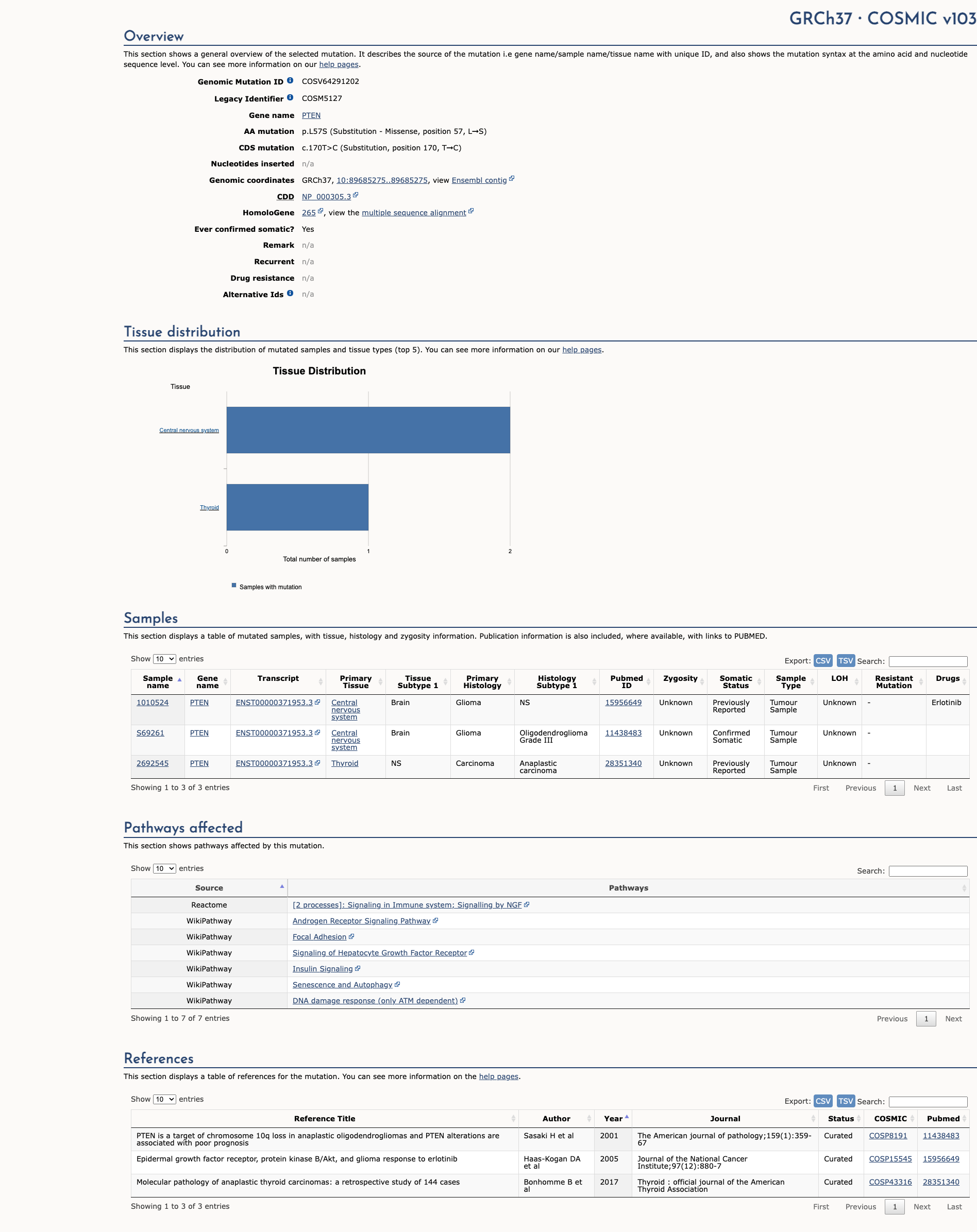
Functional Impact & Domains
Functional Domain
The PTEN L57S variant has been functionally characterized and is associated with reduced phosphatase activity in a yeast assay, indicating a loss of PTEN protein function.
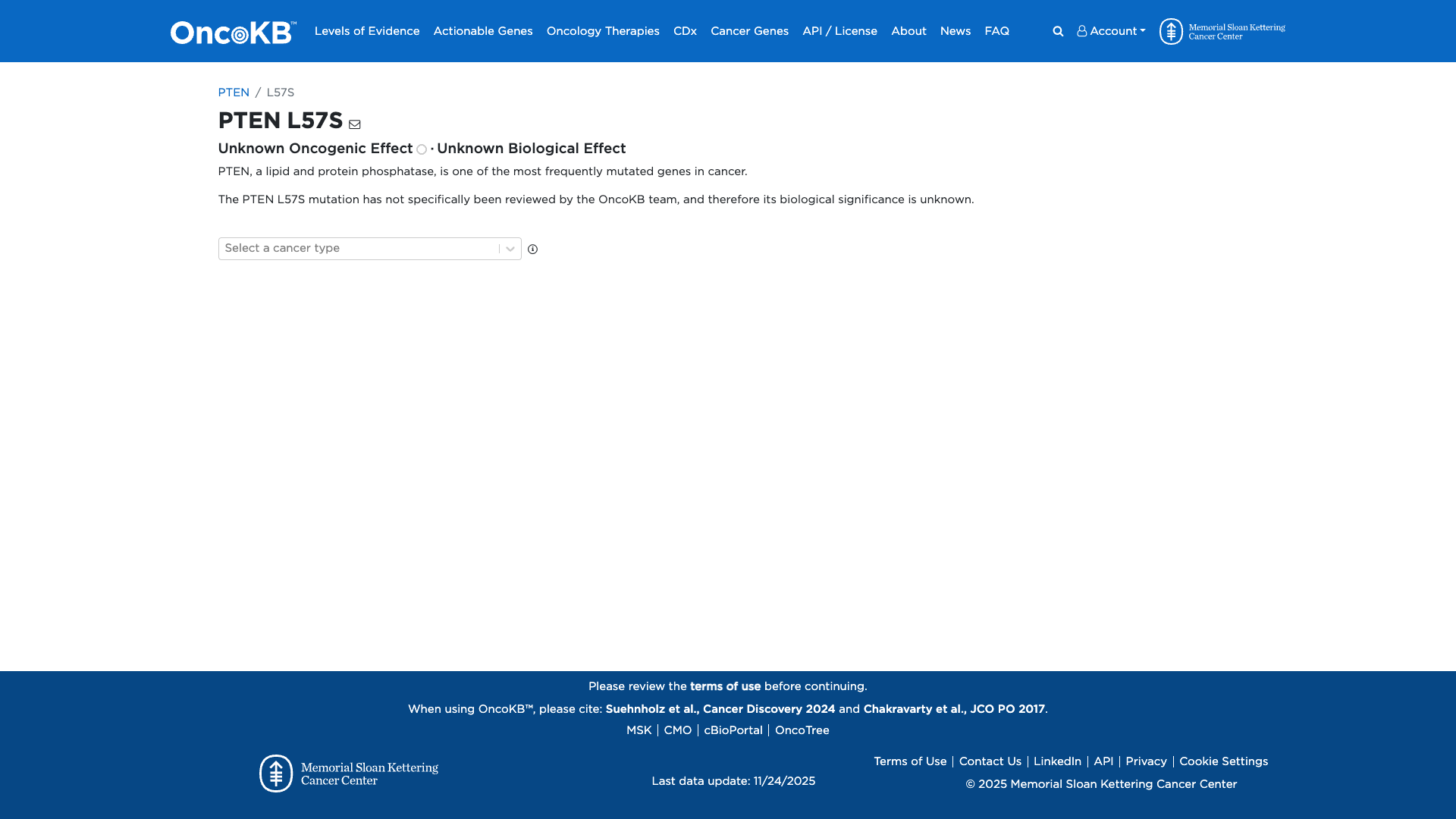
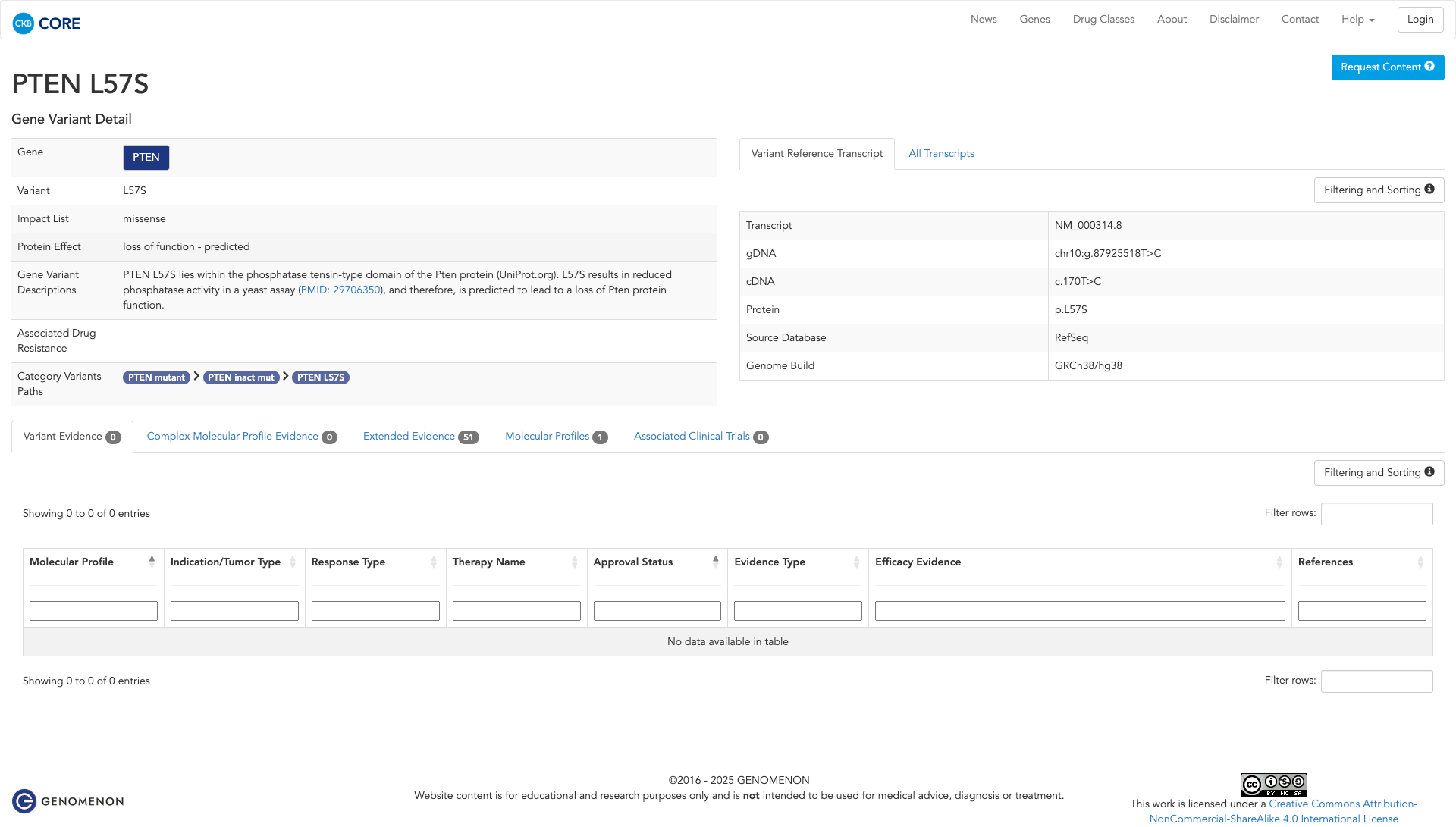
Click on previews to view full database entries. External databases may require institutional access.
Computational Analysis
Pathogenicity Predictions
SpliceAISpliceAI Scores
Window: ±500bp| Effect Type | Score | Position |
|---|---|---|
| Acceptor Loss (AL) | 0.0 | 11 bp |
| Donor Loss (DL) | 0.0 | 222 bp |
| Acceptor Gain (AG) | 0.01 | -5 bp |
| Donor Gain (DG) | 0.0 | 43 bp |
VCEP Guidelines
Applied ACMG/AMP Criteria (VCEP Specific)
PVS1 (Not Applied)
According to VCEP guidelines, PVS1 applies to loss-of-function variants following the PTEN PVS1 decision tree. The evidence for this variant shows it is a missense change and not predicted to cause loss of function. Therefore, this criterion is not applied.
PS1 (Not Applied)
According to VCEP guidelines, PS1 applies when there is the same amino acid change as a previously established pathogenic variant. The evidence for this variant shows no prior pathogenic variant affecting Leu57 to Ser. Therefore, this criterion is not applied.
PS2 (Not Applied)
According to VCEP guidelines, PS2 requires confirmed de novo occurrence. No de novo data are available for this variant. Therefore, this criterion is not applied.
PS3 (Moderate)
According to PTEN Pre-processing, the rule for PS3 is: 'Phosphatase activity ≤ -1.11 per Mighell et al. 2018, PMID: 29706350. Modification Type: Disease-specific'. The evidence for this variant shows a functional assay score of -3.7312, which is below the threshold. Therefore, this criterion is applied at Moderate strength because the PTEN‐specific functional assay demonstrates damaging effect consistent with the PS3_Moderate rule.
PS4 (Not Applied)
According to VCEP guidelines, PS4 requires increased prevalence in affected individuals or specificity score ≥4. No case‐control or proband specificity data are available. Therefore, this criterion is not applied.
PM1 (Not Applied)
According to VCEP guidelines, PM1 applies to variants located in PTEN catalytic motifs (residues 90-94, 123-130, 166-168). The evidence shows Leu57 is outside these regions. Therefore, this criterion is not applied.
PM2 (Supporting)
According to VCEP guidelines, PM2 is: 'Absent in population Databases present at <0.00001 allele frequency in gnomAD'. The evidence shows the variant is absent from gnomAD. Therefore, this criterion is applied at Supporting strength.
PM3 (Not Applied)
According to VCEP guidelines, PM3 applies to recessive genes with trans observations. PTEN is haploinsufficient and no trans observations are relevant. Therefore, this criterion is not applied.
PM4 (Not Applied)
According to VCEP guidelines, PM4 applies to in-frame indels or protein length changes. This is a missense variant without length change. Therefore, this criterion is not applied.
PM5 (Moderate)
According to VCEP guidelines, PM5 is: 'Missense change at an amino acid residue where a different missense change determined to be pathogenic has been seen before, with BLOSUM62 score equal or less than the known variant'. The evidence shows a known pathogenic missense at residue Leu57 and the BLOSUM62 criterion is met. Therefore, this criterion is applied at Moderate strength.
PM6 (Not Applied)
According to VCEP guidelines, PM6 requires assumed de novo occurrence without confirmation. No de novo data are available. Therefore, this criterion is not applied.
PP1 (Not Applied)
According to VCEP guidelines, PP1 requires familial co-segregation data. No segregation data are available. Therefore, this criterion is not applied.
PP2 (Not Applied)
According to standard ACMG guidelines, PP2 applies when a missense variant occurs in a gene with low benign variation and missense is a known mechanism. No explicit PTEN-based rate data are provided. Therefore, this criterion is not applied.
PP3 (Supporting)
According to VCEP guidelines, PP3 is: 'Multiple lines of computational evidence support a deleterious effect; Missense variants: REVEL score >0.7'. The evidence shows REVEL=0.98>0.7 plus other tools concordant. Therefore, this criterion is applied at Supporting strength.
PP4 (Not Applied)
According to standard ACMG guidelines, PP4 requires specific phenotype information. No patient phenotype is provided. Therefore, this criterion is not applied.
PP5 (Supporting)
According to standard ACMG guidelines, PP5 is: 'Reputable source reports variant as pathogenic but evidence not available for independent evaluation'. The evidence shows a ClinVar entry of Likely Pathogenic. Therefore, this criterion is applied at Supporting strength.
BA1 (Not Applied)
According to VCEP guidelines, BA1 applies when allele frequency >0.00056. The variant frequency is 0%. Therefore, this criterion is not applied.
BS1 (Not Applied)
According to VCEP guidelines, BS1 applies when allele frequency is between 0.000043 and 0.00056. The variant is absent. Therefore, this criterion is not applied.
BS2 (Not Applied)
According to VCEP guidelines, BS2 applies when observed homozygous in unaffected individuals. No such observations exist. Therefore, this criterion is not applied.
BS3 (Not Applied)
According to VCEP guidelines, BS3 applies if functional studies show no damaging effect. The functional data show damaging effect. Therefore, this criterion is not applied.
BS4 (Not Applied)
According to VCEP guidelines, BS4 applies for lack of segregation. No data on segregation absence. Therefore, this criterion is not applied.
BP1 (Not Applied)
According to standard ACMG guidelines, BP1 applies if only truncating variants cause disease and a missense is benign. PTEN missense causes disease. Therefore, this criterion is not applied.
BP2 (Not Applied)
According to VCEP guidelines, BP2 applies for variants observed in trans with pathogenic variants. No such observations. Therefore, this criterion is not applied.
BP3 (Not Applied)
According to VCEP guidelines, BP3 applies to in-frame indels in repeat regions. Not applicable for missense. Therefore, this criterion is not applied.
BP4 (Not Applied)
According to VCEP guidelines, BP4 applies when computational evidence suggests no impact (REVEL<0.5). REVEL=0.98 indicates deleterious. Therefore, this criterion is not applied.
BP5 (Not Applied)
According to VCEP guidelines, BP5 applies when an alternate molecular basis explains disease. No alternate gene basis data. Therefore, this criterion is not applied.
BP6 (Not Applied)
According to standard ACMG guidelines, BP6 applies when a reputable source reports benign. No such report exists. Therefore, this criterion is not applied.
BP7 (Not Applied)
According to VCEP guidelines, BP7 applies to synonymous variants with no splice impact. This is missense. Therefore, this criterion is not applied.