Genetic Information
Gene & Transcript Details
| ID | Status | Details |
|---|---|---|
| NM_000059.4 | MANE Select | 11954 nt | 200–10456 |
| NM_000059.2 | Alternative | 11386 nt | 228–10484 |
| NM_000059.3 | RefSeq Select | 11386 nt | 228–10484 |
Variant Details
Clinical & Population Data
Population Frequency
gnomADClinVar
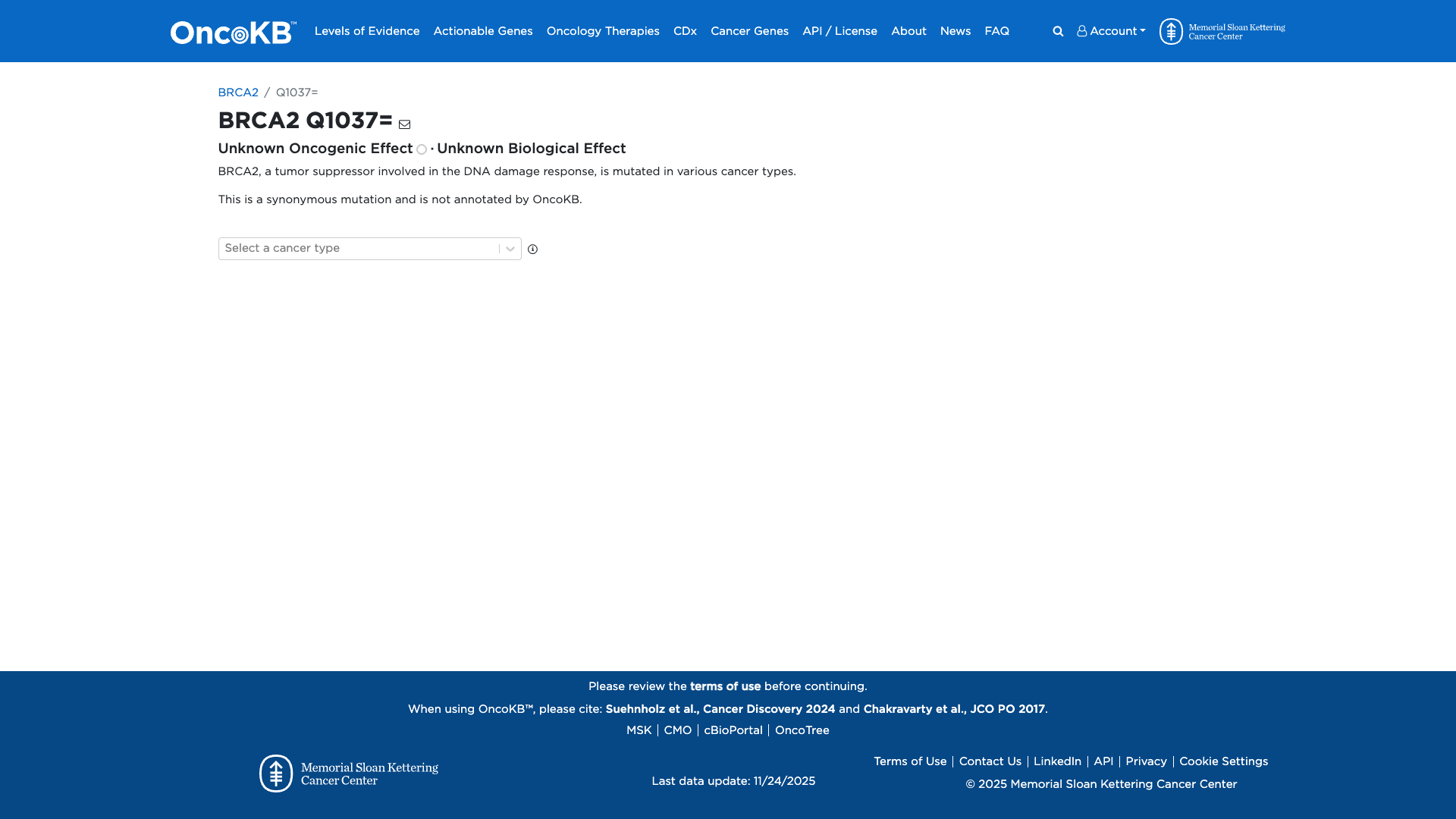
Open"This variant has been reported in ClinVar as Likely benign (6 clinical laboratories) and as Benign (1 clinical laboratories) and as Likely benign by Evidence-based Network for the Interpretation of Germline Mutant Alleles (ENIGMA) expert panel."
COSMIC Somatic Evidence
Open
Functional Impact & Domains
Functional Domain
Computational Analysis
Pathogenicity Predictions
SpliceAISpliceAI Scores
Window: ±500bp| Effect Type | Score | Position |
|---|---|---|
| Acceptor Loss (AL) | 0.0 | -127 bp |
| Donor Loss (DL) | 0.0 | 439 bp |
| Acceptor Gain (AG) | 0.0 | -400 bp |
| Donor Gain (DG) | 0.0 | -311 bp |
VCEP Guidelines
Applied ACMG/AMP Criteria (VCEP Specific)
PVS1 (Not Applied)
According to VCEP guidelines the rule for PVS1 is: "Very Strong Null variant (nonsense, frameshift, splice site (donor/acceptor ±1,2), initiation codon, single or multi-exon deletion) in a gene where loss of function (LOF) is a known mechanism of disease." The evidence for this variant shows: a synonymous change (Q1037=), not predicted to introduce a null allele. Therefore, this criterion is not applied.
PS1 (Not Applied)
According to VCEP guidelines the rule for PS1 is: "Strong Apply PS1 for predicted missense substitutions, where a previously classified pathogenic variant is considered to act via protein change (no confirmed or predicted effect on mRNA splicing (SpliceAI ≤0.1))." The evidence for this variant shows: a synonymous substitution, not a missense change. Therefore, this criterion is not applied.
PS2 (Not Applied)
According to standard ACMG guidelines the rule for PS2 is: "Confirmed de novo (both maternity and paternity confirmed) in a patient with the disease and no family history." The evidence for this variant shows: no de novo data available. Therefore, this criterion is not applied.
PS3 (Not Applied)
According to VCEP guidelines the rule for PS3 is: "Strong Well-established in vitro or in vivo functional studies supportive of a damaging effect." The evidence for this variant shows: no functional studies performed. Therefore, this criterion is not applied.
PS4 (Not Applied)
According to VCEP guidelines the rule for PS4 is: "Strong The prevalence of the variant in affected individuals is significantly increased compared to controls (p ≤0.05, OR ≥4)." The evidence for this variant shows: no case-control or prevalence data. Therefore, this criterion is not applied.
PM1 (Not Applied)
According to VCEP guidelines the rule for PM1 is: "Moderate Apply PM1 for a variant located in a mutational hot spot or critical functional domain without benign variation." The evidence for this variant shows: a synonymous change at residue 1037, outside defined functional domains. Therefore, this criterion is not applied.
PM2 (Not Applied)
According to VCEP guidelines the rule for PM2 is: "Supporting Absent from controls in an outbred population, from gnomAD v2.1 and v3.1." The evidence for this variant shows: present at MAF=0.00000401 in gnomAD. Therefore, this criterion is not applied.
PM3 (Not Applied)
According to VCEP guidelines the rule for PM3 is: "Supporting/Moderate/Strong Apply for patient with phenotype consistent with BRCA1- or BRCA2-related Fanconi Anemia and co-occurrence of variants." The evidence for this variant shows: no Fanconi anemia phenotype or co-occurring variant data. Therefore, this criterion is not applied.
PM4 (Not Applied)
According to standard ACMG guidelines the rule for PM4 is: "Protein length changes as a result of in-frame deletions/insertions or stop-loss variants." The evidence for this variant shows: a synonymous substitution, no change in protein length. Therefore, this criterion is not applied.
PM5 (Not Applied)
According to VCEP guidelines the rule for PM5 is: "Strong Protein termination codon (PTC) variant in an exon where a different proven pathogenic PTC variant has been seen before." The evidence for this variant shows: a synonymous substitution, not a PTC. Therefore, this criterion is not applied.
PM6 (Not Applied)
According to standard ACMG guidelines the rule for PM6 is: "Unconfirmed de novo (no confirmation of maternity/paternity)." The evidence for this variant shows: no de novo data available. Therefore, this criterion is not applied.
PP1 (Not Applied)
According to VCEP guidelines the rule for PP1 is: "Supporting/Moderate/Strong Co-segregation with disease in multiple affected family members." The evidence for this variant shows: no segregation data. Therefore, this criterion is not applied.
PP2 (Not Applied)
According to standard ACMG guidelines the rule for PP2 is: "Missense variant in a gene with low rate of benign missense variation and where missense variants are a common mechanism of disease." The evidence for this variant shows: a synonymous variant, not missense. Therefore, this criterion is not applied.
PP3 (Not Applied)
According to VCEP guidelines the rule for PP3 is: "Supporting Apply PP3 for predicted splicing (SpliceAI ≥0.2) for silent variants." The evidence for this variant shows: SpliceAI predicts no impact (all scores <0.2). Therefore, this criterion is not applied.
PP4 (Not Applied)
According to VCEP guidelines the rule for PP4 is: "Supporting/Moderate/Strong Use only in context of multifactorial likelihood clinical data for breast cancer phenotype." The evidence for this variant shows: no phenotype-specific multifactorial data. Therefore, this criterion is not applied.
PP5 (Not Applied)
According to standard ACMG guidelines the rule for PP5 is: "Reputable source recently reports variant as pathogenic, but evidence is not available for independent evaluation." The evidence for this variant shows: no reputable source reports this variant as pathogenic. Therefore, this criterion is not applied.
BA1 (Not Applied)
According to VCEP guidelines the rule for BA1 is: "Stand Alone Filter allele frequency (FAF) >0.1% in gnomAD v2.1/v3.1." The evidence for this variant shows: FAF=0.00000401, well below 0.1%. Therefore, this criterion is not applied.
BS1 (Not Applied)
According to VCEP guidelines the rule for BS1 is: "Strong Filter allele frequency (FAF) >0.01% in gnomAD v2.1/v3.1." The evidence for this variant shows: FAF=0.00000401, below 0.01%. Therefore, this criterion is not applied.
BS2 (Not Applied)
According to VCEP guidelines the rule for BS2 is: "Supporting/Moderate/Strong Applied in absence of recessive disease features (Fanconi Anemia)." The evidence for this variant shows: no unaffected adult heterozygote or Fanconi Anemia assessment. Therefore, this criterion is not applied.
BS3 (Not Applied)
According to VCEP guidelines the rule for BS3 is: "Strong Well-established functional studies show no damaging effect on protein function." The evidence for this variant shows: no functional studies available. Therefore, this criterion is not applied.
BS4 (Not Applied)
According to VCEP guidelines the rule for BS4 is: "Strong Lack of segregation in affected family members (LR ≤0.05)." The evidence for this variant shows: no segregation data. Therefore, this criterion is not applied.
BP1 (Strong)
According to VCEP guidelines the rule for BP1 is: "Strong Apply BP1_Strong for silent substitution outside a (potentially) clinically important functional domain AND no splicing predicted (SpliceAI ≤0.1)." The evidence for this variant shows: Q1037= is outside defined domains (aa10-40, aa2481-3186) and SpliceAI predicts no impact (≤0.1). Therefore, this criterion is applied at Strong strength.
BP2 (Not Applied)
According to standard ACMG guidelines the rule for BP2 is: "Observed in trans with a pathogenic variant for a fully penetrant dominant gene or in cis with a pathogenic variant when phase is known." The evidence for this variant shows: no co-occurrence data. Therefore, this criterion is not applied.
BP3 (Not Applied)
According to standard ACMG guidelines the rule for BP3 is: "In-frame deletions/insertions in a repetitive region without a known function." The evidence for this variant shows: a single nucleotide change, not an indel in a repeat. Therefore, this criterion is not applied.
BP4 (Not Applied)
According to VCEP guidelines the rule for BP4 is: "Supporting Missense or in-frame insertion/deletion variants inside a clinically important functional domain, or silent variants inside such domain IF no impact predicted." The evidence for this variant shows: a silent change outside functional domains. Therefore, this criterion is not applied.
BP5 (Not Applied)
According to VCEP guidelines the rule for BP5 is: "Supporting Use only to capture combined LR against pathogenicity for co-observation with pathogenic variants in other breast–ovarian cancer genes." The evidence for this variant shows: no co-observation data. Therefore, this criterion is not applied.
BP6 (Supporting)
According to standard ACMG guidelines the rule for BP6 is: "Reputable source recently reports variant as benign, but evidence not available for independent evaluation." The evidence for this variant shows: reported as Likely benign by 6 labs and Benign by 1 lab in ClinVar and by ENIGMA. Therefore, this criterion is applied at Supporting strength.
BP7 (Not Applied)
According to VCEP guidelines the rule for BP7 is: "Supporting Silent variant inside a clinically important functional domain IF BP4 met." The evidence for this variant shows: a silent variant outside domains and BP4 not met. Therefore, this criterion is not applied.