Genetic Information
Gene & Transcript Details
| ID | Status | Details |
|---|---|---|
| NM_000546.5 | RefSeq Select | 2591 nt | 203–1384 |
| NM_000546.3 | Alternative | 2640 nt | 252–1433 |
| NM_000546.6 | MANE Select | 2512 nt | 143–1324 |
| NM_000546.4 | Alternative | 2586 nt | 198–1379 |
| NM_000546.2 | Alternative | 2629 nt | 252–1433 |
Variant Details
Clinical & Population Data
Population Frequency
gnomADClinVar
Open""
COSMIC Somatic Evidence
Open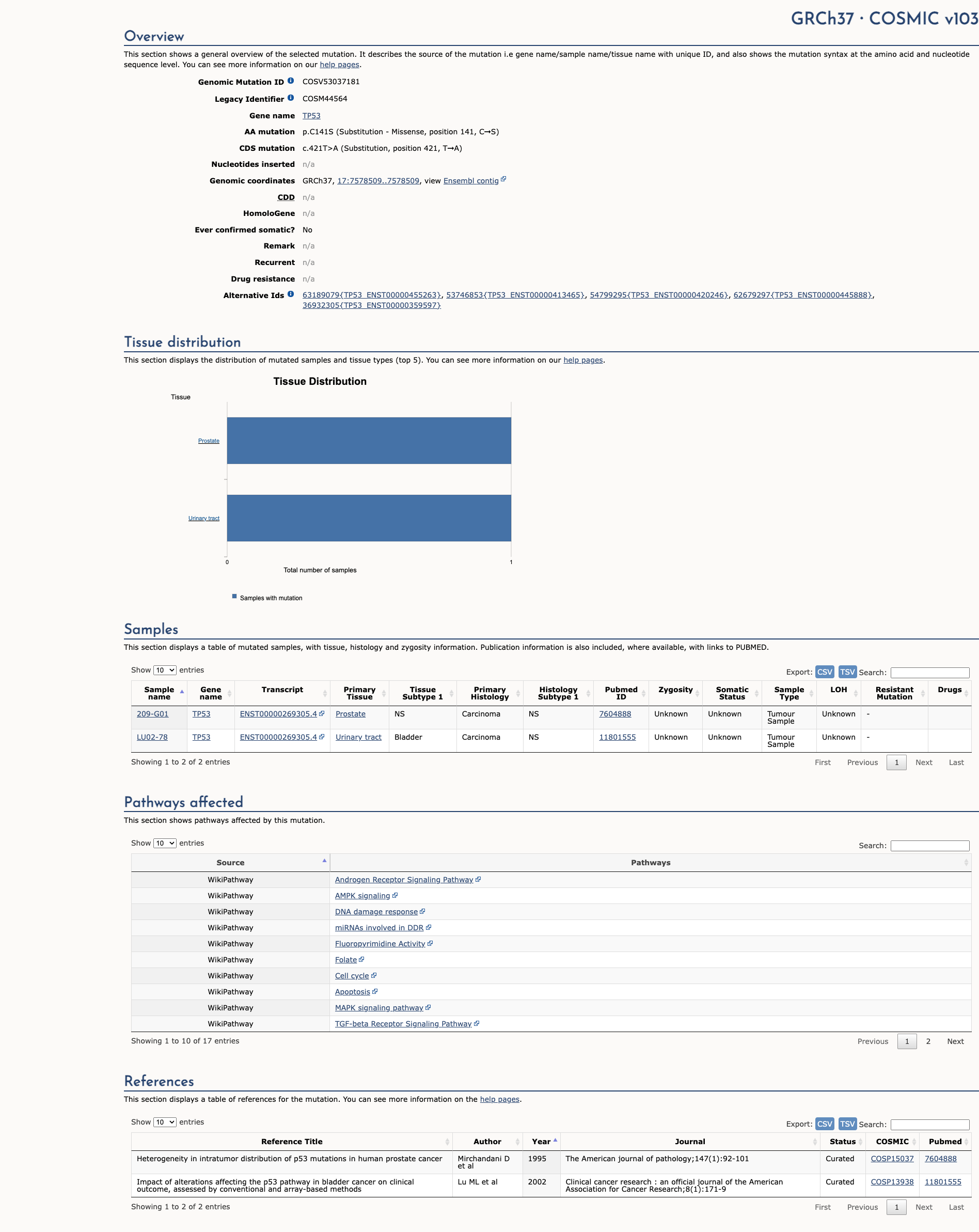
Functional Impact & Domains
Functional Domain
The TP53 C141S variant has been functionally characterized and is associated with a likely loss of function. It is located in the DNA-binding domain of the TP53 protein. In vivo studies in yeast have shown partial loss of transactivational activity compared to the wild-type. In vitro assays indicate that while the DNA-binding affinity is similar to the wild-type, there is increased oxidative dissociation and decreased induction of p21 in cultured cells, suggesting a loss of TP53 protein function.
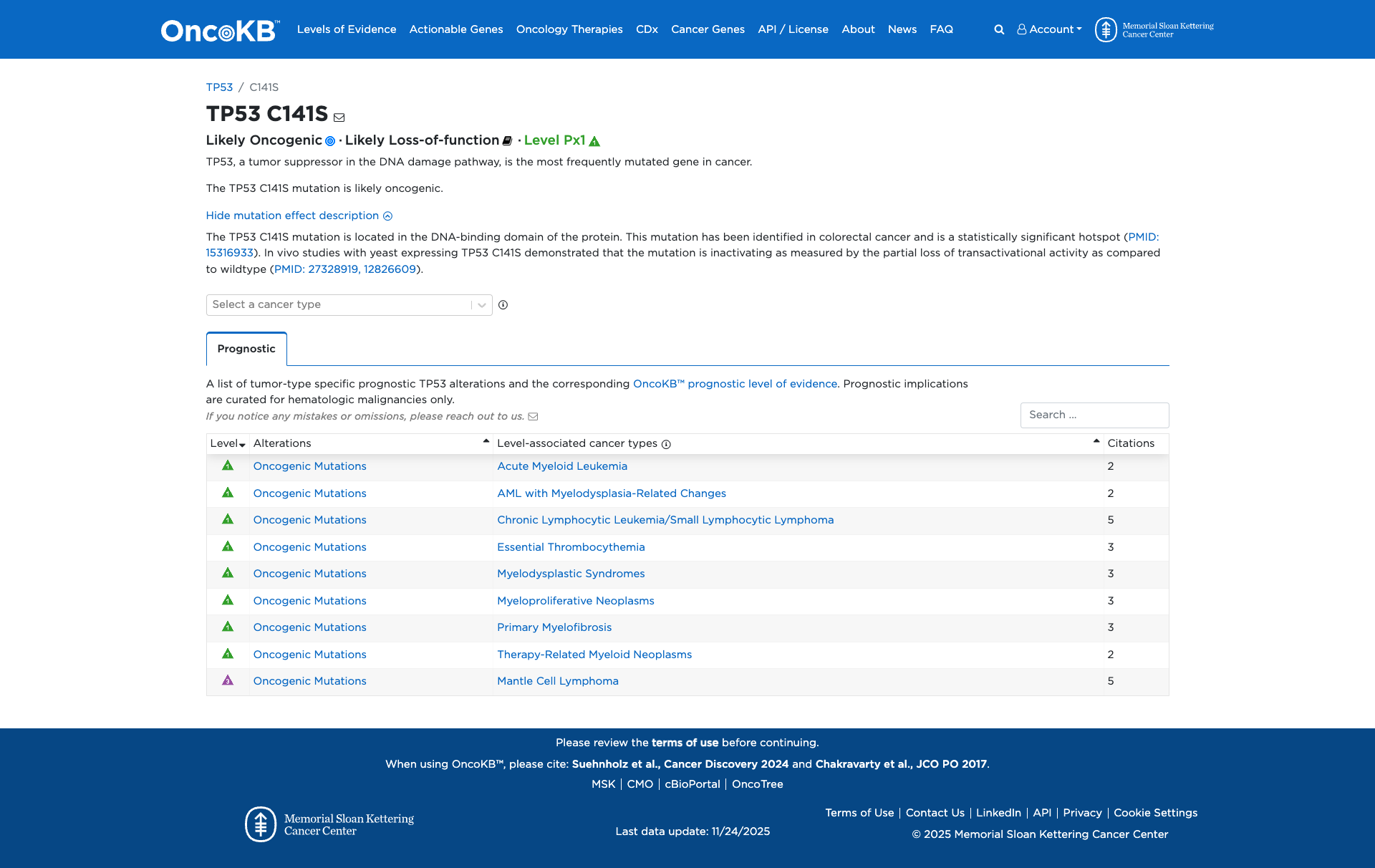
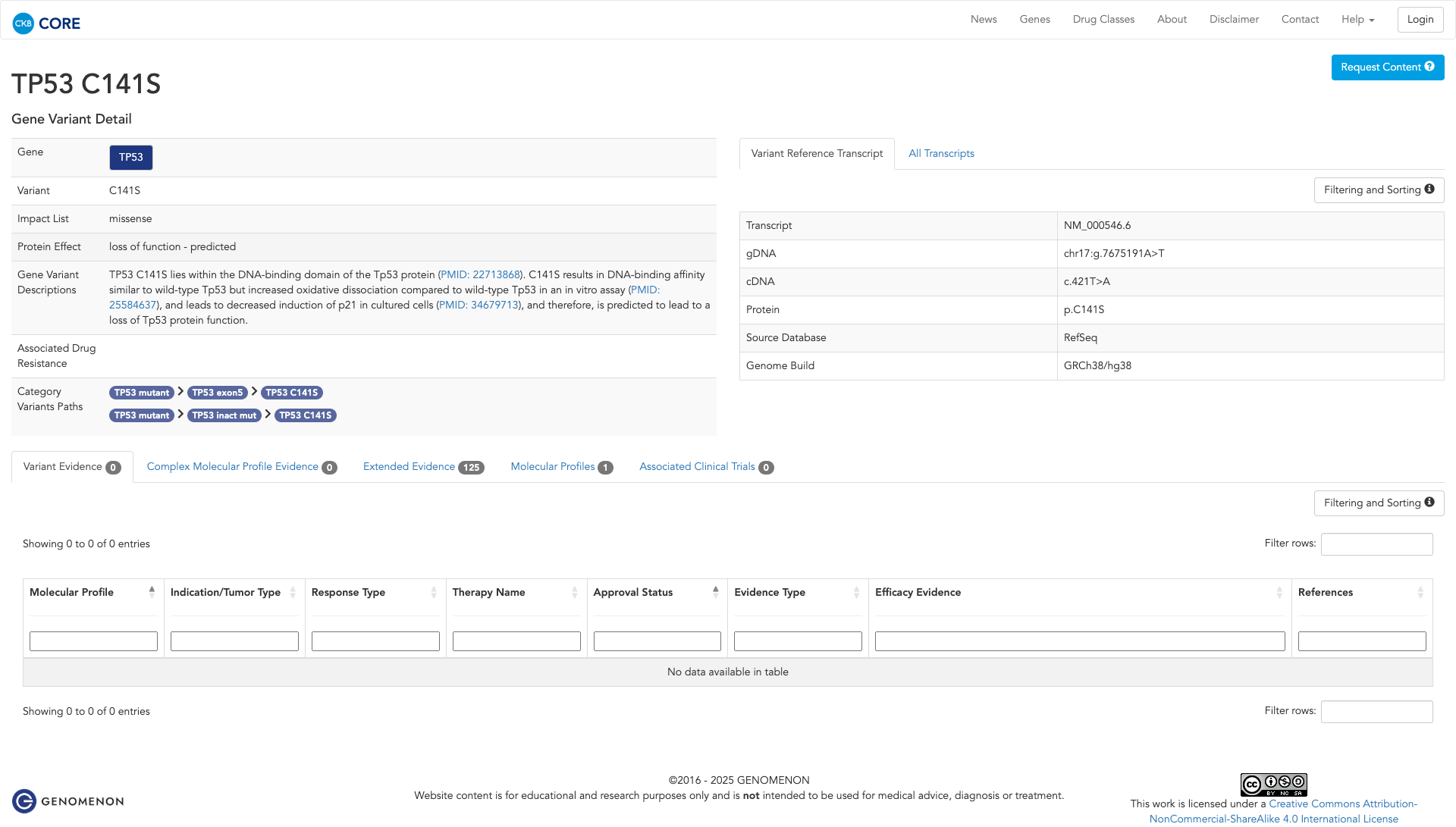
Click on previews to view full database entries. External databases may require institutional access.
Computational Analysis
Pathogenicity Predictions
SpliceAISpliceAI Scores
Window: ±500bp| Effect Type | Score | Position |
|---|---|---|
| Acceptor Loss (AL) | 0.01 | -237 bp |
| Donor Loss (DL) | 0.0 | -337 bp |
| Acceptor Gain (AG) | 0.0 | 45 bp |
| Donor Gain (DG) | 0.0 | -92 bp |
VCEP Guidelines
Applied ACMG/AMP Criteria (VCEP Specific)
PVS1 (Not Applied)
According to VCEP guidelines, the PVS1 rule is: 'PVS1 applies only to null variants (nonsense, frameshift, canonical ±1,2 splice) predicted to undergo NMD or critical domain disruption.' The evidence for this variant shows it is a missense change c.421T>A (p.Cys141Ser), not a null variant. Therefore, this criterion is not applied.
PS1 (Not Applied)
According to VCEP guidelines, the PS1 rule is: 'Strong: Same amino acid change as a previously established Pathogenic TP53 variant.' The evidence for this variant shows no identical amino acid change previously classified as Pathogenic. Therefore, this criterion is not applied.
PS2 (Not Applied)
According to VCEP guidelines, the PS2 rule is: 'Very Strong: ≥8 de novo points; Strong: 4–7 points; Moderate: 2–3 points; Supporting: 1 point based on de novo evidence.' The evidence for this variant shows no de novo or parental testing data. Therefore, this criterion is not applied.
PS3 (Moderate)
According to VCEP guidelines, the PS3_Moderate rule is: 'Partially functional on Kato et al. data AND loss of function on another assay (e.g., Kotler or second assay showing low function).' The evidence for this variant shows partial transactivational activity in yeast (in vivo) and decreased p21 induction in cultured cells (in vitro) indicating loss of TP53 function. Therefore, this criterion is applied at Moderate strength.
PS4 (Not Applied)
According to VCEP guidelines, the PS4 rule is: 'Very Strong: ≥8 proband points; Strong: 4–7.5 points; Moderate: 2–3.5 points; Supporting: 1–1.5 points based on case observations.' The evidence for this variant shows no case or proband data. Therefore, this criterion is not applied.
PM1 (Not Applied)
According to VCEP guidelines, the PM1 rule is: 'Moderate: Missense variants at codons 175, 245, 248, 249, 273, or 282; Supporting: variants with 2–9 somatic occurrences in cancerhotspots.org.' The evidence for this variant shows it is at codon 141 with zero somatic occurrences in COSMIC. Therefore, this criterion is not applied.
PM2 (Supporting)
According to VCEP guidelines, the PM2_Supporting rule is: 'Variant allele frequency <0.00003 in gnomAD or large population databases.' The evidence for this variant shows it is absent from gnomAD. Therefore, this criterion is applied at Supporting strength.
PM3 (Not Applied)
According to standard ACMG guidelines, the PM3 rule is: 'Detected in trans with a pathogenic variant in recessive disorders.' The evidence for this variant shows no trans observations or recessive context. Therefore, this criterion is not applied.
PM4 (Not Applied)
According to standard ACMG guidelines, the PM4 rule is: 'Protein length changes due to in-frame indels or stop-loss.' The evidence for this variant shows no protein length alteration. Therefore, this criterion is not applied.
PM5 (Not Applied)
According to VCEP guidelines, the PM5 rule is: 'Moderate: Missense at an amino acid where ≥1 different pathogenic missense variant has been seen; Supporting: where ≥1 likely pathogenic variant with clinical data has been seen.' The evidence for this variant shows no other pathogenic or likely pathogenic missense at Cys141. Therefore, this criterion is not applied.
PM6 (Not Applied)
According to standard ACMG guidelines, the PM6 rule is: 'Assumed de novo without confirmation of paternity/maternity.' The evidence for this variant shows no de novo information. Therefore, this criterion is not applied.
PP1 (Not Applied)
According to VCEP guidelines, the PP1 rule is: 'Supporting: Cosegregation in 3–4 meioses; Moderate: 5–6 meioses; Strong: ≥7 meioses.' The evidence for this variant shows no segregation data. Therefore, this criterion is not applied.
PP2 (Not Applied)
According to standard ACMG guidelines, the PP2 rule is: 'Missense variant in a gene with low rate of benign missense variation and where missense is a common mechanism of disease.' The evidence for this variant does not include gene-specific missense constraint metrics. Therefore, this criterion is not applied.
PP3 (Not Applied)
According to VCEP guidelines, the PP3 rule requires aGVGD and BayesDel metrics (e.g., aGVGD C65 and BayesDel ≥0.16 for Moderate; C25–C55 and BayesDel ≥0.16 for Supporting). The evidence for this variant uses REVEL and PolyPhen-2 but lacks the required VCEP-specified scores. Therefore, this criterion is not applied.
PP4 (Not Applied)
According to VCEP guidelines, the PP4 rule is: 'Supporting: Observation in tumor samples with VAF 5–35%.' The evidence for this variant shows no tumor VAF data. Therefore, this criterion is not applied.
PP5 (Not Applied)
According to standard ACMG guidelines, the PP5 rule is: 'Reputable source reports variant as pathogenic.' The evidence for this variant shows no such reports. Therefore, this criterion is not applied.
BA1 (Not Applied)
According to VCEP guidelines, the BA1 rule is: 'Stand Alone: Filtering allele frequency ≥0.001 in gnomAD.' The evidence for this variant shows absence from population databases. Therefore, this criterion is not applied.
BS1 (Not Applied)
According to VCEP guidelines, the BS1 rule is: 'Strong: Filtering allele frequency ≥0.0003 but <0.001 in gnomAD.' The evidence for this variant shows absence from population databases. Therefore, this criterion is not applied.
BS2 (Not Applied)
According to VCEP guidelines, the BS2 rule is: 'Strong: ≥8 unaffected females ≥60 years; Moderate: 4–7; Supporting: 2–3.' The evidence for this variant shows no such unaffected individual data. Therefore, this criterion is not applied.
BS3 (Not Applied)
According to VCEP guidelines, the BS3 rule is: 'Strong: Functional on Kato et al. data AND no loss of function on another assay.' The evidence for this variant indicates loss of function in assays. Therefore, this criterion is not applied.
BS4 (Not Applied)
According to VCEP guidelines, the BS4 rule is: 'Strong: Lack of segregation in affected family members.' The evidence for this variant shows no segregation data. Therefore, this criterion is not applied.
BP1 (Not Applied)
According to standard ACMG guidelines, the BP1 rule is: 'Missense variant in a gene where only truncating variants cause disease.' TP53 disease mechanism includes missense. Therefore, this criterion is not applied.
BP2 (Not Applied)
According to standard ACMG guidelines, the BP2 rule is: 'Observed in trans with a pathogenic variant in a dominant disorder.' The evidence for this variant shows no such observation. Therefore, this criterion is not applied.
BP3 (Not Applied)
According to standard ACMG guidelines, the BP3 rule is: 'In-frame indels in repetitive regions without known function.' The evidence for this variant shows a missense change, not an in-frame indel. Therefore, this criterion is not applied.
BP4 (Not Applied)
According to VCEP guidelines, the BP4 rule is: 'Supporting: BayesDel <0.16 and >-0.008 with no splicing impact.' The evidence for this variant lacks BayesDel data. Therefore, this criterion is not applied.
BP5 (Not Applied)
According to standard ACMG guidelines, the BP5 rule is: 'Variant found in a case with an alternate molecular basis for disease.' No such alternate basis is reported. Therefore, this criterion is not applied.
BP6 (Not Applied)
According to standard ACMG guidelines, the BP6 rule is: 'Reputable source reports variant as benign.' The evidence for this variant shows no such reports. Therefore, this criterion is not applied.
BP7 (Not Applied)
According to VCEP guidelines, the BP7 rule is: 'Supporting: Synonymous or intronic variant outside core splice sites with no predicted splicing impact.' The evidence for this variant shows a missense change. Therefore, this criterion is not applied.