Genetic Information
Gene & Transcript Details
| ID | Status | Details |
|---|---|---|
| NM_007294.2 | Alternative | 7191 nt | 201–5792 |
| NM_007294.3 | RefSeq Select | 7224 nt | 233–5824 |
| NM_007294.4 | MANE Select | 7088 nt | 114–5705 |
Variant Details
Clinical & Population Data
Population Frequency
gnomADClinVar
OpenVariant summary: BRCA1 c.4669G>C (p.Asp1557His) results in a non-conservative amino acid change in the encoded protein sequence. Three of five in-silico tools predict a damaging effect of the variant on protein function. The variant allele was found at a frequency of 1.6e-05 in 251130 control chromosomes. The available data on variant occurrences in the general population are insufficient to allow any conclusion about variant significance. c.4669G>C has been reported in the literature in at-least one individual affected with Ovarian cancer in whom the BRCA1 gene promoter methylation was also identified, thereby supporting a sporadic and/or an alternate etiology of disease (example, Alsop_2012 and George_2013). These report(s) do not provide unequivocal conclusions about association of the variant with Hereditary Breast And Ovarian Cancer Syndrome. At least two publications report experimental evidence evaluating an impact on protein function. These results showed no damaging effect of this variant using a transcriptional activation based assay system (Woods_2016, Fernandes_ 2019). The following publications have been ascertained in the context of this evaluation (PMID: 22711857, 30765603, 23633455, 15385441, 23704879, 28781887). Four submitters have cited clinical-significance assessments for this variant to ClinVar after 2014 (VUS: n=3; LB: n=1). At-least two subvmitters cite overlapping evidence utilized in the context of this evaluation. Based on the evidence outlined above, the variant was classified as likely benign.
This alteration is classified as likely benign based on a combination of the following: seen in unaffected individuals, population frequency, intact protein function, lack of segregation with disease, co-occurrence, RNA analysis, in silico models, amino acid conservation, lack of disease association in case-control studies, and/or the mechanism of disease or impacted region is inconsistent with a known cause of pathogenicity.
This sequence change replaces aspartic acid, which is acidic and polar, with histidine, which is basic and polar, at codon 1557 of the BRCA1 protein (p.Asp1557His). This variant is present in population databases (rs80356906, gnomAD 0.01%). This missense change has been observed in individual(s) with ovarian cancer (PMID: 22711857). ClinVar contains an entry for this variant (Variation ID: 55255). Advanced modeling of protein sequence and biophysical properties (such as structural, functional, and spatial information, amino acid conservation, physicochemical variation, residue mobility, and thermodynamic stability) performed at Invitae indicates that this missense variant is not expected to disrupt BRCA1 protein function with a negative predictive value of 95%. Experimental studies have shown that this missense change does not substantially affect BRCA1 function (PMID: 28781887). In summary, the available evidence is currently insufficient to determine the role of this variant in disease. Therefore, it has been classified as a Variant of Uncertain Significance.
This missense variant replaces aspartic acid with histidine at codon 1557 of the BRCA1 protein. Computational prediction is inconclusive regarding the impact of this variant on protein structure and function (internally defined REVEL score threshold 0.5 < inconclusive < 0.7, PMID: 27666373). A functional study has shown that the mutant protein has transcriptional activity similar to wild type (PMID: 28781887). This variant has been reported in at least one individual affected with ovarian cancer (PMID: 22711857, 23633455). This variant has been identified in 4/251130 chromosomes in the general population by the Genome Aggregation Database (gnomAD). The available evidence is insufficient to determine the role of this variant in disease conclusively. Therefore, this variant is classified as a Variant of Uncertain Significance.
"This variant has been reported in ClinVar as Uncertain significance (7 clinical laboratories) and as Likely benign (3 clinical laboratories)."
COSMIC Somatic Evidence
Open
Functional Impact & Domains
Functional Domain
The BRCA1 D1557H variant has not been functionally characterized, and its biological significance remains unknown.
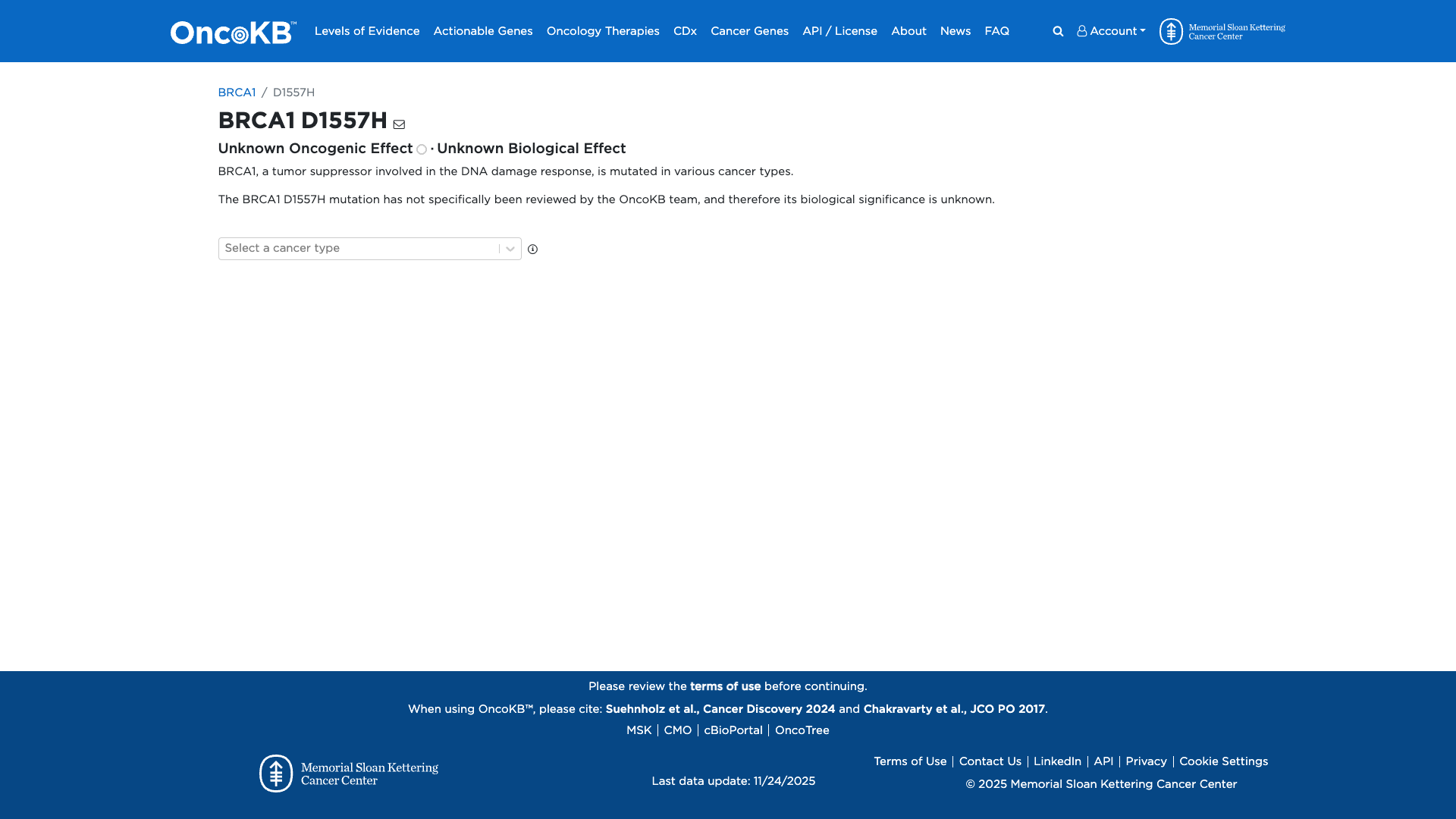
Click on previews to view full database entries. External databases may require institutional access.
Computational Analysis
Pathogenicity Predictions
SpliceAISpliceAI Scores
Window: ±500bp| Effect Type | Score | Position |
|---|---|---|
| Acceptor Loss (AL) | 0.02 | 155 bp |
| Donor Loss (DL) | 0.17 | 5 bp |
| Acceptor Gain (AG) | 0.0 | 184 bp |
| Donor Gain (DG) | 0.01 | -6 bp |
VCEP Guidelines
Applied ACMG/AMP Criteria (VCEP Specific)
PVS1 (Not Applied)
According to VCEP guidelines, the rule for PVS1 is: 'Very Strong Null variant (nonsense, frameshift, splice site (donor/acceptor ±1,2), initiation codon, single or multi-exon deletion) in a gene where loss of function is a known mechanism of disease.' The evidence for this variant shows: D1557H is a missense substitution that does not introduce a premature termination codon or affect splicing at canonical sites. Therefore, this criterion is not applied because the variant is not a null variant as required by the rule.
PS1 (Not Applied)
According to VCEP guidelines, the rule for PS1 is: 'Strong: Predicted missense substitutions, where a previously classified pathogenic variant is considered to act via protein change (no confirmed or predicted effect on mRNA splicing (SpliceAI ≤0.1)).' The evidence for this variant shows: there is no previously established pathogenic variant resulting in the same p.D1557H change. Therefore, this criterion is not applied because no matching pathogenic amino acid change exists.
PS2 (Not Applied)
According to standard ACMG guidelines, the rule for PS2 is: 'De novo (both maternity and paternity confirmed) in a patient with the disease and no family history.' The evidence for this variant shows: there are no reports of de novo occurrence with parental confirmation. Therefore, this criterion is not applied due to lack of de novo data.
PS3 (Not Applied)
According to standard ACMG guidelines, the rule for PS3 is: 'Well-established in vitro or in vivo functional studies supportive of a damaging effect on the gene or gene product.' The evidence for this variant shows: no functional studies have been performed for D1557H. Therefore, this criterion is not applied due to absence of functional data.
PS4 (Not Applied)
According to VCEP guidelines, the rule for PS4 is: 'Strong: The prevalence of the variant in affected individuals is significantly increased compared to the prevalence in controls (p-value ≤0.05 and OR ≥4).' The evidence for this variant shows: no case-control studies or prevalence comparisons have been reported. Therefore, this criterion is not applied because no statistical evidence of enrichment in cases is available.
PM1 (Not Applied)
According to VCEP guidelines, the rule for PM1 is: 'Located in a mutational hotspot and/or well-studied functional domain without benign variation.' The evidence for this variant shows: p.D1557H lies outside the defined BRCA1 RING (aa 2–101), coiled-coil (aa 1391–1424), and BRCT (aa 1650–1857) domains. Therefore, this criterion is not applied because the variant is not within a clinically important domain.
PM2 (Not Applied)
According to VCEP guidelines, the rule for PM2 is: 'Supporting: Absent from controls in an outbred population, from gnomAD v2.1 and gnomAD v3.1.' The evidence for this variant shows: it is present in gnomAD (MAF=0.00159%). Therefore, this criterion is not applied because the variant is not absent from population databases.
PM3 (Not Applied)
According to VCEP guidelines, the rule for PM3 is: 'For patient with phenotype consistent with BRCA1-related Fanconi Anemia (FA) and co-occurring variants in the same gene.' The evidence for this variant shows: there are no FA cases or co-occurrence data. Therefore, this criterion is not applied because PM3 is not relevant without FA phenotype data.
PM4 (Not Applied)
According to standard ACMG guidelines, the rule for PM4 is: 'Protein length changes due to in-frame deletions/insertions in a non-repeat region or stop-loss variants.' The evidence for this variant shows: D1557H is a missense substitution without change to protein length. Therefore, this criterion is not applied.
PM5 (Not Applied)
According to standard ACMG guidelines, the rule for PM5 is: 'Novel missense change at an amino acid residue where a different missense change determined to be pathogenic has been seen before.' The evidence for this variant shows: no other pathogenic missense substitutions at residue D1557 have been reported. Therefore, this criterion is not applied.
PM6 (Not Applied)
According to standard ACMG guidelines, the rule for PM6 is: 'Assumed de novo, but without confirmation of paternity and maternity.' The evidence for this variant shows: no assumed de novo reports exist. Therefore, this criterion is not applied.
PP1 (Not Applied)
According to VCEP guidelines, the rule for PP1 is: 'Supporting: Co-segregation with disease in multiple affected family members as measured by quantitative co-segregation analysis.' The evidence for this variant shows: no family segregation data are available. Therefore, this criterion is not applied.
PP2 (Not Applied)
According to standard ACMG guidelines, the rule for PP2 is: 'Missense variant in a gene with a low rate of benign missense variation and where missense is a common mechanism of disease.' The evidence for this variant shows: BRCA1 tolerates missense variation and there is no indication that D1557H falls in a region where benign variation is rare. Therefore, this criterion is not applied.
PP3 (Not Applied)
According to VCEP guidelines, the rule for PP3 is: 'Supporting: Missense variants inside a clinically important functional domain predicted to impact protein function (BayesDel no-AF ≥0.28) or predicted splicing (SpliceAI ≥0.2).' The evidence for this variant shows: D1557H is outside defined domains and SpliceAI maximum score is 0.17 (<0.2). Therefore, this criterion is not applied.
PP4 (Not Applied)
According to VCEP guidelines, the rule for PP4 is: 'Supporting: Combined clinical evidence towards pathogenicity based on multifactorial likelihood analysis for a specific phenotype.' The evidence for this variant shows: no multifactorial clinical data are available. Therefore, this criterion is not applied.
PP5 (Not Applied)
According to standard ACMG guidelines, the rule for PP5 is: 'Reputable source indicates variant is pathogenic or likely pathogenic without available detailed evidence.' The evidence for this variant shows: ClinVar submissions are conflicting (VUS and likely benign). Therefore, this criterion is not applied.
BA1 (Not Applied)
According to VCEP guidelines, the rule for BA1 is: 'Stand-alone: Filter allele frequency above 0.1% in gnomAD non-cancer populations.' The evidence for this variant shows: MAF is 0.00159% (<0.1%). Therefore, this criterion is not applied.
BS1 (Not Applied)
According to VCEP guidelines, the rule for BS1 is: 'Strong: Filter allele frequency above 0.01% in gnomAD non-cancer populations.' The evidence for this variant shows: MAF is 0.00159% (<0.01%). Therefore, this criterion is not applied.
BS2 (Not Applied)
According to VCEP guidelines, the rule for BS2 is: 'Strong: Observed in healthy adult individuals without features of recessive disease (Fanconi Anemia).' The evidence for this variant shows: no healthy adult testing data are available. Therefore, this criterion is not applied.
BS3 (Not Applied)
According to VCEP guidelines, the rule for BS3 is: 'Strong: Well-established functional studies show no damaging effect on protein function.' The evidence for this variant shows: no functional assay data exist. Therefore, this criterion is not applied.
BS4 (Not Applied)
According to VCEP guidelines, the rule for BS4 is: 'Strong: Lack of segregation in affected members of a family.' The evidence for this variant shows: no segregation studies are available. Therefore, this criterion is not applied.
BP1 (Not Applied)
According to VCEP guidelines, the rule for BP1 is: 'Strong: Missense variants outside a clinically important functional domain with no predicted splicing impact (SpliceAI ≤0.1).' The evidence for this variant shows: SpliceAI score is 0.17 (>0.1), so predicted splicing impact cannot be excluded. Therefore, this criterion is not applied.
BP2 (Not Applied)
According to standard ACMG guidelines, the rule for BP2 is: 'Observed in trans with a pathogenic variant for a fully penetrant dominant disorder.' The evidence for this variant shows: no trans co-occurrence data are available. Therefore, this criterion is not applied.
BP3 (Not Applied)
According to standard ACMG guidelines, the rule for BP3 is: 'In-frame insertions/deletions in a repetitive region without a known function.' The evidence for this variant shows: D1557H is a single amino acid substitution, not an indel. Therefore, this criterion is not applied.
BP4 (Not Applied)
According to VCEP guidelines, the rule for BP4 is: 'Supporting: Missense variants inside a clinically important domain with benign computational predictions (BayesDel no-AF ≤0.15 and SpliceAI ≤0.1).' The evidence for this variant shows: D1557H is outside defined domains and SpliceAI is 0.17 (>0.1). Therefore, this criterion is not applied.
BP5 (Not Applied)
According to VCEP guidelines, the rule for BP5 is: 'Supporting: Co-observation with a pathogenic variant in the same gene in unrelated unaffected individuals.' The evidence for this variant shows: no co-occurrence data are available. Therefore, this criterion is not applied.
BP6 (Not Applied)
According to standard ACMG guidelines, the rule for BP6 is: 'Reputable source reports variant as benign or likely benign without available evidence.' The evidence for this variant shows: ClinVar classifications are conflicting and not solely benign. Therefore, this criterion is not applied.
BP7 (Not Applied)
According to VCEP guidelines, the rule for BP7 is: 'Supporting: Silent or intronic variants with no predicted splicing impact.' The evidence for this variant shows: D1557H is a missense change. Therefore, this criterion is not applied.