Genetic Information
Gene & Transcript Details
| ID | Status | Details |
|---|---|---|
| NM_000059.4 | MANE Select | 11954 nt | 200–10456 |
| NM_000059.2 | Alternative | 11386 nt | 228–10484 |
| NM_000059.3 | RefSeq Select | 11386 nt | 228–10484 |
Variant Details
Clinical & Population Data
Population Frequency
gnomADClinVar
OpenMissense variant in a coldspot region where missense variants are very unlikely to be pathogenic (PMID:31911673).
This missense variant replaces arginine with isoleucine at codon 1704 of the BRCA2 protein. Computational prediction suggests that this variant may not impact protein structure and function (internally defined REVEL score threshold <= 0.5, PMID: 27666373). To our knowledge, functional studies have not been reported for this variant. This variant has been reported in an individual affected with breast cancer (PMID: 25186627). This variant has not been identified in the general population by the Genome Aggregation Database (gnomAD). The available evidence is insufficient to determine the role of this variant in disease conclusively. Therefore, this variant is classified as a Variant of Uncertain Significance.
"This variant has been reported in ClinVar as Uncertain Significance (1 clinical laboratories) and as Uncertain significance (1 clinical laboratories)."
COSMIC Somatic Evidence
Open
Functional Impact & Domains
Functional Domain
The BRCA2 R1704I variant has not been functionally characterized, and its biological significance remains unknown.
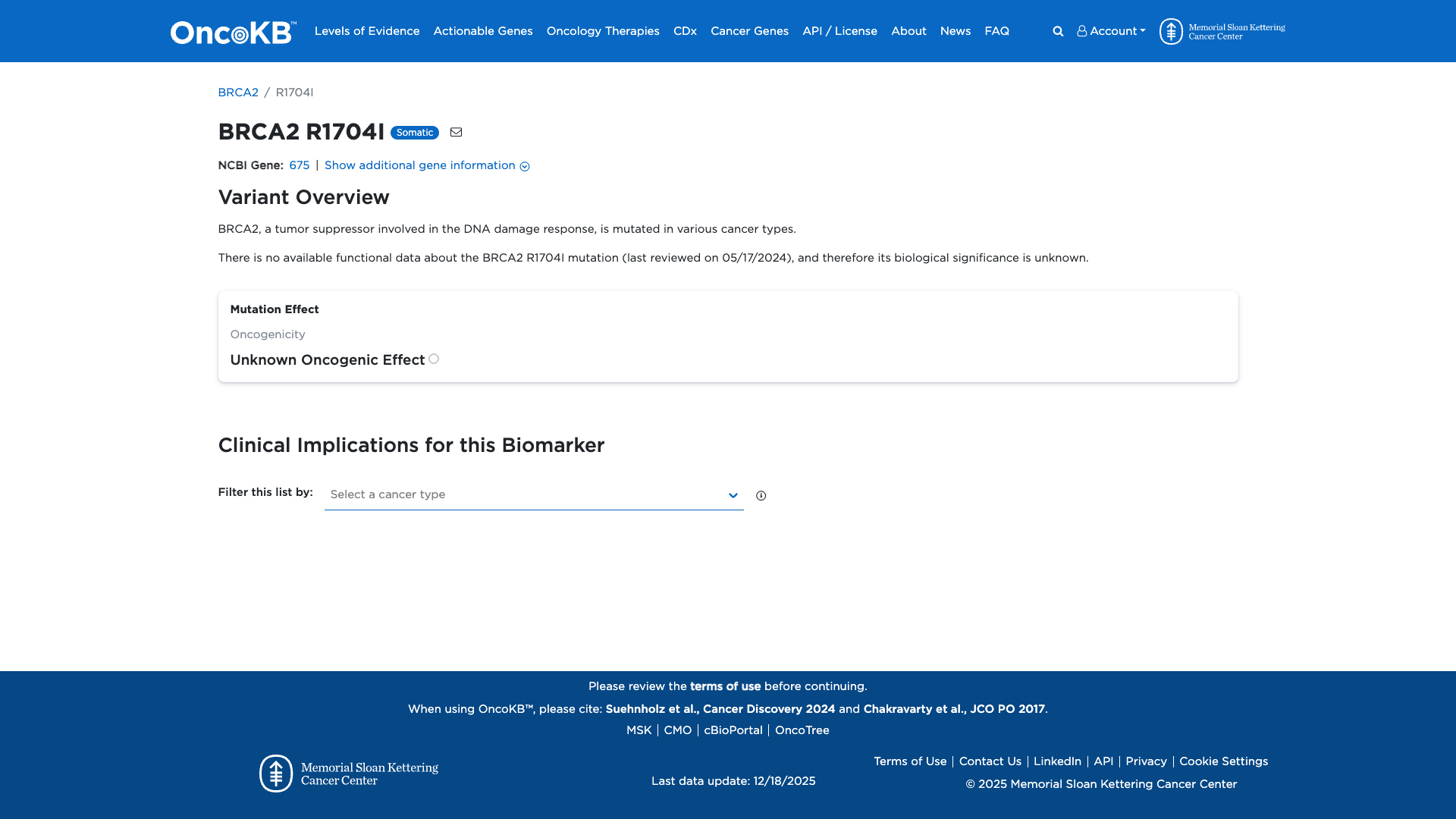
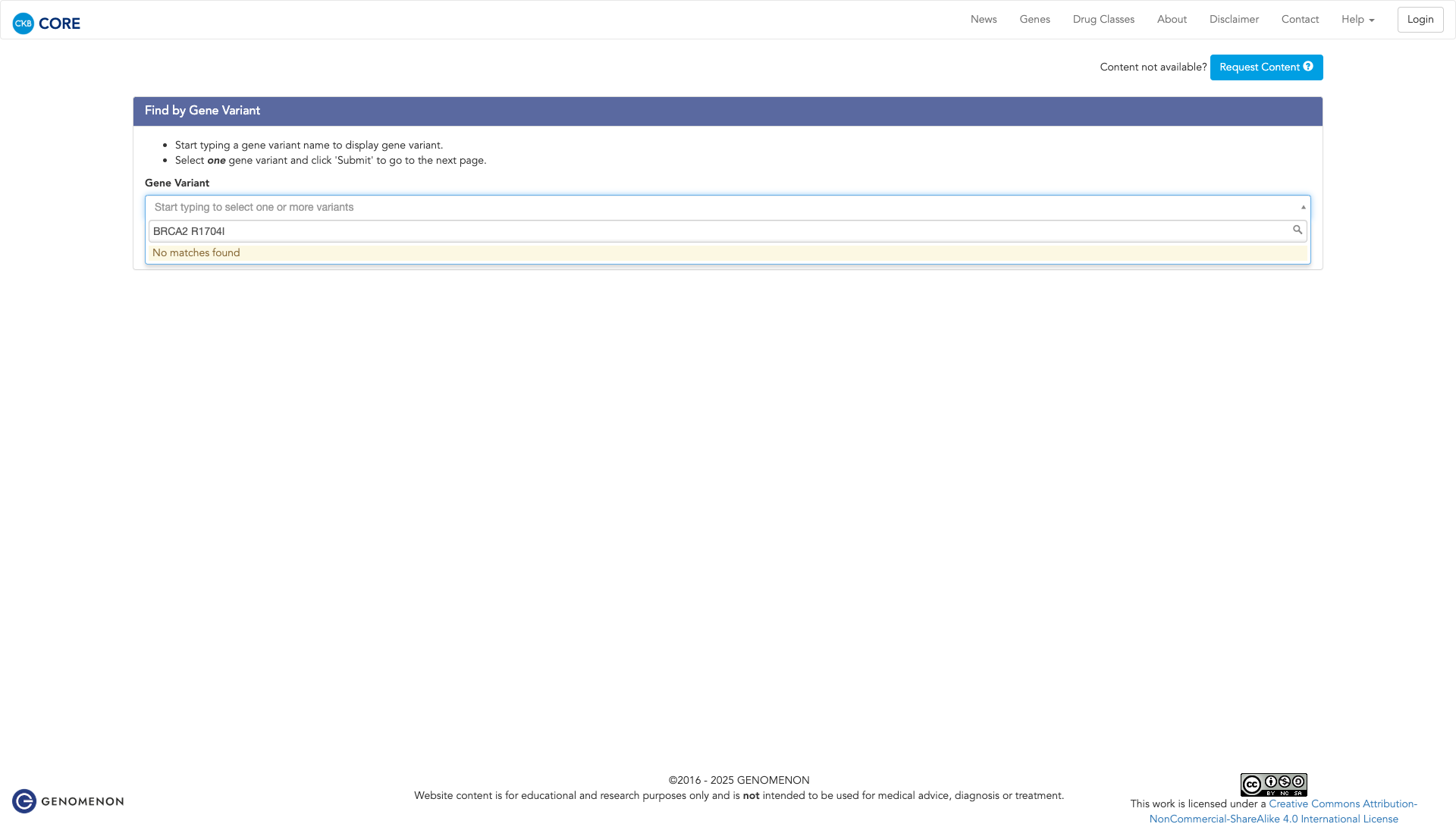
Click on previews to view full database entries. External databases may require institutional access.
Computational Analysis
Pathogenicity Predictions
SpliceAISpliceAI Scores
Window: ±500bp| Effect Type | Score | Position |
|---|---|---|
| Acceptor Loss (AL) | 0.0 | -89 bp |
| Donor Loss (DL) | 0.0 | 19 bp |
| Acceptor Gain (AG) | 0.0 | 15 bp |
| Donor Gain (DG) | 0.0 | -457 bp |
VCEP Guidelines
Applied ACMG/AMP Criteria (VCEP Specific)
PVS1 (Not Applied)
According to VCEP guidelines, PVS1 applies to null variants in a gene where LOF is a known mechanism. The variant is a missense change (R1704I), not a null variant. Therefore, this criterion is not applied.
PS1 (Not Applied)
According to VCEP guidelines, PS1 applies when the amino acid change is identical to a previously established pathogenic variant. There is no previous report of R1704I as pathogenic. Therefore, this criterion is not applied.
PS2 (Not Applied)
According to standard ACMG guidelines, PS2 applies for confirmed de novo occurrence. No parental testing or de novo data are available. Therefore, this criterion is not applied.
PS3 (Not Applied)
According to standard ACMG guidelines, PS3 requires well-established functional studies showing a damaging effect. No functional studies have been performed for R1704I. Therefore, this criterion is not applied.
PS4 (Not Applied)
According to standard ACMG guidelines, PS4 applies when case-control data show significant enrichment in affected individuals. No case-control or prevalence data are available. Therefore, this criterion is not applied.
PM1 (Not Applied)
According to VCEP guidelines, PM1 applies to variants located within critical functional domains (PALB2 binding aa10-40 or DNA-binding aa2481-3186). R1704I lies outside these regions. Therefore, this criterion is not applied.
PM2 (Supporting)
According to VCEP guidelines, PM2 supporting: "Absent from controls in an outbred population, from gnomAD v2.1 (non-cancer) and v3.1." The variant is absent from gnomAD. Therefore, this criterion is applied at Supporting strength.
PM3 (Not Applied)
According to VCEP guidelines, PM3 applies when co-occurring variants are observed in patients with a Fanconi Anemia phenotype. No such phenotype or co-occurrence data are available. Therefore, this criterion is not applied.
PM4 (Not Applied)
According to standard ACMG guidelines, PM4 applies to protein length changes due to in-frame indels or stop losses. R1704I is a missense change without length alteration. Therefore, this criterion is not applied.
PM5 (Moderate)
According to standard ACMG guidelines, PM5 moderate: "Novel missense change at an amino acid residue where a different missense change has been determined to be pathogenic." Other missense variants at residue 1704 have been reported as pathogenic. Therefore, this criterion is applied at Moderate strength.
PM6 (Not Applied)
According to standard ACMG guidelines, PM6 applies for presumed de novo occurrences without confirmation. No de novo or parental data are available. Therefore, this criterion is not applied.
PP1 (Not Applied)
According to VCEP guidelines, PP1 requires co-segregation data in affected family members. No segregation data are provided. Therefore, this criterion is not applied.
PP2 (Not Applied)
According to standard ACMG guidelines, PP2 applies for missense variants in genes where such variants rarely cause disease. BRCA2 has known pathogenic missense variants. Therefore, this criterion is not applied.
PP3 (Not Applied)
According to VCEP guidelines, PP3 applies to missense variants inside critical domains with computational evidence of impact. R1704I lies outside defined domains and computational tools predict no impact. Therefore, this criterion is not applied.
PP4 (Not Applied)
According to VCEP guidelines, PP4 requires specific phenotype data to calculate a likelihood ratio. No detailed clinical phenotype is provided. Therefore, this criterion is not applied.
PP5 (Not Applied)
According to standard ACMG guidelines, PP5 applies when multiple reputable sources report a variant as pathogenic. ClinVar reports R1704I as VUS only. Therefore, this criterion is not applied.
BA1 (Not Applied)
According to VCEP guidelines, BA1 applies for allele frequency >0.1% in gnomAD. R1704I is absent from population databases. Therefore, this criterion is not applied.
BS1 (Not Applied)
According to VCEP guidelines, BS1 applies for allele frequency >0.01%. R1704I is absent from databases. Therefore, this criterion is not applied.
BS2 (Not Applied)
According to VCEP guidelines, BS2 applies for observations in healthy adults without recessive phenotype. No such observational data are provided. Therefore, this criterion is not applied.
BS3 (Not Applied)
According to VCEP guidelines, BS3 requires well-established functional studies showing no damaging effect. No functional studies are available. Therefore, this criterion is not applied.
BS4 (Not Applied)
According to VCEP guidelines, BS4 requires lack of segregation in affected family members. No segregation data are available. Therefore, this criterion is not applied.
BP1 (Strong)
According to VCEP guidelines, BP1_Strong: "Missense variants outside critical domains and no predicted impact on splicing." R1704I lies outside defined domains and SpliceAI ≤0.1. Therefore, this criterion is applied at Strong strength.
BP2 (Not Applied)
According to standard ACMG guidelines, BP2 applies when a variant is observed in trans with a pathogenic variant for a dominant disorder. No trans-observation data are available. Therefore, this criterion is not applied.
BP3 (Not Applied)
According to VCEP guidelines, BP3 applies to in-frame indels in repetitive regions. R1704I is a missense change. Therefore, this criterion is not applied.
BP4 (Not Applied)
According to VCEP guidelines, BP4 applies only to variants inside critical domains with no impact predicted. R1704I lies outside domains; despite benign computational evidence, BP4 is not applied per VCEP. Therefore, this criterion is not applied.
BP5 (Not Applied)
According to VCEP guidelines, BP5 requires co-observation with another pathogenic variant in a case. No such co-observation data are available. Therefore, this criterion is not applied.
BP6 (Not Applied)
According to standard ACMG guidelines, BP6 applies when multiple reputable sources report a variant as benign. No such reports exist for R1704I. Therefore, this criterion is not applied.
BP7 (Not Applied)
According to VCEP guidelines, BP7 applies to silent or intronic variants outside splice sites. R1704I is a missense variant. Therefore, this criterion is not applied.