Genetic Information
Gene & Transcript Details
| ID | Status | Details |
|---|---|---|
| NM_006218.2 | Alternative | 3724 nt | 158–3364 |
| NM_006218.3 | Alternative | 9104 nt | 158–3364 |
| NM_006218.4 | MANE Select | 9259 nt | 324–3530 |
Variant Details
Clinical & Population Data
Population Frequency
gnomADClinVar
Open"This variant has been reported in ClinVar as Uncertain significance (4 clinical laboratories)."
COSMIC Somatic Evidence
OpenFunctional Impact & Domains
Functional Domain
The PIK3CA M1V variant has conflicting functional evidence. In a breast cell line, it demonstrated an activating effect by increasing growth-factor independent proliferation. However, in a murine B-cell line and a transgenic mouse model, it showed a neutral effect, failing to promote growth-factor independent proliferation or glioblastoma formation.
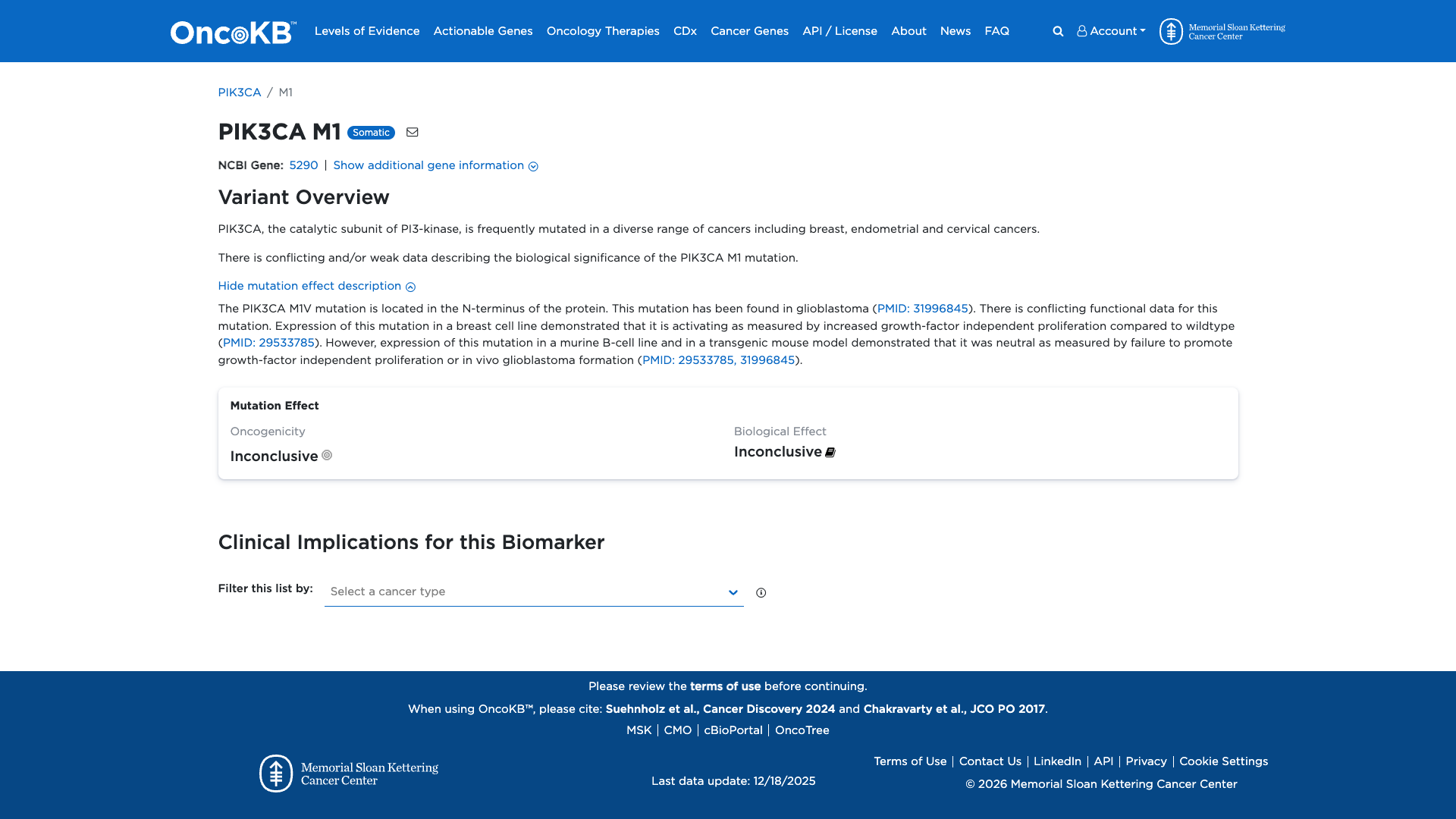
Click on previews to view full database entries. External databases may require institutional access.
Computational Analysis
Pathogenicity Predictions
SpliceAISpliceAI Scores
Window: ±500bp| Effect Type | Score | Position |
|---|---|---|
| Acceptor Loss (AL) | 0.0 | 22 bp |
| Donor Loss (DL) | 0.02 | 209 bp |
| Acceptor Gain (AG) | 0.0 | 215 bp |
| Donor Gain (DG) | 0.01 | 21 bp |
VCEP Guidelines
Applied ACMG/AMP Criteria (VCEP Specific)
PVS1 (Not Applied)
According to standard ACMG guidelines, the rule for PVS1 is: 'Null variant (nonsense, frameshift, canonical ±1 or 2 splice sites, initiation codon, single or multi‐exon deletion) in a gene where loss of function is a known mechanism of disease.' The evidence for this variant shows: c.1A>G is a start codon change in PIK3CA, a gene whose disease mechanism is gain-of-function rather than loss-of-function. Therefore, this criterion is not applied.
PS1 (Not Applied)
According to standard ACMG guidelines, the rule for PS1 is: 'Same amino acid change as a previously established pathogenic variant regardless of nucleotide change.' The evidence for this variant shows: no previously established pathogenic variant at codon 1 (M1). Therefore, this criterion is not applied.
PS2 (Not Applied)
According to standard ACMG guidelines, the rule for PS2 is: 'De novo (both maternity and paternity confirmed) in a patient with the disease and no family history.' The evidence for this variant shows: no data on de novo occurrence. Therefore, this criterion is not applied.
PS3 (Not Applied)
According to VCEP guidelines, the rule for PS3 is: 'Award PS3 if the functional assay meets the acceptability criteria with quality metrics and minimum validation controls (animal models considered separately).' The evidence for this variant shows: functional studies are conflicting and do not meet VCEP assay criteria. Therefore, this criterion is not applied.
PS4 (Not Applied)
According to VCEP guidelines, the rule for PS4 is: 'Points are assigned for phenotype with absent controls; strength based on total points.' The evidence for this variant shows: no case‐level phenotype data reported. Therefore, this criterion is not applied.
PM1 (Not Applied)
According to VCEP guidelines, the rule for PM1 is: 'Supporting: residues affecting critical functional domains provided in Table 4 for each gene.' The evidence for this variant shows: codon 1 is not within a defined critical functional domain of PIK3CA. Therefore, this criterion is not applied.
PM2 (Supporting)
According to VCEP guidelines, the rule for PM2 is: 'Supporting: absent/rare from controls in an ethnically‐matched cohort population sample.' The evidence for this variant shows: absent from gnomAD and other population databases. Therefore, this criterion is applied at Supporting strength.
PM3 (Not Applied)
According to standard ACMG guidelines, the rule for PM3 is: 'For recessive disorders, detected in trans with a pathogenic variant.' The evidence for this variant shows: PIK3CA disease is not recessive and no trans data are available. Therefore, this criterion is not applied.
PM4 (Not Applied)
According to standard ACMG guidelines, the rule for PM4 is: 'Protein length changes as a result of in‐frame deletions/insertions or stop‐loss.' The evidence for this variant shows: c.1A>G is a start codon loss, not an in‐frame indel or stop‐loss. Therefore, this criterion is not applied.
PM5 (Not Applied)
According to standard ACMG guidelines, the rule for PM5 is: 'Novel missense change at an amino acid residue where a different missense change is pathogenic.' The evidence for this variant shows: no pathogenic missense changes reported at Met1. Therefore, this criterion is not applied.
PM6 (Not Applied)
According to standard ACMG guidelines, the rule for PM6 is: 'Assumed de novo (without confirmation of paternity and maternity).' The evidence for this variant shows: no de novo data. Therefore, this criterion is not applied.
PP1 (Not Applied)
According to standard ACMG guidelines, the rule for PP1 is: 'Co‐segregation with disease in multiple affected family members.' The evidence for this variant shows: no family segregation data. Therefore, this criterion is not applied.
PP2 (Supporting)
According to VCEP guidelines, the rule for PP2 is: 'Supporting: missense constraint computed in ExAC/gnomAD; award PP2 if z‐score >3.09.' The evidence for this variant shows: PIK3CA missense constraint z‐score in gnomAD is >3.09. Therefore, this criterion is applied at Supporting strength.
PP3 (Not Applied)
According to standard ACMG guidelines, the rule for PP3 is: 'Multiple lines of computational evidence support a deleterious effect.' The evidence for this variant shows: mixed in silico predictions with a majority suggesting no impact. Therefore, this criterion is not applied.
PP4 (Not Applied)
According to standard ACMG guidelines, the rule for PP4 is: 'Patient’s phenotype or family history is highly specific for a disease with a single genetic etiology.' The evidence for this variant shows: no specific phenotype data. Therefore, this criterion is not applied.
PP5 (Not Applied)
According to standard ACMG guidelines, the rule for PP5 is: 'Reputable source recently reports variant as pathogenic.' The evidence for this variant shows: ClinVar classifies as VUS by multiple submitters. Therefore, this criterion is not applied.
BA1 (Not Applied)
According to standard ACMG guidelines, the rule for BA1 is: 'Allele frequency >5% in control populations.' The evidence for this variant shows: allele frequency is 0% in gnomAD. Therefore, this criterion is not applied.
BS1 (Not Applied)
According to VCEP guidelines, the rule for BS1 is: 'Strong: allele frequency >0.0185% in control databases.' The evidence for this variant shows: allele frequency is 0%. Therefore, this criterion is not applied.
BS2 (Not Applied)
According to VCEP guidelines, the rule for BS2 is: 'Strong: observed in ≥3 healthy individuals (homozygous or heterozygous).' The evidence for this variant shows: no observations in well‐phenotyped adults. Therefore, this criterion is not applied.
BS3 (Not Applied)
According to VCEP guidelines, the rule for BS3 is: 'Strong/Supporting: well‐established functional studies show no damaging effect.' The evidence for this variant shows: conflicting functional results not meeting VCEP quality criteria. Therefore, this criterion is not applied.
BS4 (Not Applied)
According to standard ACMG guidelines, the rule for BS4 is: 'Lack of segregation in affected family members.' The evidence for this variant shows: no segregation data. Therefore, this criterion is not applied.
BP1 (Not Applied)
According to standard ACMG guidelines, the rule for BP1 is: 'Missense variant in a gene for which primarily truncating variants cause disease.' The evidence for this variant shows: PIK3CA disease mechanism is gain‐of‐function missense. Therefore, this criterion is not applied.
BP2 (Not Applied)
According to standard ACMG guidelines, the rule for BP2 is: 'Observed in cis with a pathogenic variant.' The evidence for this variant shows: no such observations. Therefore, this criterion is not applied.
BP3 (Not Applied)
According to standard ACMG guidelines, the rule for BP3 is: 'In‐frame indels in repetitive regions.' The evidence for this variant shows: not an indel or repetitive region. Therefore, this criterion is not applied.
BP4 (Not Applied)
According to VCEP guidelines, the rule for BP4 is: 'Supporting for synonymous/intronic variants if two of three splicing tools predict no impact.' The evidence for this variant shows: not a synonymous or intronic variant. Therefore, this criterion is not applied.
BP5 (Not Applied)
According to standard ACMG guidelines, the rule for BP5 is: 'Variant found in a case with an alternate molecular basis.' The evidence for this variant shows: no such cases reported. Therefore, this criterion is not applied.
BP6 (Not Applied)
According to standard ACMG guidelines, the rule for BP6 is: 'Reputable source reports variant as benign.' The evidence for this variant shows: no such reports. Therefore, this criterion is not applied.
BP7 (Not Applied)
According to VCEP guidelines, the rule for BP7 is: 'Supporting for synonymous/intronic variants with low conservation.' The evidence for this variant shows: not a synonymous or intronic variant. Therefore, this criterion is not applied.