Genetic Information
Gene & Transcript Details
| ID | Status | Details |
|---|---|---|
| NM_007294.2 | Alternative | 7191 nt | 201–5792 |
| NM_007294.3 | RefSeq Select | 7224 nt | 233–5824 |
| NM_007294.4 | MANE Select | 7088 nt | 114–5705 |
Variant Details
Clinical & Population Data
Population Frequency
gnomADClinVar
OpenVariant summary: BRCA1 c.5332+15G>C alters a non-conserved nucleotide located close to a canonical splice site and therefore could affect mRNA splicing, leading to a significantly altered protein sequence. 4/4 computational tools predict no significant impact on normal splicing. The variant allele was found at a frequency of 1.6e-05 in 251236 control chromosomes. The available data on variant occurrences in the general population are insufficient to allow any conclusion about variant significance. To our knowledge, no occurrence of c.5332+15G>C in individuals affected with Hereditary Breast and Ovarian Cancer has been reported in the peer-reviewed literature. However, at-least one database (BIC) listed this variant as found in affected patient diagnosed with breast cancer at 53 and in unaffected duaghter". At least one publication reports experimental evidence evaluating an impact on splicing. These results showed no damaging effect of this variant on splicing that have also been further corroborated by other studies reporting no impact on homology directed repair (primary evidence unavailable). Three clinical diagnostic laboratories have submitted clinical-significance assessments for this variant to ClinVar after 2014 without evidence for independent evaluation. All laboratories classified the variant as likely benign. Based on the evidence outlined above, the variant was classified as likely benign.
"This variant has been reported in ClinVar as Uncertain significance (1 clinical laboratories) and as Likely benign (5 clinical laboratories)."
COSMIC Somatic Evidence
Open
Functional Impact & Domains
Functional Domain
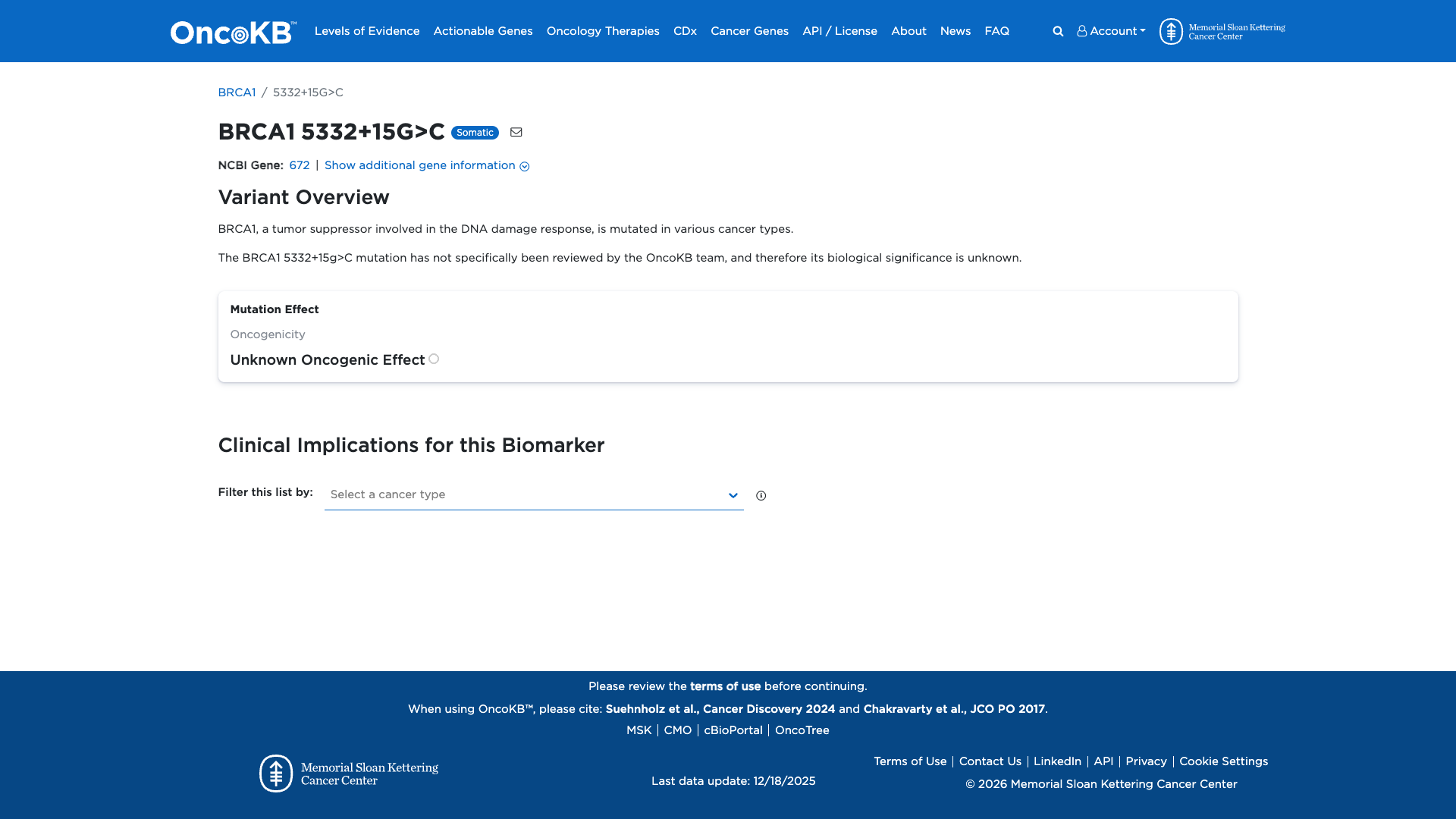
Computational Analysis
Pathogenicity Predictions
SpliceAISpliceAI Scores
Window: ±500bp| Effect Type | Score | Position |
|---|---|---|
| Acceptor Loss (AL) | 0.0 | -295 bp |
| Donor Loss (DL) | 0.0 | 162 bp |
| Acceptor Gain (AG) | 0.0 | 69 bp |
| Donor Gain (DG) | 0.0 | 15 bp |
VCEP Guidelines
Applied ACMG/AMP Criteria (VCEP Specific)
PVS1 (Not Applied)
According to VCEP guidelines, PVS1 applies to null variants (nonsense, frameshift, ±1,2 splice site) in a gene where LOF is a known mechanism. The evidence for this variant shows it is intronic at +15, outside the canonical splice sites, so PVS1 is not applied.
PS1 (Not Applied)
According to VCEP guidelines, PS1 applies when a variant predicts the same amino acid change as a known pathogenic variant. The evidence for this variant shows no predicted protein change (intronic), so PS1 is not applied.
PS2 (Not Applied)
According to standard ACMG, PS2 requires confirmed de novo occurrence. Parental testing data are not available for this variant, so PS2 is not applied.
PS3 (Not Applied)
According to standard ACMG, PS3 requires well-established functional studies showing a damaging effect. No functional assay data are available for this variant, so PS3 is not applied.
PS4 (Not Applied)
According to standard ACMG, PS4 requires case-control or segregation data showing increased prevalence in affected individuals. No such data exist for this variant, so PS4 is not applied.
PM1 (Not Applied)
According to VCEP guidelines, PM1 applies to variants in a clinically important functional domain. This intronic variant lies outside coding regions, so PM1 is not applied.
PM2 (Not Applied)
According to VCEP guidelines, PM2_Supporting requires absence from controls in gnomAD non-cancer populations. The evidence for this variant shows it is present at MAF=0.00159% in gnomAD non-cancer, so PM2 is not applied.
PM3 (Not Applied)
According to VCEP guidelines, PM3 applies when a variant is in trans with a pathogenic variant in a patient with Fanconi anemia. No phenotype or co-occurrence data are available, so PM3 is not applied.
PM4 (Not Applied)
According to standard ACMG, PM4 applies to protein length changes due to in-frame indels or stop losses. This intronic variant does not alter protein length, so PM4 is not applied.
PM5 (Not Applied)
According to VCEP guidelines, PM5 applies to novel PTC variants in exons with other pathogenic PTCs. This variant is intronic, so PM5 is not applied.
PM6 (Not Applied)
According to standard ACMG, PM6 applies for presumed de novo without confirmation. No de novo data exist, so PM6 is not applied.
PP1 (Not Applied)
According to VCEP guidelines, PP1 requires co-segregation in multiple affected family members. No segregation data are available, so PP1 is not applied.
PP2 (Not Applied)
According to standard ACMG, PP2 applies to missense variants in genes with low benign missense variation. This variant is intronic, so PP2 is not applied.
PP3 (Not Applied)
According to VCEP guidelines, PP3 applies for computationally predicted impact on protein or splicing (SpliceAI ≥0.2). SpliceAI for this variant is 0, so PP3 is not applied.
PP4 (Not Applied)
According to VCEP guidelines, PP4 applies to specific clinical phenotypes with multifactorial likelihood. No clinical phenotype data are provided, so PP4 is not applied.
PP5 (Not Applied)
According to standard ACMG, PP5 requires a reputable source classifying the variant as pathogenic. No such source exists for this variant, so PP5 is not applied.
BA1 (Not Applied)
According to VCEP guidelines, BA1 requires FAF >0.1% in gnomAD non-cancer. The observed MAF is 0.00159% (FAF=0.00159%), below 0.1%, so BA1 is not applied.
BS1 (Not Applied)
According to VCEP guidelines, BS1 requires FAF >0.01% in gnomAD non-cancer. The observed FAF of 0.00159% is below 0.01%, so BS1 is not applied.
BS2 (Not Applied)
According to VCEP guidelines, BS2 applies when variant observed in healthy adults without Fanconi anemia. No such data are available, so BS2 is not applied.
BS3 (Not Applied)
According to VCEP guidelines, BS3 requires well-established functional studies showing no damaging effect. No functional assays exist for this variant, so BS3 is not applied.
BS4 (Not Applied)
According to VCEP guidelines, BS4 requires lack of segregation in affected family members. No segregation data are available, so BS4 is not applied.
BP1 (Not Applied)
According to VCEP guidelines, BP1 applies to silent or missense variants outside functional domains. This intronic variant does not meet BP1, so it is not applied.
BP2 (Not Applied)
According to standard ACMG, BP2 applies when observed in cis/trans with a pathogenic variant in healthy individuals. No such co-observation data exist, so BP2 is not applied.
BP3 (Not Applied)
According to standard ACMG, BP3 applies to in-frame indels in repetitive regions. This intronic variant is not an indel, so BP3 is not applied.
BP4 (Supporting)
According to VCEP guidelines, BP4_Supporting applies to intronic variants outside ±1,2 splice sites with SpliceAI ≤0.1. The evidence shows this variant is at +15 and SpliceAI=0, so BP4 is applied at Supporting strength.
BP5 (Not Applied)
According to VCEP guidelines, BP5 applies to co-occurrence with pathogenic variants in multifactorial analysis. No such data are available, so BP5 is not applied.
BP6 (Not Applied)
According to standard ACMG, BP6 applies when a reputable source classifies the variant as benign without evidence. No such detailed source is available, so BP6 is not applied.
BP7 (Supporting)
According to VCEP guidelines, BP7_Supporting applies to intronic variants outside conserved splice motif positions (≥+7) if BP4 is met. This variant is at +15, BP4 is met, so BP7 is applied at Supporting strength.