Genetic Information
Gene & Transcript Details
| ID | Status | Details |
|---|---|---|
| NM_005933.4 | Alternative | 16591 nt | 22–11931 |
| NM_005933.2 | Alternative | 14982 nt | 24–11933 |
| NM_005933.3 | Alternative | 16599 nt | 24–11933 |
Variant Details
Clinical & Population Data
Population Frequency
gnomADClinVar
Open"This variant has been reported in ClinVar as Uncertain significance (1 clinical laboratories)."
COSMIC Somatic Evidence
Open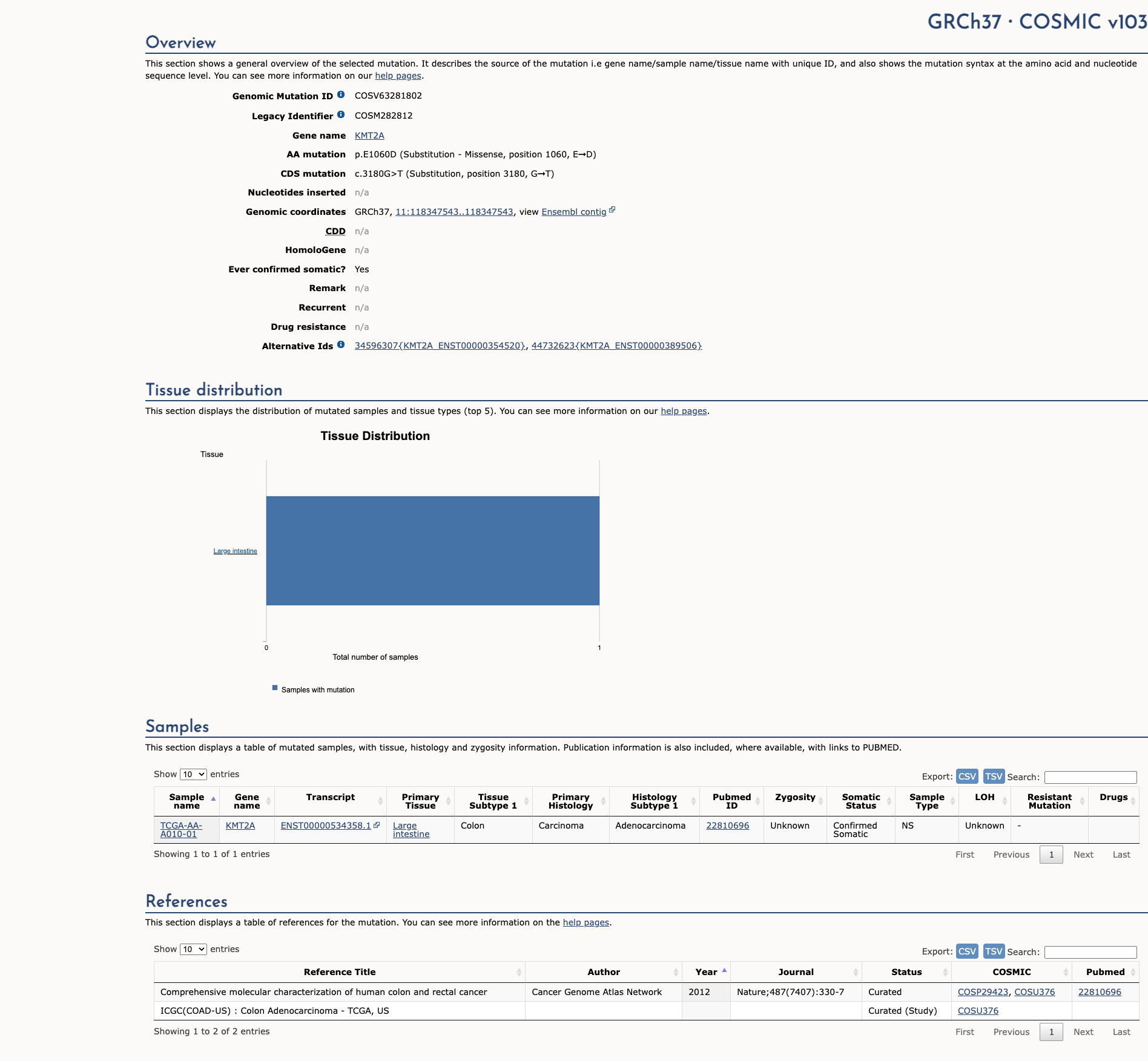
Functional Impact & Domains
Functional Domain
The KMT2A E1060D variant has not been functionally characterized, and its effect on KMT2A protein function is unknown.
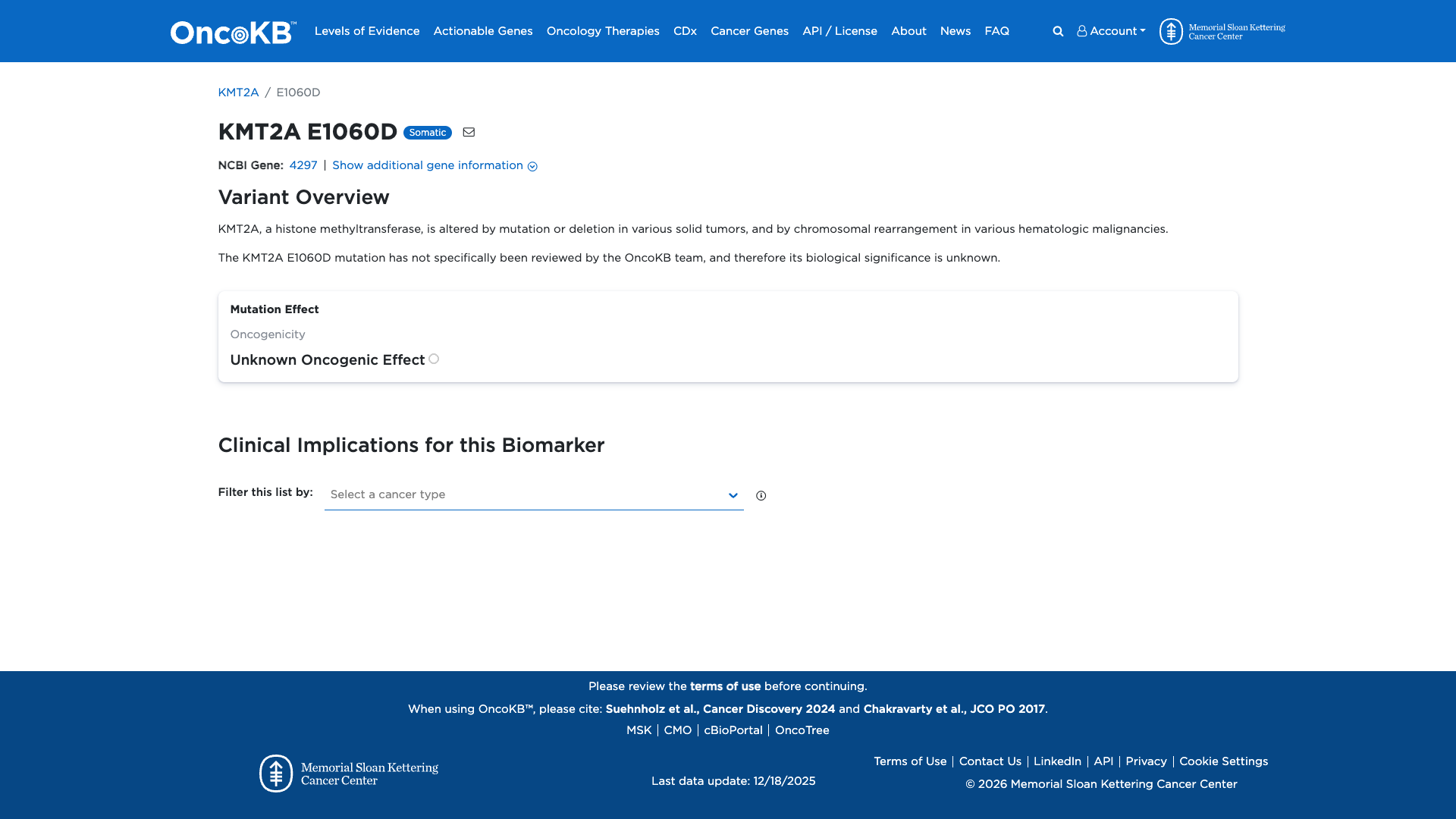
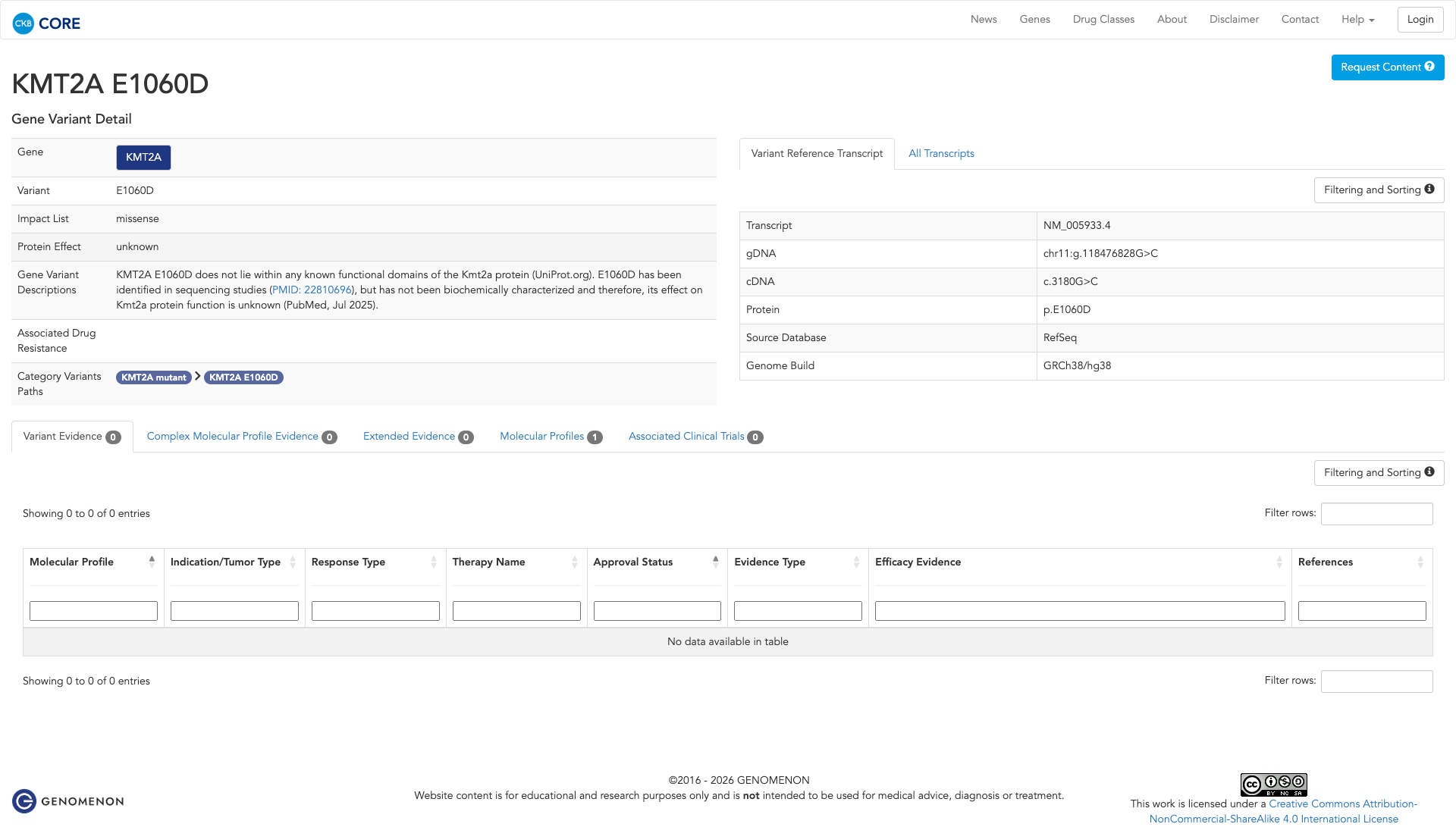
Click on previews to view full database entries. External databases may require institutional access.
Computational Analysis
Pathogenicity Predictions
SpliceAISpliceAI Scores
Window: ±500bp| Effect Type | Score | Position |
|---|---|---|
| Acceptor Loss (AL) | 0.0 | -426 bp |
| Donor Loss (DL) | 0.0 | 167 bp |
| Acceptor Gain (AG) | 0.0 | -1 bp |
| Donor Gain (DG) | 0.0 | 434 bp |
VCEP Guidelines
Applied ACMG/AMP Criteria (VCEP Specific)
PVS1 (Not Applied)
According to standard ACMG guidelines, the rule for PVS1 is: "Null variant in a gene where loss of function (LoF) is a known mechanism of disease (e.g., nonsense, frameshift, canonical ±1 or 2 splice sites, initiation codon, single exon deletion in a LoF gene)". The evidence for this variant shows: NM_005933.3:c.3180G>T (p.E1060D) is a missense change, not a null variant. Therefore, this criterion is not applied at Not Applied strength because the variant is not a null variant.
PS1 (Not Applied)
According to standard ACMG guidelines, the rule for PS1 is: "Same amino acid change as a previously established pathogenic variant regardless of nucleotide change". The evidence for this variant shows: there is no report of a pathogenic variant causing the same E1060D amino acid change. Therefore, this criterion is not applied at Not Applied strength because no known pathogenic variant shares this amino acid change.
PS2 (Not Applied)
According to standard ACMG guidelines, the rule for PS2 is: "De novo (both maternity and paternity confirmed) in a patient with the disease and no family history". The evidence for this variant shows: no de novo status or parental testing data are available. Therefore, this criterion is not applied at Not Applied strength because there is no confirmed de novo occurrence.
PS3 (Not Applied)
According to standard ACMG guidelines, the rule for PS3 is: "Well-established functional studies supportive of a damaging effect on the gene or gene product". The evidence for this variant shows: no functional studies have been performed for KMT2A p.E1060D. Therefore, this criterion is not applied at Not Applied strength because functional data are lacking.
PS4 (Not Applied)
According to standard ACMG guidelines, the rule for PS4 is: "Prevalence in affected individuals significantly increased compared with controls". The evidence for this variant shows: no case-control or affected individual data are available. Therefore, this criterion is not applied at Not Applied strength because there is no statistical enrichment in cases.
PM1 (Not Applied)
According to standard ACMG guidelines, the rule for PM1 is: "Located in a mutational hot spot or well-established functional domain without benign variation". The evidence for this variant shows: residue E1060 is not known to reside in a mutational hotspot or critical functional domain. Therefore, this criterion is not applied at Not Applied strength because the variant is not in a recognized hotspot or domain.
PM2 (Moderate)
According to standard ACMG guidelines, the rule for PM2 is: "Absent from controls (or at extremely low frequency if recessive)". The evidence for this variant shows: the variant is extremely rare in population databases (gnomAD MAF = 0.000796%). Therefore, this criterion is applied at Moderate strength because the variant is absent or at an extremely low frequency in controls.
PM3 (Not Applied)
According to standard ACMG guidelines, the rule for PM3 is: "Detected in trans with a pathogenic variant (for recessive disorders)". The evidence for this variant shows: no data on trans configuration with a pathogenic allele are available. Therefore, this criterion is not applied at Not Applied strength because trans data are lacking.
PM4 (Not Applied)
According to standard ACMG guidelines, the rule for PM4 is: "Protein length changes due to in-frame deletions/insertions or stop-loss variants". The evidence for this variant shows: p.E1060D is a missense substitution without change in protein length. Therefore, this criterion is not applied at Not Applied strength because there is no alteration in protein length.
PM5 (Not Applied)
According to standard ACMG guidelines, the rule for PM5 is: "Novel missense change at an amino acid residue where a different pathogenic missense change has been seen". The evidence for this variant shows: no different pathogenic missense variant at residue 1060 has been reported. Therefore, this criterion is not applied at Not Applied strength because no pathogenic change at this residue is known.
PM6 (Not Applied)
According to standard ACMG guidelines, the rule for PM6 is: "Assumed de novo, but without confirmation of paternity and maternity". The evidence for this variant shows: no assumed de novo data are available. Therefore, this criterion is not applied at Not Applied strength because parental status has not been assessed.
PP1 (Not Applied)
According to standard ACMG guidelines, the rule for PP1 is: "Co-segregation with disease in multiple affected family members". The evidence for this variant shows: no family segregation data are provided. Therefore, this criterion is not applied at Not Applied strength because co-segregation data are lacking.
PP2 (Not Applied)
According to standard ACMG guidelines, the rule for PP2 is: "Missense variant in a gene with a low rate of benign missense variation and where missense variants are a common mechanism of disease". The evidence for this variant shows: insufficient data to conclude that missense is the predominant mechanism for KMT2A or that benign missense variation is low. Therefore, this criterion is not applied at Not Applied strength because the gene-specific context is unclear.
PP3 (Not Applied)
According to standard ACMG guidelines, the rule for PP3 is: "Multiple lines of computational evidence support a deleterious effect on the gene/gene product (e.g., conservation, splicing impact)". The evidence for this variant shows: in silico predictions are mixed, REVEL score is low (0.34), CADD score is 4.59, and SpliceAI predicts no impact on splicing. Therefore, this criterion is not applied at Not Applied strength because computational evidence does not consistently predict deleteriousness.
PP4 (Not Applied)
According to standard ACMG guidelines, the rule for PP4 is: "Patient's phenotype or family history highly specific for a disease with a single genetic etiology". The evidence for this variant shows: no phenotype or clinical details are provided. Therefore, this criterion is not applied at Not Applied strength because phenotype-specific data are unavailable.
PP5 (Not Applied)
According to standard ACMG guidelines, the rule for PP5 is: "Reputable source reports variant as pathogenic, but without accessible evidence". The evidence for this variant shows: ClinVar classifies this variant as Uncertain Significance, not pathogenic. Therefore, this criterion is not applied at Not Applied strength because there is no reputable report of pathogenicity.
BA1 (Not Applied)
According to standard ACMG guidelines, the rule for BA1 is: "Allele frequency is too high for the disorder (based on population data)". The evidence for this variant shows: MAF is 0.000796%, which is well below the BA1 threshold. Therefore, this criterion is not applied at Not Applied strength because allele frequency is not high enough.
BS1 (Not Applied)
According to standard ACMG guidelines, the rule for BS1 is: "Allele frequency is greater than expected for disorder". The evidence for this variant shows: MAF is extremely low and not greater than disease-specific thresholds. Therefore, this criterion is not applied at Not Applied strength because the frequency is consistent with a rare variant.
BS2 (Not Applied)
According to standard ACMG guidelines, the rule for BS2 is: "Observed in a healthy adult individual for a dominant (with full penetrance expected at an early age), X-linked or mitochondrial disorder with full penetrance expected at an early age". The evidence for this variant shows: no data on observation in healthy individuals. Therefore, this criterion is not applied at Not Applied strength because healthy adult data are unavailable.
BS3 (Not Applied)
According to standard ACMG guidelines, the rule for BS3 is: "Well-established functional studies show no damaging effect on protein function or splicing". The evidence for this variant shows: no functional assays have been performed. Therefore, this criterion is not applied at Not Applied strength because functional study data are lacking.
BS4 (Not Applied)
According to standard ACMG guidelines, the rule for BS4 is: "Lack of segregation in affected family members". The evidence for this variant shows: no segregation data are provided. Therefore, this criterion is not applied at Not Applied strength because segregation evidence is unavailable.
BP1 (Not Applied)
According to standard ACMG guidelines, the rule for BP1 is: "Missense variant in a gene where only LoF causes disease". The evidence for this variant shows: the mechanism of KMT2A-related disease is not exclusively loss-of-function, and no data support a benign missense mechanism. Therefore, this criterion is not applied at Not Applied strength.
BP2 (Not Applied)
According to standard ACMG guidelines, the rule for BP2 is: "Observed in trans with a pathogenic variant for dominant disorders or in cis with a pathogenic variant". The evidence for this variant shows: no phase data exist. Therefore, this criterion is not applied at Not Applied strength because cis/trans configuration is unknown.
BP3 (Not Applied)
According to standard ACMG guidelines, the rule for BP3 is: "In-frame deletions/insertions in a repetitive region without known function". The evidence for this variant shows: this is a missense substitution, not an in-frame indel in a repetitive region. Therefore, this criterion is not applied at Not Applied strength.
BP4 (Supporting)
According to standard ACMG guidelines, the rule for BP4 is: "Multiple lines of computational evidence suggest no impact on gene or gene product". The evidence for this variant shows: in silico predictors are mixed overall, with a low CADD score (4.59), REVEL 0.34, and SpliceAI predicts no splicing impact. Therefore, this criterion is applied at Supporting strength because computational evidence does not support a deleterious effect.
BP5 (Not Applied)
According to standard ACMG guidelines, the rule for BP5 is: "Variant found in a case with an alternate molecular basis for disease". The evidence for this variant shows: no case reports with alternate diagnoses are available. Therefore, this criterion is not applied at Not Applied strength.
BP6 (Not Applied)
According to standard ACMG guidelines, the rule for BP6 is: "Reputable source reports variant as benign, but without accessible evidence". The evidence for this variant shows: ClinVar reports Uncertain Significance, not benign. Therefore, this criterion is not applied at Not Applied strength.
BP7 (Not Applied)
According to standard ACMG guidelines, the rule for BP7 is: "Synonymous variant with no predicted impact on splicing". The evidence for this variant shows: p.E1060D is a missense change, not synonymous. Therefore, this criterion is not applied at Not Applied strength.