Genetic Information
Gene & Transcript Details
| ID | Status | Details |
|---|---|---|
| NM_000314.8 | MANE Select | 8515 nt | 846–2057 |
| NM_000314.7 | RefSeq Select | 8514 nt | 845–2056 |
| NM_000314.5 | Alternative | 8719 nt | 1032–2243 |
| NM_000314.4 | Alternative | 5572 nt | 1032–2243 |
| NM_000314.3 | Alternative | 3416 nt | 1032–2243 |
| NM_000314.6 | Alternative | 8718 nt | 1032–2243 |
Variant Details
Clinical & Population Data
Population Frequency
gnomADClinVar
OpenPTEN c.388C>G (p.Arg130Gly) meets criteria to be classified as pathogenic for PTEN Hamartoma Tumor syndrome in an autosomal dominant manner using modified ACMG criteria (PMID 30311380). Please see a summary of the rules and criteria codes in the "PTEN ACMG Specifications Summary" document (assertion method column). PS3: Phosphatase activity <50% of wild type (PMID 10866302, PMID 21828076, PMID 29706350) PM1: Located at a residue within a catalytic motif as defined by the ClinGen PTEN Expert Panel. PM2: Absent in large sequenced populations (PMID 27535533). PM5: Missense change at an amino acid residue where a different missense change determined to be pathogenic or likely pathogenic and with equal or lesser BLOSUM62 score has been seen before (ClinVar Variation ID 7829, SCV000840465.2). PP2: PTEN is defined by the PTEN Expert Panel as a gene that has a low rate of benign missense variation and where missense variants are a common mechanism of disease.
This variant is considered likely pathogenic. Functional studies indicate this variant impacts protein function [PMID: 10866302,11051241, 20926450]. This variant is expected to disrupt protein structure [Myriad internal data]. This variant has been reported in multiple individuals with clinical features of gene-specific disease [PMID: 28677221, 24778394].
The p.R130G pathogenic mutation (also known as c.388C>G), located in coding exon 5 of the PTEN gene, results from a C to G substitution at nucleotide position 388. The arginine at codon 130 is replaced by glycine, an amino acid with dissimilar properties. In a massively parallel functional assay using a humanized yeast model, lipid phosphatase activity for this variant was functionally deficient (Mighell TL et al. Am. J. Hum. Genet. 2018 05;102:943-955). This variant also demonstrated wild type-like intracellular protein abundance in a massively parallel functional assay (Matreyek KA et al. Nat Genet, 2018 Jun;50:874-882). In other assays testing PTEN function, this variant showed functionally abnormal results (Lobo GP et al. Hum Mol Genet, 2009 Aug;18:2851-62; He X et al. Hum Mol Genet, 2011 Jan;20:80-9; Rodríguez-Escudero I et al. Hum Mol Genet, 2011 Nov;20:4132-42). Based on internal structural analysis, R130G disrupts an important position in the P-loop of PTEN, a motif critical for function disrupted by internally pathogenic variants (Han SY et al. Cancer Res, 2000 Jun;60:3147-51; Lee CU et al. Angew Chem Int Ed Engl, 2015 Nov;54:13796-800; Masson GR et al. Cold Spring Harb Perspect Med, 2020 03;10:). This missense alteration is located in a region that has a low rate of benign missense variation (Lek M et al. Nature. 2016 Aug 18;536(7616):285-91; DECIPHER: Database of Chromosomal Imbalance and Phenotype in Humans using Ensembl Resources. Firth H.V. et al. 2009. Am.J.Hum.Genet. 84, 524-533 (DOI: dx.doi.org/10/1016/j.ajhg.2009.03.010)). Another variant at the same codon, p.R130Q (c.389G>A), has been described in a number of individuals of varying backgrounds with classic features of PTEN Hamartoma Tumor Syndrome (PHTS) or early onset breast cancer (Kurose K et al. Am. J. Hum. Genet. 1999 Jan;64(1):308-10; Lobo GP et al. Hum. Mol. Genet., 2009 Aug;18:2851-62; Pilarski R et al. J. Med. Genet. 2011 Aug;48(8):505-12); Baig RM et al. Asian Pac. J. Cancer Prev. 2011;12(10):2773-8; Heindl M et al. Gastroenterology. 2012 May;142(5):1093-1096.e6; Busch RM et al. Genet. Med. 2013 Jul;15(7):548-53; Chen HH et al. J. Allergy Clin. Immunol., 2017 Feb;139:607-620.e15). This amino acid position is highly conserved in available vertebrate species. In addition, this alteration is predicted to be deleterious by in silico analysis. This variant is considered to be rare based on population cohorts in the Genome Aggregation Database (gnomAD). Based on the supporting evidence, this alteration is interpreted as a disease-causing mutation.
This sequence change replaces arginine, which is basic and polar, with glycine, which is neutral and non-polar, at codon 130 of the PTEN protein (p.Arg130Gly). This variant is not present in population databases (gnomAD no frequency). This missense change has been observed in individual(s) with Cowden syndrome (PMID: 1945792). ClinVar contains an entry for this variant (Variation ID: 375958). Advanced modeling of protein sequence and biophysical properties (such as structural, functional, and spatial information, amino acid conservation, physicochemical variation, residue mobility, and thermodynamic stability) performed at Invitae indicates that this missense variant is expected to disrupt PTEN protein function. Experimental studies have shown that this missense change affects PTEN function (PMID: 10866302, 11948419, 21828076, 24292679). This variant disrupts the p.Arg130 amino acid residue in PTEN. Other variant(s) that disrupt this residue have been determined to be pathogenic (PMID: 9915974, 10866302, 17942903, 21822720, 22327138, 23399955, 23470840; 22595938.). This suggests that this residue is clinically significant, and that variants that disrupt this residue are likely to be disease-causing. For these reasons, this variant has been classified as Pathogenic.
"This variant has been reported in ClinVar as Pathogenic (4 clinical laboratories) and as Likely pathogenic (1 clinical laboratories) and as Pathogenic by Clingen PTEN Variant Curation Expert Panel, Clingen expert panel."
COSMIC Somatic Evidence
Open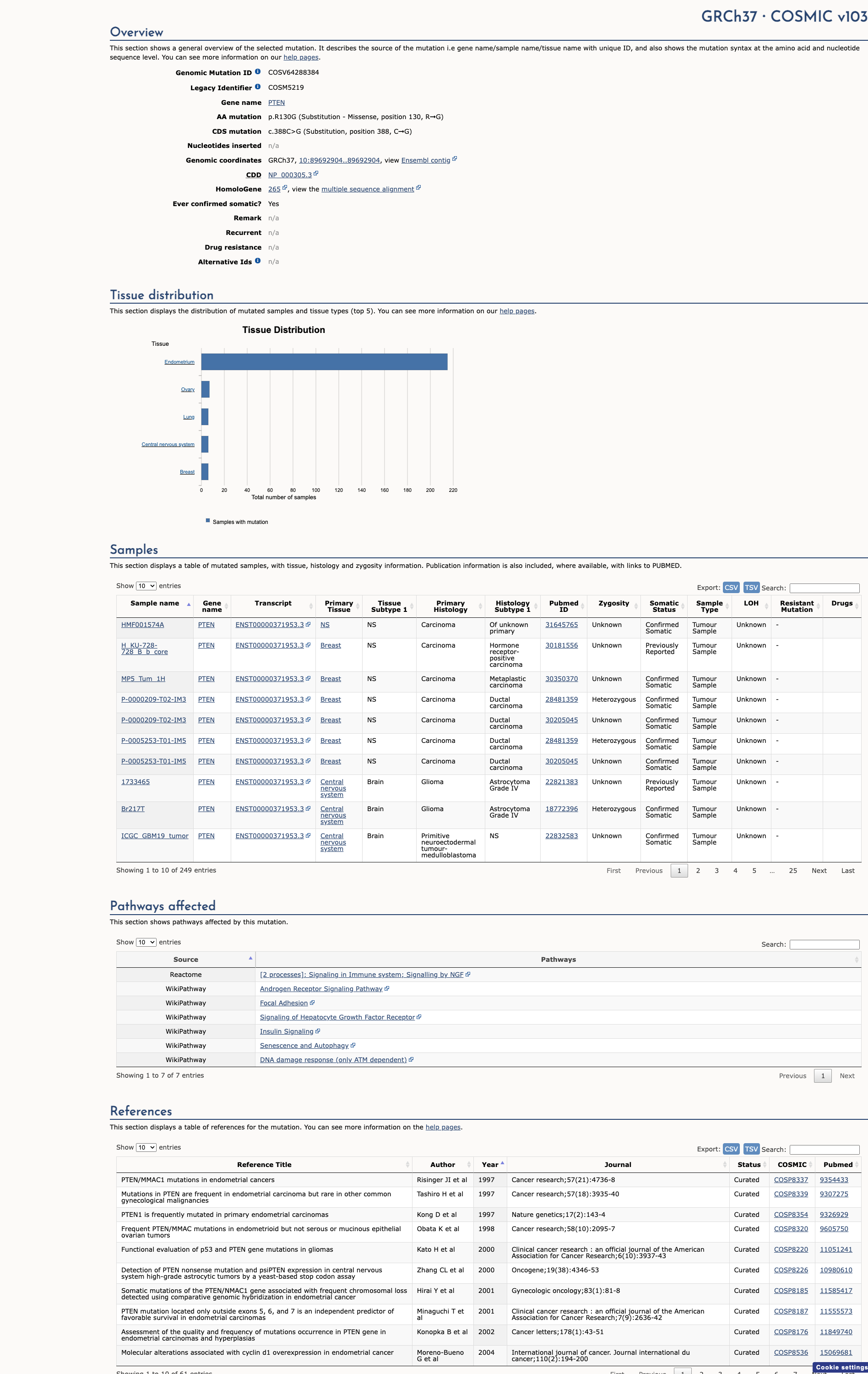
Functional Impact & Domains
Functional Domain
The PTEN R130G variant has been functionally characterized and shown to be damaging. It is located within the phosphatase domain of the PTEN protein and results in a loss of function. This variant exhibits reduced phosphatase activity and increased transformation ability in vitro, indicating an oncogenic effect.
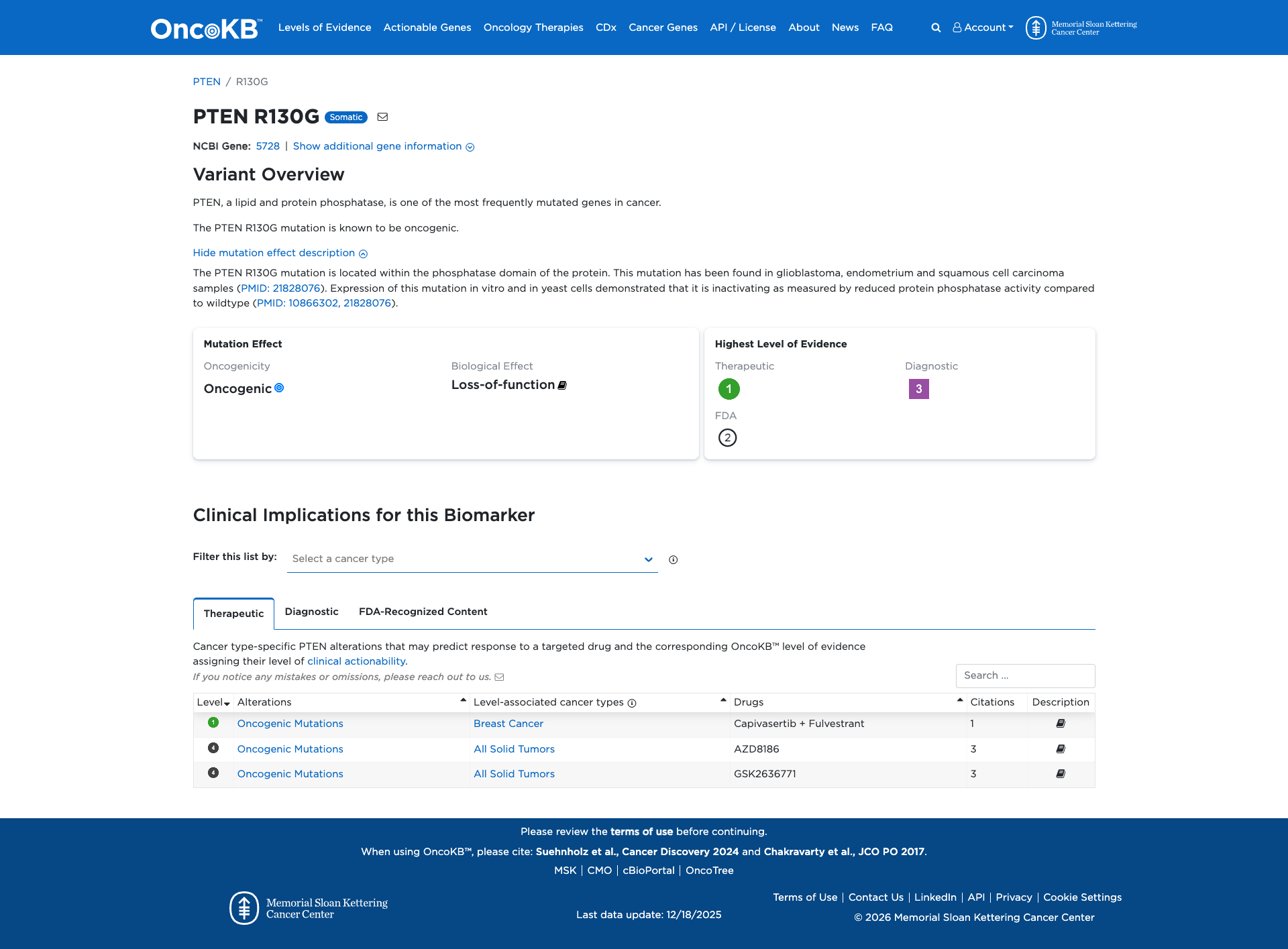
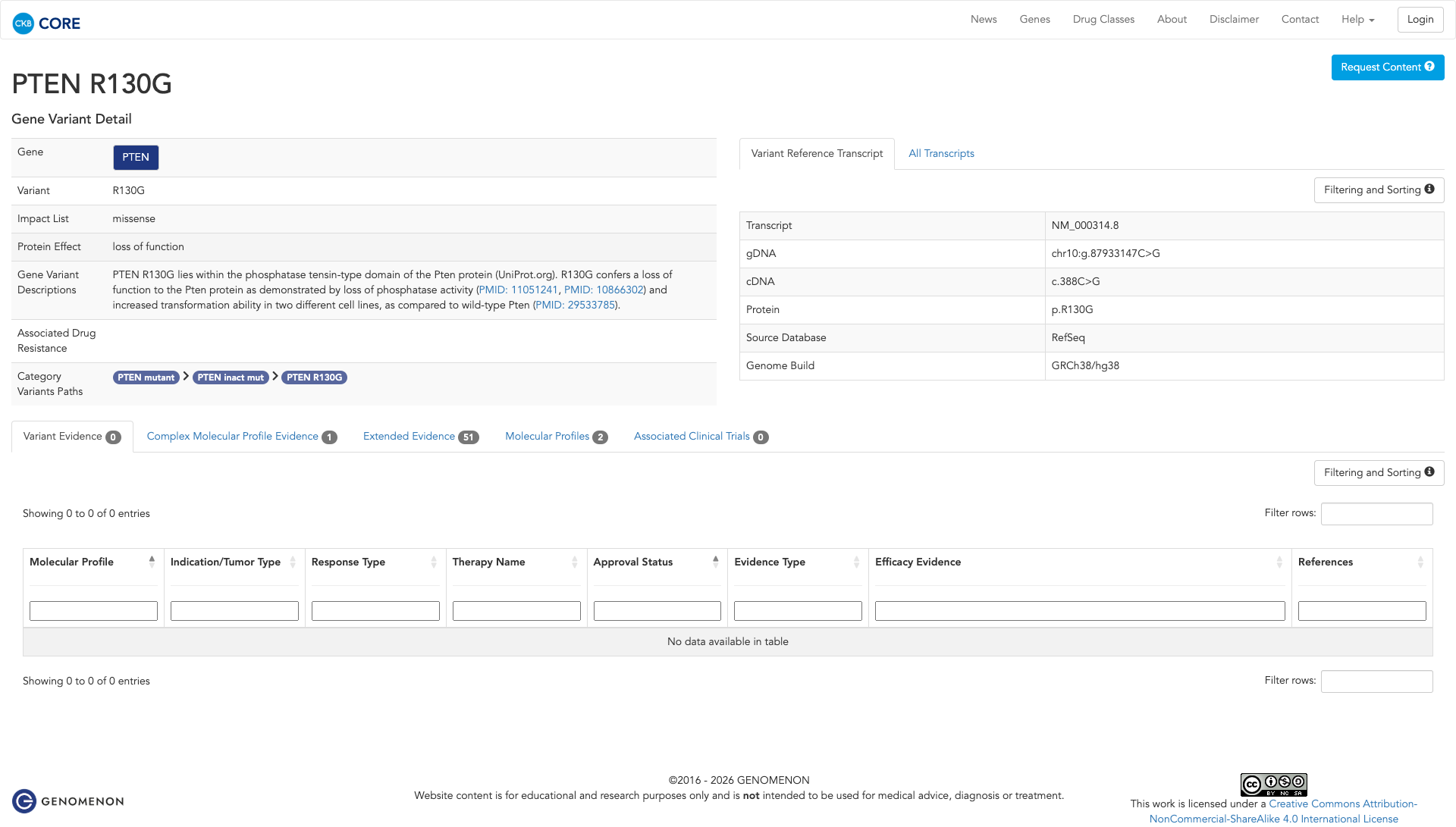
Click on previews to view full database entries. External databases may require institutional access.
Computational Analysis
Pathogenicity Predictions
SpliceAISpliceAI Scores
Window: ±500bp| Effect Type | Score | Position |
|---|---|---|
| Acceptor Loss (AL) | 0.02 | -152 bp |
| Donor Loss (DL) | 0.0 | 104 bp |
| Acceptor Gain (AG) | 0.0 | 54 bp |
| Donor Gain (DG) | 0.0 | -18 bp |
VCEP Guidelines
Applied ACMG/AMP Criteria (VCEP Specific)
PVS1 (Not Applied)
According to VCEP guidelines, PVS1 applies to null variants per the PTEN PVS1 decision tree. The evidence for this variant shows it is a missense change (R130G), not a null variant. Therefore, this criterion is not applied.
PS1 (Not Applied)
According to VCEP guidelines, PS1 applies when the same amino acid change as a previously established pathogenic variant is observed. The evidence for this variant shows it is R130G, whereas known pathogenic changes at residue 130 are R130Q and R130W. Therefore, this criterion is not applied.
PS2 (Not Applied)
According to standard ACMG guidelines, PS2 requires confirmed de novo occurrence in a patient with no family history. No de novo data are available for this variant. Therefore, this criterion is not applied.
PS3 (Moderate)
According to PTEN Pre-processing guidelines, the rule/finding for PS3 is: "Well-established in vitro or in vivo functional studies supportive of a damaging effect with phosphatase activity ≤ -1.11 per Mighell et al. 2018". The evidence for this variant shows a functional score of -2.1384, which is below the -1.11 threshold. Therefore, this criterion is applied at Moderate strength.
PS4 (Not Applied)
According to standard ACMG guidelines, PS4 requires a significant increase in prevalence of the variant in affected individuals compared with controls or proband specificity scores. No case-control or proband data are available. Therefore, this criterion is not applied.
PM1 (Moderate)
According to VCEP guidelines, PM1 applies to variants located in critical domains, including residues 123–130 of PTEN. The evidence for this variant shows it lies at residue 130 within the catalytic motif. Therefore, this criterion is applied at Moderate strength.
PM2 (Supporting)
According to VCEP guidelines, PM2_Supporting applies when a variant is absent from population databases (<0.001% allele frequency). The evidence for this variant shows it is not found in gnomAD. Therefore, this criterion is applied at Supporting strength.
PM3 (Not Applied)
According to VCEP guidelines, PM3 applies to recessive disorders for variants observed in trans with a pathogenic variant. PTEN-associated conditions are autosomal dominant and no trans data exist. Therefore, this criterion is not applied.
PM4 (Not Applied)
According to VCEP guidelines, PM4 applies to in-frame insertions or deletions. This variant is a missense change. Therefore, this criterion is not applied.
PM5 (Moderate)
According to VCEP guidelines, PM5_Moderate applies when a novel missense change occurs at a residue with a different known pathogenic missense change and the BLOSUM62 score is equal to or less than that of the known variant. The evidence for this variant shows R130G at residue 130 (known R130Q, BLOSUM62 score 1) with a BLOSUM62 score of -2 ≤ 1. Therefore, this criterion is applied at Moderate strength.
PM6 (Not Applied)
According to standard ACMG guidelines, PM6 applies to assumed de novo occurrences without paternity/maternity confirmation. No de novo data are available. Therefore, this criterion is not applied.
PP1 (Not Applied)
According to standard ACMG guidelines, PP1 applies for co-segregation with disease in multiple affected family members. No segregation data are available. Therefore, this criterion is not applied.
PP2 (Supporting)
According to standard ACMG guidelines, PP2 applies for a missense variant in a gene with low rate of benign missense variation and where missense is a common disease mechanism. PTEN meets these conditions. Therefore, this criterion is applied at Supporting strength.
PP3 (Supporting)
According to VCEP guidelines, PP3_Supporting applies when REVEL score >0.7 for missense variants. The evidence for this variant shows a REVEL score of 0.96. Therefore, this criterion is applied at Supporting strength.
PP4 (Not Applied)
According to standard ACMG guidelines, PP4 applies for a highly specific phenotype with a single genetic etiology. No patient phenotype data are provided. Therefore, this criterion is not applied.
PP5 (Supporting)
According to standard ACMG guidelines, PP5 applies when a reputable source reports the variant as pathogenic without available evidence for independent review. The evidence for this variant shows pathogenic classifications in ClinVar by multiple laboratories and the ClinGen PTEN Expert Panel. Therefore, this criterion is applied at Supporting strength.
BA1 (Not Applied)
According to VCEP guidelines, BA1 applies for allele frequency >0.056%. The evidence for this variant shows absence from population databases. Therefore, this criterion is not applied.
BS1 (Not Applied)
According to VCEP guidelines, BS1 applies for allele frequency 0.0043%–0.056%. The evidence for this variant shows absence from population databases. Therefore, this criterion is not applied.
BS2 (Not Applied)
According to VCEP guidelines, BS2 applies for homozygous observations in healthy individuals. No homozygous observations are reported. Therefore, this criterion is not applied.
BS3 (Not Applied)
According to VCEP guidelines, BS3 applies for functional studies showing no damaging effect. Functional studies show a damaging effect. Therefore, this criterion is not applied.
BS4 (Not Applied)
According to VCEP guidelines, BS4 applies for lack of segregation in affected members. No segregation data are available. Therefore, this criterion is not applied.
BP1 (Not Applied)
According to standard ACMG guidelines, BP1 applies for missense variants in genes where only truncating variants cause disease. PTEN disease mechanism includes missense. Therefore, this criterion is not applied.
BP2 (Not Applied)
According to VCEP guidelines, BP2 applies when variant is observed in trans with a pathogenic PTEN variant. No such observations exist. Therefore, this criterion is not applied.
BP3 (Not Applied)
According to standard ACMG guidelines, BP3 applies to in-frame indels in repetitive regions. This variant is a missense change. Therefore, this criterion is not applied.
BP4 (Not Applied)
According to VCEP guidelines, BP4 applies when multiple computational lines suggest no impact. Computational predictions for this variant are damaging. Therefore, this criterion is not applied.
BP5 (Not Applied)
According to standard ACMG guidelines, BP5 applies when a variant is found in a case with an alternate molecular basis. No such data are provided. Therefore, this criterion is not applied.
BP6 (Not Applied)
According to standard ACMG guidelines, BP6 applies when a reputable source reports the variant as benign without evidence. No benign reports exist. Therefore, this criterion is not applied.
BP7 (Not Applied)
According to standard ACMG guidelines, BP7 applies to silent or intronic variants with no splicing impact. This variant is a missense change. Therefore, this criterion is not applied.