Genetic Information
Gene & Transcript Details
| ID | Status | Details |
|---|---|---|
| NM_000314.8 | MANE Select | 8515 nt | 846–2057 |
| NM_000314.7 | RefSeq Select | 8514 nt | 845–2056 |
| NM_000314.5 | Alternative | 8719 nt | 1032–2243 |
| NM_000314.4 | Alternative | 5572 nt | 1032–2243 |
| NM_000314.3 | Alternative | 3416 nt | 1032–2243 |
| NM_000314.6 | Alternative | 8718 nt | 1032–2243 |
Variant Details
Clinical & Population Data
Population Frequency
gnomADClinVar
Open"This variant has been reported in ClinVar as Pathogenic (1 clinical laboratories)."
COSMIC Somatic Evidence
Open
Functional Impact & Domains
Functional Domain
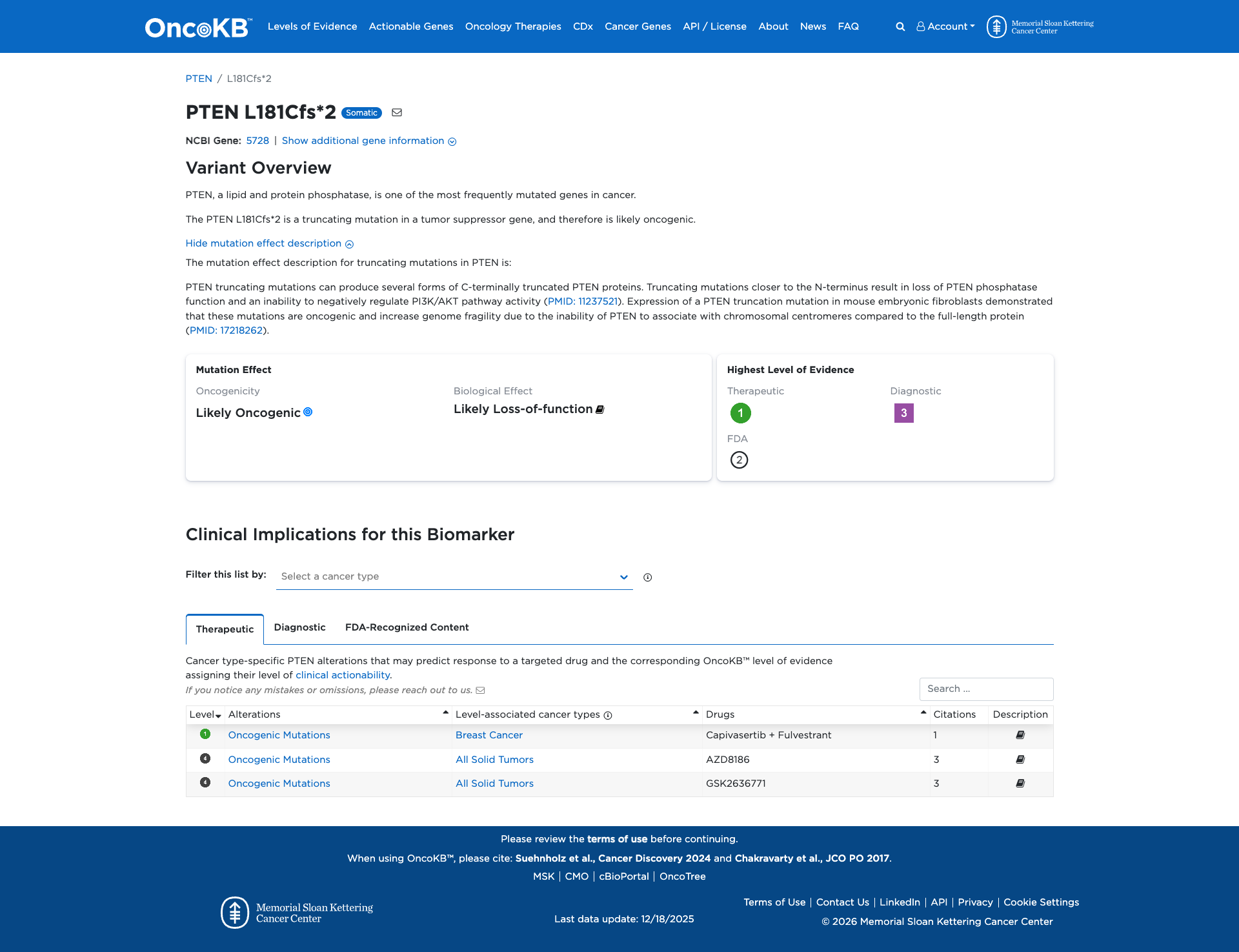
The PTEN L181Cfs*2 variant is a truncating mutation that results in the loss of PTEN phosphatase function, leading to an inability to negatively regulate PI3K/AKT pathway activity. Functional studies have shown that expression of PTEN truncation mutations in mouse embryonic fibroblasts is oncogenic and increases genome fragility due to impaired chromosomal centromere association. This evidence supports a damaging effect of the variant.
Click on previews to view full database entries. External databases may require institutional access.
Computational Analysis
Pathogenicity Predictions
SpliceAISpliceAI Scores
Window: ±500bp| Effect Type | Score | Position |
|---|---|---|
| Acceptor Loss (AL) | 0.06 | -46 bp |
| Donor Loss (DL) | 0.04 | 95 bp |
| Acceptor Gain (AG) | 0.0 | -2 bp |
| Donor Gain (DG) | 0.0 | -46 bp |
VCEP Guidelines
Applied ACMG/AMP Criteria (VCEP Specific)
PVS1 (Very Strong)
According to VCEP PVS1 decision tree (Very Strong strength): "Null Variant (nonsense, fs, start codon, splicing +1/2...) in a gene where LOF is a known mechanism of disease". The evidence for this variant shows c.541del L181Cfs*2 is a frameshift predicted to lead to NMD and is not in the last exon. Therefore, this criterion is applied at Very Strong strength because it is a null variant in PTEN with a known LOF mechanism.
PS1 (Not Applied)
According to VCEP guidelines, PS1 applies to the same amino acid change as a known pathogenic variant. This is a frameshift, not the same amino acid change; thus, PS1 is not applied.
PS2 (Not Applied)
According to VCEP guidelines, PS2 requires confirmed de novo occurrence with maternity and paternity confirmed. No de novo data are available for this variant; therefore, PS2 is not applied.
PS3 (Strong)
According to VCEP PS3 (Strong strength): "Well-established in vitro or in vivo functional studies supportive of a damaging effect on the gene or gene product." The evidence shows that PTEN truncation mutations, including L181Cfs*2, abolish phosphatase function and drive oncogenic phenotypes in cellular models. Therefore, PS3 is applied at Strong strength because functional assays demonstrate a damaging effect.
PS4 (Not Applied)
According to VCEP guidelines, PS4 requires statistical enrichment in affected individuals or case counts. No case or proband data are provided; therefore, PS4 is not applied.
PM1 (Not Applied)
According to VCEP PM1 (Moderate strength): applies to variants in defined PTEN catalytic motifs (residues 90-94, 123-130, 166-168). L181 lies outside these motifs; therefore, PM1 is not applied.
PM2 (Supporting)
According to VCEP PM2 (Supporting strength): "Absent in population databases present at <0.00001 (0.001%) allele frequency in gnomAD or another large sequenced population." The evidence shows the variant is absent from gnomAD. Therefore, PM2 is applied at Supporting strength because it is absent from controls.
PM3 (Not Applied)
According to standard ACMG, PM3 applies to recessive disorders when observed in trans with another pathogenic variant. PTEN-related disease is dominant; therefore, PM3 is not applied.
PM4 (Not Applied)
According to VCEP PM4 (Moderate strength): applies to in-frame indels or stop-loss variants. This is a frameshift leading to truncation; therefore, PM4 is not applied.
PM5 (Not Applied)
According to VCEP PM5 (Moderate strength): applies to novel missense changes at residues with known pathogenic missense variants. This is a frameshift; therefore, PM5 is not applied.
PM6 (Not Applied)
According to VCEP guidelines, PM6 requires unconfirmed de novo occurrence. No de novo data are available; therefore, PM6 is not applied.
PP1 (Not Applied)
According to VCEP PP1, segregation data in families are required. No segregation data are provided; therefore, PP1 is not applied.
PP2 (Not Applied)
According to standard ACMG, PP2 applies to missense variants in genes with low benign missense variation. This is a frameshift; therefore, PP2 is not applied.
PP3 (Not Applied)
According to VCEP PP3, multiple lines of computational evidence are required. Computational tools are not informative for truncating variants; therefore, PP3 is not applied.
PP4 (Not Applied)
According to standard ACMG, PP4 requires patient phenotype specificity. Phenotype data are not provided; therefore, PP4 is not applied.
PP5 (Not Applied)
According to standard ACMG, PP5 applies to a reputable source reporting pathogenicity without available evidence. Although ClinVar lists this variant as pathogenic, primary evidence is available; therefore, PP5 is not applied.
BA1 (Not Applied)
According to VCEP BA1 (Stand Alone): requires allele frequency >0.056% in gnomAD. The variant is absent; therefore, BA1 is not applied.
BS1 (Not Applied)
According to VCEP BS1 (Strong): requires allele frequency 0.0043-0.056% in gnomAD. The variant is absent; therefore, BS1 is not applied.
BS2 (Not Applied)
According to VCEP BS2, requires homozygous observations in unaffected individuals. No such data are available; therefore, BS2 is not applied.
BS3 (Not Applied)
According to VCEP BS3, functional studies must show no damaging effect. Functional evidence shows damaging effect; therefore, BS3 is not applied.
BS4 (Not Applied)
According to VCEP BS4, lack of segregation is required. No segregation data are provided; therefore, BS4 is not applied.
BP1 (Not Applied)
According to standard ACMG, BP1 applies to missense variants in genes where only LOF is disease mechanism. This is a LOF variant; therefore, BP1 is not applied.
BP2 (Not Applied)
According to VCEP BP2, requires observations in cis/trans with other PTEN variants. No such data; therefore, BP2 is not applied.
BP3 (Not Applied)
According to VCEP BP3, applies to in-frame indels in repetitive regions. This is a frameshift; therefore, BP3 is not applied.
BP4 (Not Applied)
According to VCEP BP4, computational evidence suggests no impact. The variant is a null variant and computational predictions are not relevant; therefore, BP4 is not applied.
BP5 (Not Applied)
According to VCEP BP5, requires alternate molecular basis in the same case. No such data; therefore, BP5 is not applied.
BP6 (Not Applied)
According to standard ACMG, BP6 applies to a reputable source reporting benign. No such report; therefore, BP6 is not applied.
BP7 (Not Applied)
According to VCEP BP7, applies to synonymous or intronic variants. This is a frameshift; therefore, BP7 is not applied.