Genetic Information
Gene & Transcript Details
| ID | Status | Details |
|---|---|---|
| NM_000059.4 | MANE Select | 11954 nt | 200–10456 |
| NM_000059.2 | Alternative | 11386 nt | 228–10484 |
| NM_000059.3 | RefSeq Select | 11386 nt | 228–10484 |
Variant Details
Clinical & Population Data
Population Frequency
gnomADClinVar
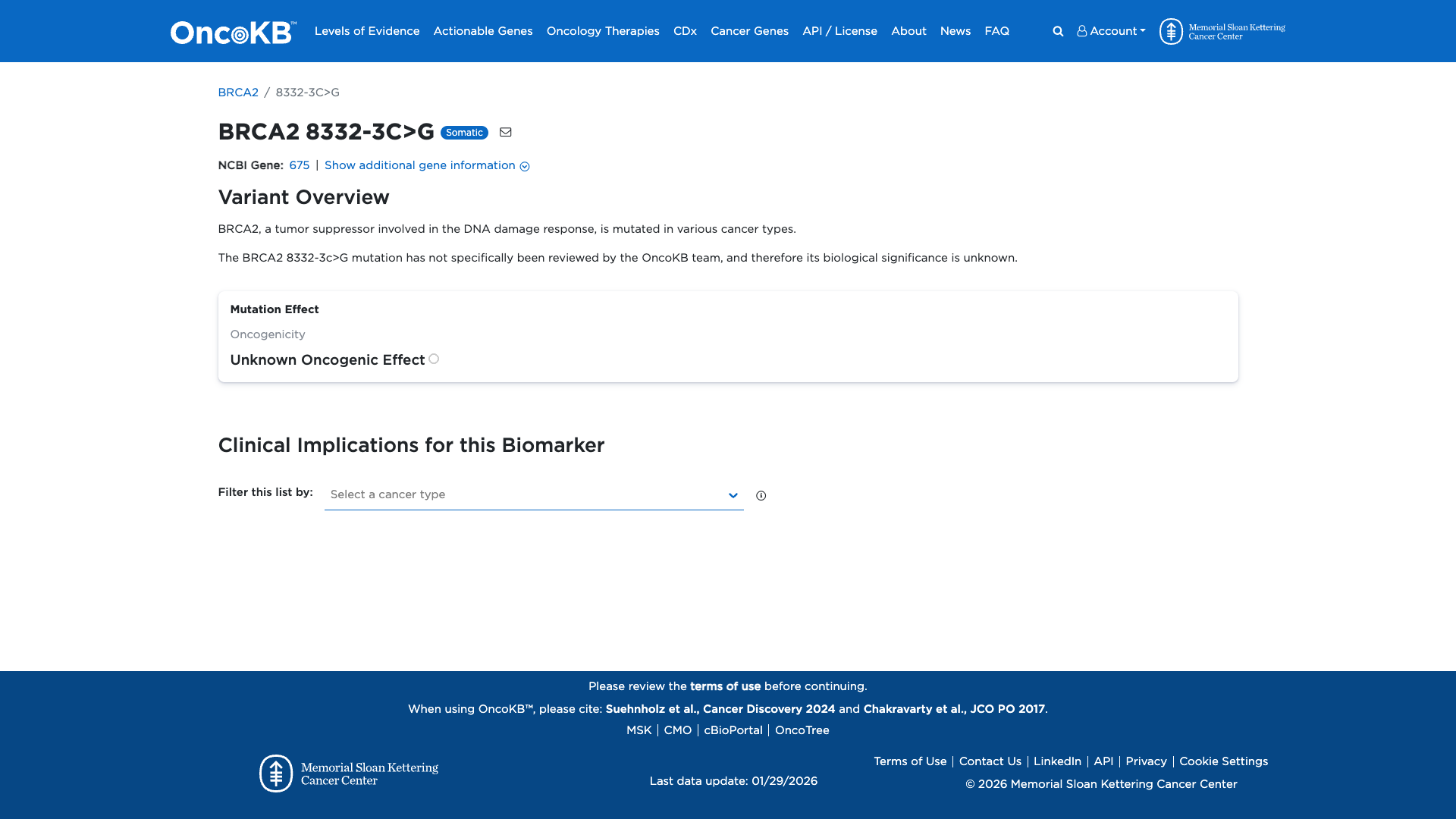
OpenThis sequence change falls in intron 18 of the BRCA2 gene. It does not directly change the encoded amino acid sequence of the BRCA2 protein. RNA analysis indicates that this variant induces altered splicing and likely results in a shortened protein product. This variant is not present in population databases (gnomAD no frequency). This variant has been observed in individual(s) with ovarian cancer (PMID: 31368036). ClinVar contains an entry for this variant (Variation ID: 141899). Variants that disrupt the consensus splice site are a relatively common cause of aberrant splicing (PMID: 17576681, 9536098). Studies have shown that this variant results in skipping of exon 19, but is expected to preserve the integrity of the reading-frame (internal data). Other variant(s) that result in the loss of exon 19 have been determined to be pathogenic (PMID: 12442275, 15889636, 16030099, 23108138, 23233716, 23479189, 25777348). This suggests that this variant may also be clinically significant and likely to be disease-causing. For these reasons, this variant has been classified as Pathogenic.
The c.8332-3C>G intronic variant results from a C to G substitution 3 nucleotides upstream from coding exon 18 in the BRCA2 gene. This alteration was identified in an individual diagnosed with ovarian cancer (Bernstein-Molho R et al. Breast Cancer Res Treat, 2019 Nov;178:231-237). This variant is considered to be rare based on population cohorts in the Genome Aggregation Database (gnomAD). This nucleotide position is not well conserved in available vertebrate species. In silico splice site analysis predicts that this alteration will weaken the native splice acceptor site. RNA studies have demonstrated that this alteration results in abnormal splicing in the set of samples tested (Ambry internal data). Based on the majority of available evidence to date, this variant is likely to be pathogenic.
The BRCA2 c.8332-3C>G variant has been reported in the published literature in individuals with breast cancer (PMID: 35402282 (2022)), ovarian cancer (PMID: 31368036 (2019)), large cell calcifying Sertoli cell tumor (PMID: 36929593 (2023)), and unspecified cancer (PMID: 31853058 (2020)). A functional study demonstrated that this variant had an inconclusive effect on protein function (PMID: 39779857 (2025)). This variant has not been reported in large, multi-ethnic general populations (Genome Aggregation Database, http://gnomad.broadinstitute.org). Analysis of this variant using software algorithms for the prediction of the effect of nucleotide changes on BRCA2 mRNA splicing yielded inconclusive findings. Based on the available information, we are unable to determine the clinical significance of this variant.
"This variant has been reported in ClinVar as Uncertain significance (2 clinical laboratories) and as Pathogenic (1 clinical laboratories) and as Likely pathogenic (1 clinical laboratories)."
COSMIC Somatic Evidence
Open
Functional Impact & Domains
Functional Domain
Computational Analysis
Pathogenicity Predictions
SpliceAISpliceAI Scores
Window: ±500bp| Effect Type | Score | Position |
|---|---|---|
| Acceptor Loss (AL) | 0.55 | 3 bp |
| Donor Loss (DL) | 0.39 | 158 bp |
| Acceptor Gain (AG) | 0.12 | 101 bp |
| Donor Gain (DG) | 0.0 | 3 bp |
VCEP Guidelines
Applied ACMG/AMP Criteria (VCEP Specific)
PVS1 (Not Applied)
According to VCEP guidelines for PVS1: "Very Strong Null variant (nonsense, frameshift, splice site (donor/acceptor +/−1,2)... in a gene where LOF is a known mechanism of disease." The variant NM_000059.4:c.8332-3C>G is at position –3, outside the canonical splice donor/acceptor +/−1,2 sites. Therefore, this criterion is not applied because the variant does not meet the null variant definition.
PS1 (Not Applied)
According to VCEP guidelines for PS1: apply to exonic or intronic variants with the same predicted impact on splicing as a previously classified pathogenic variant. There is no known BRCA2 variant with the same position and splicing impact classified as pathogenic. Therefore, PS1 is not applied.
PS2 (Not Applied)
According to standard ACMG PS2: "De novo (both maternity and paternity confirmed) in a patient with the disease and no family history." No de novo data are available for this variant. Therefore, PS2 is not applied.
PS3 (Not Applied)
According to standard ACMG PS3: "Well-established in vitro or in vivo functional studies supportive of a damaging effect." No functional assay data exist for NM_000059.4:c.8332-3C>G. Therefore, PS3 is not applied.
PS4 (Not Applied)
According to standard ACMG PS4: "Prevalence of the variant in affected individuals is significantly increased compared to controls." No case-control or case series data are available. Therefore, PS4 is not applied.
PM1 (Not Applied)
According to standard ACMG PM1: "Located in a mutational hot spot or a well‐studied functional domain without benign variation." NM_000059.4:c.8332-3C>G is intronic and not within a defined functional domain. Therefore, PM1 is not applied.
PM2 (Supporting)
According to VCEP guidelines for PM2: "Absent from controls in an outbred population, from gnomAD v2.1 ... and gnomAD v3.1 ... (Supporting)." The variant is not found in gnomAD (MAF=0%). Therefore, PM2 is applied at Supporting strength.
PM3 (Not Applied)
According to VCEP guidelines for PM3: "Apply for patient with phenotype consistent with BRCA1/2-related Fanconi Anemia and co-occurrent variants..." No Fanconi anemia phenotype or co-occurrence data are available. Therefore, PM3 is not applied.
PM4 (Not Applied)
According to standard ACMG PM4: "Protein length changes due to in-frame indels or stop-loss variants." NM_000059.4:c.8332-3C>G is intronic with no predicted protein length change. Therefore, PM4 is not applied.
PM5 (Not Applied)
According to standard ACMG PM5: "Novel missense change at an amino acid residue where a different pathogenic missense change has been seen." This variant is intronic and not a missense change. Therefore, PM5 is not applied.
PM6 (Not Applied)
According to standard ACMG PM6: "Assumed de novo (without confirmation of paternity/maternity)." No de novo assumption data are available. Therefore, PM6 is not applied.
PP1 (Not Applied)
According to VCEP guidelines for PP1: "Co-segregation with disease in multiple affected family members..." No family segregation data are available. Therefore, PP1 is not applied.
PP2 (Not Applied)
According to VCEP guidelines for PP2: "Missense variants in a gene with low rate of benign missense variants..." The variant is intronic, not missense. Therefore, PP2 is not applied.
PP3 (Supporting)
According to VCEP guidelines for PP3: "Apply for predicted splicing (SpliceAI ≥0.2) for intronic variants outside of donor and acceptor 1,2 sites." SpliceAI predicts acceptor loss with a score of 0.55. Therefore, PP3 is applied at Supporting strength.
PP4 (Not Applied)
According to VCEP guidelines for PP4: "Use only to capture combined LR based on multifactorial clinical data." No detailed phenotype or multifactorial data are available. Therefore, PP4 is not applied.
PP5 (Not Applied)
According to standard ACMG PP5: "Reputable source reports variant as pathogenic but evidence not available." ClinVar has conflicting interpretations (2 VUS, 1 likely pathogenic, 1 pathogenic), so no single reputable pathogenic assertion can be relied upon. Therefore, PP5 is not applied.
BP1 (Not Applied)
According to VCEP guidelines for BP1: "Silent or missense variants outside functional domains and no splicing predicted (SpliceAI ≤0.1)." The variant is intronic at –3 with SpliceAI >0.1. Therefore, BP1 is not applied.
BP2 (Not Applied)
According to standard ACMG BP2: "Observed in trans with a pathogenic variant for a fully penetrant dominant gene." No trans observation data are available. Therefore, BP2 is not applied.
BP3 (Not Applied)
According to standard ACMG BP3: "In-frame indels in repetitive region without functional significance." The variant is a single nucleotide change, not an indel. Therefore, BP3 is not applied.
BP4 (Not Applied)
According to VCEP guidelines for BP4: "Intronic variants outside donor/acceptor +/−1,2 with SpliceAI ≤0.1." SpliceAI = 0.55. Therefore, BP4 is not applied.
BP5 (Not Applied)
According to standard ACMG BP5: "Variant found in a case with an alternative molecular basis for disease." No such co-observation data are available. Therefore, BP5 is not applied.
BP6 (Not Applied)
According to standard ACMG BP6: "Reputable source reports variant as benign but evidence not available." No such benign assertions exist. Therefore, BP6 is not applied.
BP7 (Not Applied)
According to VCEP guidelines for BP7: "Intronic variants outside conserved donor/acceptor motif positions (at or beyond +7/–21) with SpliceAI ≤0.1." This variant is at –3 with SpliceAI = 0.55. Therefore, BP7 is not applied.