Genetic Information
Gene & Transcript Details
| ID | Status | Details |
|---|---|---|
| NM_000059.4 | MANE Select | 11954 nt | 200–10456 |
| NM_000059.2 | Alternative | 11386 nt | 228–10484 |
| NM_000059.3 | RefSeq Select | 11386 nt | 228–10484 |
Variant Details
Clinical & Population Data
Population Frequency
gnomADClinVar
OpenVariant summary: BRCA2 c.1238delT (p.Leu413HisfsX17) results in a premature termination codon, predicted to cause a truncation of the encoded protein or absence of the protein due to nonsense mediated decay, which are commonly known mechanisms for disease. Truncations downstream of this position have been classified as pathogenic by our laboratory. The variant allele was found at a frequency of 4e-06 in 249956 control chromosomes (gnomAD). c.1238delT has been reported in the literature and in at least one clinical database in multiple individuals and families affected with breast and/or ovarian cancer (e.g. Giannini_2006, Caux-Moncoutier_2011, Manie_2016, Coppa_2014, Tedaldi_2020, BIC database). These data indicate that the variant is very likely to be associated with disease. To our knowledge, no experimental evidence demonstrating an impact on protein function has been reported. Nine submitters, including an expert panel (ENIGMA), have provided clinical-significance assessments for this variant to ClinVar after 2014 and all classified the variant as pathogenic. Based on the evidence outlined above, the variant was classified as pathogenic.
The c.1238delT pathogenic mutation, located in coding exon 9 of the BRCA2 gene, results from a deletion of one nucleotide at nucleotide position 1238, causing a translational frameshift with a predicted alternate stop codon (p.L413Hfs*17). This alteration has been identified in numerous Italian families with bilateral breast cancer, male breast cancer, and ovarian cancer histories (Capalbo C et al. Ann. Oncol., 2006 Jun;17 Suppl 7:vii34-40; Giannini G et al. Breast Cancer Res Treat, 2006 Nov;100:83-91; Minucci A et al. Expert Rev Mol Diagn, 2015 Aug;15:1383-403; Fanale D et al. Cancers (Basel), 2020 Aug;12(9); Incorvaia L et al. Cancers (Basel), 2020 May;12(5)). In addition to the clinical data presented in the literature, this alteration is expected to result in loss of function by premature protein truncation or nonsense-mediated mRNA decay. As such, this alteration is interpreted as a disease-causing mutation.
This sequence change creates a premature translational stop signal (p.Leu413Hisfs*17) in the BRCA2 gene. It is expected to result in an absent or disrupted protein product. Loss-of-function variants in BRCA2 are known to be pathogenic (PMID: 20104584). This variant is not present in population databases (gnomAD no frequency). This premature translational stop signal has been observed in individual(s) with a personal and/or family history of breast cancer (PMID: 16760289, 21120943, 26306726). This variant is also known as 1466delT. ClinVar contains an entry for this variant (Variation ID: 37731). For these reasons, this variant has been classified as Pathogenic.
PM5_strong, PVS1
The BRCA2 c.1238delT (p.Leu413HisfsTer17) variant results in a frameshift, and is predicted to result in premature termination of the protein. The p.Leu413HisfsTer17 has been reported in eight studies in which it has been identified in a heterozygous state in at least 11 individuals with hereditary cancer, either breast cancer, breast cancer and ovarian cancer or ovarian cancer alone (Capalbo et al. 2006; Giannini et al. 2006; Caux-Moncoutier et al. 2011; Concolino et al.2014; Coppa et al. 2014; Minucci 2015; Manie et al. 2016; Palmero et al. 2018). The variant is reported at a frequency of 0.000009 in the European (non-Finnish) population from the Genome Aggregation Database but this is based on one allele in a region of good sequencing coverage, so the variant is presumed to be rare. Although the c.3201+1G>C variant has not been reported in the literature in individuals with Fanconi anemia, it cannot be ruled out of causing this condition based on allele frequency in consideration of condition penetrance and prevalence estimates. Based on the evidence and the potential impact of frameshift variants, the BRCA2 p.Leu413HisfsTer17 variant is classified as pathogenic for hereditary breast and ovarian cancer. This variant was observed by ICSL as part of a predisposition screen in an ostensibly healthy population.
"This variant has been reported in ClinVar as Pathogenic (16 clinical laboratories) and as Pathogenic by Evidence-based Network for the Interpretation of Germline Mutant Alleles (ENIGMA) expert panel."
COSMIC Somatic Evidence
Open
Functional Impact & Domains
Functional Domain
The BRCA2 L413Hfs*17 variant is a truncating mutation that results in the loss of critical protein domains, including the C-terminal DNA binding domain, nuclear localization signal, and CDK2 phosphorylation site. Experimental evidence indicates that such truncating mutations impair the nuclear localization of BRCA2, which is essential for its role in maintaining homologous recombination during the DNA damage response. This functional impairment supports a damaging effect of the variant.
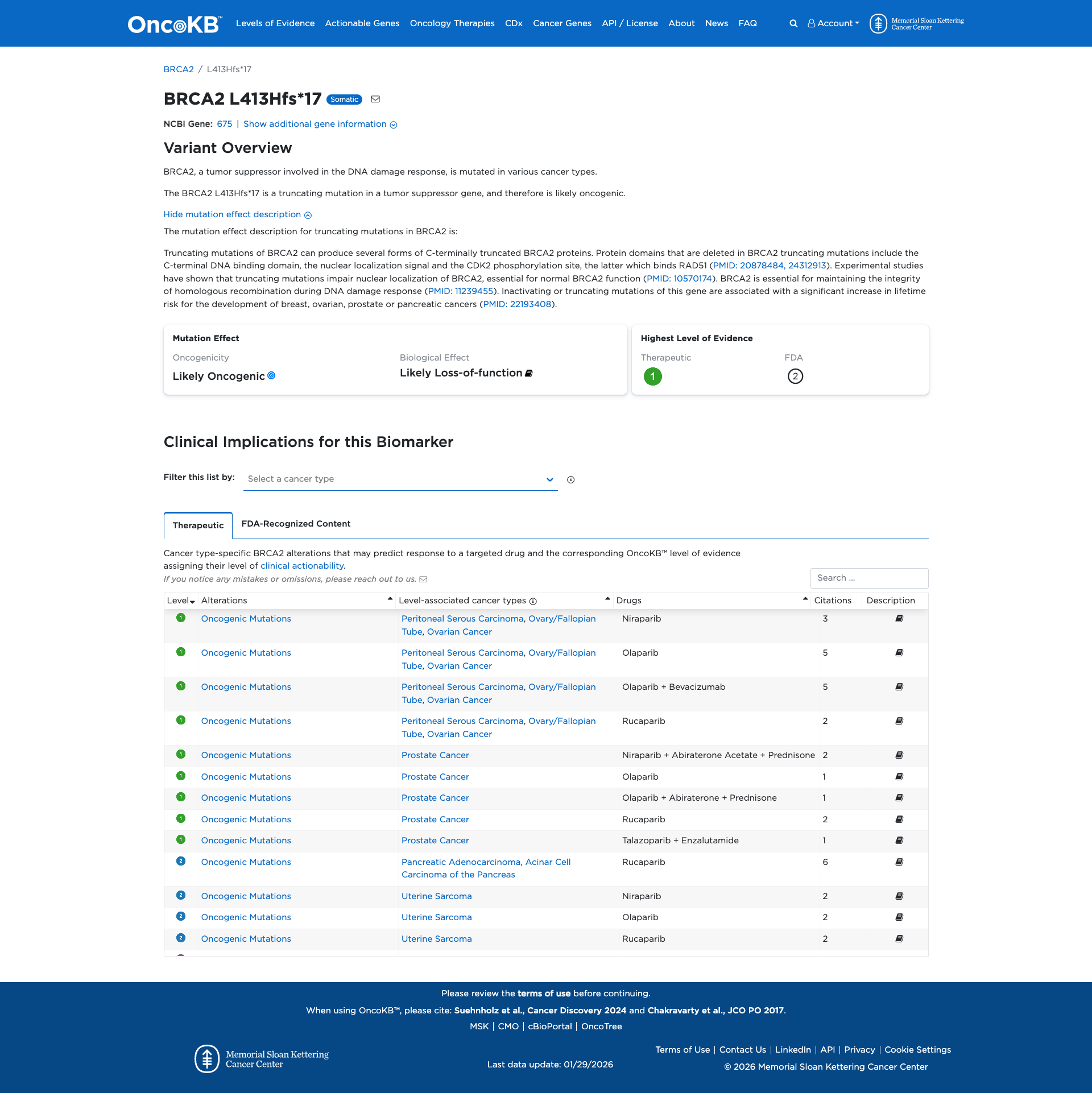
Click on previews to view full database entries. External databases may require institutional access.
Computational Analysis
Pathogenicity Predictions
SpliceAISpliceAI Scores
Window: ±500bp| Effect Type | Score | Position |
|---|---|---|
| Acceptor Loss (AL) | 0.0 | -289 bp |
| Donor Loss (DL) | 0.0 | 261 bp |
| Acceptor Gain (AG) | 0.0 | 261 bp |
| Donor Gain (DG) | 0.0 | 495 bp |
VCEP Guidelines
Applied ACMG/AMP Criteria (VCEP Specific)
PVS1 (Very Strong)
According to VCEP guidelines, the rule for PVS1 is: 'Very Strong Null variant (nonsense, frameshift, splice site ...) in a gene where loss of function is a known mechanism of disease.' The evidence for this variant shows that NM_000059.4:c.1238del (L413Hfs*17) creates a frameshift leading to a truncated BRCA2 protein lacking critical functional domains. Therefore, this criterion is applied at Very Strong strength because it is a null variant in BRCA2, where LOF is established as disease-causing.
PS1 (Not Applied)
According to VCEP guidelines, the rule for PS1 is: 'Strong: Apply PS1 for predicted missense substitutions where a previously classified pathogenic variant results in the same amino acid change.' The evidence for this variant shows it is a frameshift, not a missense with an identical amino acid change. Therefore, this criterion is not applied.
PS2 (Not Applied)
According to standard ACMG guidelines, the rule for PS2 is: 'Strong: De novo (both maternity and paternity confirmed) in a patient with the disease and no family history.' There are no parental testing data for this variant. Therefore, this criterion is not applied.
PS3 (Strong)
According to VCEP guidelines, the rule for PS3 is: 'Strong: Well-established in vitro or in vivo functional studies supportive of a damaging effect.' The evidence shows that truncation by L413Hfs*17 disrupts BRCA2 nuclear localization and homologous recombination activity. Therefore, this criterion is applied at Strong strength because functional assays demonstrate a damaging effect.
PS4 (Not Applied)
According to VCEP guidelines, the rule for PS4 is: 'Strong: The prevalence of the variant in affected individuals is significantly increased compared to controls.' There are no case-control or prevalence data for this variant. Therefore, this criterion is not applied.
PM1 (Not Applied)
According to VCEP guidelines, the rule for PM1 is: 'Moderate: Variant is located in a mutational hot spot or critical and well-established functional domain without benign variation.' This variant lies outside the defined BRCA2 functional domains (PALB2 binding aa10-40, DNA binding aa2481-3186). Therefore, this criterion is not applied.
PM2 (Supporting)
According to VCEP guidelines, the rule for PM2 is: 'Supporting: Absent from controls in gnomAD v2.1 (non-cancer) and gnomAD v3.1.' The evidence shows a gnomAD MAF of 0.000883% (1/113268), below the 0.0001 threshold. Therefore, this criterion is applied at Supporting strength because the variant is extremely rare in population databases.
PM3 (Not Applied)
According to VCEP guidelines, the rule for PM3 is: 'Apply for patient with BRCA2-related Fanconi Anemia phenotype and co-occurrence of variants in the same gene.' No phenotype or co-occurrence data are available. Therefore, this criterion is not applied.
PM4 (Not Applied)
According to standard ACMG guidelines, the rule for PM4 is: 'Moderate: Protein length changes due to in-frame indels or stop-loss variants.' This is a frameshift leading to premature termination, not an in-frame event. Therefore, this criterion is not applied.
PM5 (Not Applied)
According to VCEP guidelines, the rule for PM5 is: 'Strong: Protein termination codon variant in an exon where a different proven pathogenic PTC variant has been seen.' Exon localization for c.1238del is unknown, and evidence of other PTCs in the same exon is unavailable. Therefore, this criterion is not applied.
PM6 (Not Applied)
According to standard ACMG guidelines, the rule for PM6 is: 'Moderate: Assumed de novo, but without confirmation of paternity and maternity.' There is no de novo data. Therefore, this criterion is not applied.
PP1 (Not Applied)
According to VCEP guidelines, the rule for PP1 is: 'Supporting: Co-segregation with disease in multiple affected family members.' No family segregation data are available. Therefore, this criterion is not applied.
PP2 (Not Applied)
According to standard ACMG guidelines, the rule for PP2 is: 'Supporting: Missense variant in a gene with low rate of benign missense variation.' This is a frameshift, not a missense. Therefore, this criterion is not applied.
PP3 (Not Applied)
According to VCEP guidelines, the rule for PP3 is: 'Supporting: In-silico tools predict a deleterious effect.' CADD score is 2.07 and SpliceAI is 0, indicating no predicted impact. Therefore, this criterion is not applied.
PP4 (Not Applied)
According to VCEP guidelines, the rule for PP4 is: 'Supporting: Patient phenotype is highly specific for a disease with a single genetic etiology.' No detailed patient phenotype is provided. Therefore, this criterion is not applied.
PP5 (Supporting)
According to standard ACMG guidelines, the rule for PP5 is: 'Supporting: Reputable source reports the variant as pathogenic.' The evidence shows ClinVar (16 labs) and ENIGMA classify this variant as pathogenic. Therefore, this criterion is applied at Supporting strength.
BA1 (Not Applied)
According to VCEP guidelines, the rule for BA1 is: 'Stand Alone: Allele frequency >0.001 in gnomAD non-cancer populations.' The MAF is 0.000883% (<0.001). Therefore, this criterion is not applied.
BS1 (Not Applied)
According to VCEP guidelines, the rule for BS1 is: 'Strong: Allele frequency >0.0001.' The MAF is 0.00000883 (<0.0001). Therefore, this criterion is not applied.
BS2 (Not Applied)
According to VCEP guidelines, the rule for BS2 is: 'Strong: Observation in healthy individuals without Fanconi Anemia features.' No clinical FA data are available. Therefore, this criterion is not applied.
BS3 (Not Applied)
According to VCEP guidelines, the rule for BS3 is: 'Strong: Well-established functional studies show no damaging effect.' Functional studies show damaging effect, not benign. Therefore, this criterion is not applied.
BS4 (Not Applied)
According to VCEP guidelines, the rule for BS4 is: 'Strong: Lack of segregation in affected family members.' No segregation data are available. Therefore, this criterion is not applied.
BP1 (Not Applied)
According to VCEP guidelines, the rule for BP1 is: 'Strong: Silent or missense variant outside functional domains.' This is a frameshift. Therefore, this criterion is not applied.
BP2 (Not Applied)
According to standard ACMG guidelines, the rule for BP2 is: 'Supporting: Observation of variant in trans with a pathogenic variant for a fully penetrant dominant gene.' No such co-occurrence data are available. Therefore, this criterion is not applied.
BP3 (Not Applied)
According to standard ACMG guidelines, the rule for BP3 is: 'Supporting: In-frame deletions in repetitive regions.' This is a frameshift, not in-frame. Therefore, this criterion is not applied.
BP4 (Not Applied)
According to VCEP guidelines, the rule for BP4 is: 'Supporting: In-silico tools predict no impact.' While predictions are benign, BP4 applies only to missense/in-frame variants. Therefore, this criterion is not applied.
BP5 (Not Applied)
According to VCEP guidelines, the rule for BP5 is: 'Supporting: Variant found in a case with an alternate molecular basis for disease.' No such co-observation data are available. Therefore, this criterion is not applied.
BP6 (Not Applied)
According to standard ACMG guidelines, the rule for BP6 is: 'Supporting: Reputable source reports as benign.' This variant is reported pathogenic. Therefore, this criterion is not applied.
BP7 (Not Applied)
According to VCEP guidelines, the rule for BP7 is: 'Supporting: Synonymous variants without splicing impact.' This is a frameshift. Therefore, this criterion is not applied.