Genetic Information
Gene & Transcript Details
| ID | Status | Details |
|---|---|---|
| NM_000314.8 | MANE Select | 8515 nt | 846–2057 |
| NM_000314.7 | RefSeq Select | 8514 nt | 845–2056 |
| NM_000314.5 | Alternative | 8719 nt | 1032–2243 |
| NM_000314.4 | Alternative | 5572 nt | 1032–2243 |
| NM_000314.3 | Alternative | 3416 nt | 1032–2243 |
| NM_000314.6 | Alternative | 8718 nt | 1032–2243 |
Variant Details
Clinical & Population Data
Population Frequency
gnomADClinVar
OpenThis variant is classified as Likely pathogenic. Evidence in support of pathogenic classification: Variant is absent from gnomAD (v2, v3 and v4); Missense variant in a region that is highly intolerant to missense variation (high constraint region in DECIPHER); Missense variant predicted to be damaging by in silico tool(s) or highly conserved with a major amino acid change; This variant has been shown to be de novo in the proband (parental status confirmed) (by trio analysis). Additional information: Variant is predicted to result in a missense amino acid change from valine to glutamic acid; This variant is heterozygous; This gene is associated with autosomal dominant disease; This variant has no previous evidence of pathogenicity; No published segregation evidence has been identified for this variant; No published functional evidence has been identified for this variant; Other missense variants comparable to the one identified in this case have conflicting previous evidence for pathogenicity. p.(Val133Leu) has been classified as a VUS and p.(Val133Ile) has been classified as both pathogenic and VUS by clinical laboratories (ClinVar); Dominant negative and loss of function are known mechanisms of disease in this gene and are associated with PTEN-related disease (OMIM). Loss of function is the mechanism for null variants while missense variants have been demonstrated to exert either a loss of function or dominant-negative mechanism (PMID: 20301661); Variants in this gene are known to have variable expressivity. In particular, PTEN-related Proteus syndrome has been described to be a highly variable disorder (PMID: 20301661).
"This variant has been reported in ClinVar as Likely pathogenic (1 clinical laboratories)."
COSMIC Somatic Evidence
Open
Functional Impact & Domains
Functional Domain
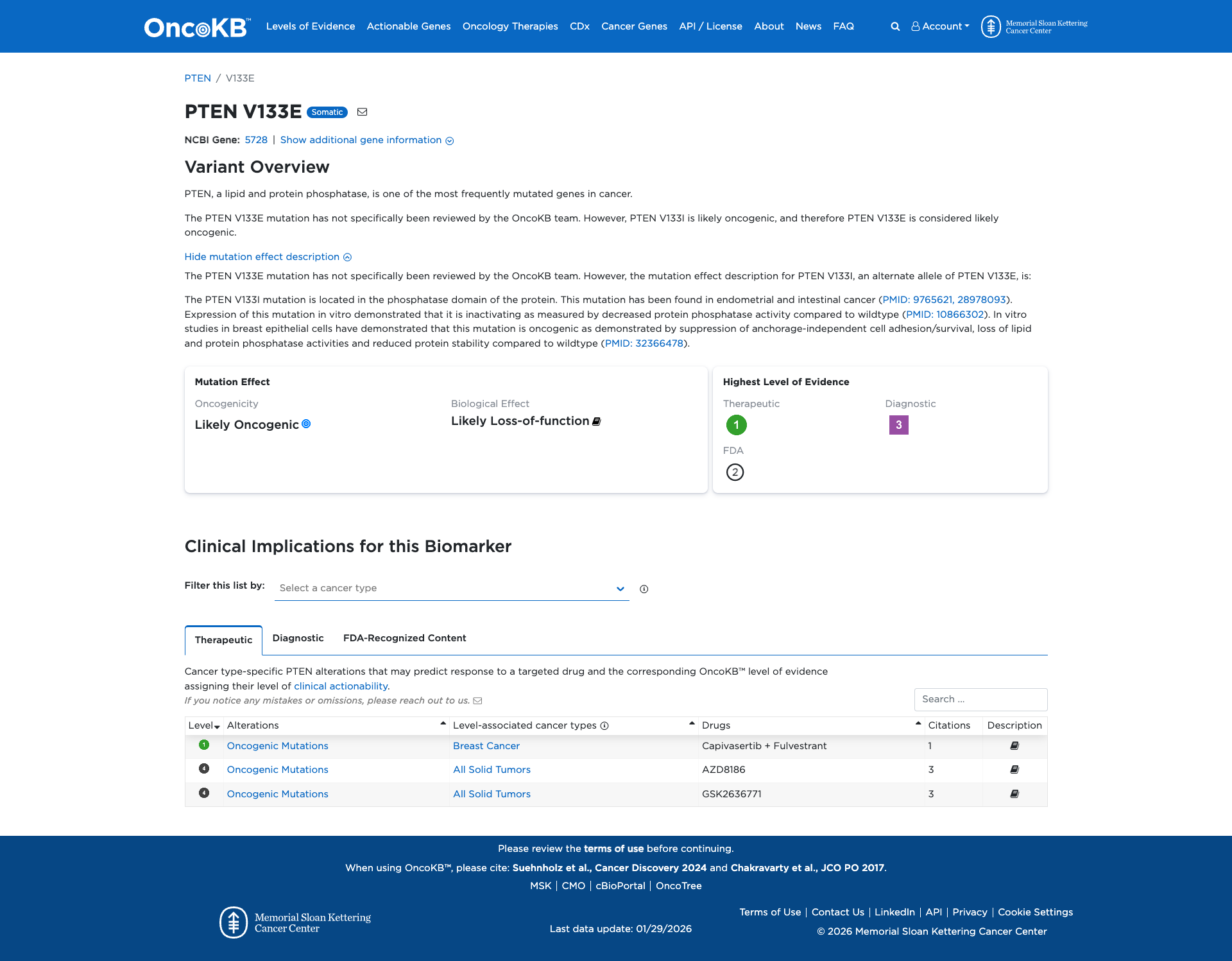
Computational Analysis
Pathogenicity Predictions
SpliceAISpliceAI Scores
Window: ±500bp| Effect Type | Score | Position |
|---|---|---|
| Acceptor Loss (AL) | 0.0 | 44 bp |
| Donor Loss (DL) | 0.0 | -28 bp |
| Acceptor Gain (AG) | 0.01 | -162 bp |
| Donor Gain (DG) | 0.0 | 94 bp |
VCEP Guidelines
Applied ACMG/AMP Criteria (VCEP Specific)
PVS1 (Not Applied)
According to VCEP guidelines the rule for PVS1 is: "Very Strong Strength: Very Strong Use PTEN PVS1 decision tree." The evidence for this variant shows: it is a missense change (c.398T>A; p.V133E) not predicted to cause loss‐of‐function under the PTEN PVS1 decision tree. Therefore, this criterion is not applied because the variant does not meet PVS1 requirements.
PS1 (Not Applied)
According to VCEP guidelines the rule for PS1 is: "Strong Strength: Strong Same amino acid change as a previously established pathogenic variant regardless of nucleotide change OR different variant at same nucleotide position as a pathogenic splicing variant, where in silico models predict impact equal to or greater than the known pathogenic variant." The evidence for this variant shows: p.V133E is novel with no identical amino acid change previously reported as pathogenic. Therefore, PS1 is not applied.
PS2 (Not Applied)
According to VCEP guidelines the rule for PS2 is: "Very Strong Strength: Very Strong Two proven OR four assumed OR one proven + two assumed de novo observations in a patient with the disease and no family history." The evidence for this variant shows: no confirmed de novo observations. Therefore, PS2 is not applied.
PS3 (Moderate)
According to PTEN Pre-processing the PS3_Moderate finding is: "Phosphatase activity score -2.0533 < threshold -1.11 per Mighell et al. 2018, PMID: 29706350." The evidence for this variant shows: the functional score of -2.0533 meets the PTEN-specific threshold for moderate functional impact. Therefore, PS3 is applied at Moderate strength.
PS4 (Not Applied)
According to VCEP guidelines the rule for PS4 is: "Moderate Strength: Moderate Probands with specificity score of 2-3.5 (see text)." The evidence for this variant shows: no case-level proband data available to calculate specificity score. Therefore, PS4 is not applied.
PM1 (Not Applied)
According to VCEP guidelines the rule for PM1 is: "Moderate Strength: Moderate Located in a mutational hot spot and/or critical and well-established functional domain. Defined to include residues in catalytic motifs: 90-94, 123-130 (NP_000305.3)." The evidence for this variant shows: p.V133E resides at codon 133, outside the defined catalytic motifs. Therefore, PM1 is not applied.
PM2 (Supporting)
According to VCEP guidelines the rule for PM2 is: "Supporting Strength: Supporting Absent in population Databases present at <0.00001 (0.001%) allele frequency in gnomAD or another large sequenced population. If multiple alleles are present within any subpopulation, allele frequency in that subpopulation must be <0.00002 (0.002%)." The evidence for this variant shows: the variant is absent from gnomAD (MAF=0%). Therefore, PM2 is applied at Supporting strength.
PM3 (Not Applied)
According to standard ACMG guidelines the rule for PM3 is: "Moderate Strength: Moderate For recessive disorders, detected in trans with a pathogenic variant." The evidence for this variant shows: PTEN-related disease is haploinsufficient and no trans recessive data applies. Therefore, PM3 is not applied.
PM4 (Not Applied)
According to VCEP guidelines the rule for PM4 is: "Moderate Strength: Moderate Protein length changes due to in-frame deletions/insertions in a non-repeat region or stop-loss variants." The evidence for this variant shows: p.V133E is a missense change without protein length alteration. Therefore, PM4 is not applied.
PM5 (Moderate)
According to VCEP guidelines the rule for PM5 is: "Moderate Strength: Moderate Missense change at an amino acid residue where a different missense change determined to be pathogenic or likely pathogenic has been seen before. In addition, variant being interrogated must have BLOSUM62 score equal to or less than the known variant." The evidence for this variant shows: residue V133 has previously observed pathogenic missense changes. Therefore, PM5 is applied at Moderate strength.
PM6 (Not Applied)
According to VCEP guidelines the rule for PM6 is: "Moderate Strength: Moderate Assumed de novo, but without confirmation of paternity and maternity, in proband with the disease and no family history." The evidence for this variant shows: no presumed de novo information. Therefore, PM6 is not applied.
PP1 (Not Applied)
According to VCEP guidelines the rule for PP1 is: "Supporting Strength: Supporting Co-segregation with disease in multiple affected family members, with 3 or 4 meioses observed." The evidence for this variant shows: no segregation data available. Therefore, PP1 is not applied.
PP2 (Supporting)
According to standard ACMG guidelines the rule for PP2 is: "Supporting Missense variant in a gene that has a low rate of benign missense variation and where missense variants are a common mechanism of disease." The evidence for this variant shows: PTEN is intolerant to benign missense and missense is a known disease mechanism. Therefore, PP2 is applied at Supporting strength.
PP3 (Supporting)
According to VCEP guidelines the rule for PP3 is: "Supporting Strength: Supporting Multiple lines of computational evidence support a deleterious effect on the gene or gene product. Splicing variants: Concordance of SpliceAl and VarSeak Missense variants: REVEL score > 0.7." The evidence for this variant shows: REVEL score = 0.99 (>0.7) and multiple tools predict deleterious. Therefore, PP3 is applied at Supporting strength.
PP4 (Not Applied)
According to standard ACMG guidelines the rule for PP4 is: "Supporting Phenotype or family history highly specific for a disease with a single genetic etiology." The evidence for this variant shows: no phenotype or family history details. Therefore, PP4 is not applied.
PP5 (Supporting)
According to standard ACMG guidelines the rule for PP5 is: "Supporting Reputable source recently reports variant as pathogenic, but the evidence is not available to the laboratory to perform an independent evaluation." The evidence for this variant shows: ClinVar lists this variant as Likely Pathogenic by one clinical laboratory. Therefore, PP5 is applied at Supporting strength.
BA1 (Not Applied)
According to VCEP guidelines the rule for BA1 is: "Stand Alone Strength: Stand Alone gnomAD Filtering allele frequency >0.00056 (0.056%)." The evidence for this variant shows: allele frequency = 0% in gnomAD. Therefore, BA1 is not applied.
BS1 (Not Applied)
According to VCEP guidelines the rule for BS1 is: "Strong Strength: Strong gnomAD Filtering allele frequency from 0.000043 (0.0043%) up to 0.00056 (0.056%)." The evidence for this variant shows: allele frequency = 0% in gnomAD. Therefore, BS1 is not applied.
BS2 (Not Applied)
According to VCEP guidelines the rule for BS2 is: "Strong Strength: Strong Observed in the homozygous state in a healthy or PHTS-unaffected individual..." The evidence for this variant shows: no homozygous observations in unaffected individuals. Therefore, BS2 is not applied.
BS3 (Not Applied)
According to VCEP guidelines the rule for BS3 is: "Strong Strength: Strong Well-established in vitro or in vivo functional studies shows no damaging effect on protein function..." The evidence for this variant shows: functional score indicates damaging effect. Therefore, BS3 is not applied.
BS4 (Not Applied)
According to VCEP guidelines the rule for BS4 is: "Strong Strength: Strong Lack of segregation in affected members of two or more families." The evidence for this variant shows: no segregation data. Therefore, BS4 is not applied.
BP1 (Not Applied)
According to standard ACMG guidelines the rule for BP1 is: "Supporting Missense variant in a gene for which primarily truncating variants are known to cause disease." The evidence for this variant shows: PTEN disease mechanism includes both truncating and missense variants. Therefore, BP1 is not applied.
BP2 (Not Applied)
According to VCEP guidelines the rule for BP2 is: "Supporting Strength: Supporting Observed in trans with a pathogenic or likely pathogenic PTEN variant..." The evidence for this variant shows: no trans observations. Therefore, BP2 is not applied.
BP3 (Not Applied)
According to standard ACMG guidelines the rule for BP3 is: "Supporting In-frame deletions/insertions in a repetitive region without a known function." The evidence for this variant shows: it is a missense change. Therefore, BP3 is not applied.
BP4 (Not Applied)
According to VCEP guidelines the rule for BP4 is: "Supporting Strength: Supporting Multiple lines of computational evidence suggest no impact on gene or gene product. Missense variants: REVEL scores < 0.5." The evidence for this variant shows: REVEL = 0.99 and other tools predict deleterious. Therefore, BP4 is not applied.
BP5 (Not Applied)
According to VCEP guidelines the rule for BP5 is: "Supporting Strength: Supporting Variant found in a case with an alternate molecular basis for disease..." The evidence for this variant shows: no alternate molecular basis reported. Therefore, BP5 is not applied.
BP6 (Not Applied)
According to standard ACMG guidelines the rule for BP6 is: "Supporting Reputable source reports variant as benign, but evidence is not available." The evidence for this variant shows: no reputable benign report. Therefore, BP6 is not applied.
BP7 (Not Applied)
According to VCEP guidelines the rule for BP7 is: "Supporting Strength: Supporting A synonymous or intronic variant at or beyond +7/-21 with no splicing impact." The evidence for this variant shows: it is a missense change. Therefore, BP7 is not applied.