Genetic Information
Gene & Transcript Details
| ID | Status | Details |
|---|---|---|
| NM_001754.3 | Alternative | 6190 nt | 400–1842 |
| NM_001754.4 | RefSeq Select | 5967 nt | 191–1633 |
| NM_001754.5 | MANE Select | 5971 nt | 195–1637 |
Variant Details
Clinical & Population Data
Population Frequency
gnomADClinVar
Open""
COSMIC Somatic Evidence
Open
Functional Impact & Domains
Functional Domain
The RUNX1 G170Vfs*9 variant is a truncating mutation in the RUNX1 gene, a known tumor suppressor involved in hematopoietic differentiation. Functional evidence indicates that truncating mutations in RUNX1 typically inhibit its function, contributing to oncogenesis and predisposing individuals to hematologic malignancies such as leukemia, lymphomas, and myelodysplastic syndromes.
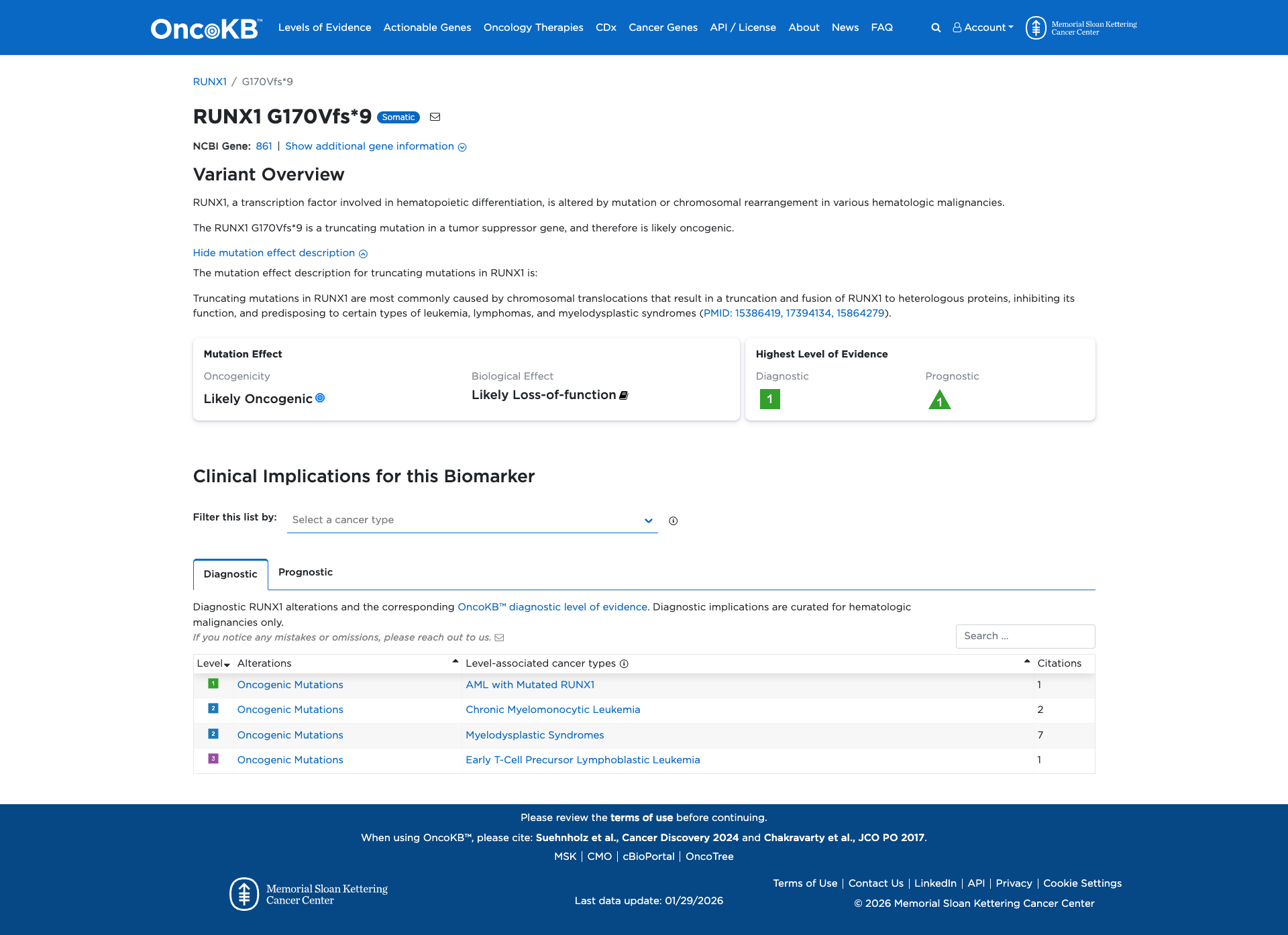
Click on previews to view full database entries. External databases may require institutional access.
Computational Analysis
Pathogenicity Predictions
SpliceAISpliceAI Scores
Window: ±500bp| Effect Type | Score | Position |
|---|---|---|
| Acceptor Loss (AL) | 0.0 | -169 bp |
| Donor Loss (DL) | 1.0 | 1 bp |
| Acceptor Gain (AG) | 0.0 | 157 bp |
| Donor Gain (DG) | 1.0 | 0 bp |
VCEP Guidelines
Applied ACMG/AMP Criteria (VCEP Specific)
PVS1 (Very Strong)
According to VCEP guidelines, the rule for PVS1 is: "Very Strong Strength: Very Strong Per modified RUNX1 PVS1 decision tree for SNVs and CNVs and table of splicing effects. Modification Type: Gene-specific". The evidence for this variant shows a frameshift resulting in a premature termination codon (G170Vfs*9) in RUNX1, a gene where loss of function is a known mechanism and not located in the last exon. Therefore, this criterion is applied at Very Strong strength because this is a null variant in a gene with established LOF disease mechanism.
PS1 (Not Applied)
According to VCEP guidelines, PS1 applies when a variant results in the same amino acid change as a previously established pathogenic variant regardless of nucleotide change. The evidence for this variant shows a unique frameshift (G170Vfs*9) with no prior identical amino acid change reported as pathogenic. Therefore, this criterion is not applied.
PS2 (Not Applied)
According to VCEP guidelines, PS2 requires proven or assumed de novo occurrence scoring against phenotypic specificity. There is no data on de novo occurrence for this variant. Therefore, this criterion is not applied.
PS3 (Not Applied)
According to VCEP guidelines, PS3 is not applicable if a variant meets PVS1. The evidence for this variant meets PVS1. Therefore, PS3 is not applied.
PS4 (Not Applied)
According to VCEP guidelines, PS4 requires multiple probands meeting RUNX1-associated phenotypic criteria. There are no reported proband counts for this variant. Therefore, this criterion is not applied.
PM1 (Not Applied)
According to VCEP guidelines, PM1 applies to missense variants affecting specific RHD residues. This variant is a frameshift, not a missense change. Therefore, this criterion is not applied.
PM2 (Supporting)
According to VCEP guidelines, the rule for PM2 is: "Supporting Strength: Variant must be completely absent from all population databases. Modification Type: Strength". The evidence for this variant shows it is absent from gnomAD and other population databases. Therefore, PM2 is applied at Supporting strength.
PM3 (Not Applied)
According to standard ACMG guidelines, PM3 applies to variants detected in trans with a pathogenic variant in a recessive disorder. RUNX1-related disease is autosomal dominant and there is no evidence of compound heterozygosity. Therefore, this criterion is not applied.
PM4 (Not Applied)
According to VCEP guidelines, PM4 applies to in-frame insertions or deletions in the RHD. This variant is a frameshift duplication, not an in-frame event. Therefore, this criterion is not applied.
PM5 (Supporting)
According to VCEP guidelines, the rule for PM5 is: "Supporting Strength: PM5_supporting is also applied to nonsense/frameshift variants that are downstream of c.98 (in transcript NM_001754.4). Modification Type: Strength". The evidence for this variant shows a frameshift at c.501_508dup (downstream of c.98). Therefore, PM5 is applied at Supporting strength.
PM6 (Not Applied)
According to VCEP guidelines, PM6 requires assumed or proven de novo cases. There is no de novo data for this variant. Therefore, this criterion is not applied.
PP1 (Not Applied)
According to VCEP guidelines, PP1 requires co-segregation with disease in multiple affected family members. No segregation data are available for this variant. Therefore, this criterion is not applied.
PP2 (Not Applied)
According to standard ACMG guidelines, PP2 applies to missense variants in a gene with low benign variation rate. This variant is a frameshift event. Therefore, this criterion is not applied.
PP3 (Supporting)
According to VCEP guidelines, the rule for PP3 is: "Supporting Strength: For missense, synonymous and intronic (intron 4-8) variants: SpliceAI ≥ 0.38, including the creation of cryptic novel splice sites. Modification Type: Gene-specific,Disease-specific". The evidence for this variant shows a SpliceAI maximum score of 1.0 predicting high impact on splicing. Therefore, PP3 is applied at Supporting strength.
PP4 (Not Applied)
According to standard ACMG guidelines, PP4 requires patient phenotype specificity consistent with RUNX1-related disease. No clinical phenotype information is provided. Therefore, this criterion is not applied.
PP5 (Not Applied)
According to standard ACMG guidelines, PP5 (reputable source) is not recommended for use. Therefore, this criterion is not applied.
BA1 (Not Applied)
According to VCEP guidelines, BA1 requires a minor allele frequency ≥ 0.15% in general populations. The variant is absent from population databases. Therefore, this criterion is not applied.
BS1 (Not Applied)
According to VCEP guidelines, BS1 requires MAF between 0.015% and 0.15%. The variant is absent from population databases. Therefore, this criterion is not applied.
BS2 (Not Applied)
According to standard ACMG guidelines, BS2 requires observation in healthy adult individuals with full penetrance. No such data exist. Therefore, this criterion is not applied.
BS3 (Not Applied)
According to VCEP guidelines, BS3 requires functional assays demonstrating normal function. No such data exist for this variant. Therefore, this criterion is not applied.
BS4 (Not Applied)
According to VCEP guidelines, BS4 requires segregation data inconsistent with pathogenicity. No segregation data exist. Therefore, this criterion is not applied.
BP1 (Not Applied)
According to standard ACMG guidelines, BP1 applies to missense variants in a gene where only truncating variants are pathogenic. This is a truncating variant. Therefore, this criterion is not applied.
BP2 (Not Applied)
According to VCEP guidelines, BP2 requires observation in trans with a pathogenic variant in a fully penetrant dominant gene or in cis, which is not documented. Therefore, this criterion is not applied.
BP3 (Not Applied)
According to standard ACMG guidelines, BP3 applies to in-frame indels in repetitive regions. This variant is a frameshift outside of a known repetitive region. Therefore, this criterion is not applied.
BP4 (Not Applied)
According to VCEP guidelines, BP4 requires benign computational evidence (SpliceAI ≤ 0.20 and REVEL < 0.50). SpliceAI is 1.0. Therefore, this criterion is not applied.
BP5 (Not Applied)
According to standard ACMG guidelines, BP5 applies when a variant is found in a case with an alternate molecular basis for disease. No such context is provided. Therefore, this criterion is not applied.
BP6 (Not Applied)
According to standard ACMG guidelines, BP6 (reputable source) is not recommended for use. Therefore, this criterion is not applied.
BP7 (Not Applied)
According to VCEP guidelines, BP7 applies to synonymous or intronic variants with SpliceAI ≤ 0.20. This is a coding frameshift. Therefore, this criterion is not applied.