Genetic Information
Gene & Transcript Details
| ID | Status | Details |
|---|---|---|
| NM_000546.5 | RefSeq Select | 2591 nt | 203–1384 |
| NM_000546.3 | Alternative | 2640 nt | 252–1433 |
| NM_000546.6 | MANE Select | 2512 nt | 143–1324 |
| NM_000546.4 | Alternative | 2586 nt | 198–1379 |
| NM_000546.2 | Alternative | 2629 nt | 252–1433 |
Variant Details
Clinical & Population Data
Population Frequency
gnomADClinVar
OpenThe p.C242F pathogenic mutation (also known as c.725G>T), located in coding exon 6 of the TP53 gene, results from a G to T substitution at nucleotide position 725. The cysteine at codon 242 is replaced by phenylalanine, an amino acid with highly dissimilar properties. This alteration has been identified in an Indian breast/ovarian cancer cohort (Singh J et al. Breast Cancer Res. Treat., 2018 Jul;170:189-196). This alteration has been reported as a germline alteration and as a somatic alteration in various tumors by the IARC TP53 database (Bouaoun L et al. IARC TP53 database [version 20, July 2019]. Hum. Mutat. 2016 Sep;37:865-76). This alteration is in the DNA binding domain of the TP53 protein and is reported to have loss of transactivation in yeast based assays (IARC TP53 database: Kato S et al. Proc. Natl. Acad. Sci. USA 2003 Jul;100:8424-9). Studies conducted in human cell lines are equivocal about this variant's ability to suppress cell growth (Kotler E et al. Mol. Cell 2018 Jul;71:178-190.e8; Giacomelli AO et al. Nat. Genet. 2018 Oct;50:1381-1387). This alteration is located in the functionally critical DNA binding domain, and it is one of four amino acid residues required for zinc binding and protein stabilization (Cho Y et al. Science, 1994 Jul;265:346-55). This amino acid position is highly conserved in available vertebrate species. In addition, this alteration is predicted to be deleterious by in silico analysis. This variant is considered to be rare based on population cohorts in the Genome Aggregation Database (gnomAD). Based on the supporting evidence, this alteration is interpreted as a disease-causing mutation.
In summary, the available evidence is currently insufficient to determine the role of this variant in disease. Therefore, it has been classified as a Variant of Uncertain Significance. Experimental studies have shown that this missense change affects TP53 function (PMID: 12826609, 29979965). Advanced modeling performed at Invitae incorporating data from internal and/or published experimental studies (PMID: 12826609, 29979965, 30224644) indicates that this missense variant is expected to disrupt TP53 function. ClinVar contains an entry for this variant (Variation ID: 376578). This missense change has been observed in individual(s) with breast or ovarian cancer (PMID: 29470806). This variant is not present in population databases (gnomAD no frequency). This sequence change replaces cysteine, which is neutral and slightly polar, with phenylalanine, which is neutral and non-polar, at codon 242 of the TP53 protein (p.Cys242Phe).
"This variant has been reported in ClinVar as Pathogenic (1 clinical laboratories) and as Uncertain significance (1 clinical laboratories)."
COSMIC Somatic Evidence
Open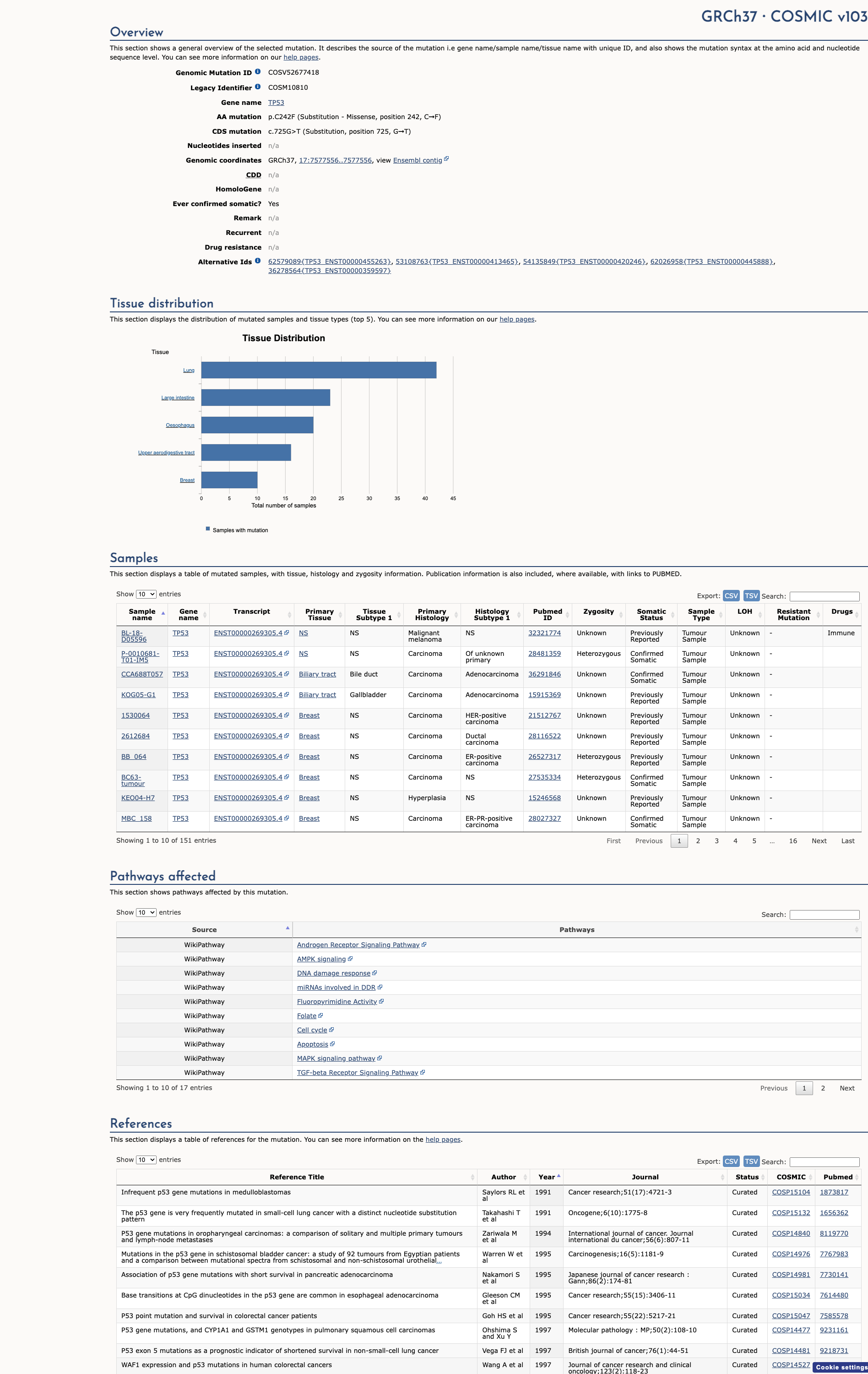
Functional Impact & Domains
Functional Domain
The TP53 C242F variant has been functionally characterized and shown to be damaging. It disrupts the zinc coordination sphere in the DNA-binding domain, leading to loss of function by destabilizing the protein and reducing its transactivation activity.
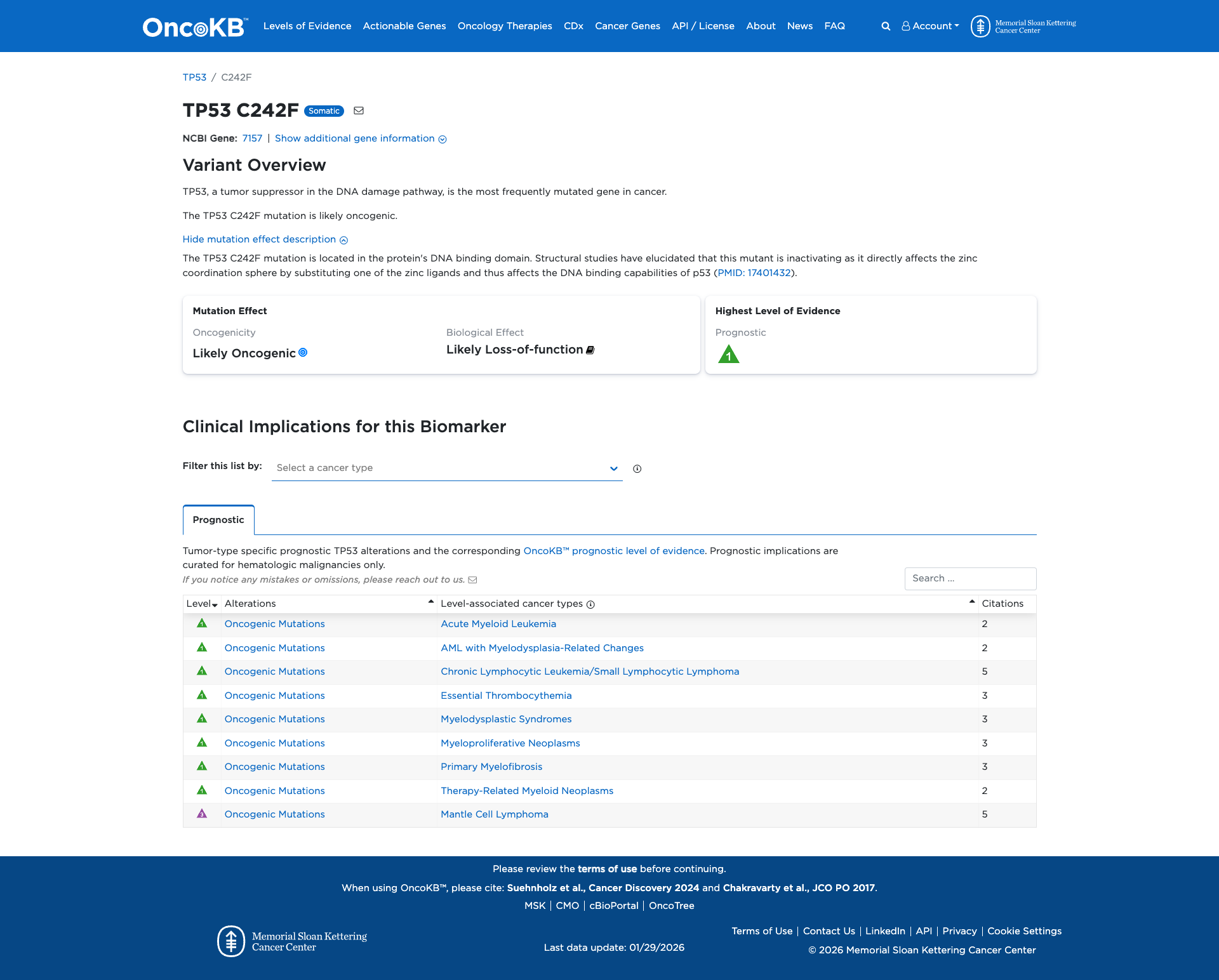
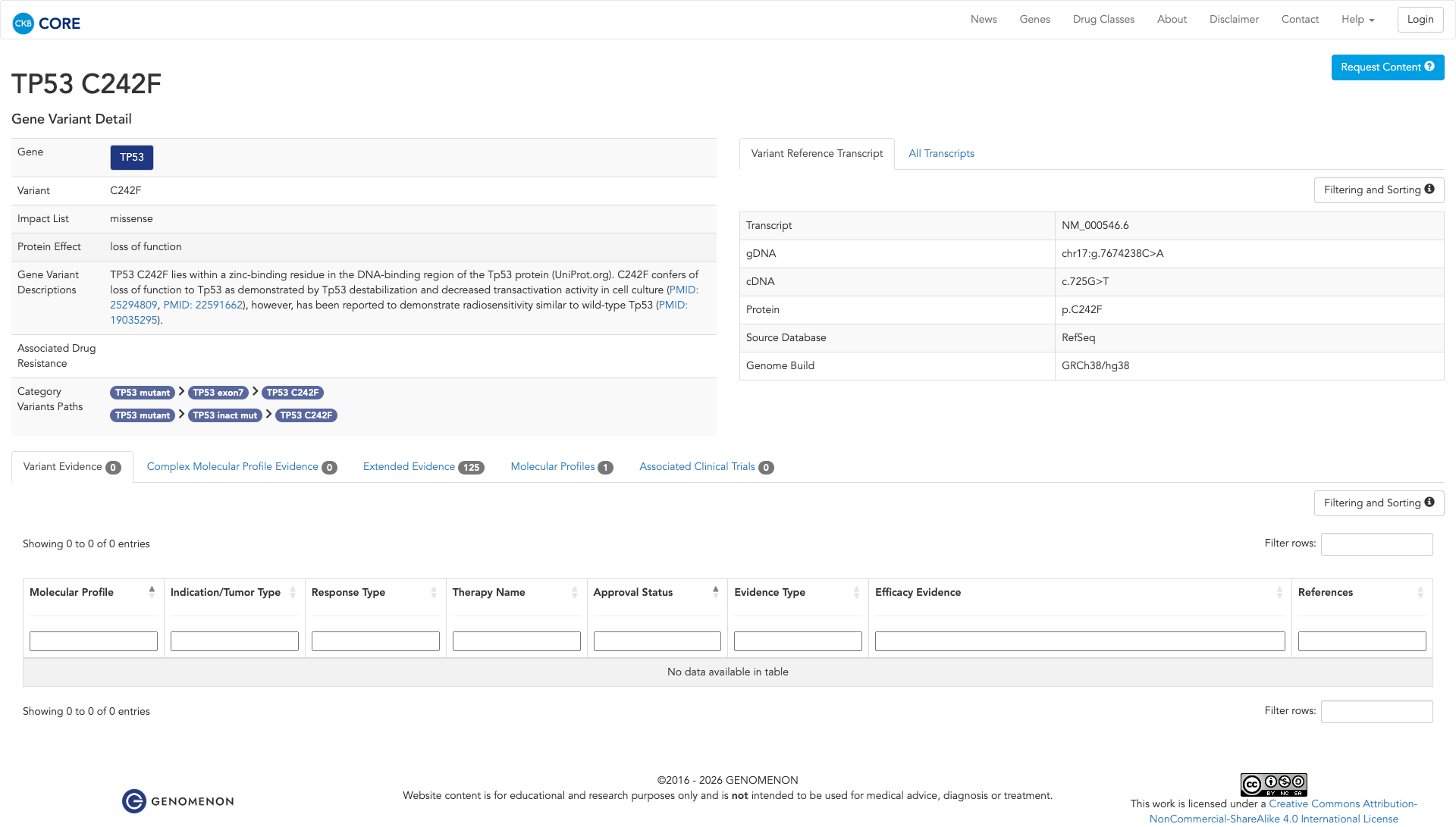
Click on previews to view full database entries. External databases may require institutional access.
Computational Analysis
Pathogenicity Predictions
SpliceAISpliceAI Scores
Window: ±500bp| Effect Type | Score | Position |
|---|---|---|
| Acceptor Loss (AL) | 0.0 | 5 bp |
| Donor Loss (DL) | 0.0 | 325 bp |
| Acceptor Gain (AG) | 0.0 | -398 bp |
| Donor Gain (DG) | 0.0 | -57 bp |
VCEP Guidelines
Applied ACMG/AMP Criteria (VCEP Specific)
PVS1 (Not Applied)
According to VCEP guidelines for TP53, PVS1 applies to null variants (nonsense, frameshift, canonical ±1,2 splice, initiation codon); this is a missense change at C242F. Therefore, PVS1 is not applied.
PS1 (Not Applied)
According to VCEP guidelines for TP53, PS1 applies when a variant results in the same amino acid change as a previously established pathogenic variant; C242F is a novel amino acid change at residue 242. Therefore, PS1 is not applied.
PS2 (Not Applied)
According to standard ACMG guidelines, PS2 applies to de novo occurrences with confirmed parental relationships; no de novo data are provided for this variant. Therefore, PS2 is not applied.
PS3 (Not Applied)
According to VCEP guidelines for TP53, PS3 strong requires non‐functional on Kato et al. data AND loss of function on another assay; the provided functional studies describe disruption of zinc coordination but do not specify Kato et al. or a second VCEP-approved assay. Therefore, PS3 is not applied.
PS4 (Not Applied)
According to VCEP guidelines for TP53, PS4 requires case/control or proband point‐based evidence; no proband or case-control data are provided. Therefore, PS4 is not applied.
PM1 (Not Applied)
According to VCEP guidelines for TP53, PM1 moderate applies to missense in codons 175, 245, 248, 249, 273, 282 or ≥10 somatic occurrences in cancerhotspots.org; C242 is not in a defined TP53 hotspot and recurrence is 0. Therefore, PM1 is not applied.
PM2 (Supporting)
According to VCEP guidelines for TP53, PM2 supporting applies when allele frequency is <0.00003 in gnomAD; the variant is absent from gnomAD. Therefore, PM2 is applied at Supporting strength.
PM3 (Not Applied)
According to standard ACMG guidelines, PM3 applies to recessive disorders with trans observations; TP53 disorders are dominant and no trans data are provided. Therefore, PM3 is not applied.
PM4 (Not Applied)
According to standard ACMG guidelines, PM4 applies to protein length changes (in-frame indels or stop loss); C242F is a missense change. Therefore, PM4 is not applied.
PM5 (Moderate)
According to VCEP guidelines for TP53, PM5 moderate applies to a novel missense at a residue where one other pathogenic missense has been seen; C242F has a previously reported pathogenic missense at residue 242. Therefore, PM5 is applied at Moderate strength.
PM6 (Not Applied)
According to standard ACMG guidelines, PM6 applies to presumed de novo without confirmation; no de novo data are provided. Therefore, PM6 is not applied.
PP1 (Not Applied)
According to VCEP guidelines for TP53, PP1 applies to segregation in ≥3 meioses; no segregation data are provided. Therefore, PP1 is not applied.
PP2 (Not Applied)
According to standard ACMG guidelines, PP2 applies when a gene has a low rate of benign missense and missense are common pathogenic; TP53 is intolerant to missense but this code is not used by the TP53 VCEP. Therefore, PP2 is not applied.
PP3 (Not Applied)
According to VCEP guidelines for TP53, PP3 requires BayesDel and aGVGD scores; no BayesDel/aGVGD data are provided. Therefore, PP3 is not applied.
PP4 (Not Applied)
According to VCEP guidelines for TP53, PP4 applies to highly specific phenotype observations; no phenotype data are provided. Therefore, PP4 is not applied.
PP5 (Not Applied)
According to standard ACMG guidelines, PP5 is not recommended and VCEP does not include PP5. Therefore, PP5 is not applied.
BA1 (Not Applied)
According to VCEP guidelines for TP53, BA1 requires allele frequency ≥0.001; the variant is absent from gnomAD. Therefore, BA1 is not applied.
BS1 (Not Applied)
According to VCEP guidelines for TP53, BS1 requires filtering allele frequency ≥0.0003; the variant is absent from gnomAD. Therefore, BS1 is not applied.
BS2 (Not Applied)
According to VCEP guidelines for TP53, BS2 requires ≥8 unaffected older females; no such data are provided. Therefore, BS2 is not applied.
BS3 (Not Applied)
According to VCEP guidelines for TP53, BS3 applies to preserved function assays; provided functional data show loss of function. Therefore, BS3 is not applied.
BS4 (Not Applied)
According to VCEP guidelines for TP53, BS4 applies to lack of segregation in affected family members; no segregation data are provided. Therefore, BS4 is not applied.
BP1 (Not Applied)
According to standard ACMG guidelines, BP1 applies to missense in genes where only truncating variants cause disease; TP53 pathogenic mechanism includes missense. Therefore, BP1 is not applied.
BP2 (Not Applied)
According to standard ACMG guidelines, BP2 applies to observation in trans with a pathogenic variant in a recessive disorder; TP53 conditions are dominant and no such data are provided. Therefore, BP2 is not applied.
BP3 (Not Applied)
According to standard ACMG guidelines, BP3 applies to in-frame indels in repetitive regions; C242F is a missense change. Therefore, BP3 is not applied.
BP4 (Not Applied)
According to VCEP guidelines for TP53, BP4 requires benign computational evidence by BayesDel; no BayesDel data are provided. Therefore, BP4 is not applied.
BP5 (Not Applied)
According to standard ACMG guidelines, BP5 applies when a variant is found in a gene for a different phenotype; not relevant here. Therefore, BP5 is not applied.
BP6 (Not Applied)
According to standard ACMG guidelines, BP6 is not recommended by VCEP. Therefore, BP6 is not applied.
BP7 (Not Applied)
According to VCEP guidelines for TP53, BP7 applies to silent variants with no impact on splicing; C242F is missense. Therefore, BP7 is not applied.