Genetic Information
Gene & Transcript Details
| ID | Status | Details |
|---|---|---|
| NM_000546.5 | RefSeq Select | 2591 nt | 203–1384 |
| NM_000546.3 | Alternative | 2640 nt | 252–1433 |
| NM_000546.6 | MANE Select | 2512 nt | 143–1324 |
| NM_000546.4 | Alternative | 2586 nt | 198–1379 |
| NM_000546.2 | Alternative | 2629 nt | 252–1433 |
Variant Details
Clinical & Population Data
Population Frequency
gnomADClinVar
Open"This variant has been reported in ClinVar as Uncertain significance (2 clinical laboratories)."
COSMIC Somatic Evidence
Open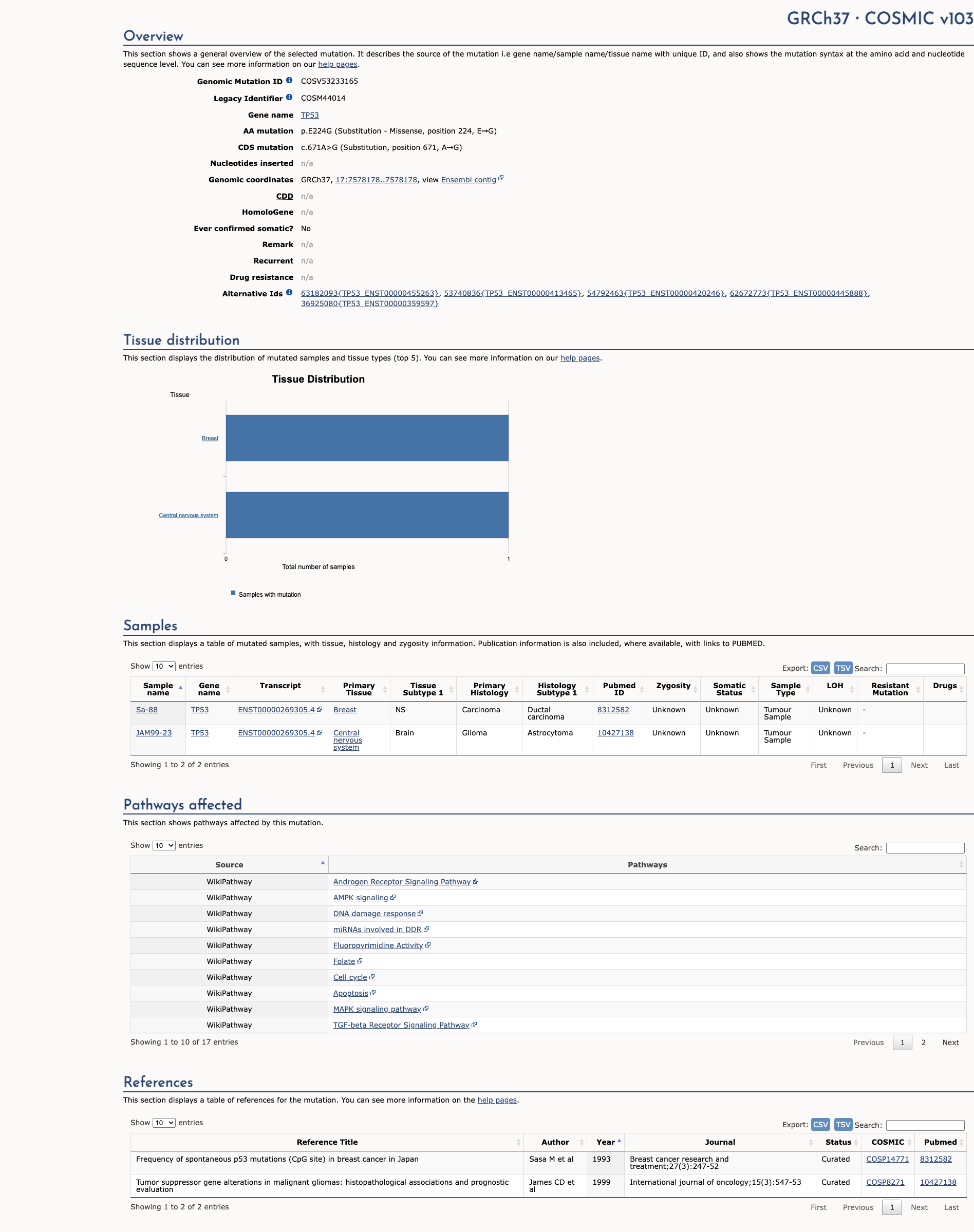
Functional Impact & Domains
Functional Domain

Computational Analysis
Pathogenicity Predictions
SpliceAISpliceAI Scores
Window: ±500bp| Effect Type | Score | Position |
|---|---|---|
| Acceptor Loss (AL) | 0.36 | 111 bp |
| Donor Loss (DL) | 0.73 | -1 bp |
| Acceptor Gain (AG) | 0.0 | -1 bp |
| Donor Gain (DG) | 0.01 | -64 bp |
VCEP Guidelines
Applied ACMG/AMP Criteria (VCEP Specific)
PVS1 (Not Applied)
According to VCEP guidelines, PVS1 applies to null variants or canonical splice variants predicted to undergo NMD in TP53. The variant is a missense change (E224G), not a null or splice variant. Therefore, PVS1 is not applied.
PS1 (Not Applied)
According to VCEP guidelines, PS1 applies when the same amino acid change as a previously established TP53 pathogenic variant is observed. There is no report of a pathogenic E224G or equivalent amino acid change at codon 224. Therefore, PS1 is not applied.
PS2 (Not Applied)
According to VCEP guidelines, PS2 applies to confirmed de novo cases meeting point thresholds. No de novo data are available. Therefore, PS2 is not applied.
PS3 (Not Applied)
According to VCEP guidelines, PS3 requires functional assay data demonstrating loss of function in TP53. No functional study results are available for E224G. Therefore, PS3 is not applied.
PS4 (Not Applied)
According to VCEP guidelines, PS4 requires proband counting to meet point thresholds. No case-level or segregation data are reported. Therefore, PS4 is not applied.
PM1 (Not Applied)
According to VCEP guidelines, PM1 Moderate applies to missense variants in TP53 hotspot codons (175, 245, 248, 249, 273, 282) or Supporting for 2–9 somatic occurrences. Codon 224 is not in the defined hotspots and has zero somatic occurrences. Therefore, PM1 is not applied.
PM2 (Supporting)
According to VCEP guidelines, PM2 Supporting is: "Variant should have an allele frequency of less than 0.00003 (0.003%) in gnomAD or another large sequenced population." The evidence shows this variant is absent from gnomAD (MAF=0%). Therefore, PM2 is applied at Supporting strength because the allele frequency is below the threshold.
PM3 (Not Applied)
According to standard ACMG guidelines, PM3 applies to detection in trans with a pathogenic variant for recessive disorders. TP53 disease is autosomal dominant and no trans observations are relevant. Therefore, PM3 is not applied.
PM4 (Not Applied)
According to standard ACMG guidelines, PM4 applies to protein length changes (in-frame indels or stop-loss). The variant is a missense change without length alteration. Therefore, PM4 is not applied.
PM5 (Not Applied)
According to VCEP guidelines, PM5 Moderate applies when ≥2 different pathogenic missense changes at the same codon have been observed; PM5 Supporting when a single pathogenic missense is known. No pathogenic variants at codon 224 are reported. Therefore, PM5 is not applied.
PM6 (Not Applied)
According to standard ACMG guidelines, PM6 applies to assumed de novo variants without confirmation. There is no de novo evidence. Therefore, PM6 is not applied.
PP1 (Not Applied)
According to VCEP guidelines, PP1 requires cosegregation in multiple meioses. No segregation data are available. Therefore, PP1 is not applied.
PP2 (Not Applied)
According to standard ACMG guidelines, PP2 applies for genes where missense is a common mechanism and benign missense variation is low. TP53 has many known pathogenic missense variants; the rule is not met. Therefore, PP2 is not applied.
PP3 (Supporting)
According to VCEP guidelines, PP3 Supporting is: "Exonic (including silent variants and apparent 'missense' variants) with predicted splice effect: SpliceAI ≥ 0.2." The evidence shows a SpliceAI donor loss score of 0.73. Therefore, PP3 is applied at Supporting strength because SpliceAI ≥ 0.2 indicates a predicted splice effect.
PP4 (Not Applied)
According to VCEP guidelines, PP4 applies for specific variant allele fraction observations in somatic contexts. Germline phenotype data are not provided. Therefore, PP4 is not applied.
PP5 (Not Applied)
According to standard ACMG guidelines, PP5 (reputable source assertion) is not used per ACMG/AMP recommendations. Therefore, PP5 is not applied.
BA1 (Not Applied)
According to VCEP guidelines, BA1 applies at FAF ≥ 0.001 in gnomAD. The variant is absent in gnomAD. Therefore, BA1 is not applied.
BS1 (Not Applied)
According to VCEP guidelines, BS1 Strong applies at FAF ≥ 0.0003 but <0.001. The variant is absent in gnomAD. Therefore, BS1 is not applied.
BS2 (Not Applied)
According to VCEP guidelines, BS2 requires observation in ≥8 healthy older females. No such data are available. Therefore, BS2 is not applied.
BS3 (Not Applied)
According to VCEP guidelines, BS3 requires functional data showing retained function. No functional assays for E224G are reported. Therefore, BS3 is not applied.
BS4 (Not Applied)
According to VCEP guidelines, BS4 requires lack of segregation in multiple affected family members. No segregation data exist. Therefore, BS4 is not applied.
BP1 (Not Applied)
According to standard ACMG guidelines, BP1 applies to missense variants in genes where only LOF causes disease. TP53 disease mechanism includes dominant negative missense effects. Therefore, BP1 is not applied.
BP2 (Not Applied)
According to standard ACMG guidelines, BP2 applies when observed in trans with a pathogenic variant for a dominant disorder. No such observations are reported. Therefore, BP2 is not applied.
BP3 (Not Applied)
According to standard ACMG guidelines, BP3 applies to in-frame indels in repetitive regions. This is a missense variant. Therefore, BP3 is not applied.
BP4 (Not Applied)
According to VCEP guidelines, BP4 requires benign computational evidence (BayesDel ≤ -0.008 and SpliceAI < 0.2). The variant has damaging predictions and SpliceAI ≥ 0.2. Therefore, BP4 is not applied.
BP5 (Not Applied)
According to standard ACMG guidelines, BP5 applies when an alternate molecular cause is identified. No alternate cause is reported. Therefore, BP5 is not applied.
BP6 (Not Applied)
According to standard ACMG guidelines, BP6 (low-confidence assertion) is not recommended. Therefore, BP6 is not applied.
BP7 (Not Applied)
According to VCEP guidelines, BP7 applies to synonymous variants with no splicing impact. This is a missense variant. Therefore, BP7 is not applied.