Genetic Information
Gene & Transcript Details
| ID | Status | Details |
|---|---|---|
| NM_000059.4 | MANE Select | 11954 nt | 200–10456 |
| NM_000059.2 | Alternative | 11386 nt | 228–10484 |
| NM_000059.3 | RefSeq Select | 11386 nt | 228–10484 |
Variant Details
Clinical & Population Data
Population Frequency
gnomADClinVar
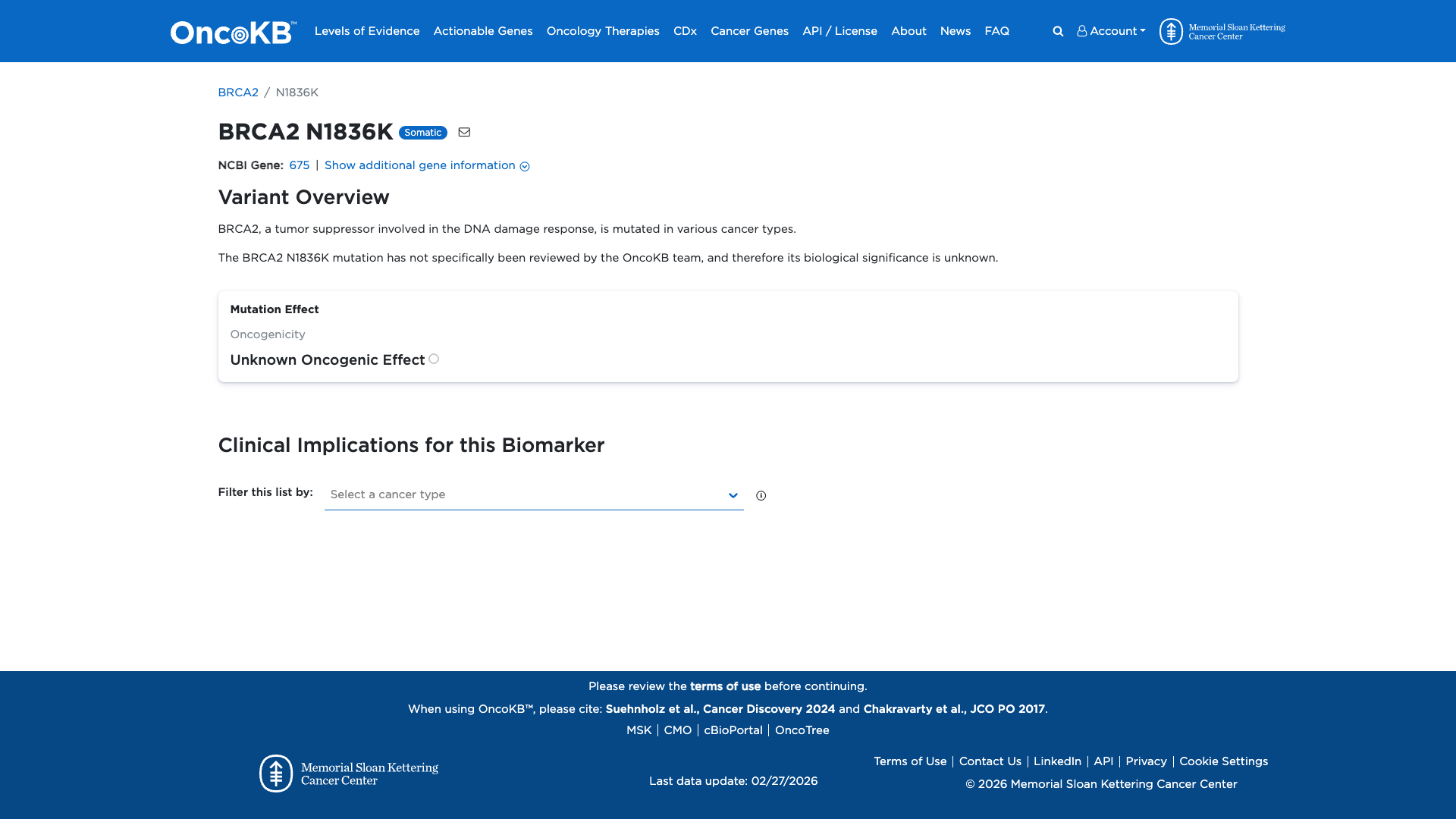
OpenMissense variant in a coldspot region where missense variants are very unlikely to be pathogenic (PMID:31911673).
Variant summary: BRCA2 c.5508T>G (p.Asn1836Lys) results in a non-conservative amino acid change in the encoded protein sequence. Three of four in-silico tools predict a benign effect of the variant on protein function. The variant was absent in 250144 control chromosomes. The available data on variant occurrences in the general population are insufficient to allow any conclusion about variant significance. c.5508T>G has been reported in the literature in individuals affected with Hereditary Breast And Ovarian Cancer Syndrome and those being tested for hereditary cancer panels, without strong evidence for causality (Lincoln_2015, Patruno_2021, Secondino_2022). These reports do not provide unequivocal conclusions about association of the variant with Hereditary Breast And Ovarian Cancer Syndrome. To our knowledge, no experimental evidence demonstrating an impact on protein function has been reported. Four clinical diagnostic laboratories have submitted clinical-significance assessments for this variant to ClinVar after 2014 without evidence for independent evaluation. All laboratories classified the variant as benign/likely benign. Based on the evidence outlined above, the variant was classified as uncertain significance.
"This variant has been reported in ClinVar as Uncertain significance (2 clinical laboratories) and as Likely benign (5 clinical laboratories)."
COSMIC Somatic Evidence
Open
Functional Impact & Domains
Functional Domain
Computational Analysis
Pathogenicity Predictions
SpliceAISpliceAI Scores
Window: ±500bp| Effect Type | Score | Position |
|---|---|---|
| Acceptor Loss (AL) | 0.0 | -226 bp |
| Donor Loss (DL) | 0.0 | 6 bp |
| Acceptor Gain (AG) | 0.0 | 218 bp |
| Donor Gain (DG) | 0.0 | -243 bp |
VCEP Guidelines
Applied ACMG/AMP Criteria (VCEP Specific)
PVS1 (Not Applied)
According to VCEP guidelines, the rule for PVS1 is: "Very Strong Null variant (nonsense, frameshift, splice site (donor/acceptor ±1,2), initiation codon, single or multi-exon deletion) in a gene where loss of function is a known mechanism of disease." The evidence for this variant shows: it is a missense change (N1836K), not a null variant. Therefore, this criterion is not applied.
PS1 (Not Applied)
According to VCEP guidelines, the rule for PS1 is: "Strong: predicted missense substitutions where a previously classified pathogenic variant results in the same amino acid change (no predicted effect on splicing)." The evidence for this variant shows: no previously established pathogenic variant causes N1836K. Therefore, this criterion is not applied.
PS2 (Not Applied)
According to standard ACMG guidelines, the rule for PS2 is: "De novo (both maternity and paternity confirmed) in a patient with the disease and no family history." The evidence for this variant shows: no de novo data or parental testing. Therefore, this criterion is not applied.
PS3 (Not Applied)
According to VCEP guidelines, the rule for PS3 is: "Strong: well-established in vitro or in vivo functional studies supportive of a damaging effect." The evidence for this variant shows: no functional characterization has been performed. Therefore, this criterion is not applied.
PS4 (Not Applied)
According to VCEP guidelines, the rule for PS4 is: "Strong: prevalence of the variant in affected individuals is significantly increased compared to controls (p≤0.05 and OR≥4)." The evidence for this variant shows: no case-control or familial aggregation data. Therefore, this criterion is not applied.
PM1 (Not Applied)
According to VCEP guidelines, the rule for PM1 is: "Moderate: variant is located in a mutational hotspot or functional domain without benign variation." The evidence for this variant shows: N1836K lies outside the BRCA2 PALB2-binding domain (aa10–40) and DNA-binding domain (aa2481–3186). Therefore, this criterion is not applied.
PM2 (Supporting)
According to VCEP guidelines, the rule for PM2 is: "Supporting: absent from controls in an outbred population (gnomAD v2.1 non-cancer exomes and v3.1 non-cancer)." The evidence for this variant shows: MAF=0% in gnomAD. Therefore, this criterion is applied at Supporting strength.
PM3 (Not Applied)
According to VCEP guidelines, the rule for PM3 is: "Supporting/Moderate/Strong: observed in trans with another pathogenic variant in a patient with a Fanconi anemia phenotype consistent with BRCA2-related FA." The evidence for this variant shows: no FA co-occurrence data. Therefore, this criterion is not applied.
PM4 (Not Applied)
According to standard ACMG guidelines, the rule for PM4 is: "In-frame indels or stop-loss variants changing protein length." The evidence for this variant shows: it is a missense change without protein length alteration. Therefore, this criterion is not applied.
PM5 (Not Applied)
According to standard ACMG guidelines, the rule for PM5 is: "Novel missense change at an amino acid position where a different missense change is pathogenic." The evidence for this variant shows: no other pathogenic missense reported at residue 1836. Therefore, this criterion is not applied.
PM6 (Not Applied)
According to standard ACMG guidelines, the rule for PM6 is: "Assumed de novo without confirmation of paternity and maternity." The evidence for this variant shows: no de novo information. Therefore, this criterion is not applied.
PP1 (Not Applied)
According to VCEP guidelines, the rule for PP1 is: "Supporting/Moderate/Strong co-segregation with disease in multiple affected family members." The evidence for this variant shows: no segregation data. Therefore, this criterion is not applied.
PP2 (Not Applied)
According to standard ACMG guidelines, the rule for PP2 is: "Missense variant in a gene where missense is a common mechanism of disease and with low benign variation." The evidence for this variant shows: BRCA2 missense variants have variable impact and benign variation exists. Therefore, this criterion is not applied.
PP3 (Not Applied)
According to VCEP guidelines, the rule for PP3 is: "Supporting: missense variant inside a functionally important domain with deleterious in silico predictions (BayesDel no-AF≥0.30 or SpliceAI≥0.2)." The evidence for this variant shows: it lies outside key domains and in silico predictors are predominantly benign. Therefore, this criterion is not applied.
PP4 (Not Applied)
According to VCEP guidelines, the rule for PP4 is: "Supporting/Moderate/Strong: phenotype-specific case-level data contributing to likelihood ratios." The evidence for this variant shows: no detailed multifactorial phenotype data. Therefore, this criterion is not applied.
PP5 (Not Applied)
According to standard ACMG guidelines, the rule for PP5 is: "Reputable source reports variant as pathogenic without available evidence." The evidence for this variant shows: ClinVar entries are VUS or Likely Benign, not authoritative pathogenic. Therefore, this criterion is not applied.
BA1 (Not Applied)
According to VCEP guidelines, the rule for BA1 is: "Stand Alone: filter allele frequency >0.1% in relevant population databases." The evidence for this variant shows: MAF=0% in gnomAD. Therefore, this criterion is not applied.
BS1 (Not Applied)
According to VCEP guidelines, the rule for BS1 is: "Strong: filter allele frequency >0.01% in relevant population databases." The evidence for this variant shows: MAF=0%. Therefore, this criterion is not applied.
BS2 (Not Applied)
According to VCEP guidelines, the rule for BS2 is: "Strong/Moderate/Supporting: observed in healthy adult individuals without Fanconi anemia features." The evidence for this variant shows: no such observations. Therefore, this criterion is not applied.
BS3 (Not Applied)
According to VCEP guidelines, the rule for BS3 is: "Strong: well-established functional studies show no damaging effect." The evidence for this variant shows: no functional assays. Therefore, this criterion is not applied.
BS4 (Not Applied)
According to VCEP guidelines, the rule for BS4 is: "Strong/Moderate/Supporting: lack of segregation in affected family members." The evidence for this variant shows: no segregation analysis. Therefore, this criterion is not applied.
BP1 (Strong)
According to VCEP guidelines, the rule for BP1_Strong is: "Strong: missense variant outside a clinically important domain (aa10–40 or aa2481–3186) with no predicted splicing impact (SpliceAI≤0.1)." The evidence for this variant shows: N1836K lies outside those domains and SpliceAI predicts no splicing effect. Therefore, this criterion is applied at Strong strength.
BP2 (Not Applied)
According to standard ACMG guidelines, the rule for BP2 is: "Observed in trans with a pathogenic variant for a dominant disorder or in cis with a benign variant." The evidence for this variant shows: no such observations. Therefore, this criterion is not applied.
BP3 (Not Applied)
According to standard ACMG guidelines, the rule for BP3 is: "In-frame indels in repetitive regions without known function." The evidence for this variant shows: it is a missense variant. Therefore, this criterion is not applied.
BP4 (Not Applied)
According to VCEP guidelines, the rule for BP4 is: "Supporting: missense variant inside a key domain with no predicted impact (BayesDel≤0.18 and SpliceAI≤0.1)." The evidence for this variant shows: it lies outside key domains. Therefore, this criterion is not applied.
BP5 (Not Applied)
According to VCEP guidelines, the rule for BP5 is: "Supporting: variant found in a case with an alternate molecular basis for disease." The evidence for this variant shows: no such cases. Therefore, this criterion is not applied.
BP6 (Not Applied)
According to standard ACMG guidelines, the rule for BP6 is: "Reputable source reports variant as benign without evidence." The evidence for this variant shows: no authoritative benign report. Therefore, this criterion is not applied.
BP7 (Not Applied)
According to VCEP guidelines, the rule for BP7 is: "Supporting: silent or intronic variant without splicing impact, or missense outside domains with functional data." The evidence for this variant shows: it is a missense variant and no functional data. Therefore, this criterion is not applied.