Genetic Information
Gene & Transcript Details
| ID | Status | Details |
|---|---|---|
| NM_000179.3 | MANE Select | 4265 nt | 90–4172 |
| NM_000179.2 | RefSeq Select | 4435 nt | 153–4235 |
| NM_000179.1 | Alternative | 4264 nt | 88–4170 |
Variant Details
Clinical & Population Data
Population Frequency
gnomADClinVar
OpenThe frequency of this variant in the general population, 0.000044 (5/112482 chromosomes, http://gnomad.broadinstitute.org), is uninformative in assessment of its pathogenicity. In the published literature, the variant has been reported in individuals with breast cancer (PMIDs: 35402282 (2022), 35127508 (2022)). In a large-scale breast cancer association study, the variant was observed in individuals with breast cancer as well as in healthy controls (PMID: 33471991 (2021), see also LOVD (http://databases.lovd.nl/shared/genes/MSH6)). Analysis of this variant using bioinformatics tools for the prediction of the effect of amino acid changes on protein structure and function yielded predictions that this variant is damaging. Based on the available information, we are unable to determine the clinical significance of this variant.
This missense variant replaces arginine with glutamine at codon 1035 of the MSH6 protein. Computational prediction suggests that this variant may have deleterious impact on protein structure and function (internally defined REVEL score threshold >= 0.7, PMID: 27666373). To our knowledge, functional studies have not been performed for this variant. This variant has been reported in an individual affected with prostate cancer (PMID: 26689913). In a large breast cancer case-control study, this variant has been reported in 3/60466 cases and 4/53461 unaffected controls (PMID: 33471991). This variant has been identified in 7/248120 chromosomes in the general population by the Genome Aggregation Database (gnomAD). The available evidence is insufficient to determine the role of this variant in disease conclusively. Therefore, this variant is classified as a Variant of Uncertain Significance.
This missense variant replaces arginine with glutamine at codon 1035 of the MSH6 protein. Computational prediction suggests that this variant may have deleterious impact on protein structure and function (internally defined REVEL score threshold >= 0.7, PMID: 27666373). To our knowledge, functional studies have not been performed for this variant. This variant has been reported in an individual affected with prostate cancer (PMID: 26689913). In a large breast cancer case-control study, this variant has been reported in 3/60466 cases and 4/53461 unaffected controls (PMID: 33471991). This variant has been identified in 7/248120 chromosomes in the general population by the Genome Aggregation Database (gnomAD). The available evidence is insufficient to determine the role of this variant in disease conclusively. Therefore, this variant is classified as a Variant of Uncertain Significance.
"This variant has been reported in ClinVar as Uncertain significance (7 clinical laboratories) and as Uncertain Significance (1 clinical laboratories) and as Likely benign (2 clinical laboratories)."
COSMIC Somatic Evidence
Open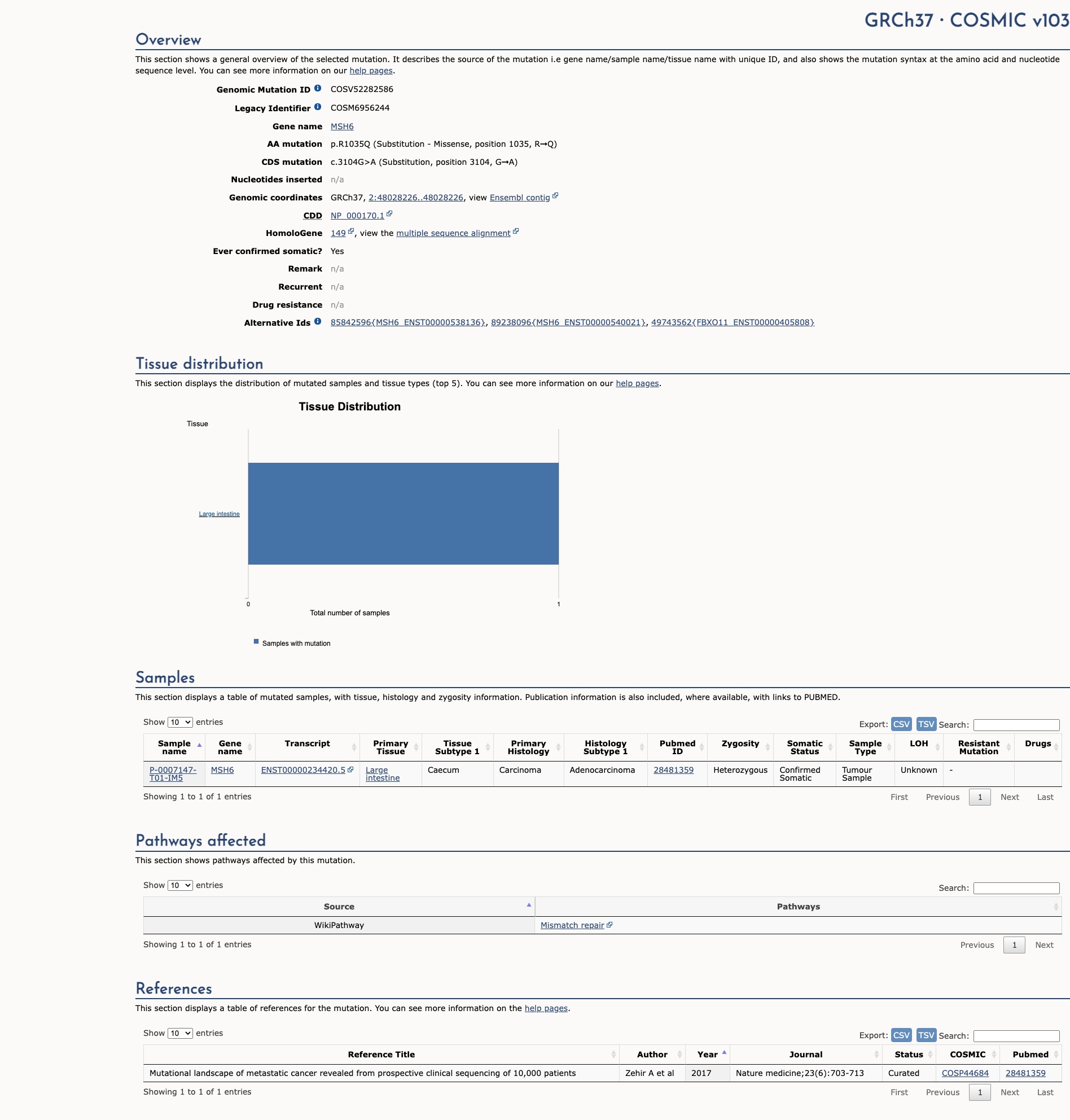
Functional Impact & Domains
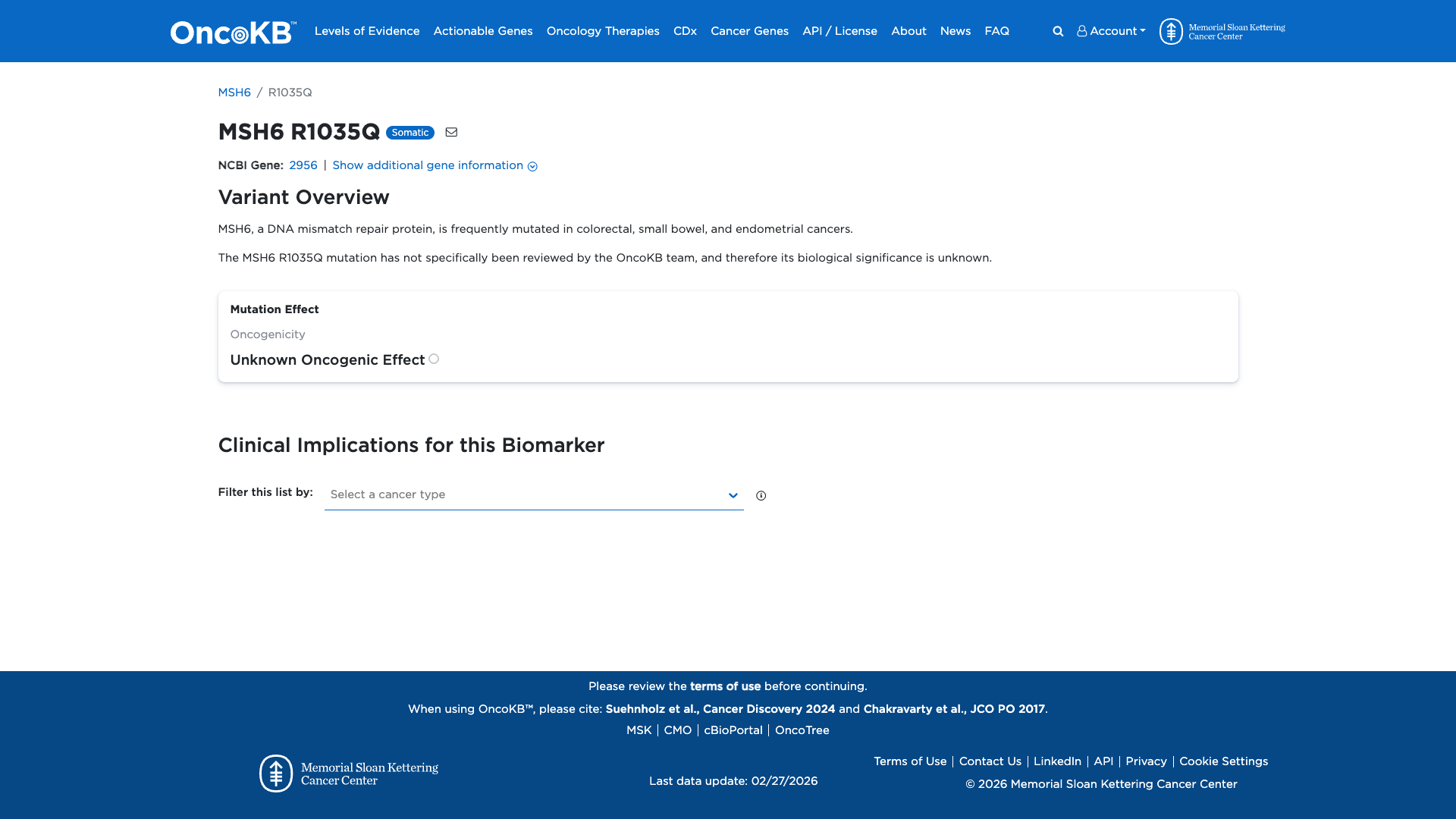
Functional Domain
Computational Analysis
Pathogenicity Predictions
SpliceAISpliceAI Scores
Window: ±500bp| Effect Type | Score | Position |
|---|---|---|
| Acceptor Loss (AL) | 0.0 | -381 bp |
| Donor Loss (DL) | 0.01 | 68 bp |
| Acceptor Gain (AG) | 0.0 | -421 bp |
| Donor Gain (DG) | 0.0 | 154 bp |
VCEP Guidelines
Applied ACMG/AMP Criteria (VCEP Specific)
PVS1 (Not Applied)
According to VCEP guidelines, the rule for PVS1 is: "Very Strong nonsense/frameshift variant introducing PTC ≤ codon 1341 or splice ±1/2 disrupting reading frame." The evidence for this variant shows: R1035Q is a missense change, not a null or splice ±1/2 variant. Therefore, PVS1 is not applied.
PS1 (Not Applied)
According to VCEP guidelines, the rule for PS1 is: "Same amino acid change as a previously established pathogenic variant." The evidence for this variant shows: no other c.3104G>A (p.R1035Q) or alternate nucleotide change at codon 1035 has been classified as pathogenic. Therefore, PS1 is not applied.
PS2 (Not Applied)
According to VCEP guidelines, the rule for PS2 is: "De novo occurrence points scoring system." The evidence for this variant shows: no data on de novo status in a proband with confirmed maternity/paternity. Therefore, PS2 is not applied.
PS3 (Not Applied)
According to VCEP guidelines, the rule for PS3 is: "Calibrated functional assays with functional odds for Pathogenicity >18.7 for strong, >4.3–≤18.7 for moderate, >2.08–≤4.3 for supporting." The evidence for this variant shows: no functional assay data are available. Therefore, PS3 is not applied.
PS4 (Not Applied)
According to standard ACMG guidelines, the rule for PS4 is: "Increased prevalence in affected individuals compared with controls." The evidence for this variant shows: no case–control or segregation cohort data. Therefore, PS4 is not applied.
PM1 (Not Applied)
According to VCEP guidelines, the rule for PM1 is: "Located in a mutational hot spot and/or critical functional domain." The evidence for this variant shows: domain context for codon 1035 is not established as a hot spot or critical domain by VCEP. Therefore, PM1 is not applied.
PM2 (Supporting)
According to VCEP guidelines, PM2 (Supporting) rule is: "Absent/extremely rare (<1 in 50,000 alleles) in gnomAD v4 dataset." The evidence for this variant shows: MAF = 0.00282% (~1 in 35,000), below the 1/50,000 threshold. Therefore, PM2 is applied at Supporting strength because the allele frequency meets the criterion.
PM3 (Not Applied)
According to VCEP guidelines, the rule for PM3 is: "Evidence for recessive disorders demonstrating in trans with pathogenic variant." The evidence for this variant shows: no data on phase or trans occurrence. Therefore, PM3 is not applied.
PM4 (Not Applied)
According to standard ACMG guidelines, the rule for PM4 is: "Protein length changes due to in‐frame indels or stop loss." The evidence for this variant shows: R1035Q is not an indel or stop‐loss. Therefore, PM4 is not applied.
PM5 (Not Applied)
According to VCEP guidelines, the rule for PM5 is: "Different missense change at same residue classified as pathogenic." The evidence for this variant shows: no other missense at codon 1035 has been classified as pathogenic. Therefore, PM5 is not applied.
PM6 (Not Applied)
According to VCEP guidelines, the rule for PM6 is: "Assumed de novo without confirmation of paternity/maternity." The evidence for this variant shows: no de novo or family data. Therefore, PM6 is not applied.
PP1 (Not Applied)
According to VCEP guidelines, the rule for PP1 is: "Co‐segregation with disease in pedigree(s)." The evidence for this variant shows: no segregation data. Therefore, PP1 is not applied.
PP2 (Not Applied)
According to standard ACMG guidelines, the rule for PP2 is: "Missense in a gene with low rate of benign missense variation and where missense variants are common mechanism." The evidence for this variant shows: insufficient data on benign missense variation rate in MSH6. Therefore, PP2 is not applied.
PP3 (Supporting)
According to standard ACMG guidelines, the rule for PP3 is: "Multiple lines of computational evidence support a deleterious effect." The evidence for this variant shows: REVEL = 0.82, pathogenic predictions from PolyPhen‐2, MetaSVM, MetaLR. Therefore, PP3 is applied at Supporting strength because multiple in silico tools predict a deleterious effect.
PP4 (Not Applied)
According to VCEP guidelines, the rule for PP4 is: "Specific phenotype or tumor testing consistent with gene defect." The evidence for this variant shows: no tumor MSI or MMR IHC data reported. Therefore, PP4 is not applied.
PP5 (Not Applied)
According to standard ACMG guidelines, the rule for PP5 is: "Reputable source reports variant as pathogenic." The evidence for this variant shows: ClinVar reports primarily VUS and some Likely Benign. Therefore, PP5 is not applied.
BA1 (Not Applied)
According to VCEP guidelines, BA1 (Stand‐alone) rule is: "GnomAD v4 Grpmax filtering allele frequency ≥0.22%." The evidence for this variant shows: MAF = 0.00282%, far below 0.22%. Therefore, BA1 is not applied.
BS1 (Not Applied)
According to VCEP guidelines, BS1 (Strong) rule is: "GnomAD v4 Grpmax filtering allele frequency ≥0.022% and <0.22%." The evidence for this variant shows: MAF = 0.00282%, below 0.022%. Therefore, BS1 is not applied.
BS2 (Not Applied)
According to VCEP guidelines, the rule for BS2 is: "Co‐occurrence in trans with pathogenic variant without clinical manifestations of CMMRD." The evidence for this variant shows: no co‐occurrence data. Therefore, BS2 is not applied.
BS3 (Not Applied)
According to VCEP guidelines, the rule for BS3 is: "Calibrated functional assays showing no impact or benign synonymous/intronic with no aberration." The evidence for this variant shows: no functional or splicing assay data. Therefore, BS3 is not applied.
BS4 (Not Applied)
According to VCEP guidelines, the rule for BS4 is: "Lack of segregation with disease in pedigree(s)." The evidence for this variant shows: no segregation data. Therefore, BS4 is not applied.
BP1 (Not Applied)
According to standard ACMG guidelines, the rule for BP1 is: "Missense in gene where only truncating variants cause disease." The evidence for this variant shows: pathogenic missense variants are known in MSH6. Therefore, BP1 is not applied.
BP2 (Not Applied)
According to standard ACMG guidelines, the rule for BP2 is: "Observed in trans with a pathogenic variant for dominant disorder." The evidence for this variant shows: no such observations. Therefore, BP2 is not applied.
BP3 (Not Applied)
According to standard ACMG guidelines, the rule for BP3 is: "In‐frame indel in repetitive region without known function." The evidence for this variant shows: R1035Q is not an indel. Therefore, BP3 is not applied.
BP4 (Not Applied)
According to standard ACMG guidelines, the rule for BP4 is: "Multiple lines of computational evidence support benign effect." The evidence for this variant shows: computational predictions are mixed with predominant pathogenic predictions. Therefore, BP4 is not applied.
BP5 (Not Applied)
According to standard ACMG guidelines, the rule for BP5 is: "Variant found in case with an alternate molecular basis for disease." The evidence for this variant shows: no evidence of alternate cause. Therefore, BP5 is not applied.
BP6 (Not Applied)
According to standard ACMG guidelines, the rule for BP6 is: "Reputable source reports variant as benign." The evidence for this variant shows: ClinVar reports uncertain and likely benign but not enough for a benign assertion. Therefore, BP6 is not applied.
BP7 (Not Applied)
According to standard ACMG guidelines, the rule for BP7 is: "Synonymous variant with no splicing impact." The evidence for this variant shows: R1035Q is missense, not synonymous. Therefore, BP7 is not applied.