Genetic Information
Gene & Transcript Details
| ID | Status | Details |
|---|---|---|
| NM_000179.3 | MANE Select | 4265 nt | 90–4172 |
| NM_000179.2 | RefSeq Select | 4435 nt | 153–4235 |
| NM_000179.1 | Alternative | 4264 nt | 88–4170 |
Variant Details
Clinical & Population Data
Population Frequency
gnomADClinVar
Open"This variant has been reported in ClinVar as Likely benign (4 clinical laboratories) and as Benign (1 clinical laboratories)."
COSMIC Somatic Evidence
Open
Functional Impact & Domains
Functional Domain
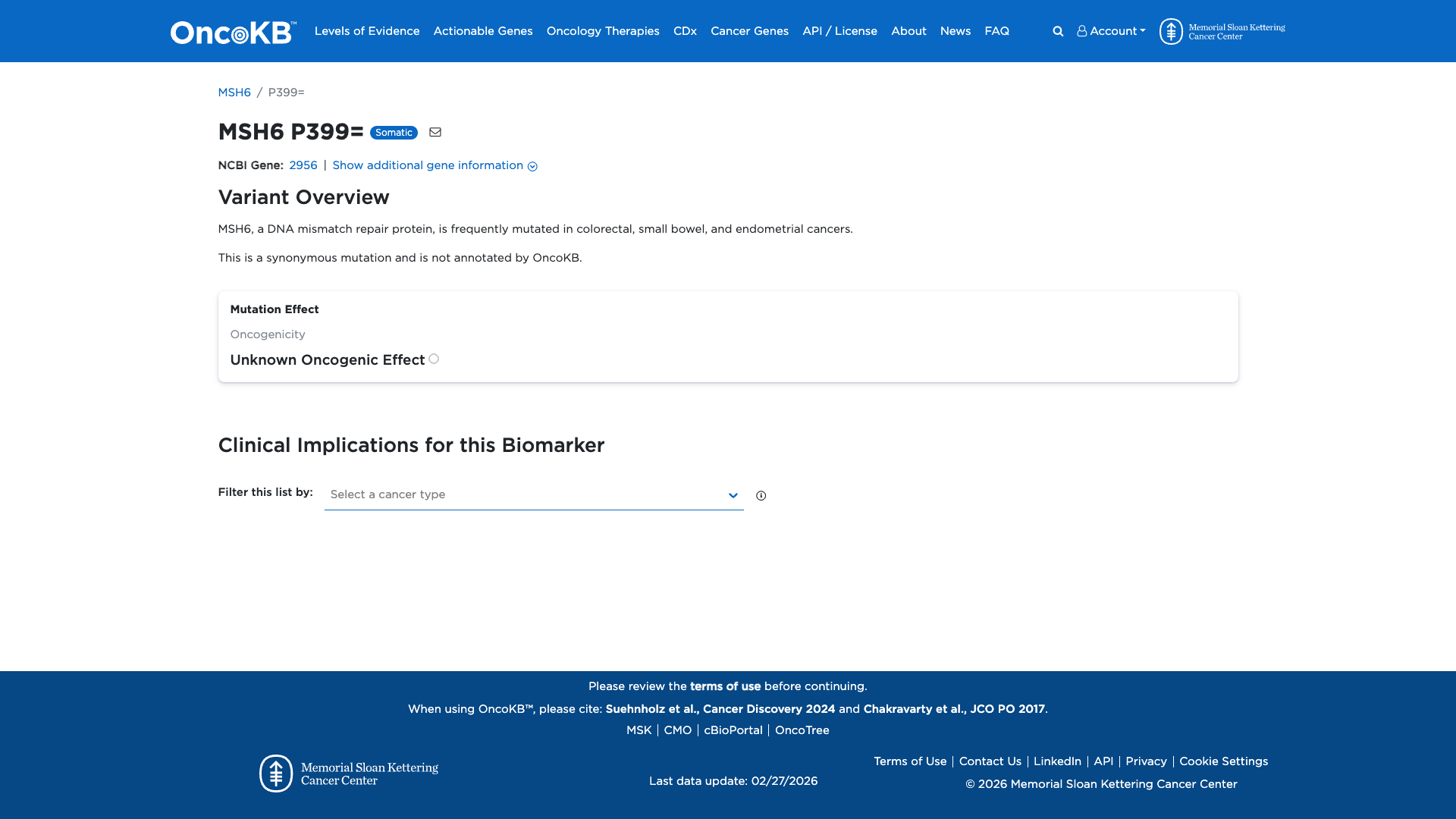
Computational Analysis
Pathogenicity Predictions
SpliceAISpliceAI Scores
Window: ±500bp| Effect Type | Score | Position |
|---|---|---|
| Acceptor Loss (AL) | 0.0 | 88 bp |
| Donor Loss (DL) | 0.0 | -288 bp |
| Acceptor Gain (AG) | 0.0 | 215 bp |
| Donor Gain (DG) | 0.0 | 87 bp |
VCEP Guidelines
Applied ACMG/AMP Criteria (VCEP Specific)
PVS1 (Not Applied)
According to VCEP guidelines, the rule for PVS1 is: "Very Strong Nonsense/frameshift variant introducing Premature Termination Codon (PTC) ≤ codon 1341 in MSH6..." The evidence for this variant shows a synonymous change c.1197T>C (P399=) which does not introduce a stop codon or frameshift. Therefore, this criterion is not applied.
PS1 (Not Applied)
According to VCEP guidelines, the rule for PS1 is: "Strong A predicted missense substitution that encodes the same amino acid change with a different underlying nucleotide change previously established by this VCEP as Pathogenic..." The evidence for this variant shows a synonymous change without an amino acid substitution. Therefore, this criterion is not applied.
PS2 (Not Applied)
According to VCEP guidelines, the rule for PS2 is: "Very Strong ≥4 de novo points; Strong 2–3 de novo points; Moderate 1 de novo point; Supporting 0.5 de novo points." The evidence for this variant shows no documented de novo observations. Therefore, this criterion is not applied.
PS3 (Not Applied)
According to VCEP guidelines, the rule for PS3 is: "Strong Calibrated functional assays with functional odds for Pathogenicity >18.7; Moderate…; Supporting…" The evidence for this variant shows no functional assay data. Therefore, this criterion is not applied.
PS4 (Not Applied)
According to standard ACMG guidelines, the rule for PS4 is: "Prevalence of the variant in affected individuals is significantly increased compared with the prevalence in controls." The evidence for this variant shows no case-control or segregation data. Therefore, this criterion is not applied.
PM1 (Not Applied)
According to standard ACMG guidelines, the rule for PM1 is: "Located in a mutational hot spot and/or critical and well-established functional domain without benign variation." The evidence for this variant shows a synonymous change outside of any known hotspot or functional domain. Therefore, this criterion is not applied.
PM2 (Supporting)
According to VCEP guidelines, the rule for PM2 is: "Supporting Absent/extremely rare (<1 in 50,000 alleles) in gnomAD v4 dataset." The evidence for this variant shows it is absent from population databases (gnomAD MAF=0%). Therefore, this criterion is applied at Supporting strength.
PM3 (Not Applied)
According to VCEP guidelines, the rule for PM3 is: "Very Strong ≥4 points; Strong ≥2 and <4 points; Moderate ≥1 and <2 points; Supporting =0.5 points for recessive conditions." The evidence for this variant shows no observations in trans with a pathogenic MSH6 variant. Therefore, this criterion is not applied.
PM4 (Not Applied)
According to standard ACMG guidelines, the rule for PM4 is: "Protein length changes due to in-frame indels or stop-loss variants." The evidence for this variant shows a synonymous substitution without any change in protein length. Therefore, this criterion is not applied.
PM5 (Not Applied)
According to VCEP guidelines, the rule for PM5 is: "Moderate Missense change at an amino acid residue where a different missense change was classified by this VCEP as Pathogenic..." The evidence for this variant shows a synonymous change, not a missense substitution. Therefore, this criterion is not applied.
PM6 (Not Applied)
According to VCEP guidelines, the rule for PM6 is: "Supporting 0.5 de novo points." The evidence for this variant shows no de novo data. Therefore, this criterion is not applied.
PP1 (Not Applied)
According to VCEP guidelines, the rule for PP1 is: "Strong co-segregation with disease in pedigree(s) with Bayes LR >18.7; Moderate Bayes LR >4.3–18.7; Supporting Bayes LR >2.08–4.3." The evidence for this variant shows no co-segregation data. Therefore, this criterion is not applied.
PP2 (Not Applied)
According to standard ACMG guidelines, the rule for PP2 is: "Missense variant in a gene that has low rates of benign missense variation and in which missense variants are a common mechanism of disease." The evidence for this variant shows a synonymous change, not a missense. Therefore, this criterion is not applied.
PP3 (Not Applied)
According to VCEP guidelines, the rule for PP3 is: "Supporting Missense variant with HCI prior probability of pathogenicity >0.68 and ≤0.81 OR Predicted splice defect for non-canonical splicing nucleotides with SpliceAI delta ≥0.2." The evidence for this variant shows SpliceAI delta scores =0, indicating no predicted splice impact. Therefore, this criterion is not applied.
PP4 (Not Applied)
According to VCEP guidelines, the rule for PP4 is: "Strong ≥3 independent CRC/Endometrial MSI-H tumors…; Moderate 2 tumors…; Supporting 1 tumor…" The evidence for this variant shows no tumor phenotype data. Therefore, this criterion is not applied.
PP5 (Not Applied)
According to standard ACMG guidelines, the rule for PP5 is: "Reputable source recently reports variant as pathogenic, but evidence is unavailable for independent evaluation." The evidence for this variant shows reports of benign/likely benign, not pathogenic. Therefore, this criterion is not applied.
BA1 (Not Applied)
According to VCEP guidelines, the rule for BA1 is: "Stand Alone GnomAD v4 Grpmax filtering allele frequency ≥0.0022 (0.22%)." The evidence for this variant shows allele frequency =0%, below the threshold. Therefore, this criterion is not applied.
BS1 (Not Applied)
According to VCEP guidelines, the rule for BS1 is: "Strong GnomAD v4 Grpmax filtering allele frequency ≥0.00022 and <0.0022 (0.022–0.22%)." The evidence for this variant shows allele frequency =0%, below the threshold. Therefore, this criterion is not applied.
BS2 (Not Applied)
According to VCEP guidelines, the rule for BS2 is: "Strong co-occurrence in trans with a known pathogenic sequence variant in the same gene in a patient with CRC after age 45…" The evidence for this variant shows no co-occurrence data. Therefore, this criterion is not applied.
BS3 (Not Applied)
According to VCEP guidelines, the rule for BS3 is: "Strong Calibrated functional assays with functional odds for Pathogenicity ≤0.05 OR Synonymous substitutions and intronic variants with no associated mRNA aberration as determined by laboratory assays." The evidence for this variant shows no laboratory-based splicing assays. Therefore, this criterion is not applied.
BS4 (Not Applied)
According to VCEP guidelines, the rule for BS4 is: "Strong Lack of co-segregation with disease in pedigree(s) with Bayes LR <0.05; Supporting Bayes LR >0.05–0.48." The evidence for this variant shows no segregation data. Therefore, this criterion is not applied.
BP1 (Not Applied)
According to standard ACMG guidelines, the rule for BP1 is: "Missense variant in a gene for which primarily truncating variants cause disease." The evidence for this variant shows a synonymous change. Therefore, this criterion is not applied.
BP2 (Not Applied)
According to standard ACMG guidelines, the rule for BP2 is: "Observed in trans with a pathogenic variant for a fully penetrant dominant disorder without disease evidence in the carrier." The evidence for this variant shows no such co-occurrence. Therefore, this criterion is not applied.
BP3 (Not Applied)
According to standard ACMG guidelines, the rule for BP3 is: "In-frame deletions/insertions in repetitive regions without a known function." The evidence for this variant shows a single-nucleotide synonymous substitution. Therefore, this criterion is not applied.
BP4 (Supporting)
According to VCEP guidelines, the rule for BP4 is: "Supporting Missense variant with HCI-prior probability of pathogenicity <0.11 OR For intronic and synonymous variants: SpliceAI predicts no splicing impact with delta score ≤0.1." The evidence for this variant shows SpliceAI delta scores =0, indicating no predicted impact on splicing. Therefore, this criterion is applied at Supporting strength.
BP5 (Not Applied)
According to standard ACMG guidelines, the rule for BP5 is: "Variant found in a case with an alternate molecular basis for disease." The evidence for this variant shows no alternate diagnosis. Therefore, this criterion is not applied.
BP6 (Supporting)
According to standard ACMG guidelines, the rule for BP6 is: "Supporting Reputable source recently reports variant as benign, but the evidence is unavailable for independent evaluation." The evidence for this variant shows ClinVar entries as Likely benign (4 labs) and Benign (1 lab) without accessible underlying data. Therefore, this criterion is applied at Supporting strength.
BP7 (Supporting)
According to VCEP guidelines, the rule for BP7 is: "Supporting A synonymous (silent) or intronic variant at or beyond -21/+7 (5′/3′ exonic)." The evidence for this variant shows a deep exonic synonymous change at codon 399, beyond splice junction proximity. Therefore, this criterion is applied at Supporting strength.