Genetic Information
Gene & Transcript Details
| ID | Status | Details |
|---|---|---|
| NM_000059.4 | MANE Select | 11954 nt | 200–10456 |
| NM_000059.2 | Alternative | 11386 nt | 228–10484 |
| NM_000059.3 | RefSeq Select | 11386 nt | 228–10484 |
Variant Details
Clinical & Population Data
Population Frequency
gnomADClinVar
OpenMissense variant in a coldspot region where missense variants are very unlikely to be pathogenic (PMID:31911673).
"This variant has been reported in ClinVar as Likely benign (1 clinical laboratories) and as Uncertain significance (1 clinical laboratories)."
COSMIC Somatic Evidence
Open
Functional Impact & Domains
Functional Domain
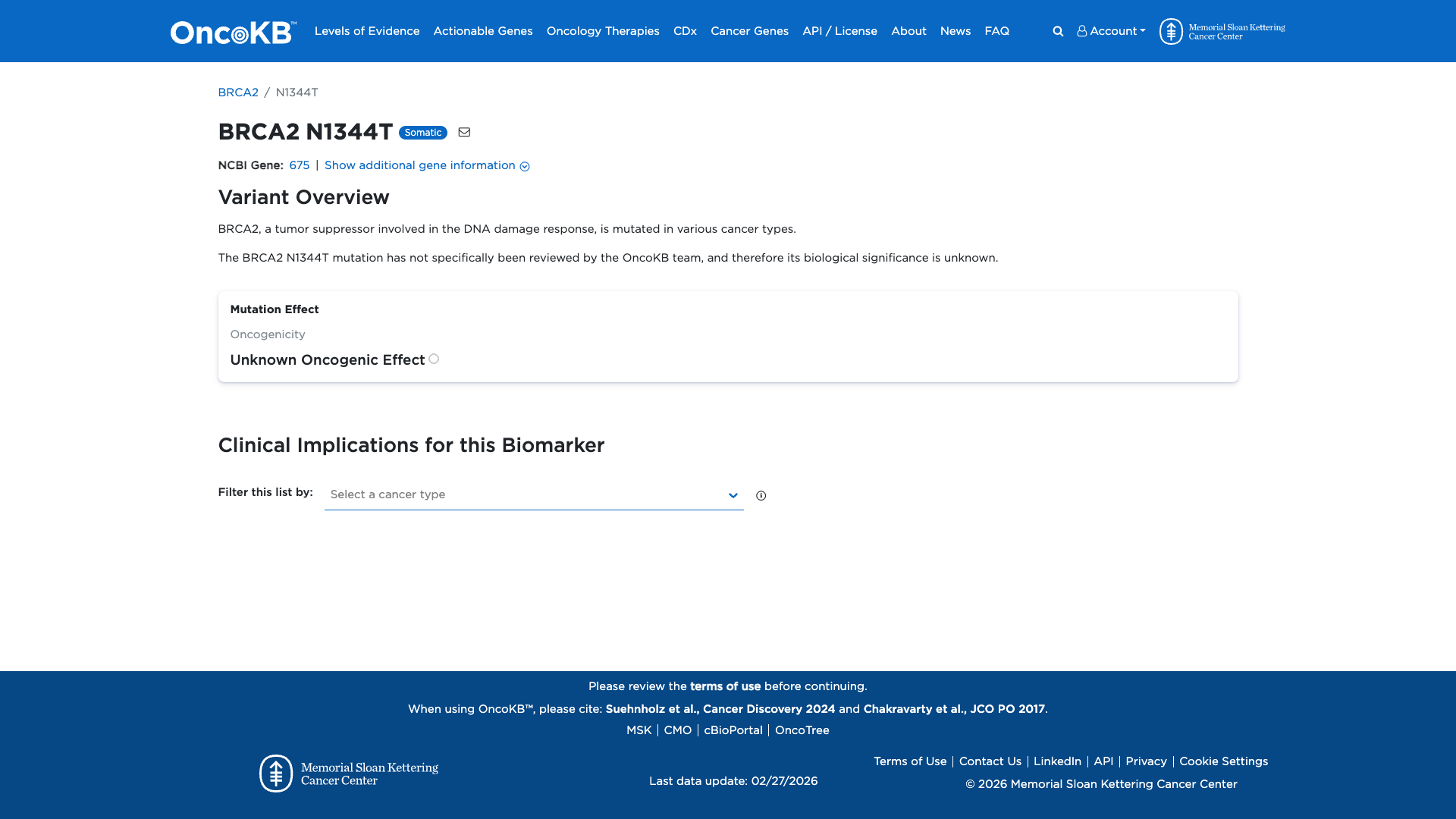
Computational Analysis
Pathogenicity Predictions
SpliceAISpliceAI Scores
Window: ±500bp| Effect Type | Score | Position |
|---|---|---|
| Acceptor Loss (AL) | 0.0 | 83 bp |
| Donor Loss (DL) | 0.0 | -481 bp |
| Acceptor Gain (AG) | 0.0 | -402 bp |
| Donor Gain (DG) | 0.0 | -185 bp |
VCEP Guidelines
Applied ACMG/AMP Criteria (VCEP Specific)
PVS1 (Not Applied)
According to VCEP PVS1 gene-specific guidelines, the rule for PVS1 is: 'Very Strong Null variant (nonsense, frameshift, splice site, initiation codon, single or multi-exon deletion) in a gene where LOF is a known mechanism of disease.' The evidence for NM_000059.4:c.4031A>C (p.Asn1344Thr) shows it is a missense change, not a null variant. Therefore, this criterion is not applied.
PS1 (Not Applied)
According to VCEP PS1 guidelines, PS1 applies for predicted missense substitutions where a previously established pathogenic variant results in the same amino acid change. There is no known pathogenic variant at residue Asn1344. Therefore, PS1 is not applied.
PS2 (Not Applied)
According to standard ACMG guidelines, PS2: 'De novo (both maternity and paternity confirmed) in a patient with the disease and no family history.' Parental testing and de novo status are not available for this variant. Therefore, PS2 is not applied.
PS3 (Not Applied)
According to VCEP PS3 guidelines, PS3 requires well-established in vitro or in vivo functional studies supportive of a damaging effect. No functional characterization is available for p.Asn1344Thr. Therefore, PS3 is not applied.
PS4 (Not Applied)
According to VCEP PS4 guidelines, PS4 requires a significantly increased prevalence in affected individuals versus controls (case-control or OR≥4). No case-control or prevalence data are available. Therefore, PS4 is not applied.
PM1 (Not Applied)
According to VCEP PM1 gene-specific guidelines, PM1 applies to variants within a clinically important functional domain (PALB2 binding aa 10-40 or DNA binding aa 2481-3186). p.Asn1344Thr lies outside these domains. Therefore, PM1 is not applied.
PM2 (Supporting)
According to VCEP PM2 gene-specific guidelines, the rule for PM2 is: 'Absent from controls in an outbred population, from gnomAD v2.1 (non-cancer, exome subset) and gnomAD v3.1 (non-cancer).' The evidence shows MAF = 0% in gnomAD. Therefore, PM2 is applied at Supporting strength because the variant is absent from population controls.
PM3 (Not Applied)
According to VCEP PM3 gene-specific guidelines, PM3 applies for biallelic variants in patients with BRCA2-related Fanconi Anemia. No clinical phenotype or co-occurrence data consistent with Fanconi Anemia are available. Therefore, PM3 is not applied.
PM4 (Not Applied)
According to standard ACMG guidelines, PM4 applies to protein length changes (in-frame indels or stop-loss). p.Asn1344Thr does not alter protein length. Therefore, PM4 is not applied.
PM5 (Not Applied)
According to VCEP PM5 gene-specific guidelines (PTC context) and standard ACMG PM5 (missense at same residue), there is no known pathogenic variant at Asn1344. Therefore, PM5 is not applied.
PM6 (Not Applied)
According to standard ACMG guidelines, PM6: 'Assumed de novo without confirmation of paternity/maternity.' There is no de novo evidence for this variant. Therefore, PM6 is not applied.
PP1 (Not Applied)
According to VCEP PP1 gene-specific guidelines, PP1 requires co-segregation in multiple affected family members. No segregation data are available. Therefore, PP1 is not applied.
PP2 (Not Applied)
According to standard ACMG guidelines, PP2 applies to missense variants in genes where missense is a common mechanism and benign variation is low. BRCA2 has many reported missense variants with mixed outcomes. Therefore, PP2 is not applied.
PP3 (Not Applied)
According to VCEP PP3 gene-specific guidelines, PP3 applies for deleterious predictions inside a functional domain (BayesDel no-AF ≥0.30 or SpliceAI ≥0.2). p.Asn1344Thr is outside defined domains and SpliceAI=0 predicts no splicing impact. Therefore, PP3 is not applied.
PP4 (Not Applied)
According to VCEP PP4 gene-specific guidelines, PP4 requires a phenotype highly specific to BRCA2-related disease and multifactorial likelihood data. No specific clinical phenotype is provided. Therefore, PP4 is not applied.
PP5 (Not Applied)
According to standard ACMG guidelines, PP5: 'Reputable source classifies variant as pathogenic' is disallowed. ClinVar reports VUS and LB for this variant. Therefore, PP5 is not applied.
BA1 (Not Applied)
According to VCEP BA1 gene-specific guidelines, BA1 applies if allele frequency >0.001 in gnomAD. MAF = 0% for this variant. Therefore, BA1 is not applied.
BS1 (Not Applied)
According to VCEP BS1 gene-specific guidelines, BS1 applies if filter allele frequency >0.0001 in gnomAD. This variant is absent from controls. Therefore, BS1 is not applied.
BS2 (Not Applied)
According to VCEP BS2 gene-specific guidelines, BS2 applies with evidence of observation in healthy adults without Fanconi Anemia features. No such data exist. Therefore, BS2 is not applied.
BS3 (Not Applied)
According to VCEP BS3 gene-specific guidelines, BS3 requires well-established functional studies showing no damaging effect. No functional assays are available. Therefore, BS3 is not applied.
BS4 (Not Applied)
According to VCEP BS4 gene-specific guidelines, BS4 requires lack of segregation in affected family members. No segregation analysis is available. Therefore, BS4 is not applied.
BP1 (Strong)
According to VCEP BP1 gene-specific guidelines, the rule for BP1_Strong is: 'Apply for missense variants outside clinically important functional domains (aa 10-40 or 2481-3186) with no splicing predicted (SpliceAI ≤0.1).' p.Asn1344Thr lies outside these domains and SpliceAI=0 predicts no splicing impact. Therefore, BP1 is applied at Strong strength.
BP2 (Not Applied)
According to standard ACMG guidelines, BP2: 'Observed in trans with a pathogenic variant' or 'in cis with a pathogenic variant' without specific phenotype. No such data. Therefore, BP2 is not applied.
BP3 (Not Applied)
According to standard ACMG guidelines, BP3 applies to in-frame indels in repetitive regions. p.Asn1344Thr is a missense variant. Therefore, BP3 is not applied.
BP4 (Not Applied)
According to VCEP BP4 gene-specific guidelines, BP4 applies only to variants inside clinically important domains with BayesDel no-AF ≤0.18 and SpliceAI ≤0.1. p.Asn1344Thr is outside defined domains. Therefore, BP4 is not applied.
BP5 (Not Applied)
According to VCEP BP5 gene-specific guidelines, BP5 applies for co-occurrence with pathogenic variants in unrelated genes without specific phenotype. No co-occurrence data available. Therefore, BP5 is not applied.
BP6 (Not Applied)
According to standard ACMG guidelines, BP6: 'Reputable source classifies as benign' is disallowed. ClinVar reports VUS and LB inconsistently. Therefore, BP6 is not applied.
BP7 (Not Applied)
According to VCEP BP7 gene-specific guidelines, BP7 applies to silent or intronic variants (or missense inside domain if BP4 met). p.Asn1344Thr is a missense variant outside domain and BP4 is not met. Therefore, BP7 is not applied.