Genetic Information
Gene & Transcript Details
| ID | Status | Details |
|---|---|---|
| NM_001127510.1 | Alternative | 10838 nt | 194–8725 |
| NM_001127510.3 | Alternative | 10812 nt | 168–8699 |
| NM_001127510.2 | Alternative | 10848 nt | 194–8725 |
Variant Details
Clinical & Population Data
Population Frequency
gnomADClinVar
Open"This variant has been reported in ClinVar as Likely benign (8 clinical laboratories) and as Benign (3 clinical laboratories) and as Likely Benign (1 clinical laboratories)."
COSMIC Somatic Evidence
Open
Functional Impact & Domains
Functional Domain
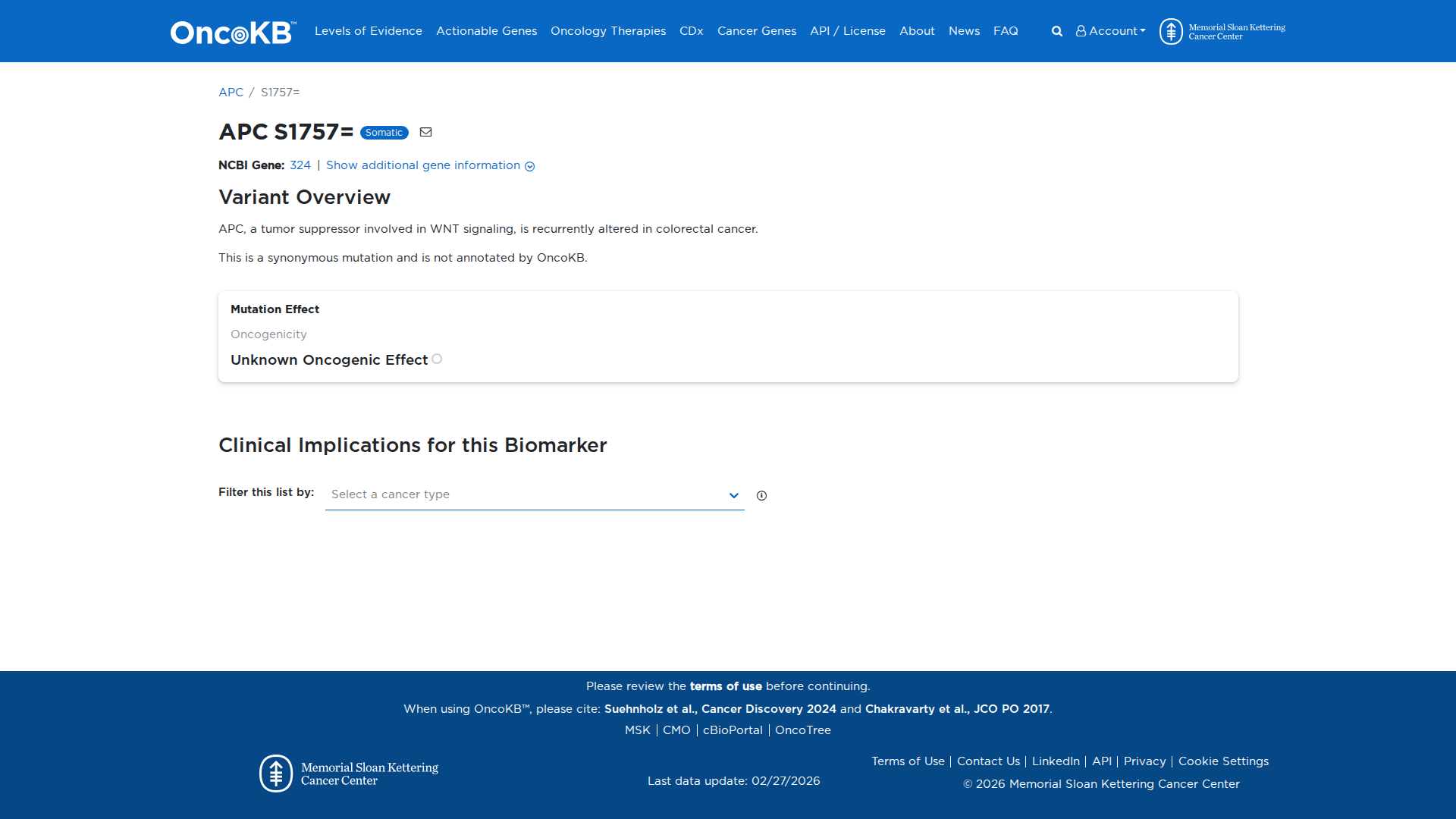
Computational Analysis
Pathogenicity Predictions
SpliceAISpliceAI Scores
Window: ±500bp| Effect Type | Score | Position |
|---|---|---|
| Acceptor Loss (AL) | 0.0 | -67 bp |
| Donor Loss (DL) | 0.0 | 28 bp |
| Acceptor Gain (AG) | 0.0 | 357 bp |
| Donor Gain (DG) | 0.0 | -110 bp |
VCEP Guidelines
Applied ACMG/AMP Criteria (VCEP Specific)
PVS1 (Not Applied)
According to VCEP guidelines, PVS1 applies to null variants in a gene where LOF is a known mechanism. This variant is synonymous (S1757=) and does not create a null allele. Therefore, this criterion is not applied.
PS1 (Not Applied)
According to VCEP guidelines, PS1 applies when a variant results in the same amino acid change as a known pathogenic variant. This variant is synonymous and does not change the amino acid. Therefore, this criterion is not applied.
PS2 (Not Applied)
According to VCEP guidelines, PS2 applies to de novo occurrences with confirmed parental relationships. No de novo data are available for this variant. Therefore, this criterion is not applied.
PS3 (Not Applied)
According to VCEP guidelines, PS3 requires functional assays demonstrating a damaging effect. No functional studies are available for this variant. Therefore, this criterion is not applied.
PS4 (Not Applied)
According to VCEP guidelines, PS4 applies when there is statistical evidence of increased prevalence in affected individuals. No case–control or phenotype data are available. Therefore, this criterion is not applied.
PM1 (Not Applied)
According to VCEP guidelines, PM1 applies to variants in mutational hotspots or critical domains. S1757= is outside known functional or mutational hotspots. Therefore, this criterion is not applied.
PM2 (Not Applied)
According to VCEP guidelines, PM2_Supporting requires allele frequency ≤0.0003% if AC>1. The gnomAD Popmax AF is 0.0229% (>0.0003%). Therefore, PM2 is not applied.
PM3 (Not Applied)
According to standard ACMG, PM3 applies to recessive disease genes when variants are observed in trans with a pathogenic variant. No such data are available. Therefore, this criterion is not applied.
PM4 (Not Applied)
According to standard ACMG, PM4 applies to protein length changes. This variant is synonymous and does not alter length. Therefore, this criterion is not applied.
PM5 (Not Applied)
According to VCEP guidelines, PM5 applies to novel missense changes at amino acid positions with a known LP/P variant. This is a silent change. Therefore, this criterion is not applied.
PM6 (Not Applied)
According to VCEP guidelines, PM6 applies to presumed de novo occurrences without confirmation. No de novo data are available. Therefore, this criterion is not applied.
PP1 (Not Applied)
According to VCEP guidelines, PP1 applies when there is segregation in families. No segregation data are available. Therefore, this criterion is not applied.
PP2 (Not Applied)
According to standard ACMG, PP2 applies to missense variants in genes with low benign missense variation. This variant is synonymous. Therefore, this criterion is not applied.
PP3 (Not Applied)
According to VCEP guidelines, PP3 applies to non-canonical splicing or missense variants with deleterious in silico predictions. SpliceAI predicts no effect and no damaging missense change exists. Therefore, this criterion is not applied.
PP4 (Not Applied)
According to standard ACMG, PP4 applies if patient phenotype is highly specific and variant fits. No phenotype data are provided. Therefore, this criterion is not applied.
PP5 (Not Applied)
According to standard ACMG, PP5 applies when a reputable source reports pathogenic. ClinVar reports benign/likely benign, not pathogenic. Therefore, this criterion is not applied.
BA1 (Not Applied)
According to VCEP guidelines, BA1 requires AF ≥0.1% (0.001). The highest Popmax AF is 0.0229% (0.000229), below threshold. Therefore, this criterion is not applied.
BS1 (Strong)
According to VCEP guidelines, BS1_Strong: "GnomAD Popmax Filtering Allele Frequency (AF) ≥ 0.001% (0.00001)". The South Asian Popmax AF is 0.0229% (0.000229), which exceeds the threshold. Therefore, BS1 is applied at Strong strength.
BS2 (Not Applied)
According to VCEP guidelines, BS2 applies with observations in healthy individuals. No such data are available. Therefore, this criterion is not applied.
BS3 (Not Applied)
According to VCEP guidelines, BS3 requires RNA assays demonstrating no aberration. No functional RNA assay data are available. Therefore, this criterion is not applied.
BS4 (Not Applied)
According to VCEP guidelines, BS4 applies to non-segregation in affected members. No family data are available. Therefore, this criterion is not applied.
BP1 (Not Applied)
According to VCEP guidelines, BP1 applies to missense variants outside defined domains. This variant is synonymous. Therefore, this criterion is not applied.
BP2 (Not Applied)
According to VCEP guidelines, BP2 applies when observed in trans with a pathogenic variant. No such observations exist. Therefore, this criterion is not applied.
BP3 (Not Applied)
According to standard ACMG, BP3 applies to in-frame indels in repetitive regions. This is a single-nucleotide silent change. Therefore, this criterion is not applied.
BP4 (Supporting)
According to VCEP guidelines, BP4_Supporting: "Synonymous (silent) or intronic variants: multiple in silico splicing predictors suggest no impact". SpliceAI predicts no impact on splicing. Therefore, BP4 is applied at Supporting strength.
BP5 (Not Applied)
According to standard ACMG, BP5 applies when an alternate genetic basis explains the phenotype. No alternate basis is documented. Therefore, this criterion is not applied.
BP6 (Supporting)
According to standard ACMG, BP6: "Reputable source recently reports variant as benign but evidence not available for independent evaluation". ClinVar lists this variant as Likely benign/Benign. Therefore, BP6 is applied at Supporting strength.
BP7 (Not Applied)
According to standard ACMG, BP7 requires a synonymous variant ≥7 bp from splice sites with multiple in silico predictors suggesting no impact. Distance from splice junction is not documented and only one predictor (SpliceAI) is reported. Therefore, BP7 is not applied.