Genetic Information
Gene & Transcript Details
| ID | Status | Details |
|---|---|---|
| NM_001754.3 | Alternative | 6190 nt | 400–1842 |
| NM_001754.4 | RefSeq Select | 5967 nt | 191–1633 |
| NM_001754.5 | MANE Select | 5971 nt | 195–1637 |
Variant Details
Clinical & Population Data
Population Frequency
gnomADClinVar
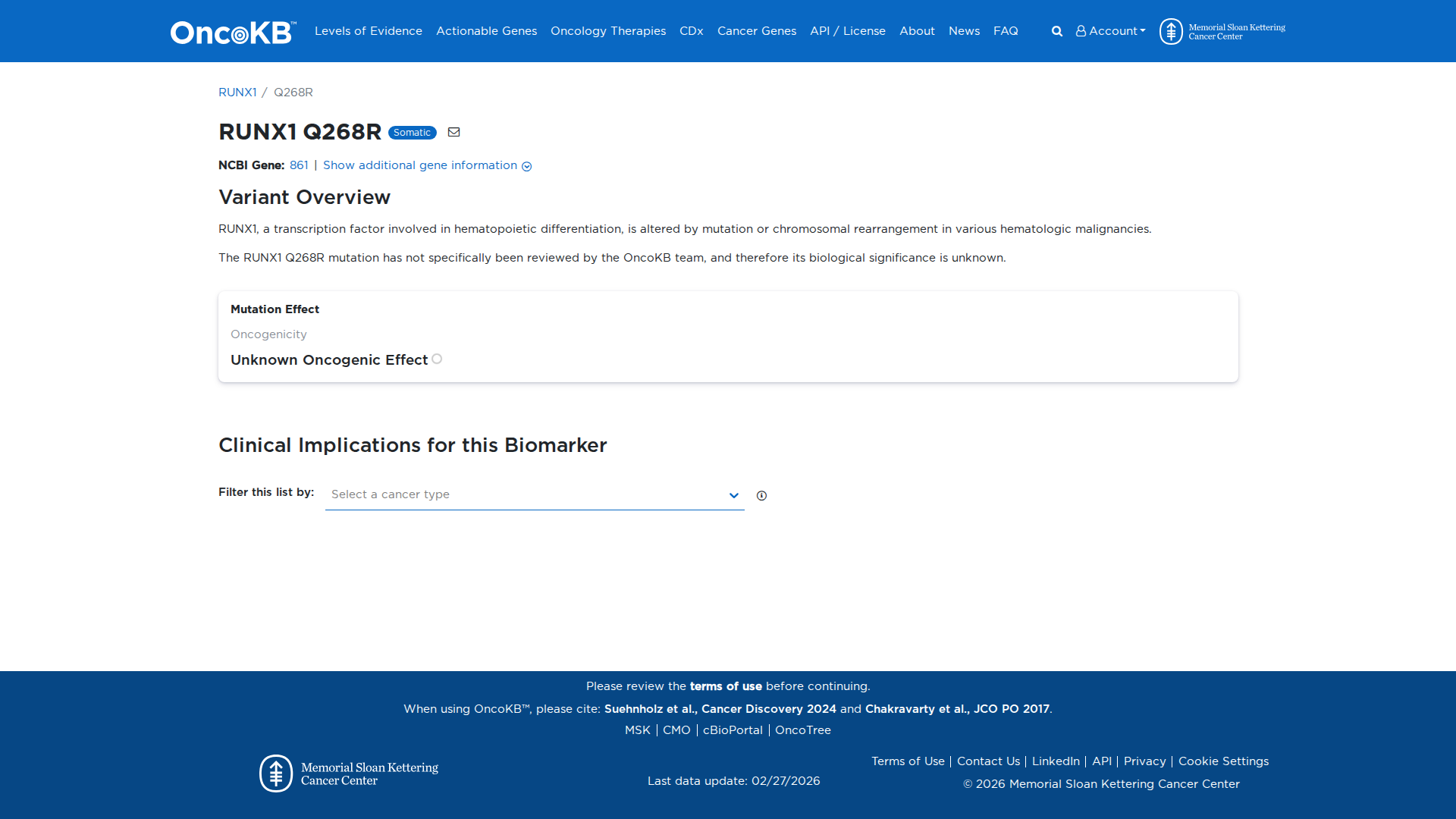
Open"This variant has been reported in ClinVar as Uncertain significance (1 clinical laboratories) and as Uncertain Significance by ClinGen Myeloid Malignancy Variant Curation Expert Panel expert panel."
COSMIC Somatic Evidence
Open
Functional Impact & Domains
Functional Domain
Computational Analysis
Pathogenicity Predictions
SpliceAISpliceAI Scores
Window: ±500bp| Effect Type | Score | Position |
|---|---|---|
| Acceptor Loss (AL) | 0.0 | None bp |
| Donor Loss (DL) | 0.0 | None bp |
| Acceptor Gain (AG) | 0.0 | None bp |
| Donor Gain (DG) | 0.0 | None bp |
VCEP Guidelines
Applied ACMG/AMP Criteria (VCEP Specific)
PVS1 (Not Applied)
According to VCEP guidelines, the rule for PVS1 is: 'Very Strong Per modified RUNX1 PVS1 decision tree for SNVs and CNVs and table of splicing effects.' The evidence for this variant shows: it is a missense change not predicted to cause a null effect or alter canonical splice sites. Therefore, this criterion is not applied at Not Applied strength because the variant does not meet null or splice loss criteria.
PS1 (Not Applied)
According to VCEP guidelines, the rule for PS1 is: 'Strong: Same amino acid change as a previously established pathogenic variant regardless of nucleotide change.' The evidence for this variant shows: no previously established pathogenic variant resulting in Q268R. Therefore, this criterion is not applied at Not Applied strength because there is no matching pathogenic amino acid change.
PS2 (Not Applied)
According to VCEP guidelines, the rule for PS2 is: 'Moderate Strength: Phenotypic specificity category: “Phenotype consistent with gene but not highly specific and high genetic heterogeneity.” For each proven de novo case give 0.5 points, for each assumed de novo case give 0.25 point. Moderate = 1.0 points total.' The evidence for this variant shows: no documented de novo occurrence. Therefore, this criterion is not applied at Not Applied strength because there is no de novo evidence.
PS3 (Not Applied)
According to VCEP guidelines, the rule for PS3 is: 'Strong: Transactivation assays demonstrating altered transactivation (<20% of wt and/or reduced to levels similar to well established pathogenic variants such as R201Q or R166Q) AND data from a secondary assay demonstrating altered function.' The evidence for this variant shows: no functional assays have been performed. Therefore, this criterion is not applied at Not Applied strength because functional data are lacking.
PS4 (Not Applied)
According to VCEP guidelines, the rule for PS4 is: 'Strong: ≥4 probands meeting at least one of the RUNX1-phenotypic criteria.' The evidence for this variant shows: no probands reported in the literature meeting RUNX1-specific phenotypes. Therefore, this criterion is not applied at Not Applied strength because there are no case reports.
PM1 (Not Applied)
According to VCEP guidelines, the rule for PM1 is: 'Moderate: Variant affecting one of the following amino acid residues within the RHD: R107, K110, A134, R162, R166, S167, R169, G170, K194, T196, D198, R201, R204.' The evidence for this variant shows: Q268R is outside the RHD region (residues 89–204). Therefore, this criterion is not applied at Not Applied strength because the residue is not within the defined hot spot.
PM2 (Supporting)
According to VCEP guidelines, the rule for PM2 is: 'Supporting Strength: Variant must be completely absent from all population databases.' The evidence for this variant shows: NM_001754.4:c.803A>G (Q268R) is absent from gnomAD and other population datasets. Therefore, this criterion is applied at Supporting strength because the variant is not observed in population controls.
PM3 (Not Applied)
According to standard ACMG guidelines, the rule for PM3 is: 'For recessive disorders, detected in trans with a pathogenic variant.' The evidence for this variant shows: RUNX1-associated disease is dominant and no in trans pathogenic allele is identified. Therefore, this criterion is not applied at Not Applied strength.
PM4 (Not Applied)
According to VCEP guidelines, the rule for PM4 is: 'Moderate: In-frame deletion/insertion impacting at least one of the specified RHD residues.' The evidence for this variant shows: it is a missense substitution, not an in-frame indel. Therefore, this criterion is not applied at Not Applied strength.
PM5 (Not Applied)
According to VCEP guidelines, the rule for PM5 is: 'Strong: Missense change at an AA residue where ≥2 different missense changes have been determined to be pathogenic before.' The evidence for this variant shows: no other pathogenic missense changes at codon 268 are reported. Therefore, this criterion is not applied at Not Applied strength.
PM6 (Not Applied)
According to VCEP guidelines, the rule for PM6 is: 'Moderate: Phenotypic specificity category ... For each proven de novo case give 0.5 points, for each assumed de novo case give 0.25 point.' The evidence for this variant shows: no assumed de novo cases. Therefore, this criterion is not applied at Not Applied strength.
PP1 (Not Applied)
According to VCEP guidelines, the rule for PP1 is: 'Strong: ≥7 meioses observed within one or across multiple families.' The evidence for this variant shows: no segregation data available. Therefore, this criterion is not applied at Not Applied strength.
PP2 (Not Applied)
According to standard ACMG guidelines, the rule for PP2 is: 'Missense variant in a gene where missense variants are a common mechanism of disease and benign missense variants are infrequent.' The evidence for this variant shows: RUNX1 has both pathogenic and benign missense variants, and Q268R lacks specific supportive context. Therefore, this criterion is not applied at Not Applied strength.
PP3 (Not Applied)
According to VCEP guidelines, the rule for PP3 is: 'Supporting: For missense variants: REVEL score ≥0.88; SpliceAI ≥0.38.' The evidence for this variant shows: in silico predictions are conflicting and do not meet VCEP thresholds. Therefore, this criterion is not applied at Not Applied strength.
PP4 (Not Applied)
According to standard ACMG guidelines, the rule for PP4 is: 'Patient's phenotype or family history is highly specific for a disease with a single genetic etiology.' The evidence for this variant shows: no phenotype information provided. Therefore, this criterion is not applied at Not Applied strength.
PP5 (Not Applied)
According to standard ACMG guidelines, the rule for PP5 is: 'Reputable source recently reports variant as pathogenic.' The evidence for this variant shows: ClinVar reports Uncertain Significance. Therefore, this criterion is not applied at Not Applied strength.
BA1 (Not Applied)
According to VCEP guidelines, the rule for BA1 is: 'Stand Alone: Minor allele frequency ≥0.15% in any general continental population dataset.' The evidence for this variant shows: allele frequency is 0%. Therefore, this criterion is not applied at Not Applied strength.
BS1 (Not Applied)
According to VCEP guidelines, the rule for BS1 is: 'Strong: Minor allele frequency between 0.015% and 0.15%.' The evidence for this variant shows: allele frequency is 0%. Therefore, this criterion is not applied at Not Applied strength.
BS2 (Not Applied)
According to standard ACMG guidelines, the rule for BS2 is: 'Observed in a healthy adult individual for a dominant disorder.' The evidence for this variant shows: no such observations. Therefore, this criterion is not applied at Not Applied strength.
BS3 (Not Applied)
According to VCEP guidelines, the rule for BS3 is: 'Strong: Transactivation assays demonstrating normal transactivation (80-115% of wt) AND secondary assay normal.' The evidence for this variant shows: no functional assays performed. Therefore, this criterion is not applied at Not Applied strength.
BS4 (Not Applied)
According to standard ACMG guidelines, the rule for BS4 is: 'Observed in ≥2 informative meioses inconsistent with disease segregation.' The evidence for this variant shows: no segregation data. Therefore, this criterion is not applied at Not Applied strength.
BP1 (Not Applied)
According to standard ACMG guidelines, the rule for BP1 is: 'Missense variant in a gene for which only loss-of-function causes disease.' The evidence for this variant shows: RUNX1 has known pathogenic missense variants. Therefore, this criterion is not applied at Not Applied strength.
BP2 (Not Applied)
According to standard ACMG guidelines, the rule for BP2 is: 'Observed in trans with a pathogenic variant in a dominant gene or in cis with a pathogenic variant.' The evidence for this variant shows: no such observations. Therefore, this criterion is not applied at Not Applied strength.
BP3 (Not Applied)
According to standard ACMG guidelines, the rule for BP3 is: 'In-frame indel in a repetitive region without known function.' The evidence for this variant shows: it is a missense substitution. Therefore, this criterion is not applied at Not Applied strength.
BP4 (Not Applied)
According to VCEP guidelines, the rule for BP4 is: 'Supporting: For missense variants REVEL <0.50 AND SpliceAI ≤0.20.' The evidence for this variant shows: in silico tools give mixed results and do not meet VCEP benign thresholds. Therefore, this criterion is not applied at Not Applied strength.
BP5 (Not Applied)
According to standard ACMG guidelines, the rule for BP5 is: 'Variant found in a case with an alternate molecular cause.' The evidence for this variant shows: no alternate cause identified. Therefore, this criterion is not applied at Not Applied strength.
BP6 (Not Applied)
According to standard ACMG guidelines, the rule for BP6 is: 'Reputable source recently reports variant as benign.' The evidence for this variant shows: none. Therefore, this criterion is not applied at Not Applied strength.
BP7 (Not Applied)
According to VCEP guidelines, the rule for BP7 is: 'Supporting: Applicable for synonymous and intronic variants with SpliceAI ≤0.20 and phyloP100way ≤2.0.' The evidence for this variant shows: it is a missense variant. Therefore, this criterion is not applied at Not Applied strength.