Genetic Information
Gene & Transcript Details
| ID | Status | Details |
|---|---|---|
| NM_024675.4 | MANE Select | 4008 nt | 154–3714 |
| NM_024675.3 | RefSeq Select | 4069 nt | 201–3761 |
Variant Details
Clinical & Population Data
Population Frequency
gnomADClinVar
Open"This variant has been reported in ClinVar as Uncertain significance (4 clinical laboratories) and as Likely benign (1 clinical laboratories)."
COSMIC Somatic Evidence
Open
Functional Impact & Domains
Functional Domain
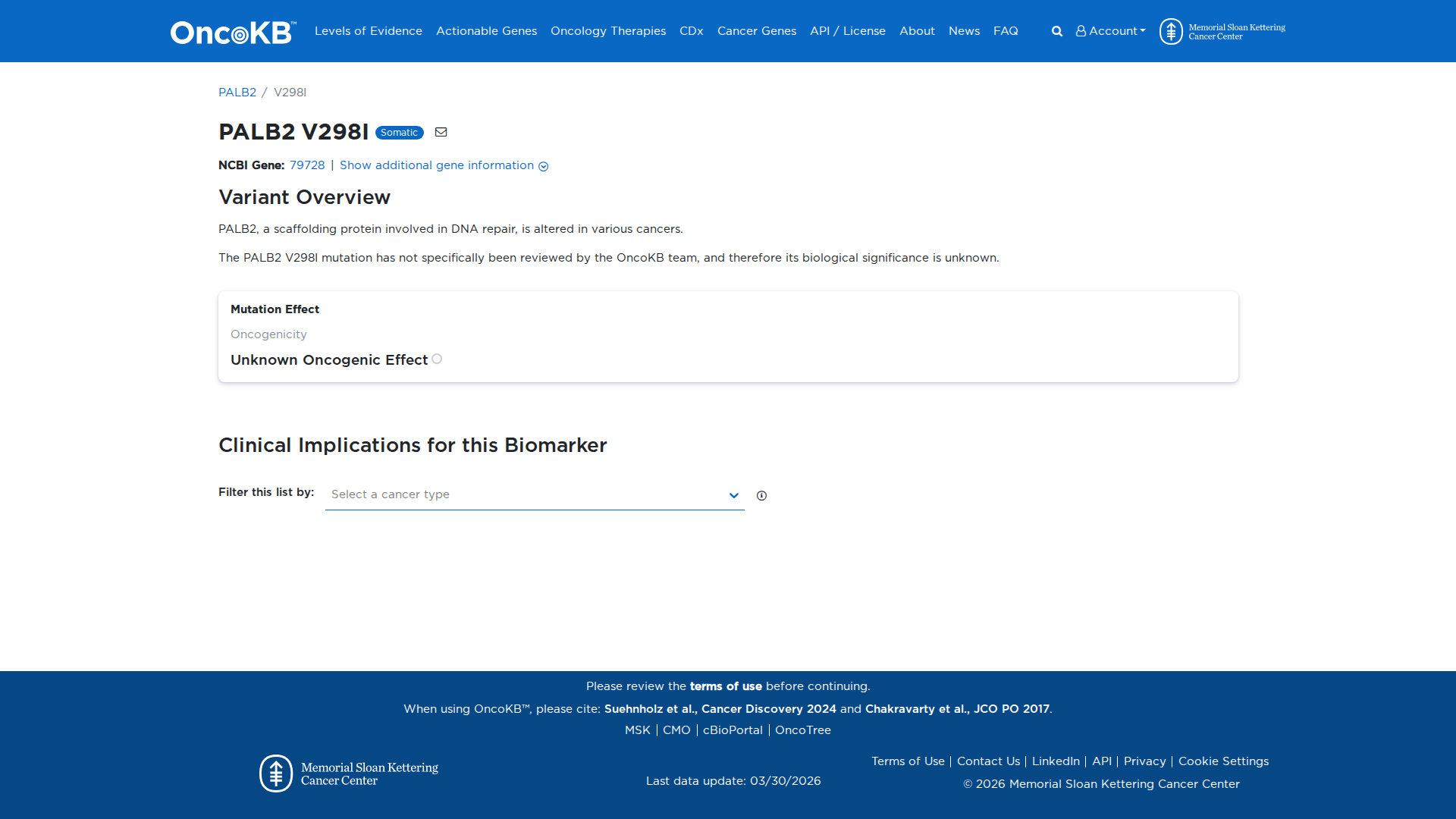
Computational Analysis
Pathogenicity Predictions
SpliceAISpliceAI Scores
Window: ±500bp| Effect Type | Score | Position |
|---|---|---|
| Acceptor Loss (AL) | 0.0 | 269 bp |
| Donor Loss (DL) | 0.0 | 34 bp |
| Acceptor Gain (AG) | 0.0 | 499 bp |
| Donor Gain (DG) | 0.0 | 198 bp |
VCEP Guidelines
Applied ACMG/AMP Criteria (VCEP Specific)
PVS1 (Not Applied)
According to VCEP guidelines, the rule for PVS1 is: "**Very Strong Strength**: Very Strong Use PALB2 PVS1 Decision Tree Modification Type: Gene-specific,Strength". The evidence for this variant shows: c.892G>A (p.V298I) is a missense change, not a null variant. Therefore, this criterion is not applied.
PS1 (Not Applied)
According to VCEP guidelines, the rule for PS1 is: "**Strong Strength**: Strong Use PALB2 PS1 Splicing table Modification Type: General recommendation". The evidence for this variant shows: no identical amino acid change has been established as pathogenic. Therefore, this criterion is not applied.
PS2 (Not Applied)
According to standard ACMG guidelines, the rule for PS2 is: "De novo (both maternity and paternity confirmed) in a patient with the disease and no family history". The evidence for this variant shows: no de novo data are available. Therefore, this criterion is not applied.
PS3 (Not Applied)
According to standard ACMG guidelines, the rule for PS3 is: "Well-established in vitro or in vivo functional studies supportive of a damaging effect on the gene or gene product". The evidence for this variant shows: no functional studies have been performed. Therefore, this criterion is not applied.
PS4 (Not Applied)
According to VCEP guidelines, the rule for PS4 is: "**Strong Strength**: Strong Case-control studies; p-value ≤.05 AND (Odds ratio, hazard ratio, or relative risk ≥3 OR lower 95% CI ≥1.5). Modification Type: Disease-specific". The evidence for this variant shows: no case-control data are available. Therefore, this criterion is not applied.
PM1 (Not Applied)
According to standard ACMG guidelines, the rule for PM1 is: "Located in a mutational hot spot and/or critical and well-established functional domain without benign variation". The evidence for this variant shows: p.V298I is not located in a known hot spot or characterized functional domain. Therefore, this criterion is not applied.
PM2 (Not Applied)
According to VCEP guidelines, the rule for PM2 is: "**Supporting Strength**: Supporting Variant absent in gnomAD or present in ≤1/300,000 alleles Modification Type: Gene-specific,Strength". The evidence for this variant shows: observed at 4/251,376 alleles (MAF=0.00159%), which is above the ≤1/300,000 threshold. Therefore, this criterion is not applied.
PM3 (Not Applied)
According to VCEP guidelines, the rule for PM3 is: "Use Fanconi Anemia PM3 tables Modification Type: Disease-specific,Strength". The evidence for this variant shows: no recessive inheritance or trans observations. Therefore, this criterion is not applied.
PM4 (Not Applied)
According to standard ACMG guidelines, the rule for PM4 is: "Protein length changes due to in-frame deletions/insertions in a non-repeat region or stop-loss variants". The evidence for this variant shows: p.V298I is a missense substitution, not an in-frame indel or stop-loss. Therefore, this criterion is not applied.
PM5 (Not Applied)
According to VCEP guidelines, the rule for PM5 is: "**Supporting Strength**: Supporting Apply to frameshifting or truncating variants with premature termination codons upstream of p.Tyr1183". The evidence for this variant shows: p.V298I is a missense change, not a truncating alteration. Therefore, this criterion is not applied.
PM6 (Not Applied)
According to standard ACMG guidelines, the rule for PM6 is: "Assumed de novo, but without confirmation of paternity and maternity". The evidence for this variant shows: no de novo evidence. Therefore, this criterion is not applied.
PP1 (Not Applied)
According to VCEP guidelines, the rule for PP1 is: "**Supporting Strength**: Supporting LOD ≥0.3 or Bayes Factor (LR) ≥2:1 Modification Type: Gene-specific". The evidence for this variant shows: no segregation data available. Therefore, this criterion is not applied.
PP2 (Not Applied)
According to standard ACMG guidelines, the rule for PP2 is: "Missense variant in a gene that has a low rate of benign missense variation and where missense variants are a common mechanism of disease". The evidence for this variant shows: no evidence that PALB2 is intolerant to missense. Therefore, this criterion is not applied.
PP3 (Not Applied)
According to VCEP guidelines, the rule for PP3 is: "**Supporting Strength**: Supporting Protein: Do not use. RNA: At least one well-established in silico predictor (e.g. SpliceAI) shows impact on splicing". The evidence for this variant shows: SpliceAI score=0, indicating no splicing impact. Therefore, this criterion is not applied.
PP4 (Not Applied)
According to standard ACMG guidelines, the rule for PP4 is: "Patient's phenotype or family history is highly specific for a disease with a single genetic etiology". The evidence for this variant shows: no phenotype/family history data. Therefore, this criterion is not applied.
PP5 (Not Applied)
According to standard ACMG guidelines, the rule for PP5 is: "Reputable source reports variant as pathogenic". The evidence for this variant shows: ClinVar entries are VUS or Likely benign. Therefore, this criterion is not applied.
BA1 (Not Applied)
According to VCEP guidelines, the rule for BA1 is: "**Stand Alone Strength**: Stand Alone GnomAD Filtering Allele Frequency >0.1% Modification Type: Disease-specific,Gene-specific". The evidence for this variant shows: MAF=0.00159% (<0.1%). Therefore, this criterion is not applied.
BS1 (Not Applied)
According to VCEP guidelines, the rule for BS1 is: "**Strong Strength**: Strong GnomAD Filtering Allele Frequency greater than expected for disease >.01% Modification Type: Disease-specific,Gene-specific". The evidence for this variant shows: MAF=0.00159% (<0.01%). Therefore, this criterion is not applied.
BS2 (Not Applied)
According to VCEP guidelines, the rule for BS2 is: "**Strong Strength**: Strong Per Fanconi Anemia BS2 tables Modification Type: Disease-specific". The evidence for this variant shows: no observations in healthy adults with full penetrance. Therefore, this criterion is not applied.
BS3 (Not Applied)
According to standard ACMG guidelines, the rule for BS3 is: "Well-established in vitro or in vivo functional studies show no damaging effect". The evidence for this variant shows: no functional data. Therefore, this criterion is not applied.
BS4 (Not Applied)
According to VCEP guidelines, the rule for BS4 is: "**Strong Strength**: Strong LOD ≤ -1.28 or Bayes Factor (LR) ≤.053:1 Modification Type: Gene-specific". The evidence for this variant shows: no segregation data. Therefore, this criterion is not applied.
BP1 (Supporting)
According to VCEP guidelines, the rule for BP1 is: "**Supporting Strength**: Supporting Apply to all missense variants. Modification Type: Gene-specific". The evidence for this variant shows: p.V298I is a missense substitution. Therefore, this criterion is applied at Supporting strength.
BP2 (Not Applied)
According to standard ACMG guidelines, the rule for BP2 is: "Observed in trans with a pathogenic variant for a fully penetrant dominant gene/disorder". The evidence for this variant shows: no such observations. Therefore, this criterion is not applied.
BP3 (Not Applied)
According to standard ACMG guidelines, the rule for BP3 is: "In-frame deletions/insertions in a repetitive region without a known function". The evidence for this variant shows: p.V298I is a missense variant, not an in-frame indel. Therefore, this criterion is not applied.
BP5 (Not Applied)
According to standard ACMG guidelines, the rule for BP5 is: "Variant found in a case with an alternate molecular basis for disease". The evidence for this variant shows: no alternate molecular basis reported. Therefore, this criterion is not applied.
BP6 (Not Applied)
According to standard ACMG guidelines, the rule for BP6 is: "Reputable source reports variant as benign". The evidence for this variant shows: ClinVar submissions are VUS or likely benign, but use of BP6 is not recommended without stronger consensus. Therefore, this criterion is not applied.
BP7 (Not Applied)
According to VCEP guidelines, the rule for BP7 is: "BP7: Synonymous and deep intronic BP7_Variable(RNA): Observed Lack of aberrant RNA defect...". The evidence for this variant shows: p.V298I is a missense change, not synonymous or intronic. Therefore, this criterion is not applied.