Genetic Information
Gene & Transcript Details
| ID | Status | Details |
|---|---|---|
| NM_000251.3 | MANE Select | 3115 nt | 37–2841 |
| NM_000251.2 | RefSeq Select | 3226 nt | 126–2930 |
| NM_000251.1 | Alternative | 3145 nt | 69–2873 |
Variant Details
Clinical & Population Data
Population Frequency
gnomADClinVar
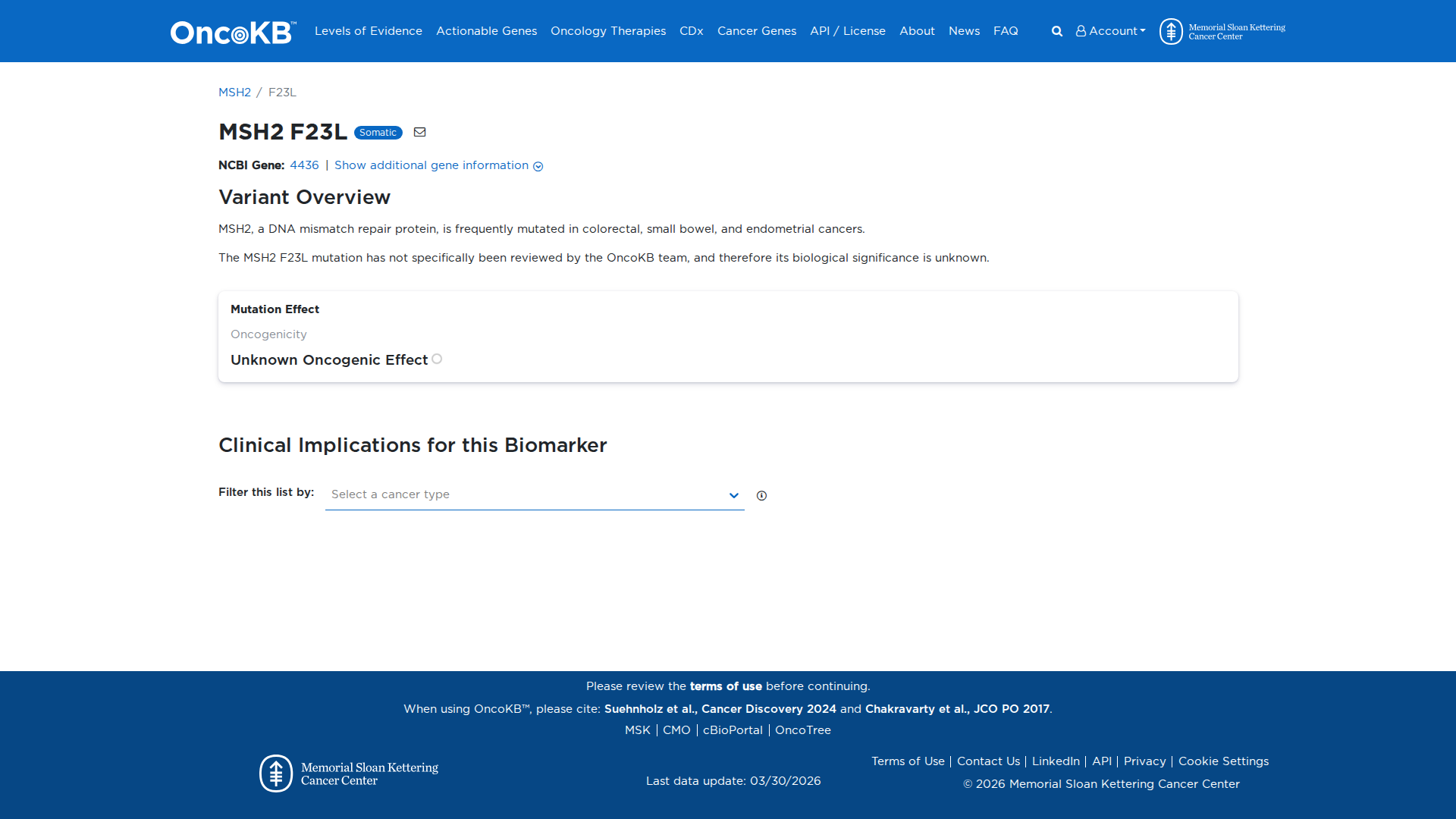
OpenVariant summary: MSH2 c.67T>C (p.Phe23Leu) results in a non-conservative amino acid change located in the DNA mismatch repair protein MutS-like, N-terminal domain of the encoded protein sequence. Three of five in-silico tools predict a benign effect of the variant on protein function. The variant allele was found at a frequency of 0.00057 in 246202 control chromosomes, predominantly within the South Asian subpopulation in the gnomAD database at a frequency of 0.0049, including 2 homozygotes. This frequency within South Asian control individuals is approximately 9-fold above the estimated maximal expected allele frequency for a pathogenic variant in MSH2 causing Lynch Syndrome phenotype (0.00057), strongly suggesting that the variant is a benign polymorphism found primarily in populations of South Asian origin. The variant has been reported in a patient with gastrointestinal stromal cancer, but without evidence of causality. Four clinical diagnostic laboratories have submitted clinical-significance assessments for this variant to ClinVar after 2014 and all classified the variant as benign/likely benign. Based on the evidence outlined above, the variant was classified as benign.
This variant is considered benign. This variant has been observed in trans with a known pathogenic variant in one or more individuals lacking clinical features consistent with gene-specific recessive disease. This variant is strongly associated with less severe personal and family histories of cancer, typical for individuals without pathogenic variants in this gene [PMID: 27363726].
This variant was observed as part of a predisposition screen in an ostensibly healthy population. A literature search was performed for the gene, cDNA change, and amino acid change (where applicable). Publications were found based on this search. However, the evidence from the literature, in combination with allele frequency data from public databases where available, was not sufficient to rule this variant in or out of causing disease. Therefore, this variant is classified as a variant of unknown significance.
This alteration is classified as likely benign based on a combination of the following: seen in unaffected individuals, population frequency, intact protein function, lack of segregation with disease, co-occurrence, RNA analysis, in silico models, amino acid conservation, lack of disease association in case-control studies, and/or the mechanism of disease or impacted region is inconsistent with a known cause of pathogenicity.
"This variant has been reported in ClinVar as Benign (7 clinical laboratories) and as Likely benign (5 clinical laboratories) and as Uncertain significance (1 clinical laboratories)."
COSMIC Somatic Evidence
Open
Functional Impact & Domains
Functional Domain
Computational Analysis
Pathogenicity Predictions
SpliceAISpliceAI Scores
Window: ±500bp| Effect Type | Score | Position |
|---|---|---|
| Acceptor Loss (AL) | 0.0 | 6 bp |
| Donor Loss (DL) | 0.01 | -83 bp |
| Acceptor Gain (AG) | 0.0 | -85 bp |
| Donor Gain (DG) | 0.0 | 32 bp |
VCEP Guidelines
Applied ACMG/AMP Criteria (VCEP Specific)
PVS1 (Not Applied)
According to VCEP guidelines, the rule for PVS1 is: "Very Strong Nonsense/frameshift variant introducing Premature Termination Codon (PTC) ≤ codon 891 in MSH2...". The evidence for this variant shows: NM_000251.3:c.67T>C is a missense (F23L), not a null variant. Therefore, this criterion is not applied because the variant type does not meet the null variant requirement.
PS1 (Not Applied)
According to VCEP guidelines, the rule for PS1 is: "Strong A predicted missense substitution that encodes the same amino acid change with a different underlying nucleotide change previously established by this VCEP as Pathogenic...". The evidence for this variant shows: there is no previously established pathogenic variant encoding F23L. Therefore, this criterion is not applied because no identical amino acid change is known to be pathogenic.
PS2 (Not Applied)
According to VCEP guidelines, the rule for PS2 is: "Very Strong ≥4 de novo points; Strong 2–3 de novo points; Moderate 1 de novo point; Supporting 0.5 de novo points.". The evidence for this variant shows: no de novo data are available. Therefore, this criterion is not applied because there is no de novo evidence.
PS3 (Not Applied)
According to VCEP guidelines, the rule for PS3 is: "Strong Calibrated functional assays with functional odds for Pathogenicity >18.7...". The evidence for this variant shows: no functional studies have been performed. Therefore, this criterion is not applied because functional assay data are lacking.
PS4 (Not Applied)
According to standard ACMG guidelines, the rule for PS4 is: "The prevalence of variant in affected individuals is significantly increased compared to controls.". The evidence for this variant shows: no case-control or case series data. Therefore, this criterion is not applied because no case-control data are available.
PM1 (Not Applied)
According to standard ACMG guidelines, the rule for PM1 is: "Located in a mutational hotspot and/or critical and well-established functional domain without benign variation.". The evidence for this variant shows: codon 23 is not a recognized hotspot or critical domain per VCEP. Therefore, this criterion is not applied because the location is not a defined hotspot.
PM2 (Not Applied)
According to VCEP guidelines, the rule for PM2 is: "Supporting Absent/extremely rare (<1 in 50,000 alleles) in gnomAD v4 dataset.". The evidence for this variant shows: gnomAD MAF=0.0559% (1 in ~1,789), which exceeds 1/50,000. Therefore, this criterion is not applied because the allele frequency is above the VCEP threshold.
PM3 (Not Applied)
According to VCEP guidelines, the rule for PM3 is: "Very Strong ≥4 points; Strong ≥2 and <4 points; Moderate ≥1 and <2 points; Supporting=0.5 points for recessive trans evidence.". The evidence for this variant shows: no trans observations with a pathogenic variant. Therefore, this criterion is not applied because there is no recessive trans evidence.
PM4 (Not Applied)
According to standard ACMG guidelines, the rule for PM4 is: "Protein length changes due to in-frame deletions/insertions or stop-loss variants.". The evidence for this variant shows: F23L is a missense substitution without length change. Therefore, this criterion is not applied because there is no protein length alteration.
PM5 (Not Applied)
According to VCEP guidelines, the rule for PM5 is: "Moderate Missense change at an amino acid residue where a different missense change was classified by this VCEP as Pathogenic...". The evidence for this variant shows: no other missense at residue 23 has been classified as pathogenic. Therefore, this criterion is not applied because there is no precedent pathogenic missense at F23.
PM6 (Not Applied)
According to VCEP guidelines, the rule for PM6 is: "Supporting 0.5 de novo points.". The evidence for this variant shows: no de novo information. Therefore, this criterion is not applied because de novo status is unconfirmed.
PP1 (Not Applied)
According to VCEP guidelines, the rule for PP1 is: "Strong/Moderate/Supporting co-segregation with disease based on Bayes LR.". The evidence for this variant shows: no family segregation data. Therefore, this criterion is not applied because segregation data are absent.
PP2 (Not Applied)
According to standard ACMG guidelines, the rule for PP2 is: "Missense variant in a gene with low rate of benign missense variation and where missense is a common mechanism of disease.". The evidence for this variant shows: MSH2 has a number of pathogenic missense and benign missense variants. Therefore, this criterion is not applied because the gene context does not meet PP2.
PP3 (Not Applied)
According to VCEP guidelines, the rule for PP3 is: "Moderate Missense variant with HCI prior probability >0.81 or predicted splice defect with SpliceAI ≥0.2.". The evidence for this variant shows: SpliceAI score=0.01, and HCI prior not >0.81; computational predictions are predominantly benign. Therefore, this criterion is not applied because computational data do not support pathogenicity.
PP4 (Not Applied)
According to VCEP guidelines, the rule for PP4 is: "Supporting if 1 CRC/Endometrial MSI-H tumor with loss of MMR protein expression consistent with variant location.". The evidence for this variant shows: no tumor phenotype data. Therefore, this criterion is not applied because no clinical tumor data are available.
PP5 (Not Applied)
According to standard ACMG guidelines, the rule for PP5 is: "Reputable source reports variant as pathogenic without available evidence.". The evidence for this variant shows: ClinVar submissions are conflicting (Benign, Likely Benign, VUS). Therefore, this criterion is not applied because there is no single reputable pathogenic assertion.
BA1 (Not Applied)
According to VCEP guidelines, the rule for BA1 is: "Stand Alone GnomAD v4 Grpmax filtering allele frequency ≥0.001 (0.1%) and variant excluded as founder pathogenic.". The evidence for this variant shows: MAF=0.0559% (<0.1%). Therefore, this criterion is not applied because the allele frequency does not meet the BA1 threshold.
BS1 (Strong)
According to VCEP guidelines, the rule for BS1 is: "Strong GnomAD v4 Grpmax filtering allele frequency ≥0.0001 and <0.001 (0.01–0.1%), excluding founder pathogenic variants.". The evidence for this variant shows: MAF=0.0559% (0.000559), which lies between 0.0001 and 0.001. Therefore, this criterion is applied at Strong strength because the allele frequency falls within the VCEP-defined benign range.
BS2 (Not Applied)
According to VCEP guidelines, the rule for BS2 is: "Strong Co-occurrence in trans with a known pathogenic sequence variant in the same gene in a patient without CMMRD.". The evidence for this variant shows: no co-occurrence data. Therefore, this criterion is not applied because co-occurrence evidence is lacking.
BS3 (Not Applied)
According to VCEP guidelines, the rule for BS3 is: "Strong Calibrated functional assays with functional odds for Pathogenicity ≤0.05 or synonymous/intronic with no mRNA aberration.". The evidence for this variant shows: no functional assays. Therefore, this criterion is not applied because no functional data are available.
BS4 (Not Applied)
According to VCEP guidelines, the rule for BS4 is: "Strong Lack of co-segregation with disease in pedigree(s) with a combined Bayes LR <0.05.". The evidence for this variant shows: no segregation studies. Therefore, this criterion is not applied because no familial non-segregation data are available.
BP1 (Not Applied)
According to standard ACMG guidelines, the rule for BP1 is: "Missense variant in a gene for which primarily truncating variants cause disease, suggesting missense is less likely pathogenic.". The evidence for this variant shows: MSH2 has known pathogenic missense variants. Therefore, this criterion is not applied because missense is an established mechanism in MSH2.
BP2 (Not Applied)
According to standard ACMG guidelines, the rule for BP2 is: "Observed in trans with a pathogenic variant for dominant disorder or in cis with another pathogenic variant.". The evidence for this variant shows: no phase or co-occurrence data. Therefore, this criterion is not applied because there is no cis/trans observation.
BP3 (Not Applied)
According to standard ACMG guidelines, the rule for BP3 is: "In-frame deletions/insertions in repetitive regions without known function.". The evidence for this variant shows: this is a missense substitution. Therefore, this criterion is not applied because it is not an in-frame indel.
BP4 (Supporting)
According to VCEP guidelines, the rule for BP4 is: "Supporting Missense variant with HCI-prior probability of pathogenicity <0.11 or SpliceAI ≤0.1.". The evidence for this variant shows: SpliceAI predicts no impact (score=0.01) and multiple in silico tools predict benign. Therefore, this criterion is applied at Supporting strength because computational data support no impact.
BP5 (Not Applied)
According to VCEP guidelines, the rule for BP5 is: "Strong '≥4 tumors with MSS/no MMR loss' or analogous tumor data inconsistent with variant impact.". The evidence for this variant shows: no tumor characterization. Therefore, this criterion is not applied because no tumor phenotype data are available.
BP6 (Not Applied)
According to standard ACMG guidelines, the rule for BP6 is: "Reputable source reports variant as benign without available evidence.". The evidence for this variant shows: ClinVar submissions are conflicting. Therefore, this criterion is not applied because there is no single reputable benign assertion.
BP7 (Not Applied)
According to VCEP guidelines, the rule for BP7 is: "Supporting synonymous or intronic variant at or beyond -21/+7 with no splicing impact.". The evidence for this variant shows: NM_000251.3:c.67T>C is a missense change. Therefore, this criterion is not applied because it is not synonymous or intronic.