Genetic Information
Gene & Transcript Details
| ID | Status | Details |
|---|---|---|
| NM_000051.3 | RefSeq Select | 13147 nt | 386–9556 |
| NM_000051.4 | MANE Select | 12915 nt | 151–9321 |
Variant Details
Clinical & Population Data
Population Frequency
gnomADClinVar
Open"This variant has been reported in ClinVar as Likely benign (7 clinical laboratories) and as Benign (2 clinical laboratories)."
COSMIC Somatic Evidence
Open
Functional Impact & Domains
Functional Domain
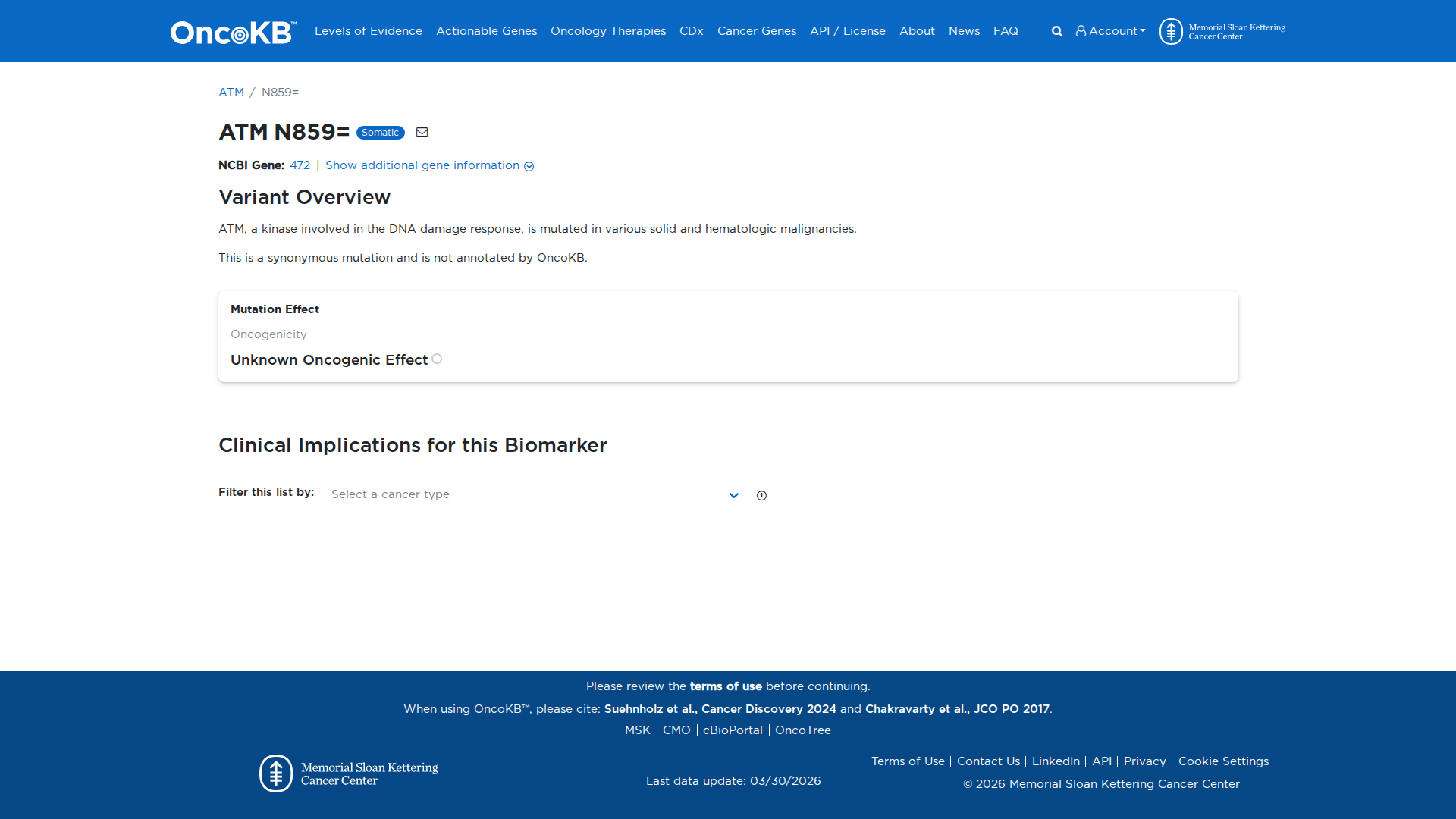
Computational Analysis
Pathogenicity Predictions
SpliceAISpliceAI Scores
Window: ±500bp| Effect Type | Score | Position |
|---|---|---|
| Acceptor Loss (AL) | 0.0 | -110 bp |
| Donor Loss (DL) | 0.0 | -206 bp |
| Acceptor Gain (AG) | 0.0 | -462 bp |
| Donor Gain (DG) | 0.0 | -33 bp |
VCEP Guidelines
Applied ACMG/AMP Criteria (VCEP Specific)
PVS1 (Not Applied)
According to VCEP guidelines, ATM PVS1 Decision Tree applies only to predicted loss-of-function variants. The evidence for this variant shows it is synonymous with no predicted splice impact (SpliceAI Δ scores = 0). Therefore, PVS1 is not applied as the variant does not meet any loss-of-function criterion.
PS1 (Not Applied)
According to standard ACMG guidelines, PS1 applies when a variant results in the same amino acid change as a known pathogenic variant. This variant is synonymous (N859=) and does not change the amino acid. Therefore, PS1 is not applied.
PS2 (Not Applied)
According to standard ACMG guidelines, PS2 applies to confirmed de novo occurrences. Parental testing data are not available. Therefore, PS2 is not applied.
PS3 (Not Applied)
According to standard ACMG guidelines, PS3 applies when well-established functional studies show a damaging effect. No functional studies have been performed for this variant. Therefore, PS3 is not applied.
PS4 (Not Applied)
According to standard ACMG guidelines, PS4 applies when case-control data demonstrate a significant association (OR ≥2). No case-control or cohort data are available. Therefore, PS4 is not applied.
PM1 (Not Applied)
According to standard ACMG guidelines, PM1 applies to variants in mutational hot spots or critical domains. This synonymous variant is outside of any known functional domain. Therefore, PM1 is not applied.
PM2 (Not Applied)
According to VCEP guidelines, PM2_supporting applies if frequency ≤0.001% AND single observation. The evidence shows MAF=0.00141% with four alleles observed. Therefore, PM2 is not applied.
PM3 (Not Applied)
According to VCEP guidelines, PM3 applies to recessive disorders when variants are observed in trans with a pathogenic variant. No trans observation data are available. Therefore, PM3 is not applied.
PM4 (Not Applied)
According to standard ACMG guidelines, PM4 applies to protein length changes (in-frame indels). This variant is synonymous and does not alter protein length. Therefore, PM4 is not applied.
PM5 (Not Applied)
According to VCEP guidelines, PM5 applies to novel missense changes at residues with known pathogenic missense. This variant is synonymous. Therefore, PM5 is not applied.
PM6 (Not Applied)
According to standard ACMG guidelines, PM6 applies to assumed de novo cases without confirmation. No de novo data are available. Therefore, PM6 is not applied.
PP1 (Not Applied)
According to standard ACMG guidelines, PP1 applies to segregation in affected family members. No segregation data are available. Therefore, PP1 is not applied.
PP2 (Not Applied)
According to standard ACMG guidelines, PP2 applies when a missense variant occurs in a gene with low benign missense rate. This variant is synonymous. Therefore, PP2 is not applied.
PP3 (Not Applied)
According to VCEP guidelines, PP3 applies when in silico predictors support a deleterious effect. The evidence shows SpliceAI predicts no splicing impact and there is no protein change. Therefore, PP3 is not applied.
PP4 (Not Applied)
According to standard ACMG guidelines, PP4 applies when the patient phenotype is highly specific for a disease. No phenotype data are provided. Therefore, PP4 is not applied.
PP5 (Not Applied)
According to standard ACMG guidelines, PP5 applies when a reputable source reports a variant as pathogenic. The variant is reported as benign/likely benign in ClinVar. Therefore, PP5 is not applied.
BA1 (Not Applied)
According to VCEP guidelines, BA1 applies for filtering allele frequency >0.5%. The evidence shows MAF=0.00141%, well below threshold. Therefore, BA1 is not applied.
BS1 (Not Applied)
According to VCEP guidelines, BS1 applies for filtering allele frequency >0.05%. The evidence shows MAF=0.00141%, below threshold. Therefore, BS1 is not applied.
BS2 (Not Applied)
According to standard ACMG guidelines, BS2 applies when variant observed in healthy adult individuals for dominant disorders. ATM is recessive and no appropriate healthy cohort data are available. Therefore, BS2 is not applied.
BS3 (Not Applied)
According to VCEP guidelines, BS3 applies when functional studies show rescue of ATM-specific features. No such studies exist. Therefore, BS3 is not applied.
BS4 (Not Applied)
According to standard ACMG guidelines, BS4 applies when segregation analysis shows lack of cosegregation. No segregation data are available. Therefore, BS4 is not applied.
BP1 (Not Applied)
According to standard ACMG guidelines, BP1 applies when a missense variant occurs in a gene where only truncating variants cause disease. This variant is synonymous. Therefore, BP1 is not applied.
BP2 (Not Applied)
According to VCEP guidelines, BP2 applies when variant is observed in cis with a pathogenic variant. No data are available. Therefore, BP2 is not applied.
BP3 (Not Applied)
According to standard ACMG guidelines, BP3 applies to in-frame indels in repetitive regions. This variant is synonymous. Therefore, BP3 is not applied.
BP4 (Not Applied)
According to VCEP guidelines, BP4 for benign computational evidence may not be applied in conjunction with BP7 for RNA in synonymous variants. We have chosen to apply BP7. Therefore, BP4 is not applied.
BP5 (Not Applied)
According to standard ACMG guidelines, BP5 applies when variant is found in a case with an alternate molecular basis for disease. No such case data are available. Therefore, BP5 is not applied.
BP6 (Supporting)
According to standard ACMG guidelines, BP6: "Reputable source recently reports variant as benign, but the evidence is not available for independent evaluation." The evidence shows ClinVar reports this variant as Likely Benign (7 labs) and Benign (2 labs). Therefore, BP6 is applied at Supporting strength.
BP7 (Supporting)
According to VCEP guidelines, "BP7 (Supporting): Use for synonymous variants with no predicted splice impact (further than +7/-40)." SpliceAI Δ scores = 0 predicting no impact on splicing for this synonymous variant. Therefore, BP7 is applied at Supporting strength.