Genetic Information
Gene & Transcript Details
| ID | Status | Details |
|---|---|---|
| NM_000314.7 | RefSeq Select | 8514 nt | 845–2056 |
| NM_000314.5 | Alternative | 8719 nt | 1032–2243 |
| NM_000314.4 | Alternative | 5572 nt | 1032–2243 |
| NM_000314.3 | Alternative | 3416 nt | 1032–2243 |
| NM_000314.6 | Alternative | 8718 nt | 1032–2243 |
| NM_000314.8 | MANE Select | 8515 nt | 846–2057 |
Variant Details
Clinical & Population Data
Population Frequency
gnomADClinVar
OpenThe p.D24N pathogenic mutation (also known as c.70G>A), located in coding exon 1 of the PTEN gene, results from a G to A substitution at nucleotide position 70. The aspartic acid at codon 24 is replaced by asparagine, an amino acid with highly similar properties. This variant was reported in individuals with features consistent with PTEN hamartoma tumor syndrome in at least one individual, it was determined to be de novo (external communication). In a massively parallel functional assay using a humanized yeast model, lipid phosphatase activity for this variant was functionally deficient (Mighell TL et al. Am J Hum Genet, 2018 May;102:943-955).This missense alteration is located in a region that has a low rate of benign missense variation (Lek M et al. Nature. 2016 Aug 18;536(7616):285-91; DECIPHER: Database of Chromosomal Imbalance and Phenotype in Humans using Ensembl Resources. Firth H.V. et al. 2009. Am.J.Hum.Genet. 84, 524-533 (DOI: dx.doi.org/10/1016/j.ajhg.2009.03.010)). This amino acid position is well conserved in available vertebrate species. This variant is considered to be rare based on population cohorts in the Genome Aggregation Database (gnomAD). Based on the supporting evidence, this variant is interpreted as a disease-causing mutation.
This sequence change replaces aspartic acid, which is acidic and polar, with asparagine, which is neutral and polar, at codon 24 of the PTEN protein (p.Asp24Asn). This variant is not present in population databases (gnomAD no frequency). This missense change has been observed in individual(s) with clinical features of PTEN-related conditions (internal data). In at least one individual the variant was observed to be de novo. ClinVar contains an entry for this variant (Variation ID: 185200). Invitae Evidence Modeling of protein sequence and biophysical properties (such as structural, functional, and spatial information, amino acid conservation, physicochemical variation, residue mobility, and thermodynamic stability) indicates that this missense variant is expected to disrupt PTEN protein function with a positive predictive value of 80%. Experimental studies have shown that this missense change does not substantially affect PTEN function (PMID: 17213812). This variant disrupts the p.Asp24 amino acid residue in PTEN. Other variant(s) that disrupt this residue have been determined to be pathogenic (PMID: 24778394, 29706633; internal data). This suggests that this residue is clinically significant, and that variants that disrupt this residue are likely to be disease-causing. For these reasons, this variant has been classified as Pathogenic.
"This variant has been reported in ClinVar as Pathogenic (3 clinical laboratories)."
COSMIC Somatic Evidence
Open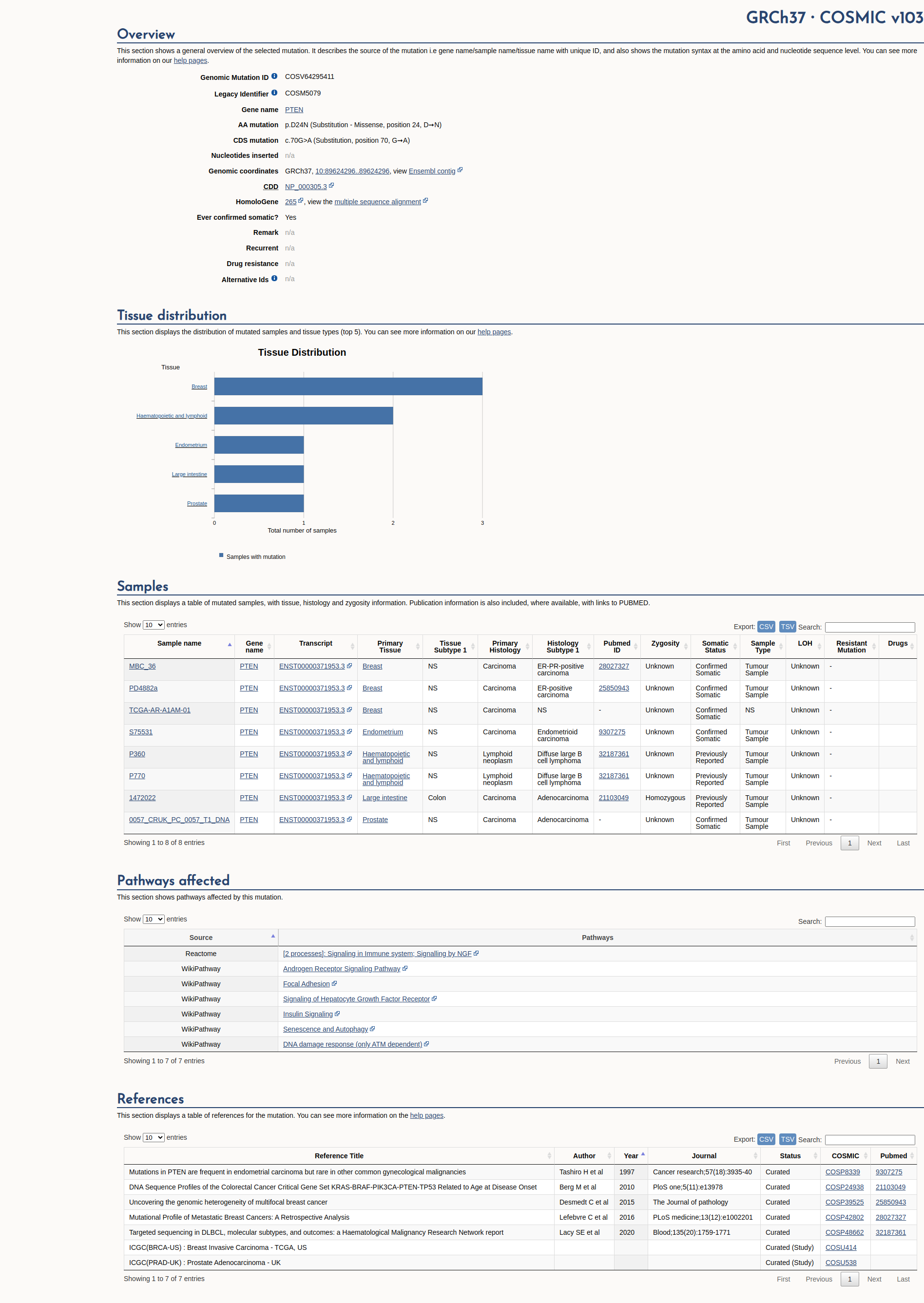
Functional Impact & Domains
Functional Domain
Error in OpenAI Consolidation. OncoKB: PTEND24NPTEND24NSomaticNCBI Gene:5728|Show additional gene information Variant OverviewPTEN, a lipid and protein phosphatase, is one of the most frequently mutated genes in cancer.The PTEN D24N mutation is likely oncogenic.Hide mutation effect description The PTEN D24N mutation is located in the phosphatase domain of the protein. This mutation has been found in endometrial cancer (PMID: 17213812). Expression of this mutation in human embryonic kidney cell line demonstrated that it is inactivating as measured by increased protein mislocalization despite no change in protein phosphatase activity compared to wildtype (PMID: 17213812). JAX-CKB: PTEN D24N lies within the phosphatase tensin-type domain of the Pten protein (UniProt.org). D24N retains phosphatase activity, but has aberrant nuclear localization and fails to inhibit Akt phosphorylation, cell proliferation, and transformation in cell culture (PMID: 17213812) and therefore, confers a loss of function to the Pten protein.
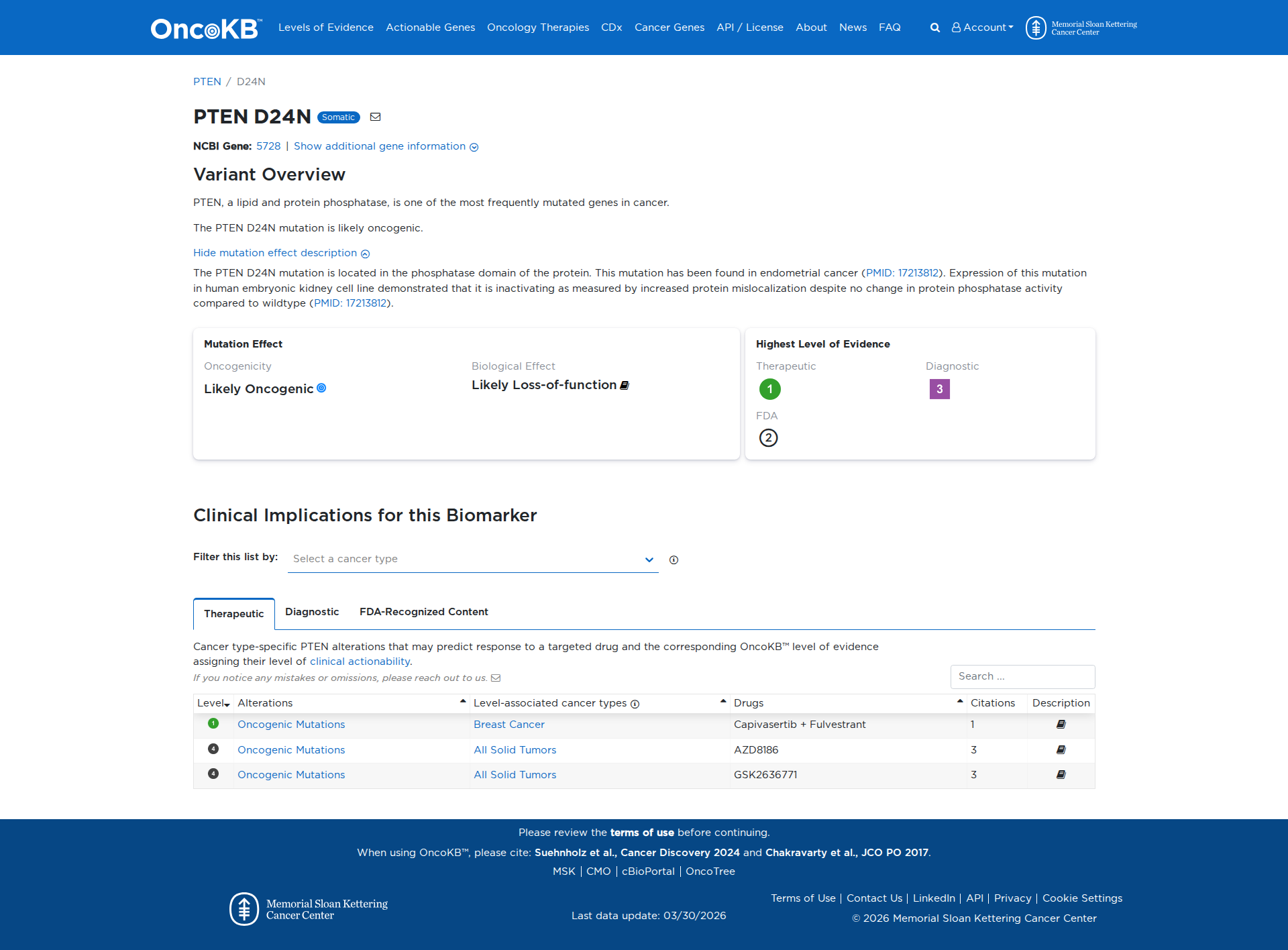
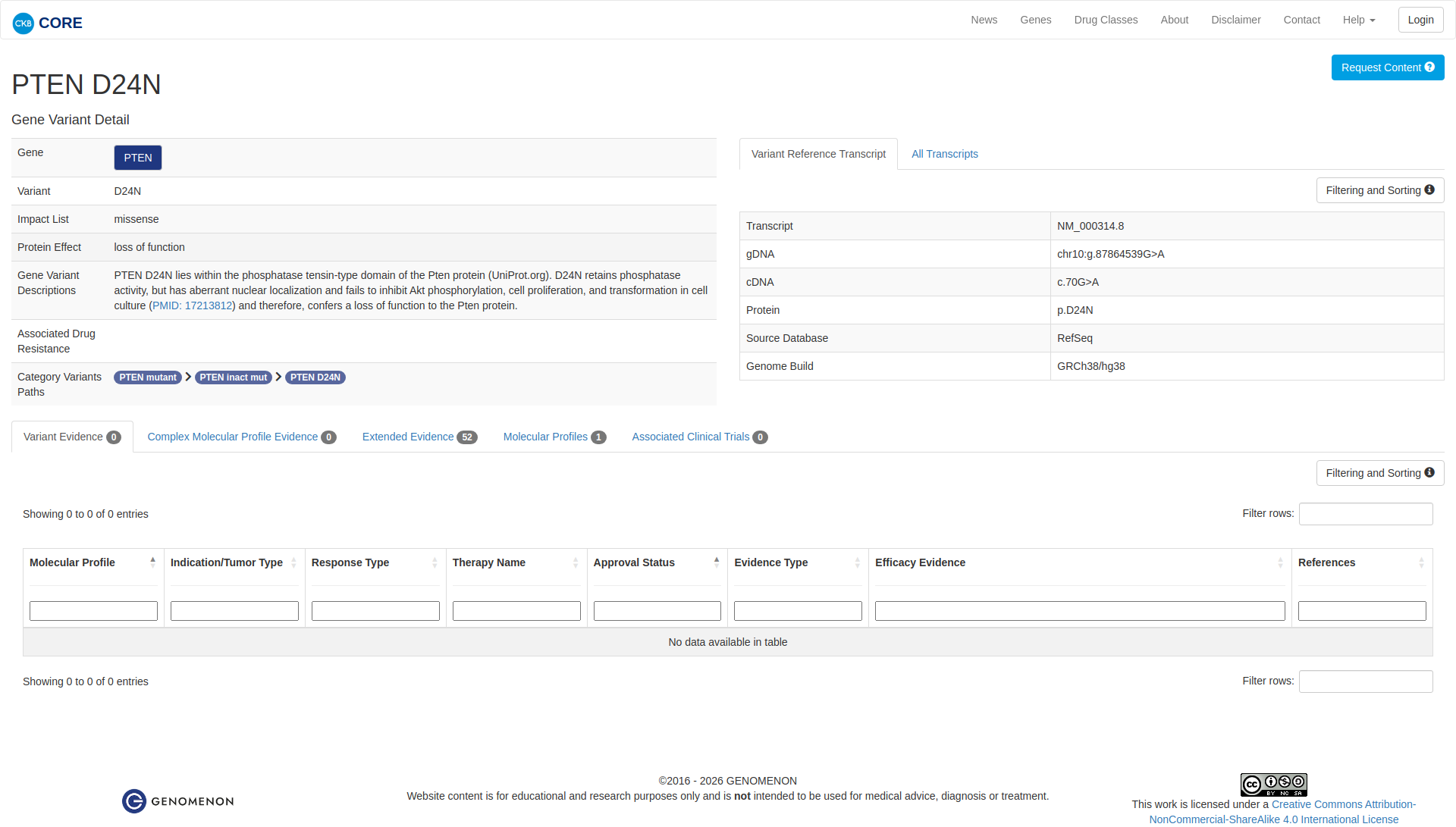
Click on previews to view full database entries. External databases may require institutional access.
Computational Analysis
Pathogenicity Predictions
SpliceAISpliceAI Scores
Window: ±500bp| Effect Type | Score | Position |
|---|---|---|
| Acceptor Loss (AL) | 0.02 | -85 bp |
| Donor Loss (DL) | 0.0 | 85 bp |
| Acceptor Gain (AG) | 0.0 | -270 bp |
| Donor Gain (DG) | 0.01 | 9 bp |
VCEP Guidelines
Applied ACMG/AMP Criteria (VCEP Specific)
BP4 (Unknown (Pre-LLM))
From pre-LLM assessment (LLM Failed)
PM2 (Unknown (Pre-LLM))
From pre-LLM assessment (LLM Failed)
PP5 (Unknown (Pre-LLM))
From pre-LLM assessment (LLM Failed)
PS3 (Unknown (Pre-LLM))
From pre-LLM assessment (LLM Failed)