Genetic Information
Gene & Transcript Details
| ID | Status | Details |
|---|---|---|
| NM_000546.5 | RefSeq Select | 2591 nt | 203–1384 |
| NM_000546.3 | Alternative | 2640 nt | 252–1433 |
| NM_000546.6 | MANE Select | 2512 nt | 143–1324 |
| NM_000546.4 | Alternative | 2586 nt | 198–1379 |
| NM_000546.2 | Alternative | 2629 nt | 252–1433 |
Variant Details
Clinical & Population Data
Population Frequency
gnomADClinVar
OpenThis variant is considered likely pathogenic. Functional studies indicate this variant impacts protein function [PMID: 29979965, 16861262]. This variant is expected to disrupt protein structure [Myriad internal data].
This variant is not present in population databases (ExAC no frequency). In summary, the available evidence is currently insufficient to determine the role of this variant in disease. Therefore, it has been classified as a Variant of Uncertain Significance. Experimental studies in yeast have shown that this variant impairs TP53 protein transcriptional activity (PMID: 12826609, 16861262). This variant has not been reported in the literature in individuals with TP53-related hereditary cancer. ClinVar contains an entry for this variant (Variation ID: 376646). This sequence change replaces proline with histidine at codon 278 of the TP53 protein (p.Pro278His). The proline residue is highly conserved and there is a moderate physicochemical difference between proline and histidine.
The p.P278H variant (also known as c.833C>A), located in coding exon 7 of the TP53 gene, results from a C to A substitution at nucleotide position 833. The proline at codon 278 is replaced by histidine, an amino acid with similar properties. This variant is in the DNA binding domain of the TP53 protein and is reported to have loss of transactivation capacity in yeast based assays (Kato S et al. Proc. Natl. Acad. Sci. U.S.A. 2003 Jul 8;100(14):8424-9). Studies conducted in human cell lines indicate this alteration is deficient at growth suppression (Kotler E et al. Mol. Cell 2018 Jul;71:178-190.e8; Giacomelli AO et al. Nat. Genet. 2018 Oct;50:1381-1387). This variant was detected in at least one individual at an allele fraction that is suggestive of clonal hematopoiesis, a predictor of TP53 pathogenicity (Ambry internal data; Fortuno C et al. Genet Med. 2022 03;24:673-680). This amino acid position is highly conserved in available vertebrate species. In addition, this alteration is predicted to be deleterious by in silico analysis. This variant is considered to be rare based on population cohorts in the Genome Aggregation Database (gnomAD). Based on the supporting evidence, this variant is interpreted as a disease-causing mutation.
"This variant has been reported in ClinVar as Uncertain significance (4 clinical laboratories) and as Likely pathogenic (1 clinical laboratories) and as Pathogenic (1 clinical laboratories)."
COSMIC Somatic Evidence
Open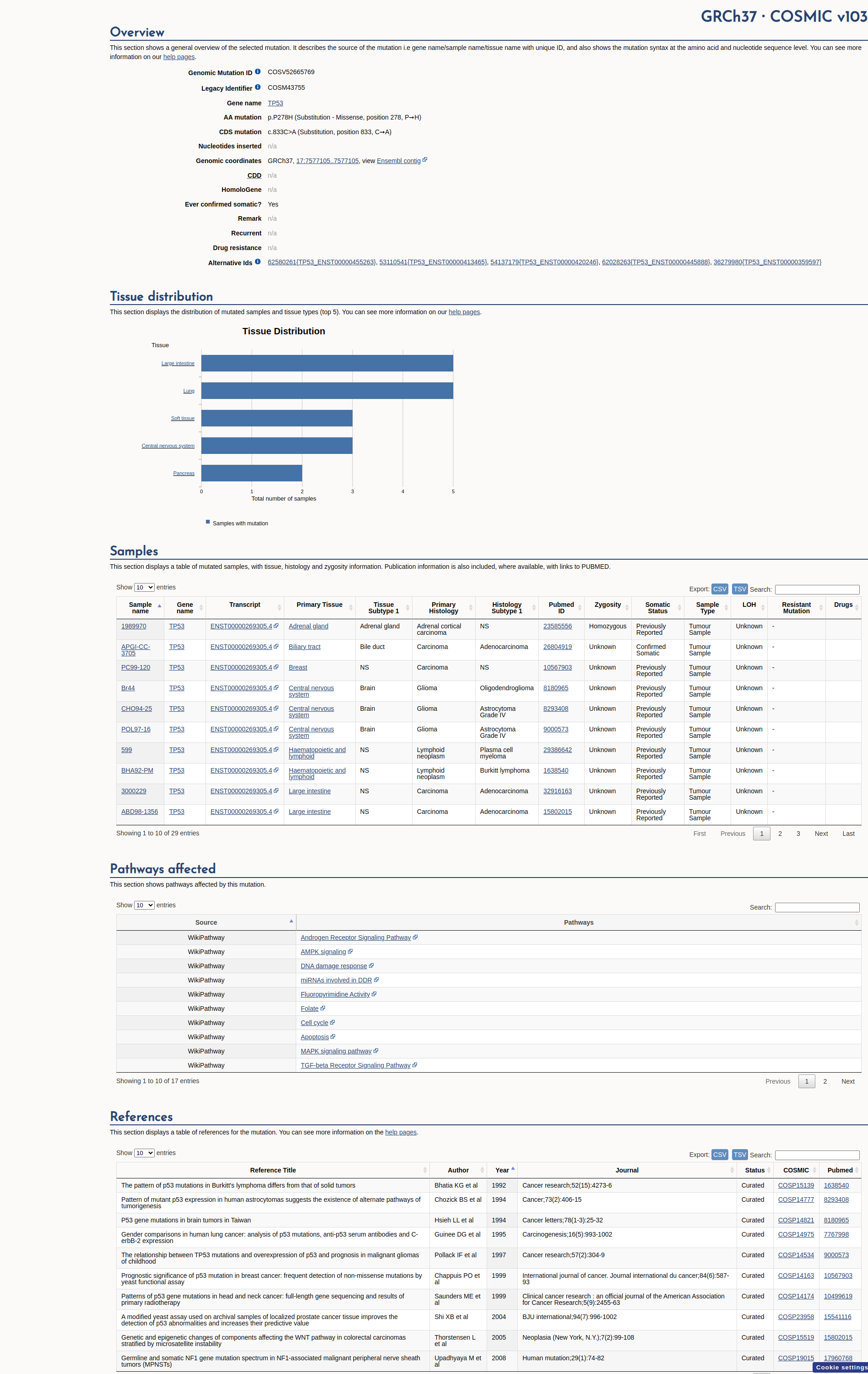
Functional Impact & Domains
Functional Domain
The TP53 P278H variant has been functionally characterized and shown to be damaging. In vivo studies with yeast and in vitro studies with human cancer cell lines indicate that the mutation is inactivating, as evidenced by the loss of transactivational activity and reduced growth suppression activity compared to the wildtype protein.
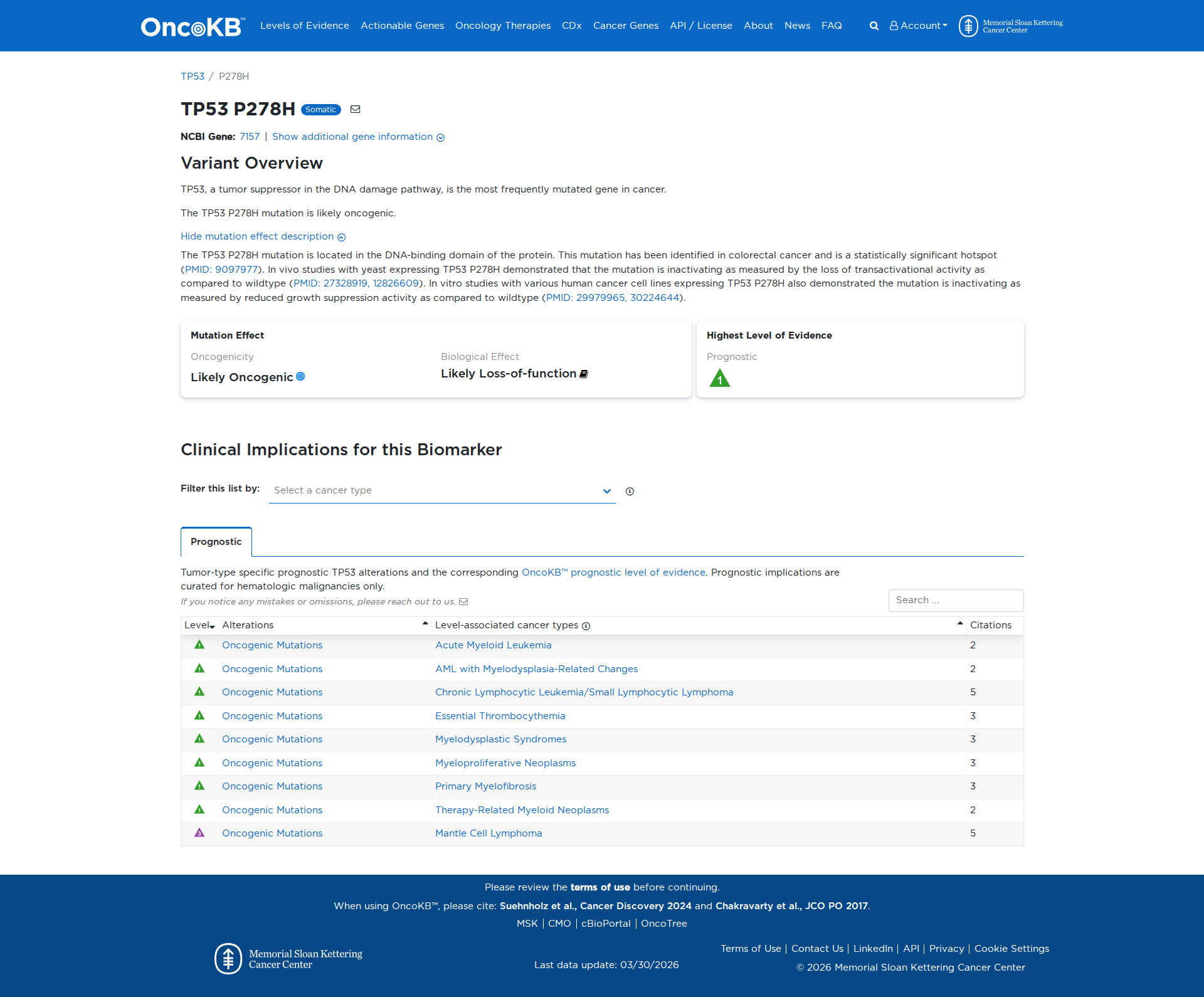
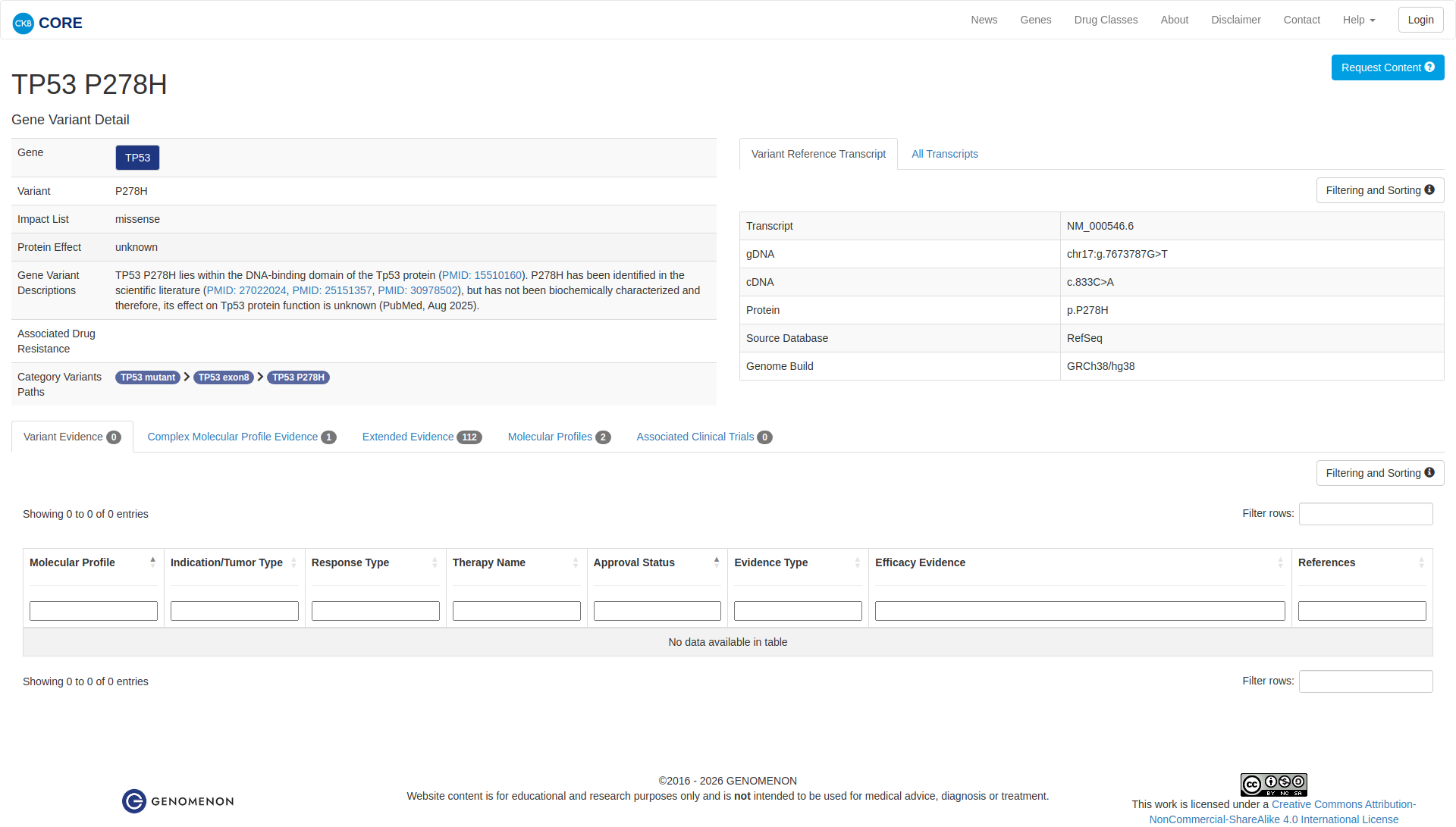
Click on previews to view full database entries. External databases may require institutional access.
Computational Analysis
Pathogenicity Predictions
SpliceAISpliceAI Scores
Window: ±500bp| Effect Type | Score | Position |
|---|---|---|
| Acceptor Loss (AL) | 0.0 | 53 bp |
| Donor Loss (DL) | 0.0 | 104 bp |
| Acceptor Gain (AG) | 0.0 | 26 bp |
| Donor Gain (DG) | 0.0 | -86 bp |
VCEP Guidelines
Applied ACMG/AMP Criteria (VCEP Specific)
PVS1 (Not Applied)
According to standard ACMG guidelines, the rule for PVS1 applies to null variants predicted to result in loss of function. The evidence for this variant shows that it is a missense change (P278H) and not a null/truncating variant. Therefore, this criterion is not applied.
PS1 (Not Applied)
According to VCEP guidelines, PS1 applies when the same amino acid change as a known pathogenic variant is caused by a different nucleotide change. The evidence for this variant shows no other P278H change previously classified as pathogenic under VCEP specifications. Therefore, this criterion is not applied.
PS2 (Not Applied)
According to VCEP guidelines, PS2 applies to confirmed de novo occurrences with specified point thresholds. No de novo data are available for this variant. Therefore, this criterion is not applied.
PS3 (Not Applied)
According to VCEP guidelines, PS3_Strong requires non-functional Kato et al. data AND loss of function on another assay. The evidence for this variant shows general in vivo (yeast) and in vitro cell line studies but no specific Kato, Giacomelli, Kotler, or Kawaguchi assay data as required. Therefore, this criterion is not applied.
PS4 (Not Applied)
According to VCEP guidelines, PS4 requires case points from affected individuals. No case or proband count data are provided for TP53 P278H. Therefore, this criterion is not applied.
PM1 (Not Applied)
According to VCEP guidelines, PM1 applies moderately to missense variants at TP53 codons 175, 245, 248, 249, 273, or 282. Codon 278 is outside these specified hotspots. Therefore, this criterion is not applied.
PM2 (Supporting)
According to VCEP guidelines, PM2_Supporting applies for variants with allele frequency <0.00003 in gnomAD. The evidence for this variant shows it is absent from gnomAD (MAF=0%). Therefore, this criterion is applied at Supporting strength.
PM3 (Not Applied)
According to standard ACMG guidelines, PM3 applies to variants in trans with a pathogenic variant for recessive disorders. TP53‐related disease is dominant and no trans data are available. Therefore, this criterion is not applied.
PM4 (Not Applied)
According to standard ACMG guidelines, PM4 applies to protein length changes (in‐frame indels). This is a missense variant. Therefore, this criterion is not applied.
PM5 (Not Applied)
According to VCEP guidelines, PM5 applies when ≥1 different pathogenic missense variants have been seen at the same residue. No such pathogenic P278 variants are documented. Therefore, this criterion is not applied.
PM6 (Not Applied)
According to VCEP guidelines, PM6 applies to presumed de novo occurrences without confirmation. No de novo information is available. Therefore, this criterion is not applied.
PP1 (Not Applied)
According to VCEP guidelines, PP1 requires cosegregation in 3–4 meioses. No segregation data are provided. Therefore, this criterion is not applied.
PP2 (Not Applied)
According to standard ACMG guidelines, PP2 applies when missense variants in a gene with low benign missense rate. TP53 has many pathogenic missense variants, and this rule is not appropriate. Therefore, this criterion is not applied.
PP3 (Not Applied)
According to VCEP guidelines, PP3_Moderate applies for BayesDel ≥0.16 and aGVGD C65. No BayesDel or aGVGD data are available, and in silico evidence is mixed. Therefore, this criterion is not applied.
PP4 (Not Applied)
According to VCEP guidelines, PP4 applies for CHIP‐related observations at defined VAF thresholds. No VAF observations are provided. Therefore, this criterion is not applied.
PP5 (Not Applied)
According to standard ACMG guidelines, PP5 applies when a reputable source reports pathogenicity without underlying evidence. ClinVar reports are mixed (4 VUS, 1 LP, 1 P). No single reputable assertion dominates. Therefore, this criterion is not applied.
BA1 (Not Applied)
According to VCEP guidelines, BA1 applies for filtering AF ≥0.001. The variant is absent from gnomAD. Therefore, this criterion is not applied.
BS1 (Not Applied)
According to VCEP guidelines, BS1 applies for filtering AF ≥0.0003. The variant is absent from gnomAD. Therefore, this criterion is not applied.
BS2 (Not Applied)
According to VCEP guidelines, BS2 applies for ≥2 unaffected elderly females. No such data are available. Therefore, this criterion is not applied.
BS3 (Not Applied)
According to VCEP guidelines, BS3 applies when functional assays show preserved function. The evidence shows damaging function. Therefore, this criterion is not applied.
BS4 (Not Applied)
According to VCEP guidelines, BS4 applies when lack of segregation is demonstrated. No segregation data are provided. Therefore, this criterion is not applied.
BP1 (Not Applied)
According to standard ACMG guidelines, BP1 applies to missense in genes where truncating variants are the sole mechanism. TP53 has known pathogenic missense variants, so BP1 does not apply. Therefore, this criterion is not applied.
BP2 (Not Applied)
According to standard ACMG guidelines, BP2 applies when observed in trans with a pathogenic variant for a dominant gene. No such data are available. Therefore, this criterion is not applied.
BP3 (Not Applied)
According to standard ACMG guidelines, BP3 applies to in‐frame deletions in repetitive regions. This is a missense variant. Therefore, this criterion is not applied.
BP4 (Not Applied)
According to VCEP guidelines, BP4_Moderate requires BayesDel ≤−0.008 and SpliceAI <0.2. SpliceAI <0.2 is met but BayesDel data are unavailable. Therefore, this criterion is not applied.
BP5 (Not Applied)
According to standard ACMG guidelines, BP5 applies when a variant is observed in cis with a pathogenic variant. No such data are available. Therefore, this criterion is not applied.
BP6 (Not Applied)
According to standard ACMG guidelines, BP6 applies when a reputable source reports benign without evidence. No such benign assertion is present. Therefore, this criterion is not applied.
BP7 (Not Applied)
According to VCEP guidelines, BP7 applies to synonymous or intronic variants outside the splice consensus. This is a missense variant. Therefore, this criterion is not applied.