Genetic Information
Gene & Transcript Details
| ID | Status | Details |
|---|---|---|
| NM_004333.6 | MANE Select | 6459 nt | 227–2527 |
| NM_004333.2 | Alternative | 2513 nt | 62–2362 |
| NM_004333.3 | Alternative | 2477 nt | 62–2362 |
| NM_004333.4 | Alternative | 2949 nt | 62–2362 |
| NM_004333.5 | RefSeq Select | 4560 nt | 226–2526 |
Variant Details
Clinical & Population Data
Population Frequency
gnomADClinVar
Open"Present in ClinVar, however no clinical evidence available for this variant."
COSMIC Somatic Evidence
Open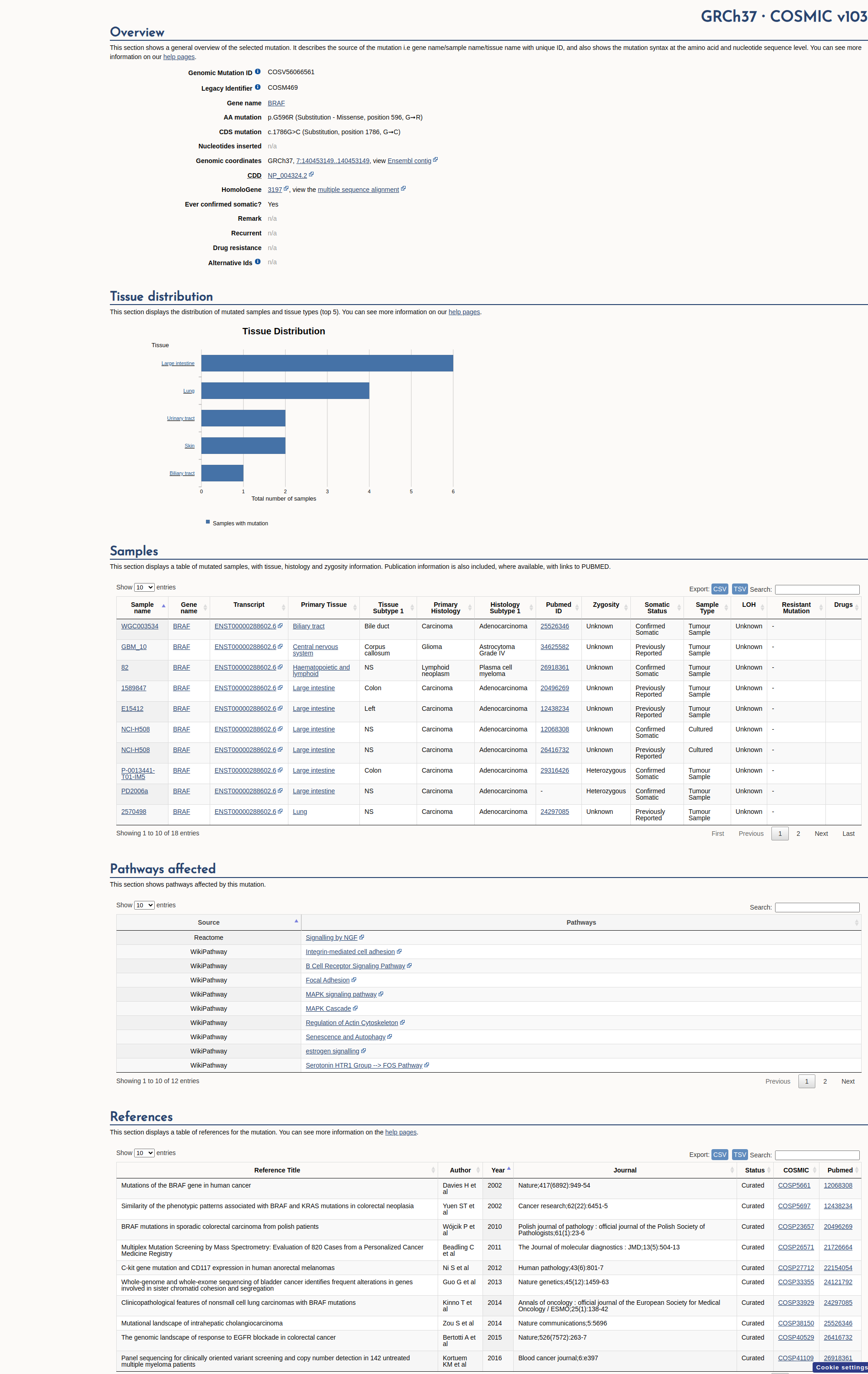
Functional Impact & Domains
Functional Domain
The BRAF G596R variant has been functionally characterized as oncogenic, with evidence indicating that it is RAS-dependent in activating the MAPK pathway and signals as a dimer with CRAF. It typically co-occurs with other mechanisms that amplify RAS signaling. Preclinical studies have shown that cells expressing this variant are sensitive to certain targeted therapies (PLX8394, RMC-4550, trametinib plus dabrafenib) and resistant to vemurafenib. Despite its oncogenic potential, the variant exhibits impaired BRAF kinase activity and decreased MEK and ERK phosphorylation, suggesting a loss of BRAF protein function. It is not transforming in culture and does not promote tumor formation in mouse models.
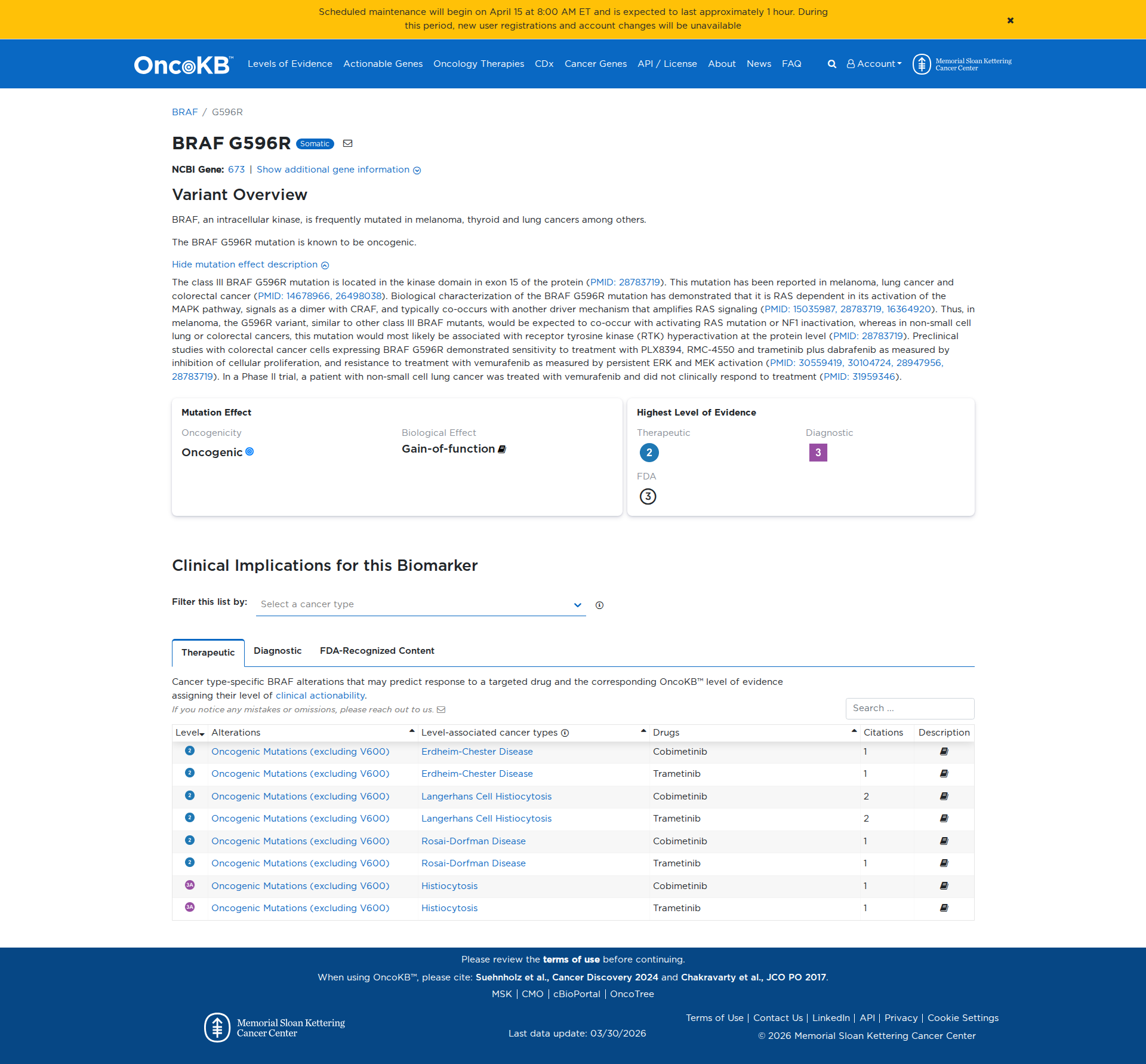
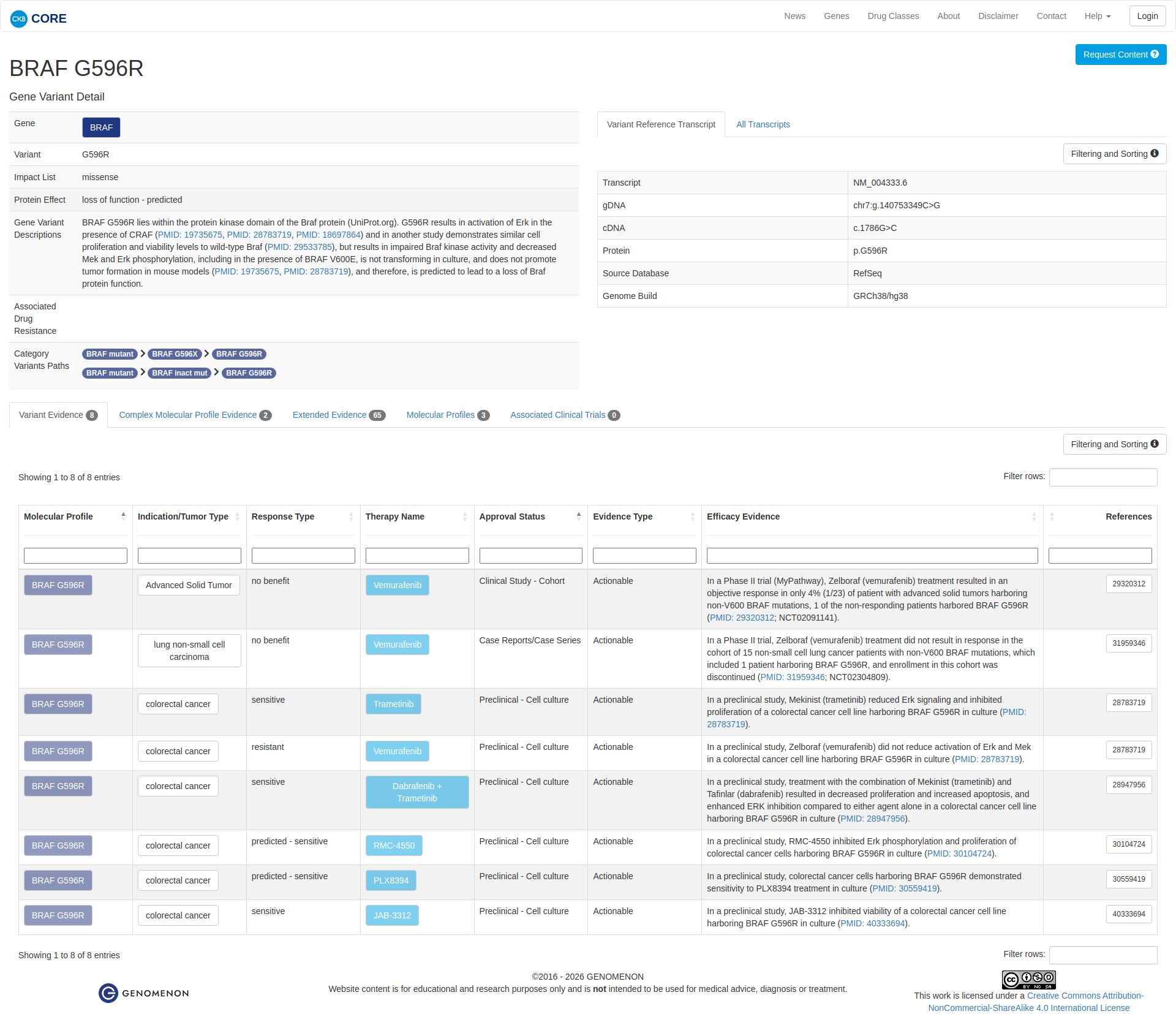
Click on previews to view full database entries. External databases may require institutional access.
Computational Analysis
Pathogenicity Predictions
SpliceAISpliceAI Scores
Window: ±500bp| Effect Type | Score | Position |
|---|---|---|
| Acceptor Loss (AL) | 0.0 | 9 bp |
| Donor Loss (DL) | 0.0 | 47 bp |
| Acceptor Gain (AG) | 0.24 | 44 bp |
| Donor Gain (DG) | 0.3 | -74 bp |
VCEP Guidelines
Applied ACMG/AMP Criteria (VCEP Specific)
PVS1 (Not Applied)
According to standard ACMG guidelines, the rule for PVS1 is: 'Null variant (nonsense, frameshift, start codon, canonical ±1 or 2 splice sites, single exon or multi-exon deletion) in a gene where loss of function is a known mechanism of disease'. The evidence for this variant shows: NM_004333.4:c.1786G>C is a missense change (G596R) and does not introduce a premature stop codon or affect canonical splice sites. Therefore, this criterion is not applied because the variant is not a null variant.
PS1 (Not Applied)
According to VCEP guidelines, the rule for PS1 is: 'Strong Same amino acid change as a previously established pathogenic variant regardless of nucleotide change'. The evidence for this variant shows: there is no previously established pathogenic variant causing p.Gly596Arg in BRAF or RAF1. Therefore, this criterion is not applied because the amino acid change is not previously established as pathogenic.
PS2 (Not Applied)
According to VCEP guidelines, the rule for PS2 is: 'Very Strong: 4 Points for confirmed de novo (maternity and paternity confirmed) in a patient with the disease and no family history'. The evidence for this variant shows: there is no information regarding de novo occurrence in an affected individual. Therefore, this criterion is not applied due to lack of de novo evidence.
PS3 (Not Applied)
According to VCEP guidelines, the rule for PS3 is: 'Moderate Two or more different approved assays demonstrating a deleterious effect'. The evidence for this variant shows: functional studies described complex kinase impairment and no transforming activity in mouse models, but these assays do not demonstrate a germline RASopathy gain-of-function defect. Therefore, this criterion is not applied because the functional data do not meet the VCEP requirement for pathogenic gain-of-function.
PS4 (Not Applied)
According to VCEP guidelines, the rule for PS4 is: 'Strong ≥5 probands or case-control data demonstrating increased prevalence in affected vs controls'. The evidence for this variant shows: no case-control or proband count data are available. Therefore, this criterion is not applied due to lack of prevalence data in affected individuals.
PM1 (Moderate)
According to VCEP guidelines, the rule for PM1 is: 'Moderate Applicable only to critical and well-established functional domains available in the supplementary table (exon 6, exon 11, P-loop [AA 459-474], CR3 activation segment [AA 594-627])'. The evidence for this variant shows: p.Gly596Arg lies within the CR3 activation segment (AA 594-627). Therefore, this criterion is applied at Moderate strength because the residue is in a critical functional domain.
PM2 (Supporting)
According to VCEP guidelines, the rule for PM2 is: 'Supporting The variant must be absent from controls (gnomAD)'. The evidence for this variant shows: MAF = 0% in gnomAD and not found in other population databases. Therefore, this criterion is applied at Supporting strength because the variant is absent from population controls.
PM3 (Not Applied)
According to standard ACMG guidelines, the rule for PM3 is: 'For recessive disorders, detected in trans with a pathogenic variant'. The evidence for this variant shows: BRAF-associated disorders are not recessive and no trans observations reported. Therefore, this criterion is not applied.
PM4 (Not Applied)
According to standard ACMG guidelines, the rule for PM4 is: 'Protein length changes due to in-frame indels or stop-loss in non-repeat regions'. The evidence for this variant shows: it is a single amino acid substitution, not an indel. Therefore, this criterion is not applied.
PM5 (Not Applied)
According to VCEP guidelines, the rule for PM5 is: 'Strong ≥2 different [likely] pathogenic residue changes at the same codon observed in ≥5 probands; Moderate 1 [likely] pathogenic residue change at the same codon'. The evidence for this variant shows: no other pathogenic variants reported at codon 596 in BRAF. Therefore, this criterion is not applied.
PM6 (Not Applied)
According to VCEP guidelines, the rule for PM6 is: 'Supporting/Moderate/Strong for unconfirmed de novo cases'. The evidence for this variant shows: no data on de novo status. Therefore, this criterion is not applied.
PP1 (Not Applied)
According to VCEP guidelines, the rule for PP1 is: 'Supporting/Moderate/Strong based on number of informative meioses segregating with disease'. The evidence for this variant shows: no segregation data available. Therefore, this criterion is not applied.
PP2 (Supporting)
According to VCEP guidelines, the rule for PP2 is: 'Supporting Missense z score is >3.09 in gnomAD'. The evidence for this variant shows: BRAF has a missense constraint z score >3.09, indicating missense changes are under selective constraint. Therefore, this criterion is applied at Supporting strength because the gene is intolerant to missense variation.
PP3 (Not Applied)
According to VCEP guidelines, the rule for PP3 is: 'Supporting For missense variants: REVEL ≥0.7'. The evidence for this variant shows: REVEL score not available and other computational tools give mixed results (CADD 5.97, PolyPhen-2, MetaSVM conflicting). Therefore, this criterion is not applied due to insufficient consistent computational support.
PP4 (Not Applied)
According to standard ACMG guidelines, the rule for PP4 is: 'Patient’s phenotype or family history is highly specific for a disease with a single genetic etiology'. The evidence for this variant shows: no germline RASopathy phenotype or family history provided. Therefore, this criterion is not applied.
PP5 (Not Applied)
According to standard ACMG guidelines, the rule for PP5 is: 'Reputable source reports variant as pathogenic without independent evidence'. The evidence for this variant shows: ClinVar entry exists but no clinical assertion. Therefore, this criterion is not applied.
BA1 (Not Applied)
According to VCEP guidelines, the rule for BA1 is: 'Stand Alone GnomAD filtering allele frequency ≥0.05%'. The evidence for this variant shows: allele frequency is 0% in gnomAD. Therefore, this criterion is not applied.
BS1 (Not Applied)
According to VCEP guidelines, the rule for BS1 is: 'Strong GnomAD filtering allele frequency ≥0.025%'. The evidence for this variant shows: allele frequency is 0% in gnomAD. Therefore, this criterion is not applied.
BS2 (Not Applied)
According to standard ACMG guidelines, the rule for BS2 is: 'Observed in a healthy adult individual for a dominant disorder with full penetrance at an early age'. The evidence for this variant shows: no healthy adult observations reported. Therefore, this criterion is not applied.
BS3 (Not Applied)
According to standard ACMG guidelines, the rule for BS3 is: 'Well-established functional studies show no damaging effect'. The evidence for this variant shows: functional studies are conflicting, indicating both impaired kinase activity and oncogenic potential via dimerization, not clearly benign. Therefore, this criterion is not applied.
BS4 (Not Applied)
According to standard ACMG guidelines, the rule for BS4 is: 'Lack of segregation in affected members of a family'. The evidence for this variant shows: no family segregation data. Therefore, this criterion is not applied.
BP1 (Not Applied)
According to VCEP guidelines, the rule for BP1 is: 'Supporting for truncating variants in gain-of-function genes not applicable to missense variants'. The evidence for this variant shows: it is a missense change. Therefore, this criterion is not applied.
BP2 (Not Applied)
According to standard ACMG guidelines, the rule for BP2 is: 'Observed in trans with a pathogenic variant for a dominant disorder'. The evidence for this variant shows: no such observations. Therefore, this criterion is not applied.
BP3 (Not Applied)
According to standard ACMG guidelines, the rule for BP3 is: 'In-frame indels in a repetitive region without a known function'. The evidence for this variant shows: it is a single amino acid substitution, not an indel. Therefore, this criterion is not applied.
BP4 (Not Applied)
According to VCEP guidelines, the rule for BP4 is: 'Supporting For missense variants: REVEL ≤0.3'. The evidence for this variant shows: REVEL not provided and other tools give mixed results. Therefore, this criterion is not applied.
BP5 (Not Applied)
According to standard ACMG guidelines, the rule for BP5 is: 'Variant found in a case with an alternate molecular basis for disease'. The evidence for this variant shows: no such alternate diagnosis. Therefore, this criterion is not applied.
BP6 (Not Applied)
According to standard ACMG guidelines, the rule for BP6 is: 'Reputable source reports variant as benign without evidence'. The evidence for this variant shows: no benign assertion in reputable databases. Therefore, this criterion is not applied.
BP7 (Not Applied)
According to standard ACMG guidelines, the rule for BP7 is: 'Synonymous variant with no impact on splicing and low conservation'. The evidence for this variant shows: it is a missense change. Therefore, this criterion is not applied.