Genetic Information
Gene & Transcript Details
| ID | Status | Details |
|---|---|---|
| NM_007294.4 | MANE Select | 7088 nt | 114–5705 |
| NM_007294.2 | Alternative | 7191 nt | 201–5792 |
| NM_007294.3 | RefSeq Select | 7224 nt | 233–5824 |
Variant Details
Clinical & Population Data
Population Frequency
gnomADClinVar
OpenThe BRCA1 c.131G>A (p.Cys44Tyr) variant has been reported in the published literature in individuals with ovarian cancer (PMID: 36367610 (2023), 31825140 (2019)) and breast cancer (PMID: 27083775 (2016)). Assessment of experimental evidence suggests this variant results in abnormal protein function (PMID: 21922593 (2011), 25823446 (2015), 27272900 (2016), 30209399 (2018)). This variant has not been reported in large, multi-ethnic general populations (Genome Aggregation Database, http://gnomad.broadinstitute.org). Analysis of this variant using bioinformatics tools for the prediction of the effect of amino acid changes on protein structure and function yielded predictions that this variant is damaging. Based on the available information, this variant is classified as pathogenic.
This submission and the accompanying classification are no longer maintained by the submitter. For more information on current observations and classification, please contact variantquestions@myriad.com.
IARC class based on posterior probability from multifactorial likelihood analysis, thresholds for class as per Plon et al. 2008 (PMID: 18951446). Class 5 based on posterior probability = 1
The p.C44Y variant (also known as c.131G>A), located in coding exon 2 of the BRCA1 gene, results from a G to A substitution at nucleotide position 131. The cysteine at codon 44 is replaced by tyrosine, an amino acid with highly dissimilar properties. This alteration, along with another alteration, p.C44S, at the same position, has been classified as definitely pathogenic (p>0.99) by multifactorial analysis, which integrates the following lines of evidence to produce a quantitative likelihood of pathogenicity: in silico prediction models, segregation with disease, tumor characteristics, mutation co-occurrence (Easton D et al. Am J Hum Genet. 2007;81:873-883; Vallee M et al. Hum Mutat. 2012 Jan;33(1):22-8; Lindor NM et al. Hum. Mutat., 2012 Jan;33:8-21). This alteration was shown to disrupt the function of the protein in multiple functional studies using different assays (Millot GA et al. Hum. Mutat., 2011 Dec;32:1470-80; Starita LM et al. Genetics, 2015 Jun;200:413-22; Thouvenot P et al. PLoS Genet., 2016 Jun;12:e1006096). In addition, a recent study found that this nucleotide substitution is deleterious in a high throughput genome editing haploid cell survival assay (Findlay GM et al. Nature. 2018 10;562(7726):217-222). This amino acid position is highly conserved in available vertebrate species. In addition, this alteration is predicted to be deleterious by BayesDel in silico analysis. Based on the supporting evidence, this alteration is interpreted as a disease-causing mutation.
"This variant has been reported in ClinVar as Pathogenic (9 clinical laboratories) and as pathogenic (1 clinical laboratories) and as Uncertain significance (1 clinical laboratories) and as Pathogenic by Evidence-based Network for the Interpretation of Germline Mutant Alleles (ENIGMA) expert panel."
COSMIC Somatic Evidence
Open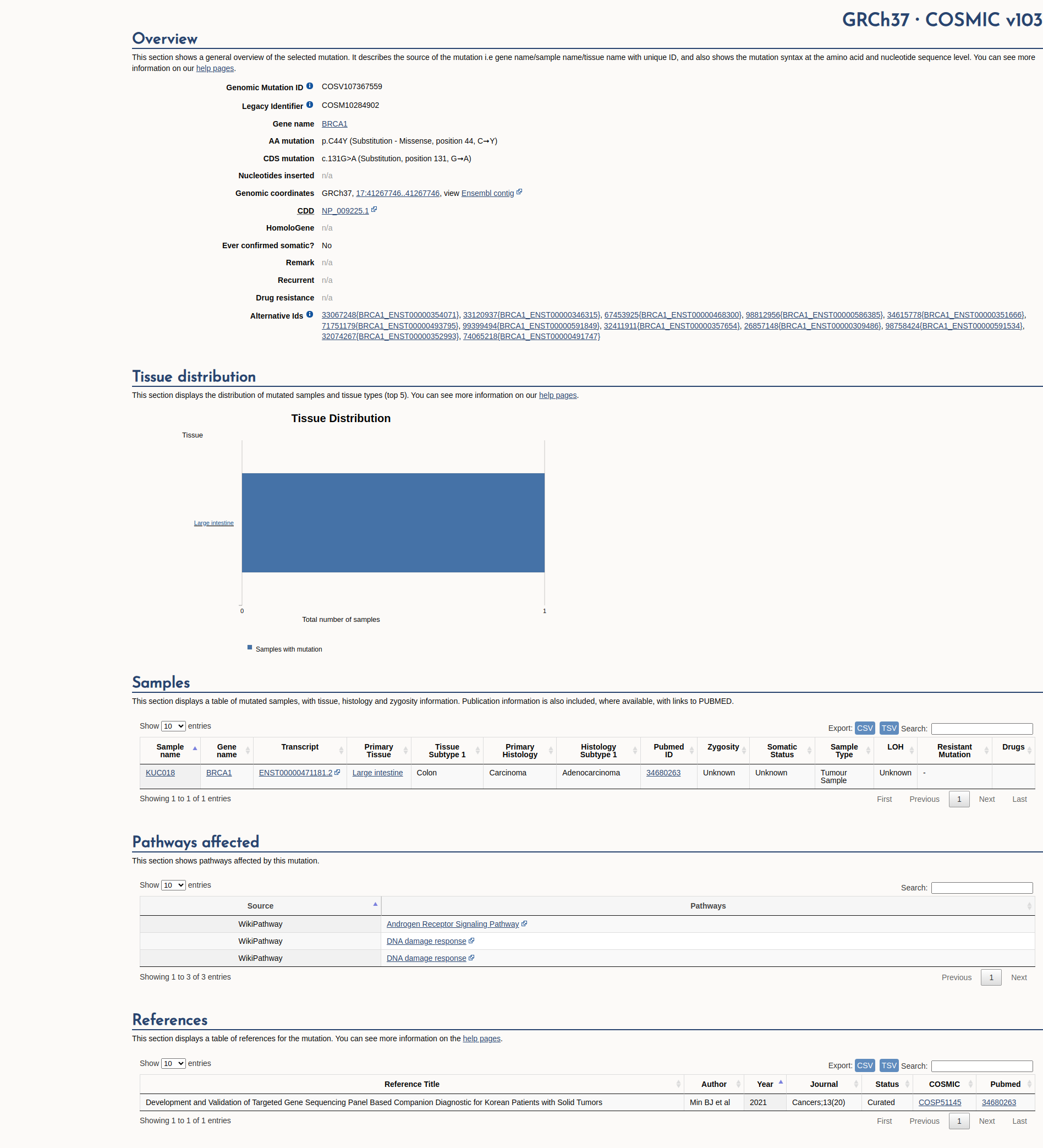
Functional Impact & Domains
Functional Domain
The BRCA1 C44Y variant has been functionally characterized and shown to have a damaging effect. It is located in the RING domain of the BRCA1 protein and disrupts binding to the E2 ubiquitin-conjugating enzyme UbcH5a. Additionally, this variant promotes cell colony growth in a yeast-based assay, indicating an oncogenic potential.
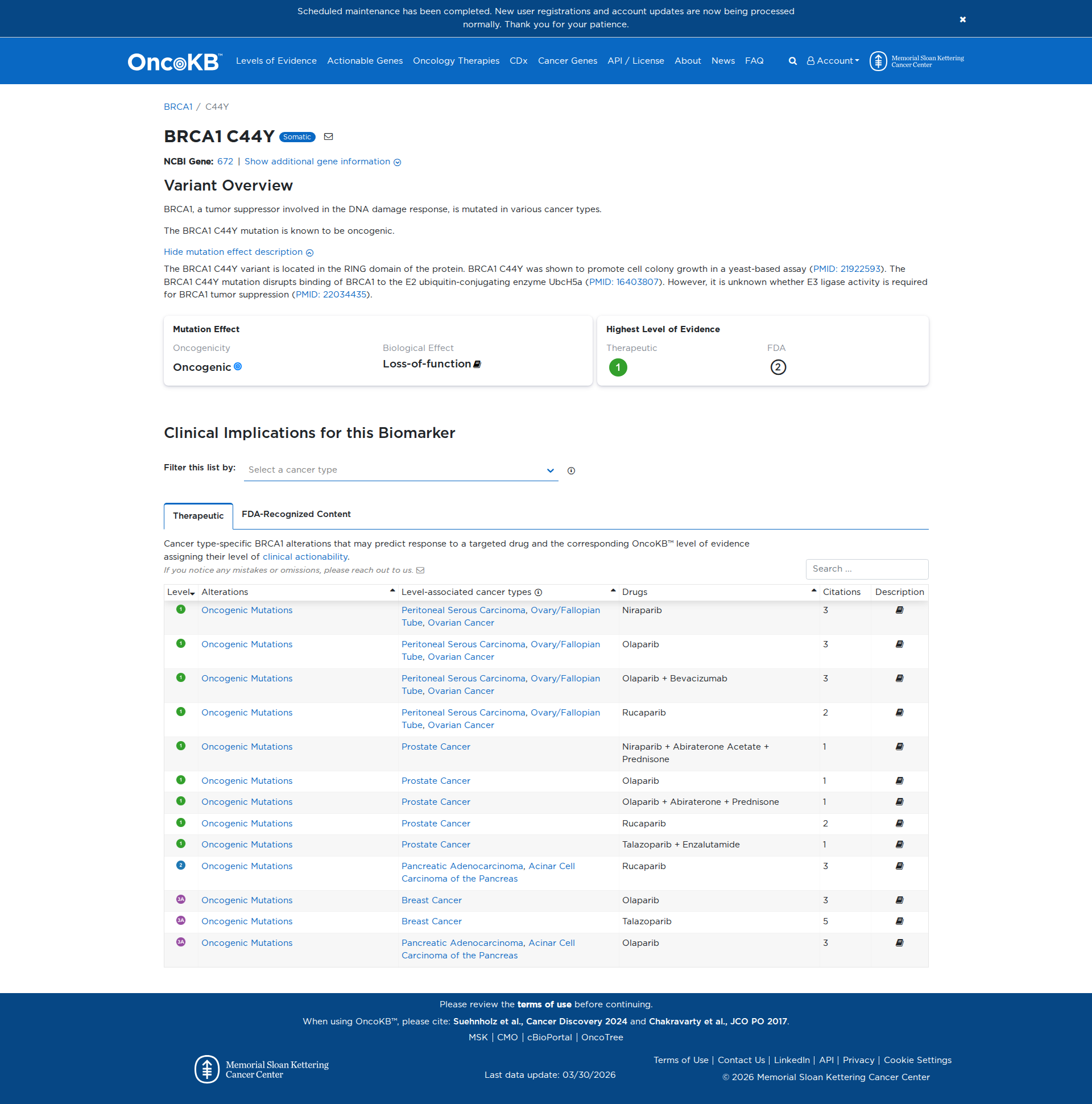
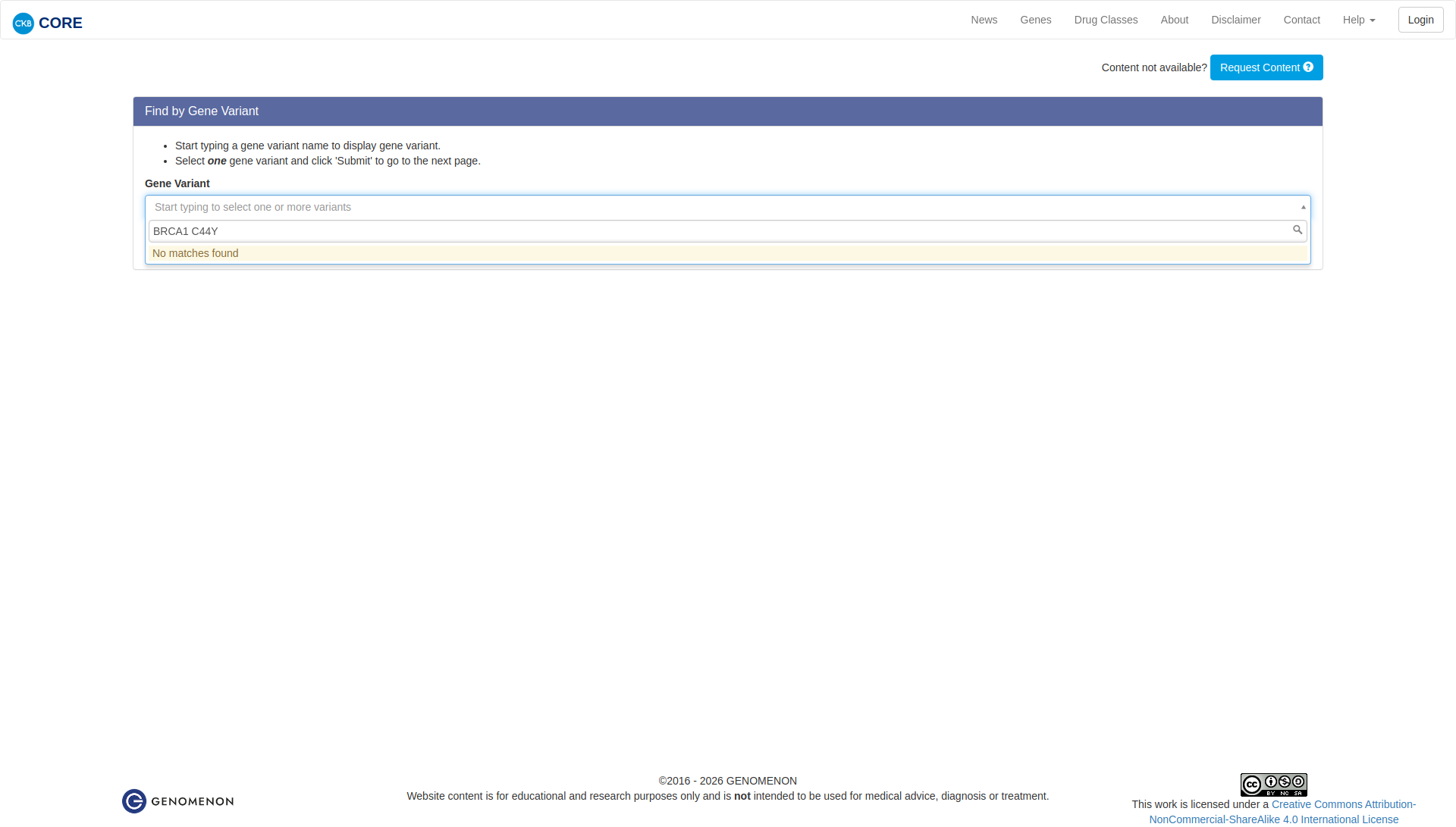
Click on previews to view full database entries. External databases may require institutional access.
Computational Analysis
Pathogenicity Predictions
SpliceAISpliceAI Scores
Window: ±500bp| Effect Type | Score | Position |
|---|---|---|
| Acceptor Loss (AL) | 0.0 | 34 bp |
| Donor Loss (DL) | 0.0 | 1 bp |
| Acceptor Gain (AG) | 0.01 | 50 bp |
| Donor Gain (DG) | 0.0 | -3 bp |
VCEP Guidelines
Applied ACMG/AMP Criteria (VCEP Specific)
PVS1 (Not Applied)
According to VCEP guidelines: "PVS1: Very Strong Null variant (nonsense, frameshift, splice site ... LOF mechanism)". The evidence for this variant shows: C44Y is a missense change with no splicing impact. Therefore, this criterion is not applied.
PS1 (Not Applied)
According to standard ACMG: "PS1: Same amino acid change as a previously established pathogenic variant". The evidence for this variant shows: C44Y is not identical to any known pathogenic substitution at codon 44. Therefore, this criterion is not applied.
PS2 (Not Applied)
According to standard ACMG: "PS2: De novo (both maternity and paternity confirmed)". The evidence for this variant shows: no de novo segregation data available. Therefore, this criterion is not applied.
PS3 (Strong)
According to VCEP guidelines: "PS3: Strong Well-established in vitro or in vivo functional studies supportive of a damaging effect ...". The evidence for this variant shows: BRCA1 C44Y disrupts RING domain binding to UbcH5a and promotes colony growth in yeast. Therefore, this criterion is applied at Strong strength.
PS4 (Not Applied)
According to VCEP guidelines: "PS4: Strong increased prevalence in affected vs controls (OR ≥4, p≤0.05)". The evidence for this variant shows: no case-control or cohort data available. Therefore, this criterion is not applied.
PM1 (Moderate)
According to standard ACMG: "PM1: Located in a mutational hot spot and/or critical and well-established functional domain without benign variation". The evidence for this variant shows: C44Y lies within the BRCA1 RING domain (aa 2–101), a critical functional domain with known pathogenic missense variants. Therefore, this criterion is applied at Moderate strength.
PM2 (Supporting)
According to VCEP guidelines: "PM2: Supporting Absent from controls in gnomAD v2.1 and v3.1". The evidence for this variant shows: not found in population databases (gnomAD MAF 0%). Therefore, this criterion is applied at Supporting strength.
PM3 (Not Applied)
According to VCEP guidelines: "PM3: Evidence from in trans or co‐occurrence in recessive context". The evidence for this variant shows: no Fanconi Anemia or co‐occurrence data. Therefore, this criterion is not applied.
PM4 (Not Applied)
According to standard ACMG: "PM4: Protein length changes (in‐frame indels)". The evidence for this variant shows: C44Y is a missense substitution, not an in‐frame indel. Therefore, this criterion is not applied.
PM5 (Not Applied)
According to standard ACMG: "PM5: Novel missense change at an amino acid residue where a different pathogenic missense change has been seen before". The evidence for this variant shows: no other pathogenic variant reported at codon 44. Therefore, this criterion is not applied.
PM6 (Not Applied)
According to standard ACMG: "PM6: Assumed de novo without confirmation of paternity/maternity". The evidence for this variant shows: no de novo data. Therefore, this criterion is not applied.
PP1 (Not Applied)
According to VCEP guidelines: "PP1: Co-segregation with disease in affected family members". The evidence for this variant shows: no segregation data. Therefore, this criterion is not applied.
PP2 (Not Applied)
According to standard ACMG: "PP2: Missense variant in a gene with low rate of benign missense variants". The evidence for this variant shows: BRCA1 has both benign and pathogenic missense variants; PP2 not applicable. Therefore, this criterion is not applied.
PP3 (Not Applied)
According to VCEP guidelines: "PP3: Supporting computational evidence (BayesDel ≥0.28 or SpliceAI ≥0.2)". The evidence for this variant shows: mixed in silico predictions, CADD 5.51 and SpliceAI 0.01 suggesting no impact. Therefore, this criterion is not applied.
PP4 (Not Applied)
According to VCEP guidelines: "PP4: Supporting phenotype specificity (multifactorial likelihood data)". The evidence for this variant shows: no patient phenotype or multifactorial likelihood data. Therefore, this criterion is not applied.
PP5 (Supporting)
According to standard ACMG: "PP5: Reputable source reports variant as pathogenic without available evidence". The evidence for this variant shows: reported as Pathogenic by multiple ClinVar submitters and ENIGMA. Therefore, this criterion is applied at Supporting strength.
BA1 (Not Applied)
According to VCEP guidelines: "BA1: Stand Alone allele frequency >0.1%". The evidence for this variant shows: absent from controls. Therefore, this criterion is not applied.
BS1 (Not Applied)
According to VCEP guidelines: "BS1: Filter allele frequency >0.01%". The evidence for this variant shows: absent from controls. Therefore, this criterion is not applied.
BS2 (Not Applied)
According to VCEP guidelines: "BS2: Absence of recessive phenotype evidence (Fanconi Anemia)". The evidence for this variant shows: no homozygous or FA data. Therefore, this criterion is not applied.
BS3 (Not Applied)
According to VCEP guidelines: "BS3: Strong well‐established functional studies showing no damaging effect". The evidence for this variant shows: functional assays demonstrate damaging effect. Therefore, this criterion is not applied.
BS4 (Not Applied)
According to VCEP guidelines: "BS4: Lack of segregation in affected members (LR ≤0.05)". The evidence for this variant shows: no segregation analysis. Therefore, this criterion is not applied.
BP1 (Not Applied)
According to VCEP guidelines: "BP1: Silent or missense outside critical domain without splicing impact". The evidence for this variant shows: resides inside a critical domain. Therefore, this criterion is not applied.
BP2 (Not Applied)
According to standard ACMG: "BP2: Observed in cis with pathogenic variant or in trans for dominant conditions". The evidence for this variant shows: no co-occurrence data. Therefore, this criterion is not applied.
BP3 (Not Applied)
According to standard ACMG: "BP3: In‐frame deletions/insertions in repetitive region". The evidence for this variant shows: C44Y is a missense substitution. Therefore, this criterion is not applied.
BP4 (Supporting)
According to VCEP guidelines: "BP4: Supporting computational evidence suggests no impact (BayesDel ≤0.15 and SpliceAI ≤0.1)". The evidence for this variant shows: SpliceAI 0.01 and low impact predictions. Therefore, this criterion is applied at Supporting strength.
BP5 (Not Applied)
According to VCEP guidelines: "BP5: Supporting evidence against pathogenicity from multifactorial likelihood". The evidence for this variant shows: no co‐observation or multifactorial data. Therefore, this criterion is not applied.
BP6 (Not Applied)
According to standard ACMG: "BP6: Reputable source reports variant as benign without available evidence". The evidence for this variant shows: no such reports. Therefore, this criterion is not applied.
BP7 (Not Applied)
According to VCEP guidelines: "BP7: Silent or intronic outside conserved splice sites with no predicted impact". The evidence for this variant shows: missense change. Therefore, this criterion is not applied.