Genetic Information
Gene & Transcript Details
| ID | Status | Details |
|---|---|---|
| NM_000251.3 | MANE Select | 3115 nt | 37–2841 |
| NM_000251.1 | Alternative | 3145 nt | 69–2873 |
| NM_000251.2 | RefSeq Select | 3226 nt | 126–2930 |
Variant Details
Clinical & Population Data
Population Frequency
gnomADClinVar
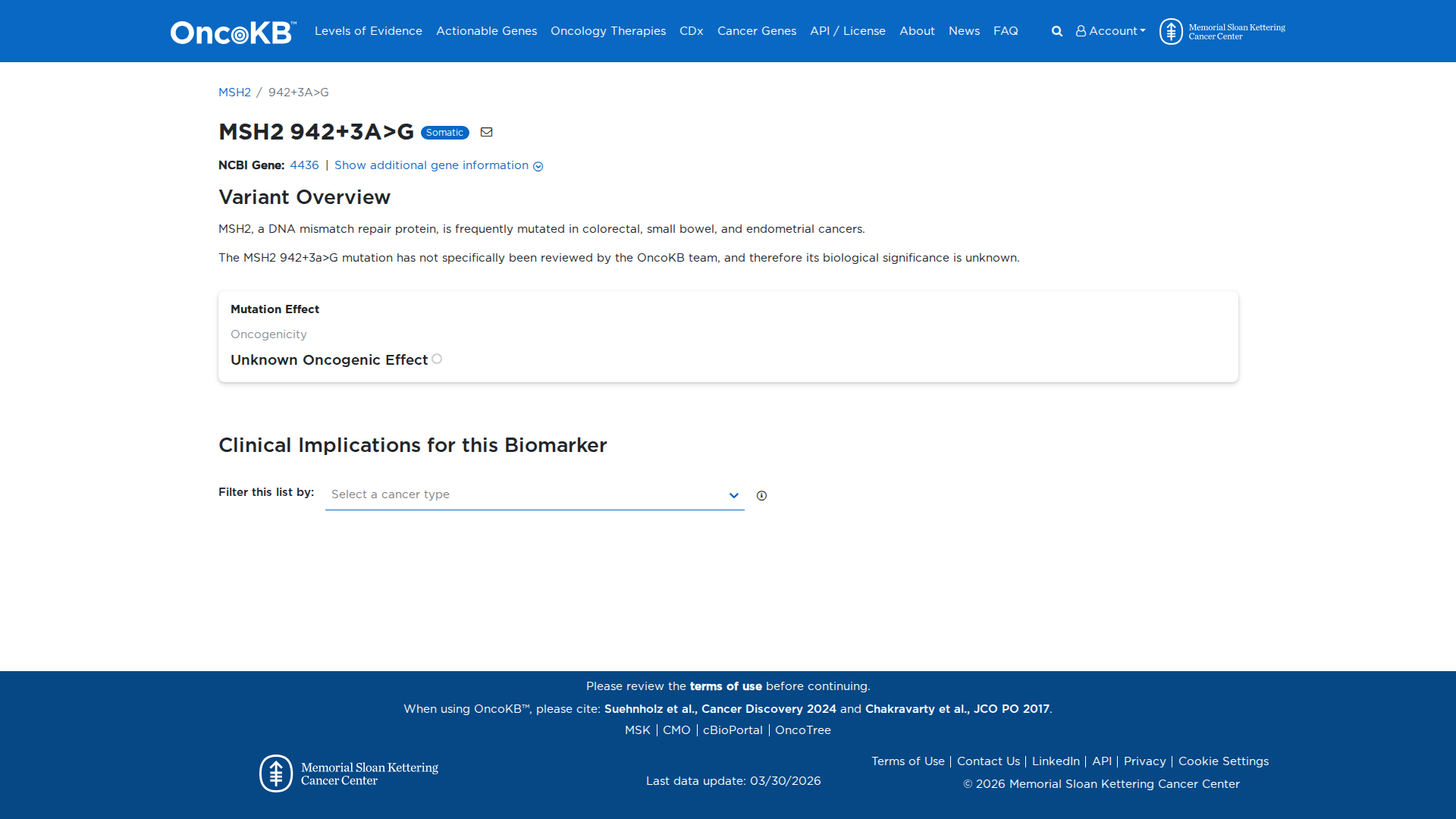
OpenVariant summary: MSH2 c.942+3A>G alters a conserved nucleotide located close to a canonical splice site and therefore could affect mRNA splicing, leading to a significantly altered protein sequence. Several computational tools predict a significant impact on normal splicing: Two predict the variant abolishes a canonical 5' splicing donor site. One predict the variant weakens a canonical 5' donor site. At least one publication reports experimental evidence that this variant affects mRNA splicing and re-classified this variant from VUS to likely pathogenic (example: Karam_2019). The variant was absent in 30582 control chromosomes (gnomAD). c.942+3A>G has been reported in the literature in individuals that had targeted multi-gene panel testing for hereditary cancer (example: Karam_2019 and Bhai_2021). The following publications have been ascertained in the context of this evaluation (PMID: 31642931, 34326862). Five submitters have cited clinical-significance assessments for this variant to ClinVar after 2014 and classified the variant as VUS (n=3) and likely pathogenic (n=2). Based on the evidence outlined above, the variant was classified as likely pathogenic.
The c.942+3A>G intronic variant results from an A to G substitution 3 nucleotides after coding exon 5 in the MSH2 gene. This alteration was identified in an individual whose endometrial tumor demonstrated loss of both MSH2/MSH6 on immunohistochemistry (IHC) and had a family history of Lynch-associated cancers (Ambry internal data). While this exact alteration has not been reported in the literature, an alteration at the same nucleotide position (c.942+3A>T) has been reported in numerous individuals meeting clinical diagnostic criteria for Lynch syndrome and has been shown by multiple functional studies to cause exon 5 skipping (South CD et al. J. Natl. Cancer Inst. 2008 Feb;100(4):277-81; Desai DC et al. J. Med. Genet. 2000 Sep;37(9):646-52; Arnold S et al. Hum. Mutat. 2009 May;30(5):757-70; Auclair J et al. Hum. Mutat. 2006 Feb;27(2):145-54; Casey G et al. JAMA. 2005 Feb;293(7):799-809; Chong G et al. Hum. Mutat. 2009 Aug;30(8):E797-812). This variant is considered to be rare based on population cohorts in the Genome Aggregation Database (gnomAD). This nucleotide position is well conserved in available vertebrate species. In silico splice site analysis predicts that this alteration will not have any significant effect on splicing. RNA studies have demonstrated that this alteration results in abnormal splicing in the set of samples tested (Ambry internal data). Based on the majority of available evidence to date, this variant is likely to be pathogenic.
The MSH2 c.942+3A>G variant has been reported in the published literature in an individual affected with breast cancer (PMID: 34326862 (2021)) as well as an individual affected with endometrial cancer with a family history of Lynch syndrome associated cancers (Ambry Genetics internal data, ClinVar Accession: SCV001180678.5). Another variant at the same nucleotide position, c.942+3A>T, has been described as being pathogenic (ClinVar Variation ID: 36580) and has been reported in numerous individuals/families with Lynch syndrome (PMID: 10978353 (2000), 16395668 (2006), 33003368 (2020)). The c.942+3A>G variant has not been reported in large, multi-ethnic general populations (Genome Aggregation Database, http://gnomad.broadinstitute.org). This variant has also been reported to result in aberrant splicing (PMID: 31642931 (2019)). Analysis of this variant using software algorithms for the prediction of the effect of nucleotide changes on splicing yielded predictions that this variant may affect proper MSH2 mRNA splicing. Based on the available information, this variant is classified as likely pathogenic.
This sequence change falls in intron 5 of the MSH2 gene. It does not directly change the encoded amino acid sequence of the MSH2 protein. RNA analysis indicates that this variant induces altered splicing and likely results in a shortened protein product. This variant is not present in population databases (gnomAD no frequency). This variant has been observed in individual(s) with clinical features of MSH2-related conditions (PMID: 31642931). Invitae Evidence Modeling of clinical and family history, age, sex, and reported ancestry of multiple individuals with this MSH2 variant has been performed. This variant is expected to be benign with a negative predictive value of at least 95%. This is a validated machine learning model that incorporates the clinical features of 1,627,235 individuals referred to our laboratory for MSH2 testing. ClinVar contains an entry for this variant (Variation ID: 418625). Variants that disrupt the consensus splice site are a relatively common cause of aberrant splicing (PMID: 17576681, 9536098). Studies have shown that this variant results in skipping of exon 5, but is expected to preserve the integrity of the reading-frame (internal data). This variant disrupts the c.942+3A nucleotide in the MSH2 gene. Other variant(s) that disrupt this nucleotide have been determined to be pathogenic (PMID: 8062247, 10978353, 15222003, 16395668, 19419416, 20682701, 21681552, 22883484, 24310308). This suggests that this nucleotide is clinically significant, and that variants that disrupt this position are likely to be disease-causing. In summary, the currently available evidence indicates that the variant is pathogenic, but additional data are needed to prove that conclusively. Therefore, this variant has been classified as Likely Pathogenic.
"This variant has been reported in ClinVar as Likely pathogenic (5 clinical laboratories) and as Uncertain significance (2 clinical laboratories) and as likely pathogenic (1 clinical laboratories)."
COSMIC Somatic Evidence
Open
Functional Impact & Domains
Functional Domain
Computational Analysis
Pathogenicity Predictions
SpliceAISpliceAI Scores
Window: ±500bp| Effect Type | Score | Position |
|---|---|---|
| Acceptor Loss (AL) | 0.02 | -152 bp |
| Donor Loss (DL) | 0.02 | -3 bp |
| Acceptor Gain (AG) | 0.0 | -487 bp |
| Donor Gain (DG) | 0.0 | -129 bp |
VCEP Guidelines
Applied ACMG/AMP Criteria (VCEP Specific)
PVS1 (Not Applied)
According to VCEP guidelines, PVS1 applies to variants at IVS±1 or IVS±2 where exon skipping or use of a cryptic splice site disrupts reading frame and is predicted to undergo NMD. The rule for PVS1 is: "Variants at IVS±1 or IVS±2 where exon skipping or use of a cryptic splice site disrupts reading frame and is predicted to undergo NMD." The evidence for this variant shows it is at position +3, outside the canonical splice sites. Therefore, this criterion is not applied at Not Applied strength because the variant does not meet the VCEP positional requirement for PVS1.
PS1 (Not Applied)
According to standard ACMG guidelines, PS1 applies when a variant encodes the same amino acid change as a previously established pathogenic variant. The rule for PS1 is: "Same amino acid change as a previously established pathogenic variant regardless of nucleotide change." The evidence for this variant shows no amino acid change (it is intronic). Therefore, this criterion is not applied at Not Applied strength because there is no missense change.
PS2 (Not Applied)
According to standard ACMG guidelines, PS2 applies to confirmed de novo variants with both maternity and paternity confirmed. The rule for PS2 is: "De novo (both maternity and paternity confirmed) in a patient with the disease and no family history." There are no data on de novo occurrence for this variant. Therefore, this criterion is not applied at Not Applied strength due to lack of de novo evidence.
PS3 (Not Applied)
According to VCEP guidelines, PS3 requires calibrated functional assays with functional odds >18.7 for strong evidence. The rule for PS3 is: "Strong: Calibrated functional assays with functional odds for Pathogenicity >18.7." There are no functional assay data for this variant. Therefore, this criterion is not applied at Not Applied strength because functional evidence is unavailable.
PS4 (Not Applied)
According to standard ACMG guidelines, PS4 applies when the prevalence of the variant in affected individuals is significantly increased compared with controls. The rule for PS4 is: "The prevalence of the variant in affected individuals is significantly increased compared with controls." There are no case-control or case-series data for this variant. Therefore, this criterion is not applied at Not Applied strength due to absence of statistical evidence.
PM1 (Not Applied)
According to standard ACMG guidelines, PM1 applies to variants located in a mutational hot spot and/or critical, well-established functional domain without benign variation. The rule for PM1 is: "Located in a mutational hot spot and/or critical and well-established functional domain without benign variation." This intronic variant is not located in a recognized hot spot or functional domain. Therefore, this criterion is not applied at Not Applied strength.
PM2 (Supporting)
According to VCEP guidelines, PM2_Supporting applies when a variant is absent/extremely rare (<1 in 50,000 alleles) in the gnomAD v4 dataset. The rule for PM2 is: "Supporting: Absent/extremely rare (<1 in 50,000 alleles) in gnomAD v4 dataset." The evidence shows this variant is absent from gnomAD. Therefore, this criterion is applied at Supporting strength because the variant meets the rarity threshold.
PM3 (Not Applied)
According to standard ACMG guidelines, PM3 applies to recessive disorders when detected in trans with a pathogenic variant. The rule for PM3 is: "For recessive disorders, detected in trans with a pathogenic variant." There is no evidence of trans configuration with another pathogenic variant. Therefore, this criterion is not applied at Not Applied strength.
PM4 (Not Applied)
According to standard ACMG guidelines, PM4 applies to protein length changes due to in-frame deletions/insertions or stop-loss variants. The rule for PM4 is: "Protein length changes due to in-frame deletions/insertions or stop-loss variants." This intronic variant does not change protein length. Therefore, this criterion is not applied at Not Applied strength.
PM5 (Not Applied)
According to standard ACMG guidelines, PM5 applies when a novel missense change occurs at an amino acid residue where a different missense change is pathogenic. The rule for PM5 is: "Missense change at an amino acid residue where a different missense change is established as pathogenic." This variant is intronic and does not change an amino acid. Therefore, this criterion is not applied at Not Applied strength.
PM6 (Not Applied)
According to standard ACMG guidelines, PM6 applies to presumed de novo variants without confirmed parental testing. The rule for PM6 is: "Presumed de novo, without confirmation of paternity and maternity." No de novo data are available. Therefore, this criterion is not applied at Not Applied strength.
PP1 (Not Applied)
According to standard ACMG guidelines, PP1 applies when there is co-segregation with disease in multiple affected family members. The rule for PP1 is: "Co-segregation with disease in multiple affected family members." There are no segregation data. Therefore, this criterion is not applied at Not Applied strength.
PP2 (Not Applied)
According to standard ACMG guidelines, PP2 applies to missense variants in a gene with low rate of benign missense variation and where missense is a common mechanism. The rule for PP2 is: "Missense variant in a gene with low rate of benign missense variation and where missense is a common mechanism of disease." This variant is intronic. Therefore, this criterion is not applied at Not Applied strength.
PP3 (Not Applied)
According to VCEP guidelines, PP3 supporting strength applies for predicted splice defect using SpliceAI with delta ≥0.2 or high HCI prior. The rule for PP3 is: "Supporting: Predicted splice defect for non-canonical splice nucleotides using SpliceAI with delta score ≥0.2." SpliceAI predicts a delta score of 0.02. Therefore, this criterion is not applied at Not Applied strength because the predicted splice impact is below threshold.
PP4 (Not Applied)
According to VCEP guidelines, PP4 applies when tumor data show consistent MSI-H or loss of MMR protein expression. The rule for PP4 is: "Supporting: 1 CRC/Endometrial MSI-H tumor with loss of MMR protein expression consistent with variant location." No tumor data are available. Therefore, this criterion is not applied at Not Applied strength.
PP5 (Supporting)
According to standard ACMG guidelines, PP5 applies when a reputable source reports the variant as pathogenic but evidence is unavailable for independent review. The rule for PP5 is: "Reputable source recently reports variant as pathogenic, but the evidence is not available to the laboratory to perform an independent evaluation." ClinVar contains entries classifying this variant as Likely Pathogenic. Therefore, this criterion is applied at Supporting strength because of reputable ClinVar classifications without primary evidence.
BA1 (Not Applied)
According to standard ACMG guidelines, BA1 applies when allele frequency is >5% in population databases. The rule for BA1 is: "Allele frequency is greater than 5% in population databases." This variant is absent from population databases. Therefore, this criterion is not applied at Not Applied strength.
BS1 (Not Applied)
According to VCEP guidelines, BS1 applies when allele frequency is ≥0.01% and <0.1% in gnomAD v4. The rule for BS1 is: "Strong: GnomAD v4 Grpmax filtering allele frequency ≥0.0001 and <0.001." This variant is absent. Therefore, this criterion is not applied at Not Applied strength.
BS2 (Not Applied)
According to VCEP guidelines, BS2 applies when a variant is observed in trans with a pathogenic variant in a patient without CMMRD. The rule for BS2 is: "Strong: Co-occurrence in trans with a known pathogenic sequence variant in the same gene in a patient without evidence of CMMRD." No co-occurrence data are available. Therefore, this criterion is not applied at Not Applied strength.
BS3 (Not Applied)
According to VCEP guidelines, BS3 applies when functional assays show no impact with odds ≤0.05. The rule for BS3 is: "Strong: Calibrated functional assays with functional odds for Pathogenicity ≤0.05 OR Synonymous/intronic variants with no associated mRNA aberration in assays." No functional or mRNA assay data are available. Therefore, this criterion is not applied at Not Applied strength.
BS4 (Not Applied)
According to standard ACMG guidelines, BS4 applies for lack of co-segregation with disease. The rule for BS4 is: "Strong: Lack of co-segregation with disease in pedigree(s)." There are no segregation data. Therefore, this criterion is not applied at Not Applied strength.
BP1 (Not Applied)
According to standard ACMG guidelines, BP1 applies to missense changes in a gene where only truncating variants cause disease. The rule for BP1 is: "Missense variant in a gene where primarily truncating variants are known to cause disease." This variant is intronic. Therefore, this criterion is not applied at Not Applied strength.
BP2 (Not Applied)
According to standard ACMG guidelines, BP2 applies when a variant is observed in cis with a pathogenic variant. The rule for BP2 is: "Observed in cis with a pathogenic variant." There is no cis-co-occurrence data. Therefore, this criterion is not applied at Not Applied strength.
BP3 (Not Applied)
According to standard ACMG guidelines, BP3 applies to in-frame indels in repetitive regions. The rule for BP3 is: "In-frame deletions/insertions in repetitive regions without a known function." This variant is a single nucleotide change in an intron. Therefore, this criterion is not applied at Not Applied strength.
BP4 (Supporting)
According to VCEP guidelines, BP4 applies to intronic variants with SpliceAI delta score ≤0.1 predicting no splicing impact. The rule for BP4 is: "Supporting: SpliceAI predicts no splicing impact with delta score ≤0.1." The evidence shows SpliceAI delta = 0.02. Therefore, this criterion is applied at Supporting strength because predicted splicing impact is below threshold.
BP5 (Not Applied)
According to VCEP guidelines, BP5 applies when tumors show features inconsistent with pathogenicity. The rule for BP5 is: "Supporting: Tumor features inconsistent with variant pathogenicity." No tumor phenotype data are available. Therefore, this criterion is not applied at Not Applied strength.
BP6 (Not Applied)
According to standard ACMG guidelines, BP6 applies when a reputable source reports the variant as benign without available evidence. The rule for BP6 is: "Reputable source reports variant as benign, but evidence not available." There are no such benign classifications. Therefore, this criterion is not applied at Not Applied strength.
BP7 (Not Applied)
According to VCEP guidelines, BP7 applies to synonymous or intronic variants at or beyond -21/+7 predicting no effect. The rule for BP7 is: "Supporting: Intronic variant at or beyond -21/+7 predicting no impact." This variant is at +3, within the splice region. Therefore, this criterion is not applied at Not Applied strength.