Genetic Information
Gene & Transcript Details
| ID | Status | Details |
|---|---|---|
| NM_000546.3 | Alternative | 2640 nt | 252–1433 |
| NM_000546.5 | RefSeq Select | 2591 nt | 203–1384 |
| NM_000546.6 | MANE Select | 2512 nt | 143–1324 |
| NM_000546.4 | Alternative | 2586 nt | 198–1379 |
| NM_000546.2 | Alternative | 2629 nt | 252–1433 |
Variant Details
Clinical & Population Data
Population Frequency
gnomADClinVar
Open""
COSMIC Somatic Evidence
Open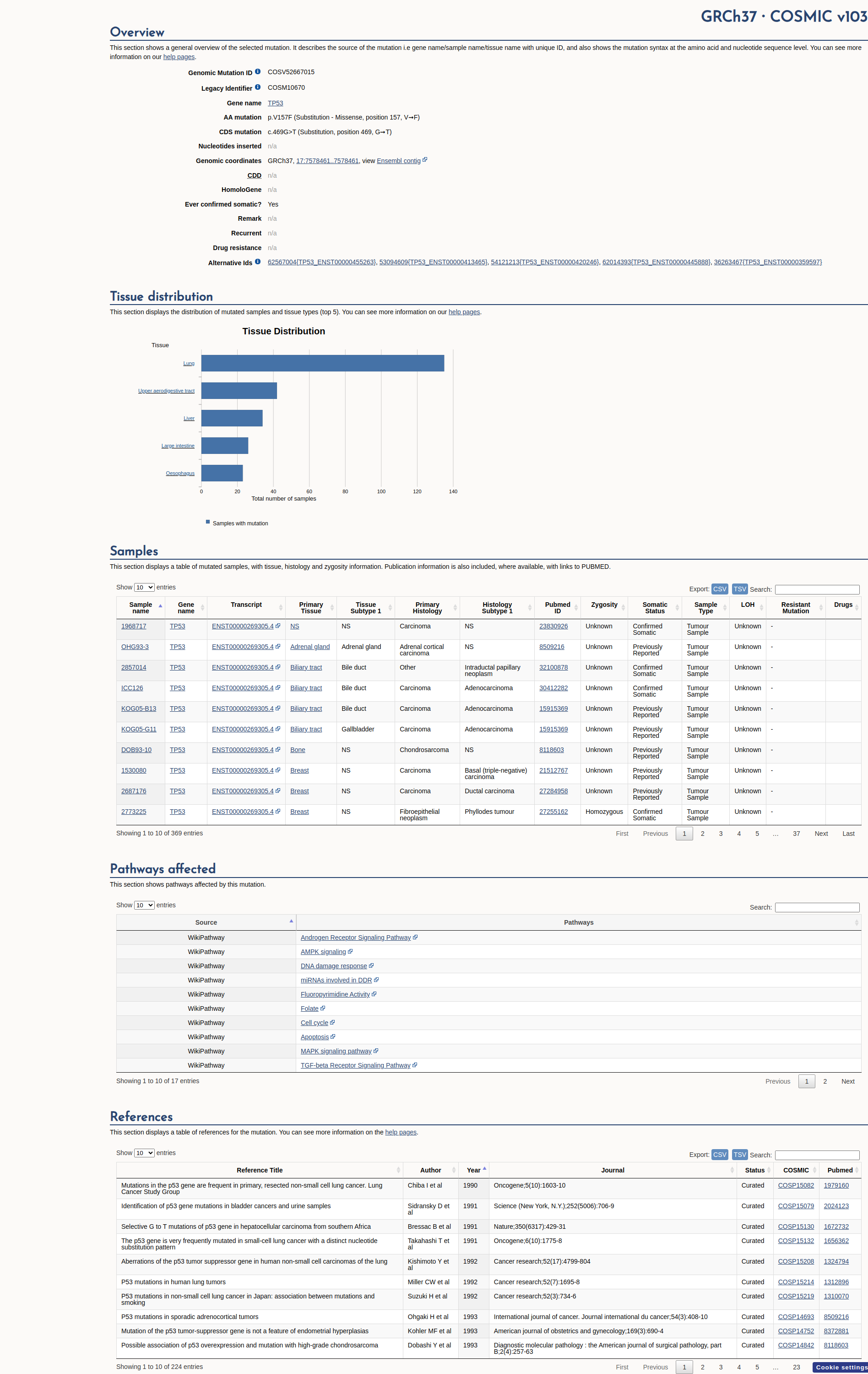
Functional Impact & Domains
Functional Domain
The TP53 V157F variant has been functionally characterized and is likely damaging. It is located in the DNA-binding domain of the TP53 protein. In vitro and structural studies have shown that this mutation results in decreased DNA-binding activity and impaired transcriptional activity. The mutant protein exhibits a rearranged DNA-binding surface, reduced expression of pro-apoptotic proteins, and a diminished apoptotic response. Additionally, the variant confers a gain of function, leading to aberrant gene regulation in cell culture.
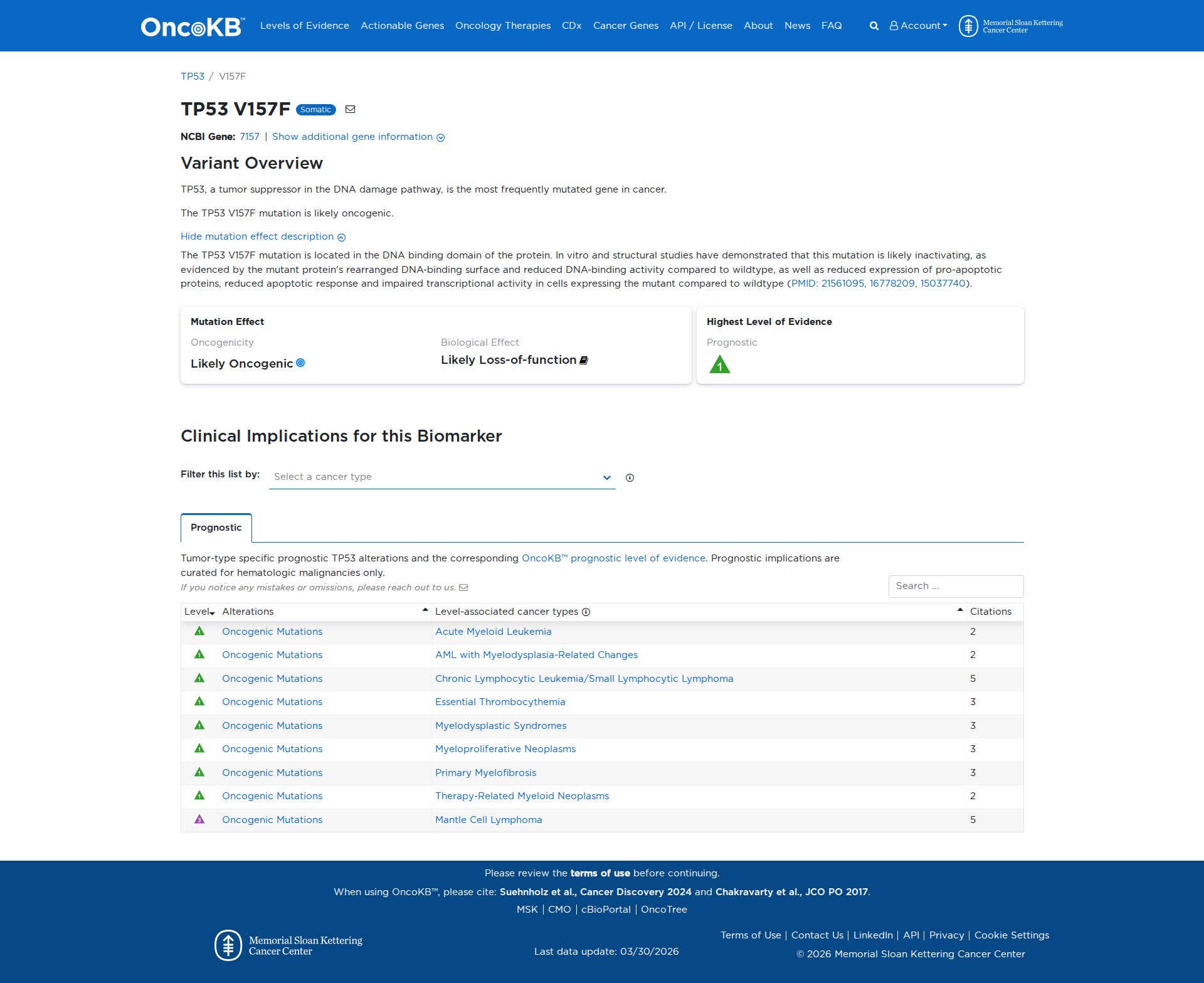
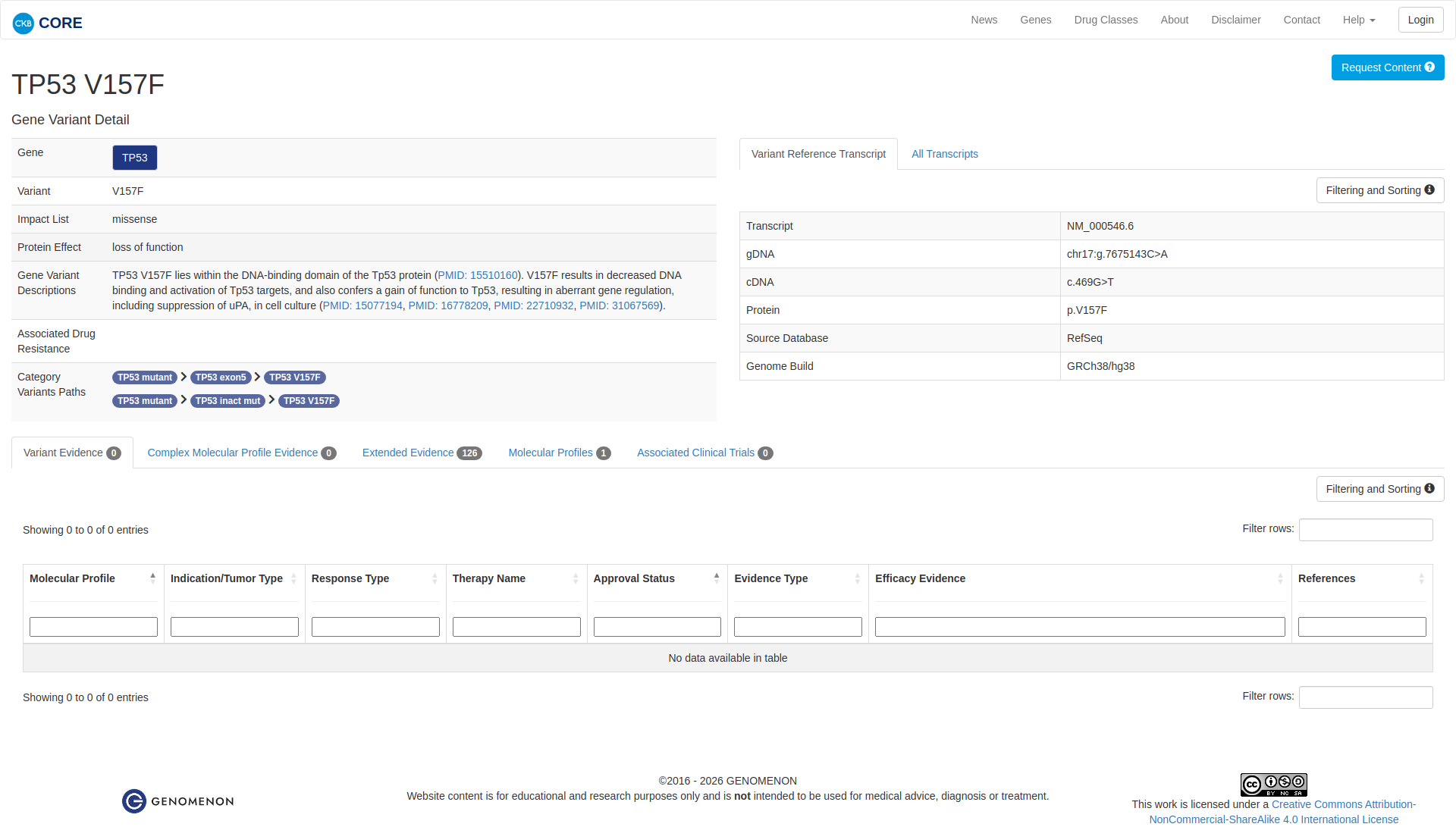
Click on previews to view full database entries. External databases may require institutional access.
Computational Analysis
Pathogenicity Predictions
SpliceAISpliceAI Scores
Window: ±500bp| Effect Type | Score | Position |
|---|---|---|
| Acceptor Loss (AL) | 0.0 | -143 bp |
| Donor Loss (DL) | 0.0 | -44 bp |
| Acceptor Gain (AG) | 0.0 | -189 bp |
| Donor Gain (DG) | 0.0 | 35 bp |
VCEP Guidelines
Applied ACMG/AMP Criteria (VCEP Specific)
PVS1 (Not Applied)
According to VCEP guidelines, PVS1 applies only to null variants resulting in loss of function via nonsense, frameshift, canonical splice, or initiation codon disruptions. The variant NM_000546.5:c.469G>T (p.V157F) is a missense change. Therefore, PVS1 is not applied because this is not a null variant.
PS1 (Not Applied)
According to VCEP guidelines, PS1 applies when the variant results in an amino acid change previously established as pathogenic at the same residue. There is no report of a different nucleotide change causing p.V157F or any other pathogenic variant at codon 157. Therefore, PS1 is not applied because there is no identical amino acid change asserted as pathogenic.
PS2 (Not Applied)
According to VCEP guidelines, PS2 applies to confirmed de novo occurrences with specific point thresholds. No de novo data are available for this variant. Therefore, PS2 is not applied due to lack of de novo evidence.
PS3 (Strong)
According to VCEP guidelines, PS3_Strong: "Non-functional on Kato et al. data AND loss of function (LOF) on another assay." The evidence for p.V157F shows well-established in vitro and structural studies demonstrating decreased DNA-binding activity, impaired transcriptional function, reduced pro-apoptotic protein expression, and a gain-of-function oncogenic phenotype. Therefore, PS3 is applied at Strong strength because multiple functional assays indicate non-function and LOF consistent with the VCEP PS3_Strong rule.
PS4 (Not Applied)
According to VCEP guidelines, PS4 applies based on proband counting and case–control data with point thresholds. No case or proband data meeting VCEP thresholds were provided. Therefore, PS4 is not applied due to absence of qualifying clinical case evidence.
PM1 (Not Applied)
According to VCEP guidelines, PM1 applies to missense variants within TP53 hotspot codons (175, 245, 248, 249, 273, 282). Codon 157 is outside these specified hotspots. Therefore, PM1 is not applied because the variant is not located in a VCEP-defined hotspot codon.
PM2 (Supporting)
According to VCEP guidelines, PM2_Supporting: "Allele frequency <0.00003 in gnomAD or large population databases." The variant p.V157F is absent from gnomAD and other population databases. Therefore, PM2 is applied at Supporting strength because the allele frequency meets the VCEP PM2_Supporting threshold.
PM3 (Not Applied)
According to standard ACMG guidelines, PM3 applies to variants observed in trans with a pathogenic variant in recessive disorders. TP53 disorders are dominant and no trans observations are relevant. Therefore, PM3 is not applied because the variant is not in a recessive context.
PM4 (Not Applied)
According to standard ACMG guidelines, PM4 applies to protein length–altering variants such as in-frame indels or stop‐loss variants. The variant p.V157F is a missense change without alteration of protein length. Therefore, PM4 is not applied.
PM5 (Not Applied)
According to VCEP guidelines, PM5 applies when ≥1 different missense variant at the same residue has been classified as (Likely) Pathogenic. There are no other reported pathogenic or likely pathogenic missense variants at codon 157. Therefore, PM5 is not applied.
PM6 (Not Applied)
According to standard ACMG guidelines, PM6 applies to assumed de novo occurrences without confirmation of paternity/maternity. No such data are available for this variant. Therefore, PM6 is not applied.
PP1 (Not Applied)
According to VCEP guidelines, PP1 applies for co-segregation with disease in families meeting specific meiosis thresholds. No segregation data are available. Therefore, PP1 is not applied.
PP2 (Not Applied)
According to standard ACMG guidelines, PP2 applies when a gene has low rate of benign missense variation and missense is common mechanism. TP53 has both benign and pathogenic missense, and no VCEP specification uses PP2. Therefore, PP2 is not applied.
PP3 (Not Applied)
According to VCEP guidelines, PP3_Moderate requires BayesDel ≥0.16 and no predicted splicing impact. BayesDel data are not provided and in silico results are mixed. Therefore, PP3 is not applied.
PP4 (Not Applied)
According to VCEP guidelines, PP4 applies for LFS-associated tumor types with specific VAF criteria. No tumor VAF or phenotype data are provided. Therefore, PP4 is not applied.
PP5 (Not Applied)
According to standard ACMG guidelines, PP5 applies for reputable source assertions without available data. No reputable source assertions (e.g., ClinVar) are present. Therefore, PP5 is not applied.
BA1 (Not Applied)
According to VCEP guidelines, BA1 requires allele frequency ≥0.001 in gnomAD subpopulations. The variant is absent from population databases. Therefore, BA1 is not applied.
BS1 (Not Applied)
According to VCEP guidelines, BS1 requires filtering allele frequency ≥0.0003 but <0.001. The variant is absent from gnomAD. Therefore, BS1 is not applied.
BS2 (Not Applied)
According to VCEP guidelines, BS2 requires observation in ≥2 unrelated older unaffected females. No such data are available. Therefore, BS2 is not applied.
BS3 (Not Applied)
According to VCEP guidelines, BS3 applies when functional assays show no loss of function. The functional data for p.V157F demonstrate damaging effects. Therefore, BS3 is not applied.
BS4 (Not Applied)
According to VCEP guidelines, BS4 applies when there is lack of co-segregation in affected family members. No segregation data are available. Therefore, BS4 is not applied.
BP1 (Not Applied)
According to standard ACMG guidelines, BP1 applies to missense variants in genes where only truncating variants cause disease. TP53 has pathogenic missense variants, so BP1 is not applied.
BP2 (Not Applied)
According to standard ACMG guidelines, BP2 applies when observed in cis with a pathogenic variant in dominant disorders. No such observations are reported. Therefore, BP2 is not applied.
BP3 (Not Applied)
According to standard ACMG guidelines, BP3 applies to in‐frame indels in repetitive regions. This is a missense variant, so BP3 is not applied.
BP4 (Supporting)
According to standard ACMG guidelines, BP4: "Multiple lines of computational evidence suggest no impact on gene or gene product." SpliceAI predicts no splicing impact and CADD score is low (2.39), though other in silico tools are mixed. Therefore, BP4 is applied at Supporting strength because overall computational evidence leans benign for splicing and functional impact.
BP5 (Not Applied)
According to standard ACMG guidelines, BP5 applies when a variant is found in a case with an alternate molecular cause. No alternate cause is reported. Therefore, BP5 is not applied.
BP6 (Not Applied)
According to standard ACMG guidelines, BP6 applies to unpublished reputable source assertions without data. No such assertions exist. Therefore, BP6 is not applied.
BP7 (Not Applied)
According to VCEP guidelines, BP7 applies to synonymous/intronic variants with no splicing impact. This is a missense variant. Therefore, BP7 is not applied.