Genetic Information
Gene & Transcript Details
| ID | Status | Details |
|---|---|---|
| NM_006218.2 | Alternative | 3724 nt | 158–3364 |
| NM_006218.3 | Alternative | 9104 nt | 158–3364 |
| NM_006218.4 | MANE Select | 9259 nt | 324–3530 |
Variant Details
Clinical & Population Data
Population Frequency
gnomADClinVar
Open""
COSMIC Somatic Evidence
Open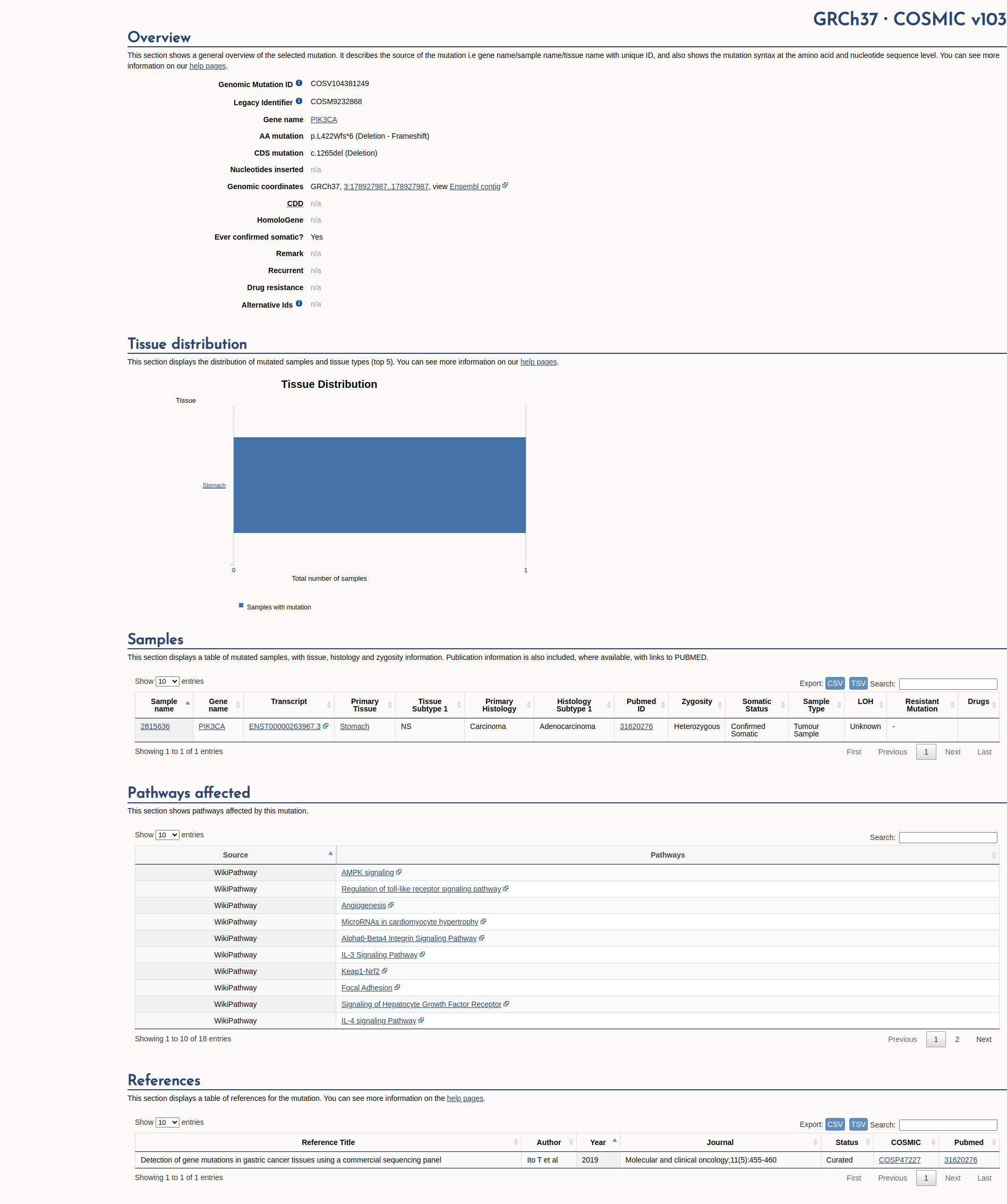
Functional Impact & Domains
Functional Domain
The variant PIK3CA L422Wfs*6 is a truncating mutation in the PIK3CA gene, which is an oncogene. Truncating mutations in oncogenes are typically nonfunctional, suggesting a potential damaging effect. However, no specific functional characterization data for this variant is available.
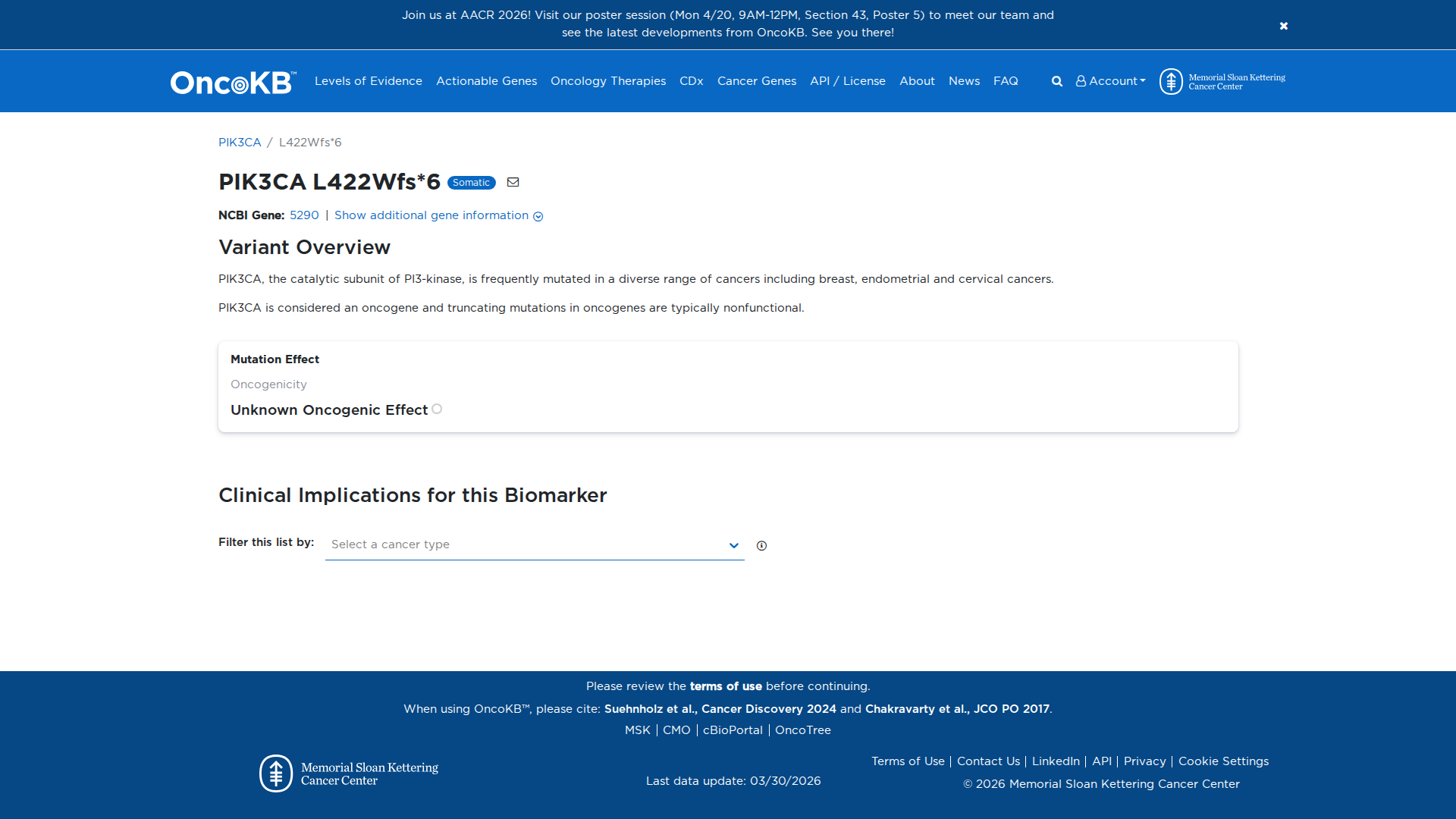
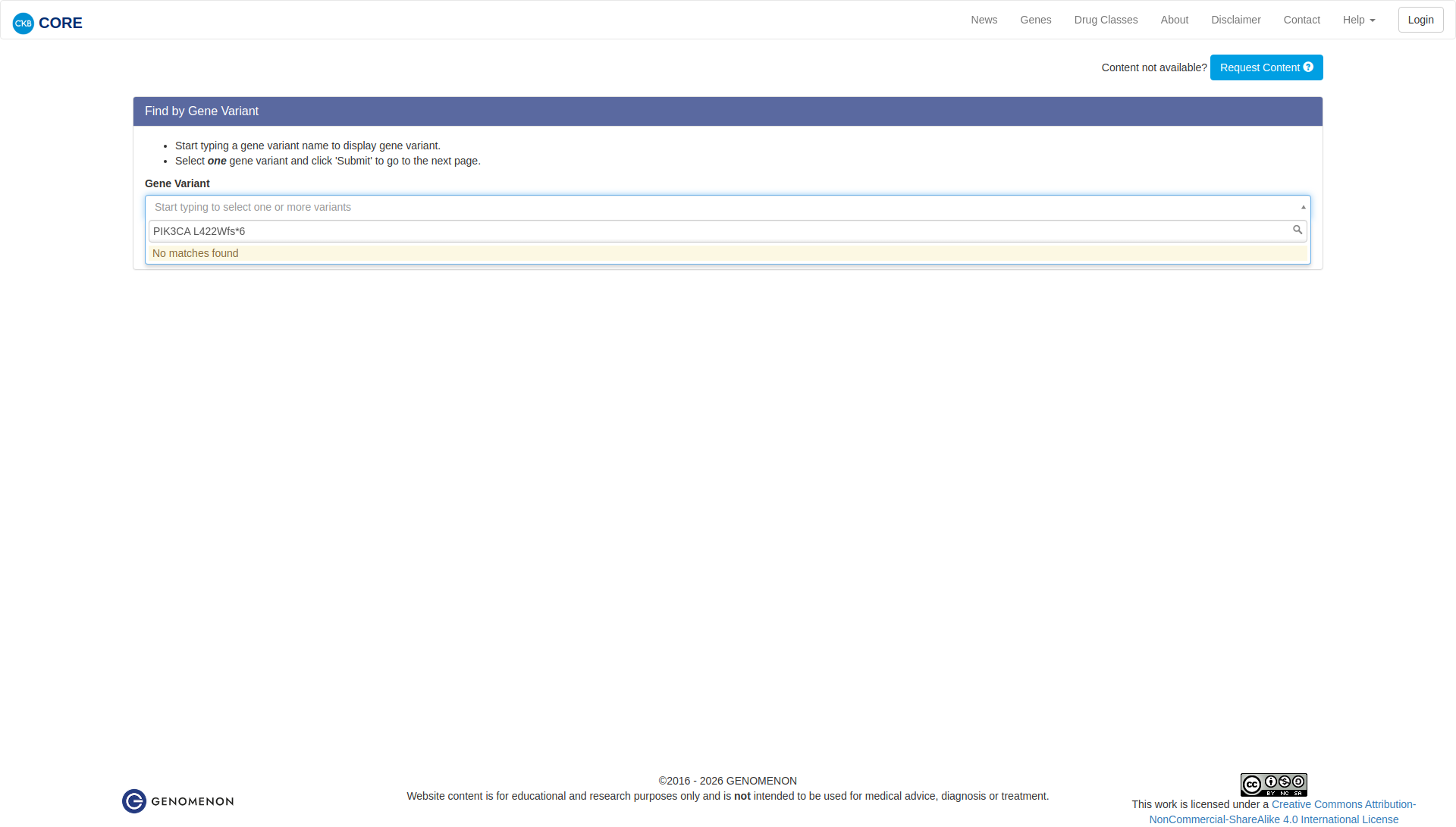
Click on previews to view full database entries. External databases may require institutional access.
Computational Analysis
Pathogenicity Predictions
SpliceAISpliceAI Scores
Window: ±500bp| Effect Type | Score | Position |
|---|---|---|
| Acceptor Loss (AL) | 0.02 | 215 bp |
| Donor Loss (DL) | 0.0 | 146 bp |
| Acceptor Gain (AG) | 0.07 | 38 bp |
| Donor Gain (DG) | 0.0 | 322 bp |
VCEP Guidelines
Applied ACMG/AMP Criteria (VCEP Specific)
PVS1 (Very Strong)
According to standard ACMG guidelines, the rule for PVS1 is: 'Null Variant (nonsense, fs, start codon, splicing +1/2, startgain, single or multi-exon deletion) in a gene where LOF is a known mechanism of disease'. The evidence for this variant shows: c.1265del causes a frameshift (L422Wfs*6) predicted to result in premature truncation in a gene where loss of function is established as a disease mechanism and the variant is not in the last exon. Therefore, this criterion is applied at Very Strong strength because it is a null variant in a LOF‐sensitive gene.
PS1 (Not Applied)
According to VCEP guidelines, the rule for PS1 is: 'Strong Strength: Strong No change. Modification Type: None'. The evidence for this variant shows: there is no previously reported pathogenic variant causing the identical amino acid change. Therefore, PS1 is not applied.
PS2 (Not Applied)
According to VCEP guidelines, the rule for PS2 (de novo) is: 'Strong Strength: Award PS2_Strong if Criteria 1 AND Criteria 2 are fulfilled; Moderate Strength: Award PS2_Moderate if one criterion is fulfilled'. The evidence for this variant shows: no parental testing or tissue mosaicism data are available. Therefore, PS2 is not applied.
PS3 (Not Applied)
According to VCEP guidelines, the rule for PS3 is: 'Strong Strength: functional assays meeting VCEP‐specified quality metrics; Moderate/Supporting per assay validation'. The evidence for this variant shows: no specific functional assay data are available for L422Wfs*6. Therefore, PS3 is not applied.
PS4 (Not Applied)
According to VCEP guidelines, the rule for PS4 is: 'Points‐based phenotypic data only if variant is absent from controls (PM2); strength assigned by total points'. The evidence for this variant shows: no case‐level clinical reports or aggregate phenotypic data. Therefore, PS4 is not applied.
PM1 (Not Applied)
According to VCEP guidelines, the rule for PM1 is: 'Supporting Strength: residues affecting critical functional domains provided in Table 4'. The evidence for this variant shows: L422 is not located in a defined hotspot or critical domain per VCEP Table 4. Therefore, PM1 is not applied.
PM2 (Supporting)
According to VCEP guidelines, the rule for PM2 is: 'Supporting Strength: Absent/rare from controls in an ethnically‐matched cohort population sample (≥1)'. The evidence for this variant shows: it is absent from gnomAD and other population databases (MAF=0%). Therefore, PM2 is applied at Supporting strength.
PM3 (Not Applied)
According to standard ACMG guidelines, the rule for PM3 is: 'Detected in trans with a pathogenic variant for a recessive disorder'. The evidence for this variant shows: PIK3CA‐related conditions are not purely recessive and no in trans data are available. Therefore, PM3 is not applied.
PM4 (Not Applied)
According to standard ACMG guidelines, the rule for PM4 is: 'Protein length change due to in-frame deletion/insertion in non-repeat region or stop-loss'. The evidence for this variant shows: it is a frameshift, not an in-frame indel. Therefore, PM4 is not applied.
PM5 (Not Applied)
According to VCEP guidelines, the rule for PM5 is: 'Moderate Strength: no change from standard ACMG; different amino acid change at same residue'. The evidence for this variant shows: it is a frameshift, not a missense change. Therefore, PM5 is not applied.
PM6 (Not Applied)
According to standard ACMG guidelines, the rule for PM6 is: 'Assumed de novo, but without confirmation of maternity/paternity'. The evidence for this variant shows: no de novo data. Therefore, PM6 is not applied.
PP1 (Not Applied)
According to standard ACMG guidelines, the rule for PP1 is: 'Co-segregation with disease in multiple affected family members'. The evidence for this variant shows: no segregation data. Therefore, PP1 is not applied.
PP2 (Not Applied)
According to VCEP guidelines, the rule for PP2 is: 'Supporting Strength: missense constraint z-score >3.09 for PIK3CA'. The evidence for this variant shows: it is a frameshift, not a missense. Therefore, PP2 is not applied.
PP3 (Not Applied)
According to standard ACMG guidelines, the rule for PP3 is: 'Multiple computational lines of evidence support a deleterious effect'. The evidence for this variant shows: no in silico predictions were provided for this frameshift. Therefore, PP3 is not applied.
PP4 (Not Applied)
According to standard ACMG guidelines, the rule for PP4 is: 'Patient’s phenotype or family history highly specific for a disease with a single genetic etiology'. The evidence for this variant shows: no phenotype data are available. Therefore, PP4 is not applied.
PP5 (Not Applied)
According to standard ACMG guidelines, the rule for PP5 is: 'Reputable source reports variant as pathogenic without accessible evidence'. The evidence for this variant shows: not reported in ClinVar or other databases. Therefore, PP5 is not applied.
BA1 (Not Applied)
According to VCEP guidelines, the rule for BA1 is: 'Stand Alone Strength: allele frequency >0.0926%'. The evidence for this variant shows: absent from population databases. Therefore, BA1 is not applied.
BS1 (Not Applied)
According to VCEP guidelines, the rule for BS1 is: 'Strong Strength: allele frequency >0.0185%'. The evidence for this variant shows: absent from population databases. Therefore, BS1 is not applied.
BS2 (Not Applied)
According to VCEP guidelines, the rule for BS2 is: 'Strong Strength: ≥3 homozygotes or heterozygotes in healthy individuals'. The evidence for this variant shows: no occurrences in population databases. Therefore, BS2 is not applied.
BS3 (Not Applied)
According to VCEP guidelines, the rule for BS3 is: 'Strong Strength: well-validated functional assays show no damaging effect'. The evidence for this variant shows: no functional assays. Therefore, BS3 is not applied.
BS4 (Not Applied)
According to standard ACMG guidelines, the rule for BS4 is: 'Lack of segregation in affected members'. The evidence for this variant shows: no family segregation data. Therefore, BS4 is not applied.
BP1 (Not Applied)
According to standard ACMG guidelines, the rule for BP1 is: 'Missense variant in gene where only LOF causes disease'. The evidence for this variant shows: it is a frameshift, not missense. Therefore, BP1 is not applied.
BP2 (Not Applied)
According to standard ACMG guidelines, the rule for BP2 is: 'Observed in cis or trans with a pathogenic variant in the same gene'. The evidence for this variant shows: no phase data available. Therefore, BP2 is not applied.
BP3 (Not Applied)
According to standard ACMG guidelines, the rule for BP3 is: 'In-frame indel in repetitive region'. The evidence for this variant shows: it is a frameshift, not an in-frame indel. Therefore, BP3 is not applied.
BP4 (Not Applied)
According to VCEP guidelines, the rule for BP4 is: 'Supporting Strength: two of three splicing tools predict no impact for synonymous or non-coding variants'. The evidence for this variant shows: it is a frameshift coding variant. Therefore, BP4 is not applied.
BP5 (Not Applied)
According to standard ACMG guidelines, the rule for BP5 is: 'Variant found in a case with an alternate molecular basis for disease'. The evidence for this variant shows: no such alternate molecular diagnosis. Therefore, BP5 is not applied.
BP6 (Not Applied)
According to standard ACMG guidelines, the rule for BP6 is: 'Reputable source reports variant as benign without available evidence'. The evidence for this variant shows: no such report. Therefore, BP6 is not applied.
BP7 (Not Applied)
According to standard ACMG guidelines, the rule for BP7 is: 'Synonymous variant with no splice impact and low conservation'. The evidence for this variant shows: it is not synonymous. Therefore, BP7 is not applied.