Genetic Information
Gene & Transcript Details
| ID | Status | Details |
|---|---|---|
| NM_000051.3 | RefSeq Select | 13147 nt | 386–9556 |
| NM_000051.4 | MANE Select | 12915 nt | 151–9321 |
Variant Details
Clinical & Population Data
Population Frequency
gnomADClinVar
Open""
COSMIC Somatic Evidence
Open
Functional Impact & Domains
Functional Domain
The ATM R2506Tfs*3 variant is a truncating mutation in the ATM gene, which is involved in the DNA damage response. Functional evidence indicates that truncating mutations in ATM can lead to the production of C-terminally truncated proteins, resulting in decreased DNA repair efficiency and increased cellular motility. These effects support a damaging and likely oncogenic role for this variant.
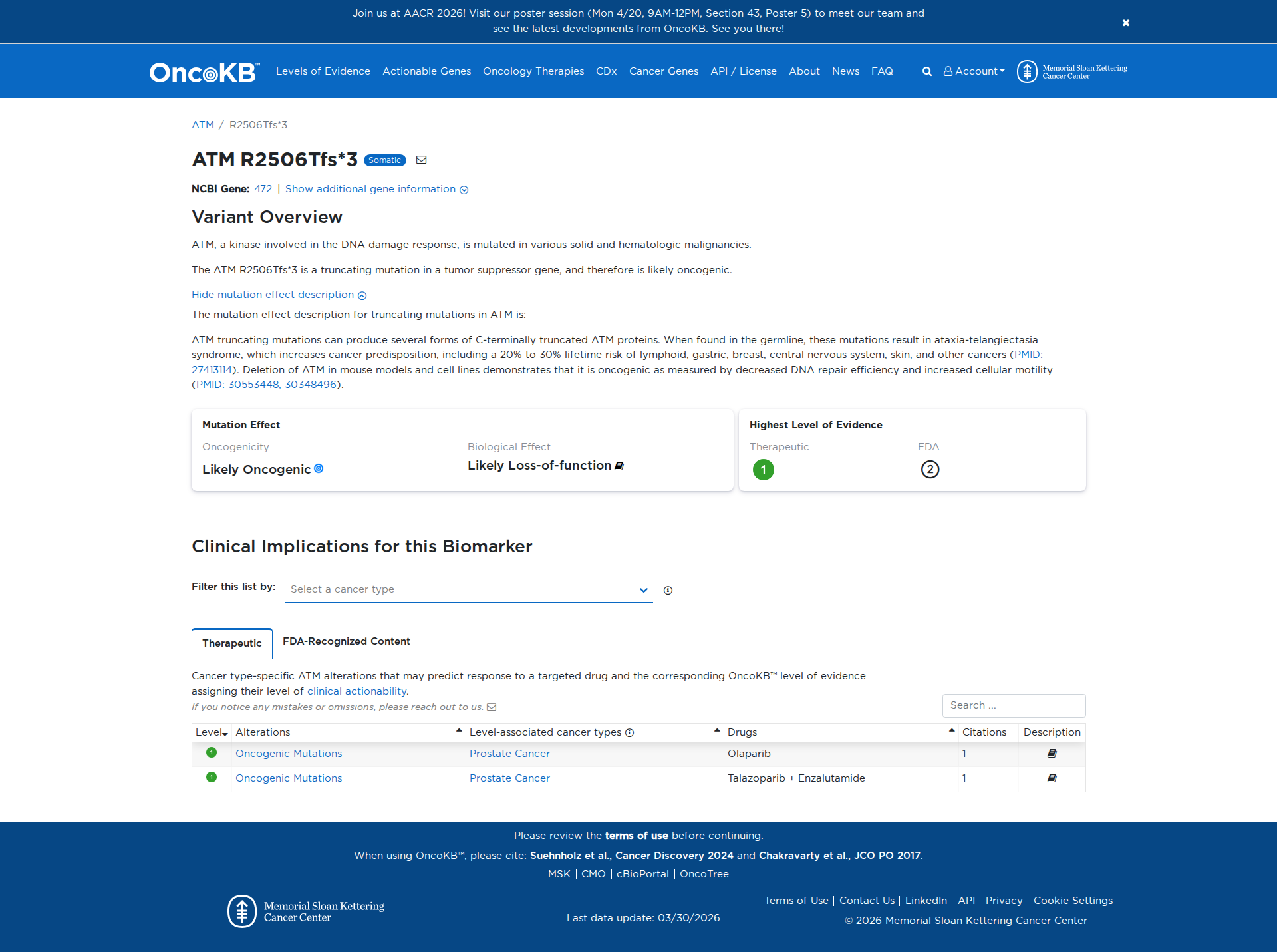
Click on previews to view full database entries. External databases may require institutional access.
Computational Analysis
Pathogenicity Predictions
SpliceAISpliceAI Scores
Window: ±500bp| Effect Type | Score | Position |
|---|---|---|
| Acceptor Loss (AL) | 1.0 | 3 bp |
| Donor Loss (DL) | 0.0 | 347 bp |
| Acceptor Gain (AG) | 0.96 | 7 bp |
| Donor Gain (DG) | 0.0 | 364 bp |
VCEP Guidelines
Applied ACMG/AMP Criteria (VCEP Specific)
PVS1 (Very Strong)
According to VCEP guidelines, the rule for PVS1 is: "Very Strong Strength: Very Strong Use ATM PVS1 Decision Tree Modification Type: Gene-specific,Strength." The evidence for this variant shows it is a frameshift leading to a premature stop codon (R2506Tfs*3) in ATM, a gene where loss of function is a known disease mechanism. Therefore, this criterion is applied at Very Strong strength because it is a null variant in a gene with LOF mechanism.
PS1 (Not Applied)
According to VCEP guidelines, PS1 applies to protein changes identical to known pathogenic variants after splicing is ruled out. There is no evidence of another variant producing the same protein change. Therefore, this criterion is not applied.
PS2 (Not Applied)
According to standard ACMG guidelines, the rule for PS2 is: "De novo (both maternity and paternity confirmed) in a patient with the disease and no family history." No parental testing data are available. Therefore, this criterion is not applied.
PS3 (Not Applied)
According to VCEP guidelines, the rule for PS3 Moderate strength is: "Use when a variant fails to rescue both an ATM-specific feature AND radiosensitivity," and Supporting strength is: "Use when a variant fails to rescue an ATM-specific feature only." There are no rescue assay data. Therefore, this criterion is not applied.
PS4 (Not Applied)
According to standard ACMG guidelines, the rule for PS4 is: "The prevalence of the variant in affected individuals is significantly increased compared with controls." No case-control or case series data are available. Therefore, this criterion is not applied.
PM1 (Not Applied)
According to standard ACMG guidelines, the rule for PM1 is: "Located in a mutational hot spot or well-studied functional domain without benign variation." This variant is not in a defined hotspot or functional domain. Therefore, this criterion is not applied.
PM2 (Not Applied)
According to VCEP guidelines, the rule for PM2 Supporting strength is: "Frequency ≤0.001% if n=1 in a single subpopulation." This variant has two alleles observed across populations (MAF=0.000799%), not a single allele. Therefore, this criterion is not applied.
PM3 (Not Applied)
According to VCEP guidelines, PM3 applies for variants detected in trans with a pathogenic variant in recessive disorders. No segregation or allelic data are available. Therefore, this criterion is not applied.
PM4 (Not Applied)
According to standard ACMG guidelines, the rule for PM4 is: "Protein length changes as a result of in-frame deletions/insertions or stop-loss variants." This is a frameshift leading to truncation, not an in-frame indel or stop-loss. Therefore, this criterion is not applied.
PM5 (Supporting)
According to VCEP guidelines, the rule for PM5 Supporting strength is: "Use for genomic frameshift and truncating variants with PTC upstream of p.R3047." The R2506Tfs*3 introduces a PTC upstream of codon 3047. Therefore, this criterion is applied at Supporting strength because it is a truncating variant upstream of p.R3047.
PM6 (Not Applied)
According to standard ACMG guidelines, the rule for PM6 is: "Assumed de novo, without confirmation of paternity and maternity." No de novo data are available. Therefore, this criterion is not applied.
PP1 (Not Applied)
According to standard ACMG guidelines, the rule for PP1 is: "Co-segregation with disease in multiple affected family members." No segregation data are available. Therefore, this criterion is not applied.
PP2 (Not Applied)
According to standard ACMG guidelines, the rule for PP2 is: "Missense variant in a gene with low rate of benign missense variation." This is not a missense variant. Therefore, this criterion is not applied.
PP3 (Supporting)
According to VCEP guidelines, the rule for PP3 Supporting strength is: "At least one well-established in silico predictor (e.g. SpliceAI) shows impact on splicing." SpliceAI predicts a high impact on splicing (max score=1.0). Therefore, this criterion is applied at Supporting strength because in silico tools support a deleterious splicing effect.
PP4 (Not Applied)
According to standard ACMG guidelines, the rule for PP4 is: "Patient’s phenotype or family history specific for a disease with a single genetic etiology." No phenotype data are provided. Therefore, this criterion is not applied.
PP5 (Not Applied)
According to standard ACMG guidelines, the rule for PP5 is: "Reputable source reports variant as pathogenic without available evidence." This variant is not reported in ClinVar or another reputable source. Therefore, this criterion is not applied.
BA1 (Not Applied)
According to VCEP guidelines, the rule for BA1 Stand Alone is: "Filtering allele frequency >0.5%." The variant frequency is 0.000799%. Therefore, this criterion is not applied.
BS1 (Not Applied)
According to VCEP guidelines, the rule for BS1 Strong is: "Filtering allele frequency >0.05%." The variant frequency is 0.000799%. Therefore, this criterion is not applied.
BS2 (Not Applied)
According to standard ACMG guidelines, the rule for BS2 is: "Observed in healthy adult individuals with full‐penetrance expected at an early age." No such observations are reported. Therefore, this criterion is not applied.
BS3 (Not Applied)
According to VCEP guidelines, the rule for BS3 Moderate or Supporting is: "Use when a variant rescues both an ATM specific feature AND radiosensitivity, or either one for Supporting." No rescue data are available. Therefore, this criterion is not applied.
BS4 (Not Applied)
According to standard ACMG guidelines, the rule for BS4 is: "Lack of segregation in affected members of a family." No segregation data exist. Therefore, this criterion is not applied.
BP1 (Not Applied)
According to standard ACMG guidelines, the rule for BP1 is: "Missense variant in a gene where truncating variants are known to cause disease." This is not a missense variant. Therefore, this criterion is not applied.
BP2 (Not Applied)
According to VCEP guidelines, the rule for BP2 is: "Use ATM PM3/BP2 table for allelic observations." No allelic data are available. Therefore, this criterion is not applied.
BP3 (Not Applied)
According to standard ACMG guidelines, the rule for BP3 is: "In-frame indels in repetitive regions without functional elements." Not applicable to this frameshift variant. Therefore, this criterion is not applied.
BP4 (Not Applied)
According to VCEP guidelines, the rule for BP4 Supporting strength is: "REVEL ≤0.249 or in silico predictors show no impact on splicing." SpliceAI predicts impact. Therefore, this criterion is not applied.
BP5 (Not Applied)
According to standard ACMG guidelines, the rule for BP5 is: "Variant found in a case with an alternate molecular basis for disease." No such data. Therefore, this criterion is not applied.
BP6 (Not Applied)
According to standard ACMG guidelines, the rule for BP6 is: "Reputable source reports benign." No such reports exist. Therefore, this criterion is not applied.
BP7 (Not Applied)
According to standard ACMG guidelines, the rule for BP7 is: "Synonymous variant with no splicing impact." This is not a synonymous variant. Therefore, this criterion is not applied.