Genetic Information
Gene & Transcript Details
| ID | Status | Details |
|---|---|---|
| NM_007294.4 | MANE Select | 7088 nt | 114–5705 |
| NM_007294.2 | Alternative | 7191 nt | 201–5792 |
| NM_007294.3 | RefSeq Select | 7224 nt | 233–5824 |
Variant Details
Clinical & Population Data
Population Frequency
gnomADClinVar
OpenThe p.C1697Y variant (also known as c.5090G>A), located in coding exon 16 of the BRCA1 gene, results from a G to A substitution at nucleotide position 5090. The cysteine at codon 1697 is replaced by tyrosine, an amino acid with highly dissimilar properties. Both this alteration, as well as a close-match at the same codon (p.C1697R), have been reported in multiple HBOC families (Bergthorsson JT et al. J. Med. Genet. 2001 Jun;38:361-8; Biunno I et al. Fam. Cancer. 2014 Sep;13:437-44). In addition, both alterations have demonstrated abnormal protein function with respect to transactivation, protein/peptide binding, protein stability/steady-state levels, and homology-directed repair (Woods NT et al. npg Genomic Medicine. 2016: 1:16001; Vallon-Christersson J et al. Hum. Mol. Genet. 2001 Feb;10:353-60; Glover JN. Fam. Cancer. 2006;5:89-93; Williams RS et al. J. Biol. Chem. 2003 Dec;278:53007-16; Lee MS et al. Cancer Res. 2010 Jun;70:4880-90; Ambry internal data). One functional study found that this nucleotide substitution is deleterious in a high throughput genome editing haploid cell survival assay (Findlay GM et al. Nature. 2018 10;562:217-222). Internal structural analysis indicates that both amino acid substitutions are predicted to disrupt the protein-protein binding interface of BRCA1 (Clapperton JA et al. Nat. Struct. Mol. Biol. 2004 Jun;11:512-8; Ambry internal data). This variant was not reported in population-based cohorts in the Genome Aggregation Database (gnomAD) (Lek M et al. Nature. 2016 08;536:285-91). This amino acid position is highly conserved in available vertebrate species. In addition, this alteration is predicted to be deleterious by in silico analysis. Based on the majority of available evidence to date, this variant is likely to be pathogenic.
This sequence change replaces cysteine, which is neutral and slightly polar, with tyrosine, which is neutral and polar, at codon 1697 of the BRCA1 protein (p.Cys1697Tyr). This variant is not present in population databases (gnomAD no frequency). This missense change has been observed in individual(s) with breast and/or ovarian cancer (PMID: 24729269, 29470806). ClinVar contains an entry for this variant (Variation ID: 37635). Invitae Evidence Modeling incorporating data from in vitro experimental studies (PMID: 30209399) indicates that this missense variant is expected to disrupt BRCA1 function with a positive predictive value of 95%. Experimental studies have shown that this missense change affects BRCA1 function (PMID: 28781887, 30209399). This variant disrupts the p.Cys1697 amino acid residue in BRCA1. Other variant(s) that disrupt this residue have been determined to be pathogenic (PMID: 11157798, 11389159, 18465347). This suggests that this residue is clinically significant, and that variants that disrupt this residue are likely to be disease-causing. For these reasons, this variant has been classified as Pathogenic.
Variant summary: BRCA1 c.5090G>A (p.Cys1697Tyr) results in a non-conservative amino acid change located in the BRCT domain of the encoded protein sequence. Five of five in-silico tools predict a damaging effect of the variant on protein function. The variant was absent in 251600 control chromosomes. c.5090G>A has been reported in the literature in multiple individuals affected with Hereditary Breast And Ovarian Cancer Syndrome (example, Biunno_2014, Wang_2019, Abdel-Razeq_2023, Wen_2023). These data indicate that the variant is very likely to be associated with disease. Multiple publications report experimental evidence evaluating an impact on protein function. The most pronounced variant effect results in loss of homology directed repair (HDR) activity (example Findlay_2018). The following publications have been ascertained in the context of this evaluation (PMID: 36660366, 28781887, 30209399, 29470806, 30982232, 37523182, 24729269). ClinVar contains an entry for this variant (Variation ID: 37635). Based on the evidence outlined above, the variant was classified as pathogenic.
The c.5090G>A variant in BRCA1 is a missense variant predicted to cause substitution of Cysteine by Tyrosine at amino acid 1697 (p.Cys1697Tyr). This variant is absent from gnomAD v2.1 (exomes only, non-cancer subset, read depth ≥25) and gnomAD v3.1 (non-cancer subset, read depth ≥25) (PM2_Supporting met). This BRCA1 missense variant is within a key functional domain and the computational predictor BayesDel (noAF) gives a score of 0.386, above the recommended threshold of 0.28 for prediction of impact on BRCA1 function via protein change. SpliceAI predictor score of 0.02 suggests that the variant has no impact on splicing (score threshold <0.10) (PP3 met). Reported by two calibrated studies to exhibit protein function similar to pathogenic control variants (PMIDs: 30209399, 38709234) (PS3 met). Multifactorial likelihood ratio analysis using clinically calibrated data produced a combined LR for this variant of 0.48 (based on Family History LR=0.48), within the thresholds for supporting benign evidence (LR >0.23 & ≥0.48) (PMID: 31853058). The VCEP decided to not yet include BP5_Supporting as the LR is very close to the threshold of no evidence, and the Family history model is currently being updated. The VCEP is interested in additional data that could be incorporated in the classification of this variant, please contact the submitter. In summary, this variant meets the criteria to be classified as a Likely pathogenic variant for BRCA1-related cancer predisposition based on the ACMG/AMP criteria applied as specified by the ENIGMA BRCA1/2 VCEP (PM2_Supporting, PP3, PS3).
"This variant has been reported in ClinVar as Likely pathogenic (3 clinical laboratories) and as Pathogenic (3 clinical laboratories) and as Uncertain significance (3 clinical laboratories) and as Likely Pathogenic by ClinGen ENIGMA BRCA1 and BRCA2 Variant Curation Expert Panel, ClinGen expert panel."
COSMIC Somatic Evidence
Open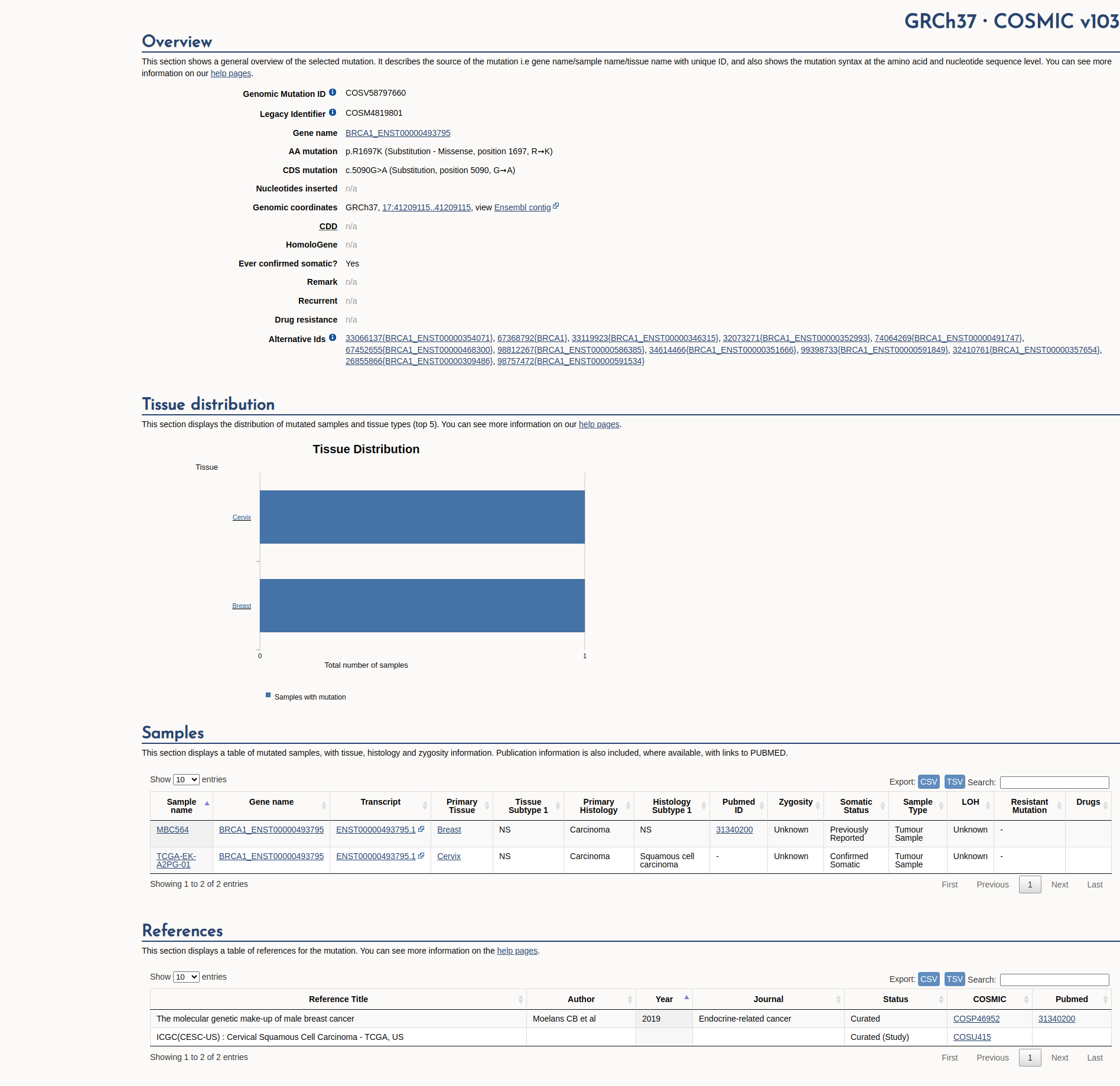
Functional Impact & Domains
Functional Domain
Error in OpenAI Consolidation. OncoKB: BRCA1C1697YBRCA1C1697YSomaticNCBI Gene:672|Show additional gene information Variant OverviewBRCA1, a tumor suppressor involved in the DNA damage response, is mutated in various cancer types.The BRCA1 C1697Y mutation has not specifically been reviewed by the OncoKB team. However, BRCA1 C1697R is likely oncogenic, and therefore BRCA1 C1697Y is considered likely oncogenic.Hide mutation effect description The BRCA1 C1697Y mutation has not specifically been reviewed by the OncoKB team. However, the mutation effect description for BRCA1 C1697R, an alternate allele of BRCA1 C1697Y, is: The BRCA1 C1697R mutation is located in the BRCT domain. In a study of 117 distinct BRCA1 missense variants identified in patients with a known family history of breast or ovarian cancer, the C1697R variant was demonstrated to have severe folding defect, uncertain binding activity, uncertain binding specificity and compromised transcriptional activity (PMID: 20516115). In a separate study of 8 BRCA1 variants identified in Scandinavian breast and ovarian cancer families, C1697R was shown to have loss of transcriptional activity compared to wild type BRCA1 (PMID: 11157798). Another study of 94 BRCA1 variants showed that C1697R had no transcriptional activation of BRCA1 and was cancer-associated (PMID: 15172985). JAX-CKB: No results found
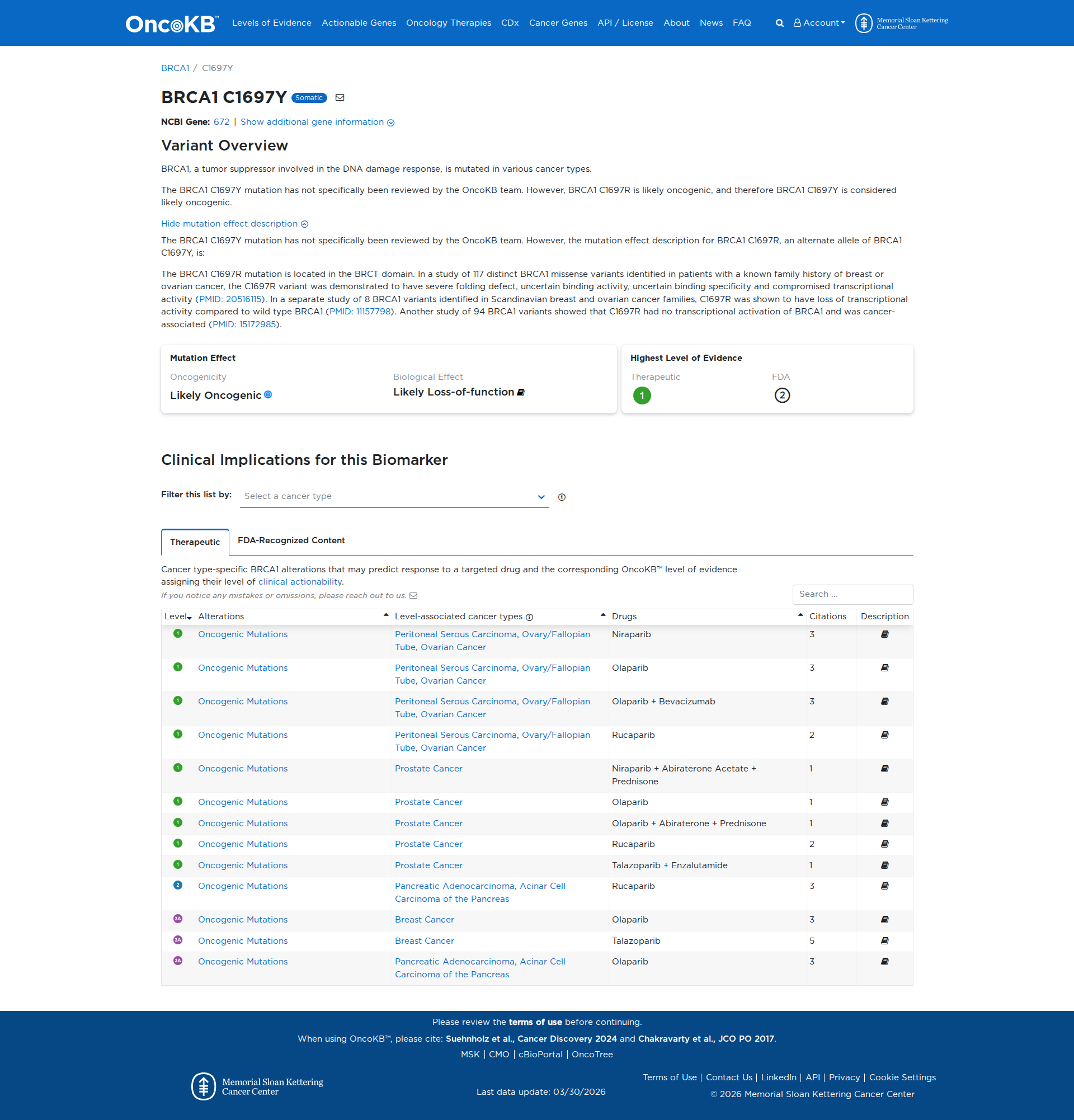

Click on previews to view full database entries. External databases may require institutional access.
Computational Analysis
Pathogenicity Predictions
SpliceAISpliceAI Scores
Window: ±500bp| Effect Type | Score | Position |
|---|---|---|
| Acceptor Loss (AL) | 0.0 | 32 bp |
| Donor Loss (DL) | 0.0 | 5 bp |
| Acceptor Gain (AG) | 0.03 | 15 bp |
| Donor Gain (DG) | 0.02 | -62 bp |
VCEP Guidelines
Applied ACMG/AMP Criteria (VCEP Specific)
PS3 (Unknown (Pre-LLM))
From pre-LLM assessment (LLM Failed)
PM2 (Unknown (Pre-LLM))
From pre-LLM assessment (LLM Failed)
PP5 (Unknown (Pre-LLM))
From pre-LLM assessment (LLM Failed)
BP4 (Unknown (Pre-LLM))
From pre-LLM assessment (LLM Failed)