Genetic Information
Gene & Transcript Details
| ID | Status | Details |
|---|---|---|
| NM_000179.2 | RefSeq Select | 4435 nt | 153–4235 |
| NM_000179.1 | Alternative | 4264 nt | 88–4170 |
| NM_000179.3 | MANE Select | 4265 nt | 90–4172 |
Variant Details
Clinical & Population Data
Population Frequency
gnomADClinVar
OpenThis alteration is classified as likely benign based on a combination of the following: seen in unaffected individuals, population frequency, intact protein function, lack of segregation with disease, co-occurrence, RNA analysis, in silico models, amino acid conservation, lack of disease association in case-control studies, and/or the mechanism of disease or impacted region is inconsistent with a known cause of pathogenicity.
This variant is considered likely benign. This variant is strongly associated with less severe personal and family histories of cancer, typical for individuals without pathogenic variants in this gene [PMID: 27363726].
Variant summary: MSH6 c.942C>G (p.Ser314Arg) results in a non-conservative amino acid change in the encoded protein sequence. Algorithms developed to predict the effect of missense changes on protein structure and function are either unavailable or do not agree on the potential impact of this missense change. The variant allele was found at a frequency of 4.8e-05 in 251294 control chromosomes, predominantly at a frequency of 0.00068 within the African or African-American subpopulation in the gnomAD database. The observed variant frequency within African or African-American control individuals in the gnomAD database exceeds the estimated maximal expected allele frequency for disease-causing variants in MSH6. c.942C>G has been reported as a germline Benign/VUS variant in settings of multigene panel testing among individuals with a variety of cancers such as ALL, Endometrial and Colorectal Cancer (e.g. Zhang_2015, Ring_2016, Yurgelun_2017). These report(s) do not provide unequivocal conclusions about association of the variant with Lynch Syndrome and related cancers. To our knowledge, no experimental evidence demonstrating an impact on protein function has been reported. The following publications have been ascertained in the context of this evaluation (PMID: 27443514, 28135145, 26580448). ClinVar contains an entry for this variant (Variation ID: 229741). Based on the evidence outlined above, the variant was classified as likely benign.
"This variant has been reported in ClinVar as Likely benign (6 clinical laboratories) and as Uncertain significance (4 clinical laboratories) and as Likely Benign (1 clinical laboratories) and as Benign (1 clinical laboratories)."
COSMIC Somatic Evidence
Open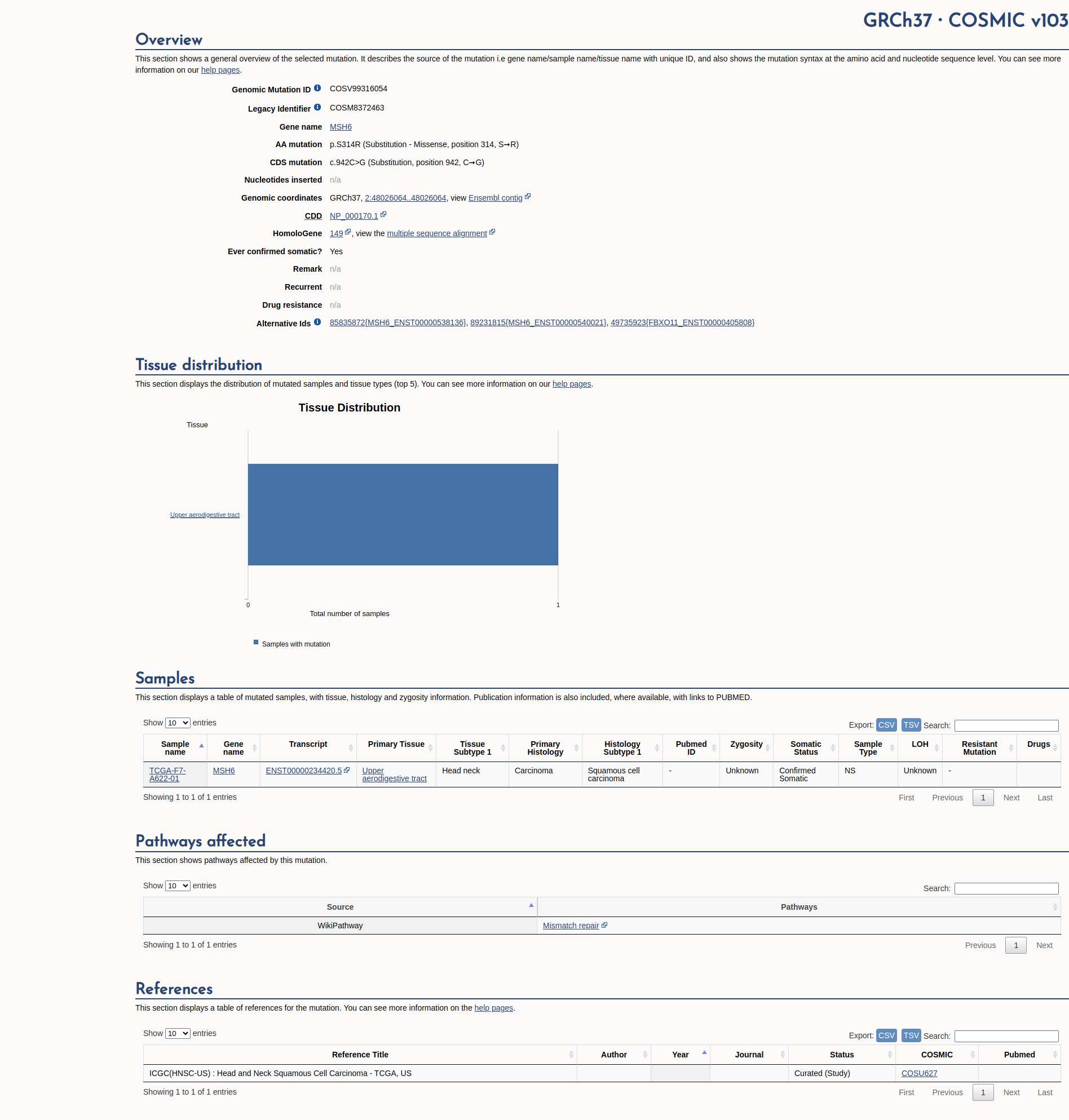
Functional Impact & Domains
Functional Domain
Error in OpenAI Consolidation. OncoKB: MSH6S314RMSH6S314RSomaticNCBI Gene:2956|Show additional gene information Variant OverviewMSH6, a DNA mismatch repair protein, is frequently mutated in colorectal, small bowel, and endometrial cancers.The MSH6 S314R mutation has not specifically been reviewed by the OncoKB team, and therefore its biological significance is unknown. JAX-CKB: No results found
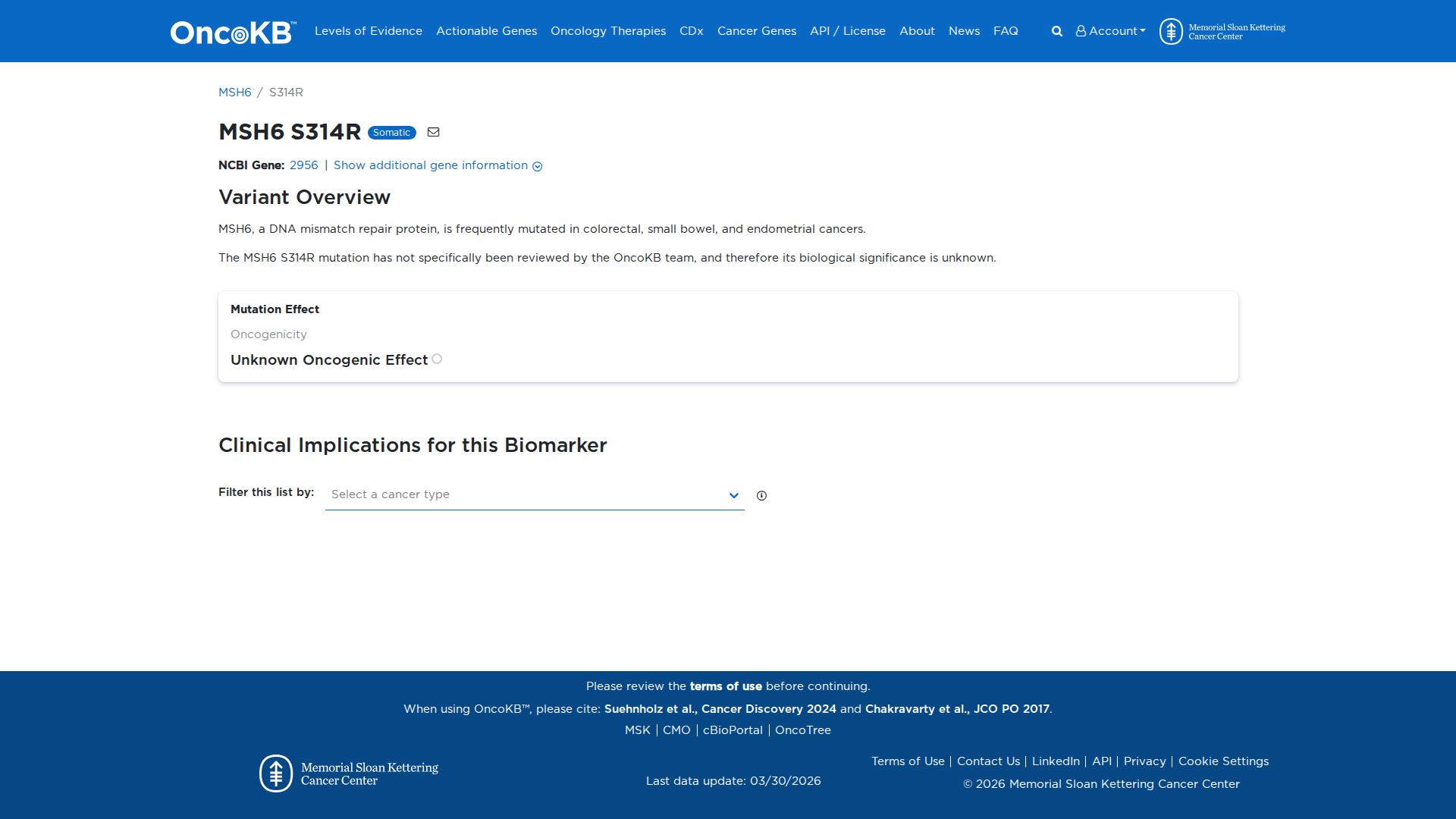

Click on previews to view full database entries. External databases may require institutional access.
Computational Analysis
Pathogenicity Predictions
SpliceAISpliceAI Scores
Window: ±500bp| Effect Type | Score | Position |
|---|---|---|
| Acceptor Loss (AL) | 0.01 | -310 bp |
| Donor Loss (DL) | 0.01 | 342 bp |
| Acceptor Gain (AG) | 0.0 | 470 bp |
| Donor Gain (DG) | 0.0 | -33 bp |
VCEP Guidelines
Applied ACMG/AMP Criteria (VCEP Specific)
PM2 (Unknown (Pre-LLM))
From pre-LLM assessment (LLM Failed)
BP4 (Unknown (Pre-LLM))
From pre-LLM assessment (LLM Failed)