Genetic Information
Gene & Transcript Details
| ID | Status | Details |
|---|---|---|
| NM_024675.4 | MANE Select | 4008 nt | 154–3714 |
| NM_024675.3 | RefSeq Select | 4069 nt | 201–3761 |
Variant Details
Clinical & Population Data
Population Frequency
gnomADClinVar
OpenThis variant is considered benign. This variant is strongly associated with less severe personal and family histories of cancer, typical for individuals without pathogenic variants in this gene [PMID: 25085752]. This variant has been observed in trans with a known pathogenic variant in one or more individuals lacking clinical features consistent with gene-specific recessive disease.
This alteration is classified as likely benign based on a combination of the following: seen in unaffected individuals, population frequency, intact protein function, lack of segregation with disease, co-occurrence, RNA analysis, in silico models, amino acid conservation, lack of disease association in case-control studies, and/or the mechanism of disease or impacted region is inconsistent with a known cause of pathogenicity.
Variant summary: PALB2 c.1042C>A (p.Gln348Lys) results in a conservative amino acid change in the encoded protein sequence. Five of five in-silico tools predict a benign effect of the variant on protein function. The variant allele was found at a frequency of 4.3e-05 in 257982 control chromosomes. This frequency is not significantly higher than expected for a pathogenic variant in PALB2 causing Hereditary Breast And Ovarian Cancer Syndrome (4.3e-05 vs 0.00016), allowing no conclusion about variant significance. c.1042C>A has been reported in the literature in at least one individual affected with breast cancer (Decker_2017), but also in healthy controls (Ramus_2015). These reports do not provide unequivocal conclusions about association of the variant with Hereditary Breast And Ovarian Cancer Syndrome. Co-occurrence with another pathogenic variant associated with Hereditary Breast and Ovarian Cancer has been reported in an internal sample (BRCA2 c.9789_9790delGA , p.Asn3264LeufsX12), providing supporting evidence for a benign role. To our knowledge, no experimental evidence demonstrating an impact on protein function has been reported. Five other clinical diagnostic laboratories have submitted clinical-significance assessments for this variant to ClinVar after 2014 without evidence for independent evaluation. They have cited the variant as likely benign (n=1) and uncertain significance (n=4). Based on the evidence outlined above, the variant was classified as uncertain significance.
This submission and the accompanying classification are no longer maintained by the submitter. For more information on current observations and classification, please contact variantquestions@myriad.com.
The PALB2 c.1042C>A (p.Gln348Lys) variant has been reported in the published literature in individuals with breast cancer (PMID: 33471991 (2021), 28779002 (2017), see also LOVD (http://databases.lovd.nl/shared)). This variant has also been identified in reportedly unaffected individuals (PMID: 33471991 (2021), 28779002 (2017), 26315354 (2015), see also LOVD (http://databases.lovd.nl/shared)). Additionally, this variant has been reported to segregate with disease in a family affected with chordoma, however the variant was also identified in unaffected family members (PMID: 35762214 (2022)). The frequency of this variant in the general population (Genome Aggregation Database, http://gnomad.broadinstitute.org) is uninformative in the assessment of its pathogenicity. Analysis of this variant using bioinformatics tools for the prediction of the effect of amino acid changes on protein structure and function yielded predictions that this variant is benign. Based on the available information, we are unable to determine the clinical significance of this variant.
"This variant has been reported in ClinVar as Uncertain significance (9 clinical laboratories) and as Benign (1 clinical laboratories) and as Likely benign (2 clinical laboratories)."
COSMIC Somatic Evidence
Open
Functional Impact & Domains
Functional Domain
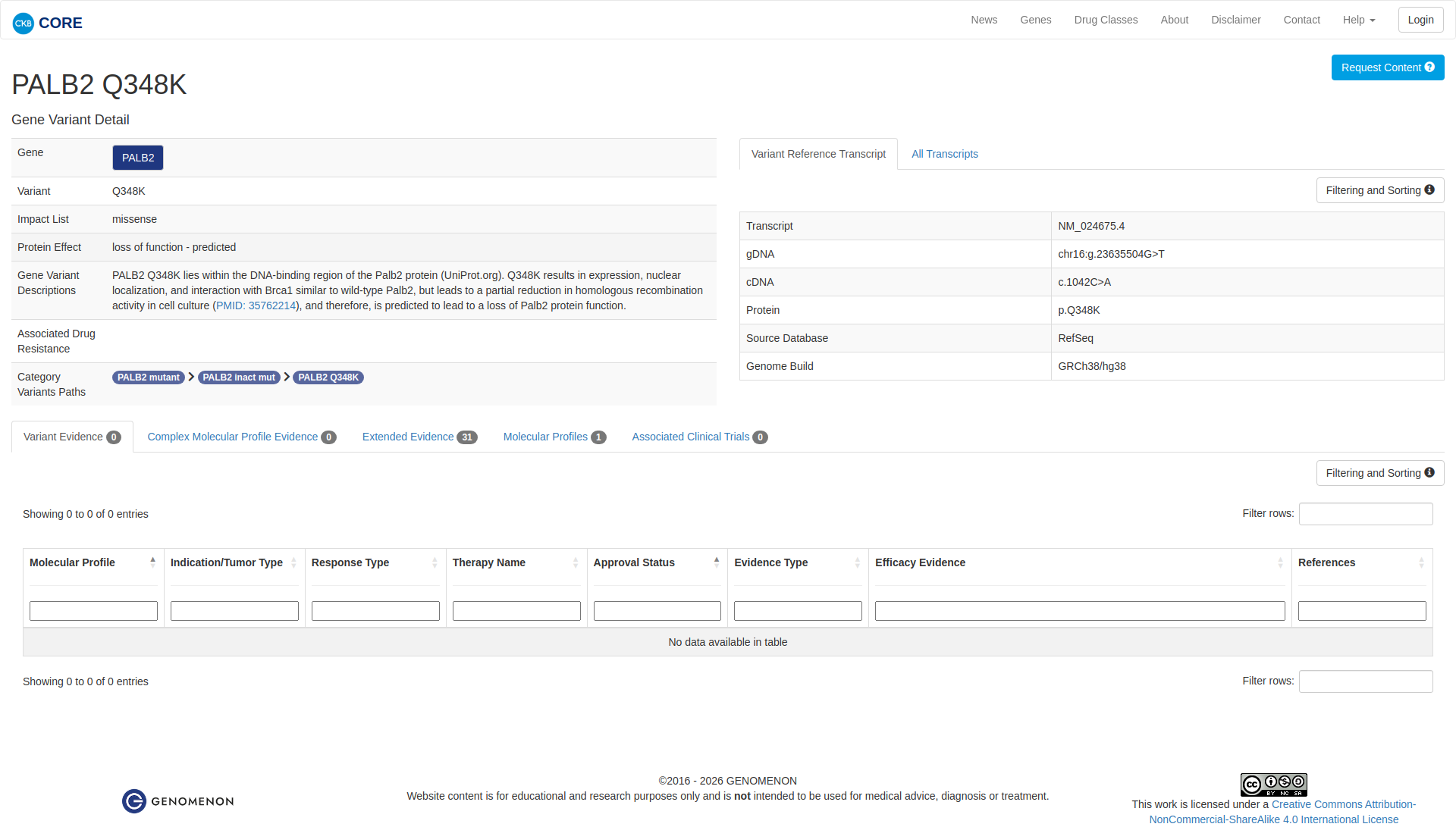
Error in OpenAI Consolidation. OncoKB: PALB2Q348KPALB2Q348KSomaticNCBI Gene:79728|Show additional gene information Variant OverviewPALB2, a scaffolding protein involved in DNA repair, is altered in various cancers.The PALB2 Q348K mutation has not specifically been reviewed by the OncoKB team, and therefore its biological significance is unknown. JAX-CKB: PALB2 Q348K lies within the DNA-binding region of the Palb2 protein (UniProt.org). Q348K results in expression, nuclear localization, and interaction with Brca1 similar to wild-type Palb2, but leads to a partial reduction in homologous recombination activity in cell culture (PMID: 35762214), and therefore, is predicted to lead to a loss of Palb2 protein function.

Click on previews to view full database entries. External databases may require institutional access.
Computational Analysis
Pathogenicity Predictions
SpliceAISpliceAI Scores
Window: ±500bp| Effect Type | Score | Position |
|---|---|---|
| Acceptor Loss (AL) | 0.0 | 26 bp |
| Donor Loss (DL) | 0.0 | -72 bp |
| Acceptor Gain (AG) | 0.0 | -133 bp |
| Donor Gain (DG) | 0.0 | 348 bp |
VCEP Guidelines
Applied ACMG/AMP Criteria (VCEP Specific)
PM2 (Unknown (Pre-LLM))
From pre-LLM assessment (LLM Failed)
BP4 (Unknown (Pre-LLM))
From pre-LLM assessment (LLM Failed)