Genetic Information
Gene & Transcript Details
| ID | Status | Details |
|---|---|---|
| NM_001330437.2 | Alternative | 6085 nt | 166–1959 |
| NM_001330437.1 | Alternative | 6151 nt | 215–2008 |
Variant Details
Clinical & Population Data
Population Frequency
gnomADClinVar
OpenThe p.Lys70Arg variant in PTPN11 has been identified in >5 individuals with clin ical features of a RASopathy, including confirmed de novo inheritance in 1 indiv idual, and segregated with disease in 3 affected relatives (LMM data, Xu 2017). This variant was absent from large population studies and is reported in ClinVar (Variation ID: 44603). Computational prediction tools and conservation analysis do not provide strong support for or against an impact to the protein. This var iant is located in the directly interacting residues between N-SH2 and the PTPN domains, where pathogenic missense variants are common. In summary, this variant meets criteria to be classified as pathogenic for Noonan syndrome in an autosom al dominant manner based upon presence in affected individuals, de novo observat ion, segregation with disease, and absence from controls. ACMG/AMP Criteria appl ied: PS4, PM1, PM2, PM6, PP1.
The c.2019A>G (p.Lys70Arg) variant in PTPN11 was absent from large population studies (PM2; gnomAD, http://gnomad.broadinstitute.org). It has been identified in at least 6 probands with Noonan syndrome (PS4; SCV000061296.6; PMID: 29084544).One case was described as an unconfirmed de novo occurrence (PM6; PMID: 29084544). It has been reported to segregate with clinical features of a RASopathy in at least 3 family members (PP1; SCV000061296.6). Furthermore, the variant is in a location that has been defined by the ClinGen RASopathy Expert Panel to be a mutational hotspot or domain of PTPN11 (PM1; PMID: 29493581). Finally, PTPN11 has been defined by the ClinGen RASopathy Expert Panel as a gene with a low rate of benign missense variants and pathogenic missense variants are common (PP2; PMID: 29493581). In summary, this variant meets criteria to be classified as pathogenic for RASopathies in an autosomal dominant manner. Rasopathy-specific ACMG/AMP criteria applied (PMID:29493581): PS4, PM6, PM1, PM2, PP1, PP2.
Variant summary: PTPN11 c.209A>G (p.Lys70Arg) results in a conservative amino acid change located in the SH2 domain (IPR000980) of the encoded protein sequence. Four of five in-silico tools predict a damaging effect of the variant on protein function. The variant was absent in 251054 control chromosomes (gnomAD). c.209A>G has been reported in the literature in individuals affected with and/or undergoing diagnostic evaluation for Noonan Syndrome And Related Conditions (e.g. Leach_2019, Xu_2017). At least one case of a confirmed de novo occurrence in an individual with Noonan syndrome has been reported (Xu_2017). In addition, a ClinVar submitter reports the variant in at least 5 individuals with clinical features of a RASopathy, including segregation with disease in 3 affected relatives (SCV000061296.6). These data indicate that the variant is very likely to be associated with disease. To our knowledge, no experimental evidence demonstrating an impact on protein function has been reported. Four ClinVar submitters (evaluation after 2014) cite the variant as pathogenic (n=2)/likely pathogenic (n=2). Some submitters cite overlapping evidence utilized in the context of this evaluation. Recently the ClinGen RASopathy Variant Curation Expert Panel settled on a classification of Pathogenic for this variant (personal communication, June 2020). Based on the evidence outlined above, the variant was re-classified as pathogenic.
This sequence change replaces lysine, which is basic and polar, with arginine, which is basic and polar, at codon 70 of the PTPN11 protein (p.Lys70Arg). This variant is not present in population databases (gnomAD no frequency). This missense change has been observed in individual(s) with Noonan syndrome (PMID: 29084544). In at least one individual the variant was observed to be de novo. ClinVar contains an entry for this variant (Variation ID: 44603). Invitae Evidence Modeling of protein sequence and biophysical properties (such as structural, functional, and spatial information, amino acid conservation, physicochemical variation, residue mobility, and thermodynamic stability) indicates that this missense variant is expected to disrupt PTPN11 protein function with a positive predictive value of 95%. For these reasons, this variant has been classified as Pathogenic.
The variant is not observed in the gnomAD v2.1.1 dataset. The variant is located in a mutational hot spot and/or well-established functional domain in which established pathogenic variants have been reported. Missense changes are a common disease-causing mechanism. In silico tool predictions suggest damaging effect of the variant on gene or gene product (REVEL: 0.67; 3Cnet: 0.73). Same nucleotide change resulting in same amino acid change has been previously reported as pathogenic/likely pathogenic with strong evidence (ClinVar ID: VCV000044603 / PMID: 29084544). The variant has been previously reported as assumed (i.e. paternity and maternity not confirmed) de novo in at least one similarly affected unrelated individual (PMID: 29084544). Therefore, this variant is classified as Pathogenic according to the recommendation of ACMG/AMP guideline.
"This variant has been reported in ClinVar as Pathogenic (6 clinical laboratories) and as Likely pathogenic (3 clinical laboratories) and as Pathogenic by ClinGen RASopathy Variant Curation Expert Panel expert panel."
COSMIC Somatic Evidence
Open
Functional Impact & Domains
Functional Domain
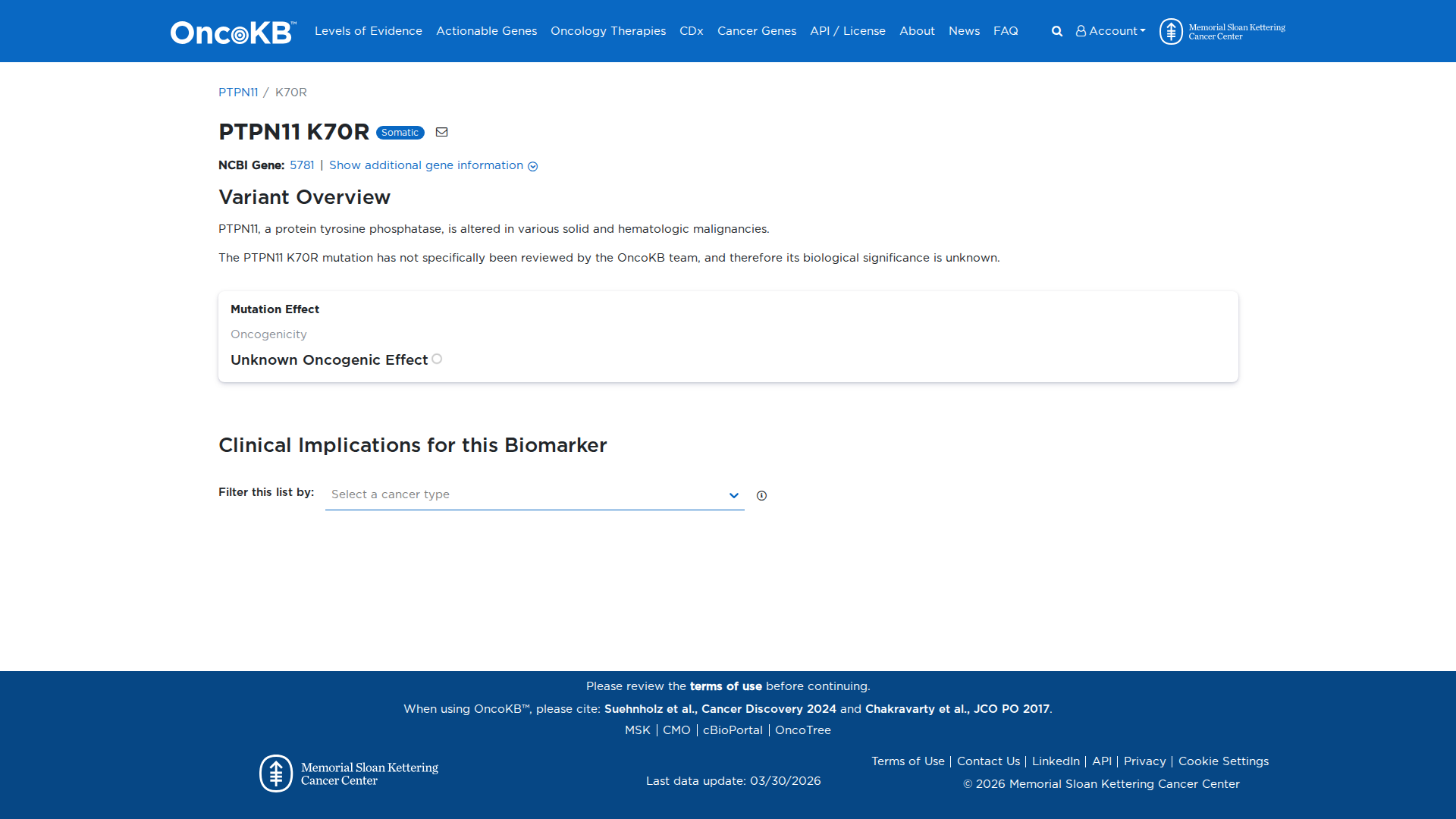
Error in OpenAI Consolidation. OncoKB: PTPN11K70RPTPN11K70RSomaticNCBI Gene:5781|Show additional gene information Variant OverviewPTPN11, a protein tyrosine phosphatase, is altered in various solid and hematologic malignancies.The PTPN11 K70R mutation has not specifically been reviewed by the OncoKB team, and therefore its biological significance is unknown. JAX-CKB: No results found

Click on previews to view full database entries. External databases may require institutional access.
Computational Analysis
Pathogenicity Predictions
SpliceAISpliceAI Scores
Window: ±500bp| Effect Type | Score | Position |
|---|---|---|
| Acceptor Loss (AL) | 0.0 | -68 bp |
| Donor Loss (DL) | 0.0 | -277 bp |
| Acceptor Gain (AG) | 0.0 | -160 bp |
| Donor Gain (DG) | 0.0 | -31 bp |
VCEP Guidelines
Applied ACMG/AMP Criteria (VCEP Specific)
PM2 (Unknown (Pre-LLM))
From pre-LLM assessment (LLM Failed)
PP5 (Unknown (Pre-LLM))
From pre-LLM assessment (LLM Failed)
BP4 (Unknown (Pre-LLM))
From pre-LLM assessment (LLM Failed)