Genetic Information
Gene & Transcript Details
| ID | Status | Details |
|---|---|---|
| NM_000546.3 | Alternative | 2640 nt | 252–1433 |
| NM_000546.5 | RefSeq Select | 2591 nt | 203–1384 |
| NM_000546.6 | MANE Select | 2512 nt | 143–1324 |
| NM_000546.4 | Alternative | 2586 nt | 198–1379 |
| NM_000546.2 | Alternative | 2629 nt | 252–1433 |
Variant Details
Clinical & Population Data
Population Frequency
gnomADClinVar
OpenThe p.R379L variant (also known as c.1136G>T), located in coding exon 10 of the TP53 gene, results from a G to T substitution at nucleotide position 1136. The arginine at codon 379 is replaced by leucine, an amino acid with dissimilar properties. This variant is reported to have partially functional transactivation in yeast based assays (Kato S et al. Proc Natl Acad Sci U S A, 2003 Jul;100:8424-9). Studies conducted in human cell lines indicate this alteration is proficient at growth suppression and has no dominant negative effect (Giacomelli AO et al. Nat Genet, 2018 Oct;50:1381-1387). This amino acid position is not well conserved in available vertebrate species. In addition, the in silico prediction for this alteration is inconclusive. Based on the available evidence, the clinical significance of this variant remains unclear.
This sequence change replaces arginine, which is basic and polar, with leucine, which is neutral and non-polar, at codon 379 of the TP53 protein (p.Arg379Leu). This variant is not present in population databases (gnomAD no frequency). This missense change has been observed in individuals with clinical features of Li-Fraumeni syndrome (internal data). ClinVar contains an entry for this variant (Variation ID: 216463). Invitae Evidence Modeling of protein sequence and biophysical properties (such as structural, functional, and spatial information, amino acid conservation, physicochemical variation, residue mobility, and thermodynamic stability) indicates that this missense variant is not expected to disrupt TP53 protein function with a negative predictive value of 95%. Experimental studies have shown that this missense change does not substantially affect TP53 function (PMID: 12826609, 30224644). In summary, the available evidence is currently insufficient to determine the role of this variant in disease. Therefore, it has been classified as a Variant of Uncertain Significance.
This missense variant replaces arginine with leucine at codon 379 of the TP53 protein. Computational prediction suggests that this variant may not impact protein structure and function. In functional studies, the mutant protein has shown ~70% of wild-type activity in yeast transactivation assays (IARC database and PMID: 12826609) and normal function in human cell growth suppression assays (PMID: 30224644). This variant has not been reported in individuals affected with hereditary cancer in the literature. This variant has not been identified in the general population by the Genome Aggregation Database (gnomAD). The available evidence is insufficient to determine the role of this variant in disease conclusively. Therefore, this variant is classified as a Variant of Uncertain Significance.
"This variant has been reported in ClinVar as Uncertain significance (7 clinical laboratories) and as Likely Benign by ClinGen TP53 Variant Curation Expert Panel, ClinGen expert panel."
COSMIC Somatic Evidence
Open
Functional Impact & Domains
Functional Domain
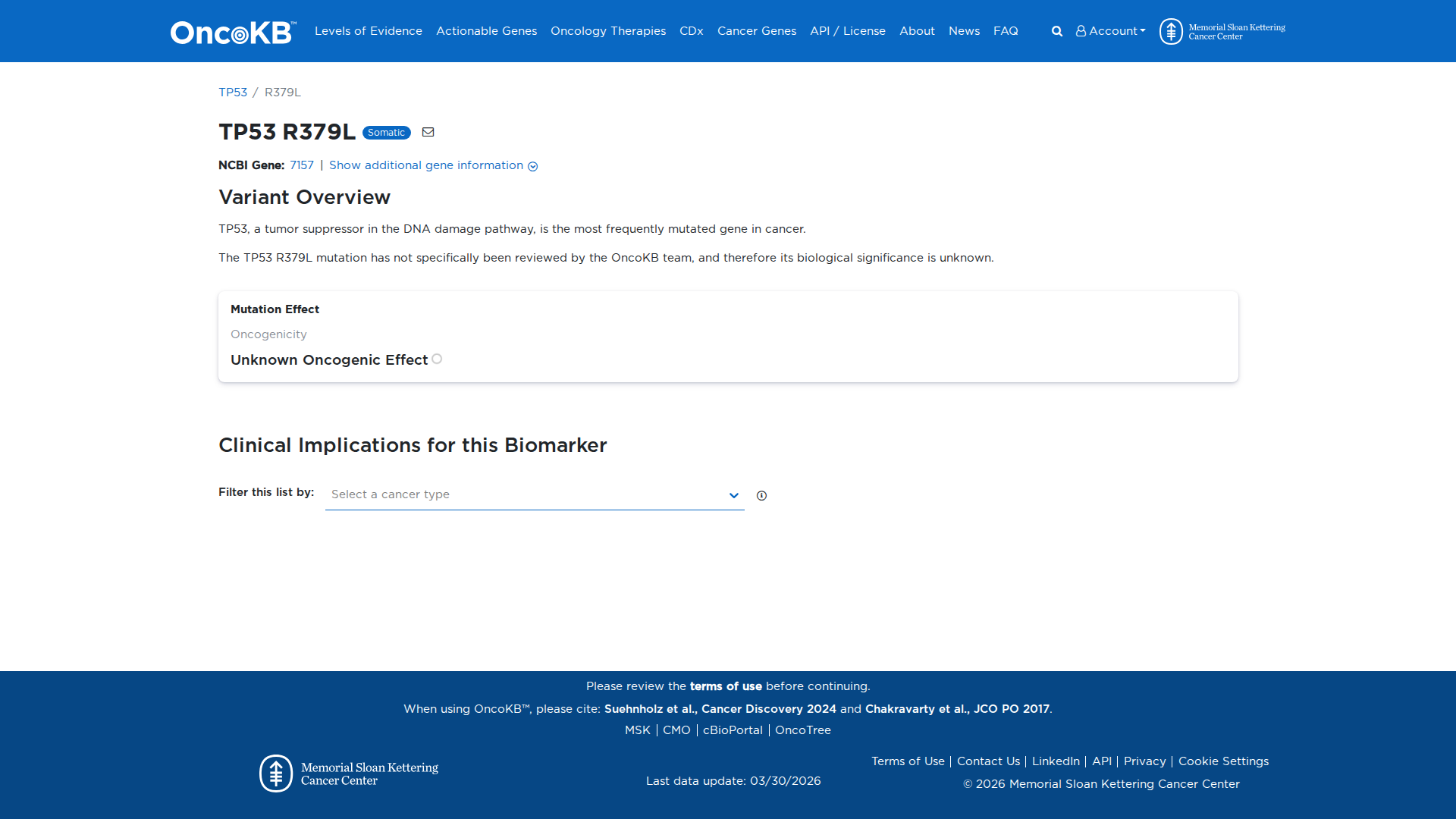
Error in OpenAI Consolidation. OncoKB: TP53R379LTP53R379LSomaticNCBI Gene:7157|Show additional gene information Variant OverviewTP53, a tumor suppressor in the DNA damage pathway, is the most frequently mutated gene in cancer.The TP53 R379L mutation has not specifically been reviewed by the OncoKB team, and therefore its biological significance is unknown. JAX-CKB: No results found

Click on previews to view full database entries. External databases may require institutional access.
Computational Analysis
Pathogenicity Predictions
SpliceAISpliceAI Scores
Window: ±500bp| Effect Type | Score | Position |
|---|---|---|
| Acceptor Loss (AL) | 0.1 | 35 bp |
| Donor Loss (DL) | 0.01 | 237 bp |
| Acceptor Gain (AG) | 0.0 | 129 bp |
| Donor Gain (DG) | 0.01 | 16 bp |
VCEP Guidelines
Applied ACMG/AMP Criteria (VCEP Specific)
PM2 (Unknown (Pre-LLM))
From pre-LLM assessment (LLM Failed)
BP4 (Unknown (Pre-LLM))
From pre-LLM assessment (LLM Failed)