Genetic Information
Gene & Transcript Details
| ID | Status | Details |
|---|---|---|
| NM_000546.3 | Alternative | 2640 nt | 252–1433 |
| NM_000546.5 | RefSeq Select | 2591 nt | 203–1384 |
| NM_000546.6 | MANE Select | 2512 nt | 143–1324 |
| NM_000546.4 | Alternative | 2586 nt | 198–1379 |
| NM_000546.2 | Alternative | 2629 nt | 252–1433 |
Variant Details
Clinical & Population Data
Population Frequency
gnomADClinVar
OpenThis missense variant replaces threonine with methionine at codon 125 DNA binding domain of the TP53 protein. Computational prediction suggests that this variant may have deleterious impact on protein structure and function (internally defined REVEL score threshold >= 0.7, PMID: 27666373). Splice site prediction tools are inconclusive regarding the impact of this variant on RNA splicing. One RNA study showed use of a cryptic donor splice site and exon 4 skipping (PMID: 34675114). Functional studies have shown the mutant protein to be defective in transactivation activity (PMID: 10761705, 12826609, 28369373) and functional in human cell growth assays (PMID: 29979965, 30224644). This variant has been reported in individuals meeting the Chompret criteria for Li-Fraumeni syndrome, including individuals affected with adrenocortical carcinoma (PMID: 26014290, 28369373; DOI:10.7759/cureus.24602) and individuals affected with early-onset breast cancer (PMID: 25503501, 34675114). This variant has been reported in additional individuals affected with breast cancer (PMID: 26845104, 31206626, 30128536, 34675114), ovarian cancer (PMID: 30216591), and bladder urothelial carcinoma (PMID: 34240179). This variant has been identified in 1/31400 chromosomes in the general population by the Genome Aggregation Database (gnomAD). Different missense variants occurring at the same amino acid position, p.Thr125Arg and p.Thr125Lys, are known to be disease-causing (ClinVar variation ID: 376667, 216465), indicating that threonine at this position is important for TP53 function. Based on the available evidence, this variant is classified as Likely Pathogenic.
This submission and the accompanying classification are no longer maintained by the submitter. For more information on current observations and classification, please contact variantquestions@myriad.com.
The p.T125M variant (also known as c.374C>T), located in coding exon 3 of the TP53 gene, results from a C to T substitution at nucleotide position 374. The threonine at codon 125 is replaced by methionine, an amino acid with similar properties. This variant is in the DNA binding domain of the TP53 protein and is reported to have non-functional transactivation in yeast based assays (Kato S et al. Proc. Natl. Acad. Sci. USA. 2003 Jul;100:8424-9). However, studies conducted in human cell lines indicate this alteration is proficient at growth suppression and has no dominant negative effect (Kotler E et al. Mol.Cell. 2018 Jul;71:178-190.e8; Giacomelli AO et al. Nat. Genet. 2018 Oct;50:1381-1387). This variant has been reported in multiple individuals with early-onset breast cancer (Maxwell KN et al. Genet. Med. 2015 Aug;17:630-8; Shirts BH et al. Genet. Med. 2016 10;18:974-81; Weitzel JN et al. Cancer. 2019 Aug;125:2829-2836) as well as in two individuals with childhood-onset adrenocortical carcinoma (Bougeard G et al. J. Clin. Oncol. 2015 Jul;33:2345-52). Another alteration at the same codon, p.T125R (c.374C>G), has been reported in several families meeting clinical criteria for Li Fraumeni syndrome (Morgan J et al Hum Mutat. 2010 Apr;31(4):484-91; Waszak SM et al. Lancet Oncol. 2018 06;19:785-798; Li JY et al. Int J Cancer. 2019 01;144:281-289). In addition, several functional studies indicate that p.T125R is deleterious (Kato S et al. Proc. Natl. Acad. Sci. USA. 2003 Jul;100:8424-9; Kotler E et al. Mol.Cell. 2018 Jul;71:178-190.e8; Giacomelli AO et al. Nat. Genet. 2018 Oct;50:1381-1387; Menendez D et al. Mol. Cell. Biol. 2006 Mar;26:2297-308). The p.T125M amino acid position is highly conserved in available vertebrate species. In addition, this alteration is predicted to be deleterious by in silico analysis. Based on the majority of available evidence to date, this variant is likely to be pathogenic.
This sequence change replaces threonine, which is neutral and polar, with methionine, which is neutral and non-polar, at codon 125 of the TP53 protein (p.Thr125Met). This variant is present in population databases (rs786201057, gnomAD 0.01%). This missense change has been observed in individuals with adrenocortical carcinoma, breast cancer, and/or Li-Fraumeni-associated cancers (PMID: 25503501, 26014290, 26845104; internal data). It has also been observed to segregate with disease in related individuals. ClinVar contains an entry for this variant (Variation ID: 183748). An algorithm developed to predict the effect of missense changes on protein structure and function (PolyPhen-2) suggests that this variant is likely to be disruptive. Experimental studies have shown that this missense change affects TP53 function (PMID: 12826609). RNA analysis performed to evaluate the impact of this missense change on mRNA splicing indicates it does not significantly alter splicing (internal data). This variant disrupts the p.Thr125 amino acid residue in TP53. Other variant(s) that disrupt this residue have been determined to be pathogenic (PMID: 12826609, 16508005; internal data). This suggests that this residue is clinically significant, and that variants that disrupt this residue are likely to be disease-causing. For these reasons, this variant has been classified as Pathogenic.
"This variant has been reported in ClinVar as Likely pathogenic (11 clinical laboratories) and as Pathogenic (3 clinical laboratories) and as Likely Pathogenic (1 clinical laboratories) and as Uncertain significance (1 clinical laboratories)."
COSMIC Somatic Evidence
Open
Functional Impact & Domains
Functional Domain
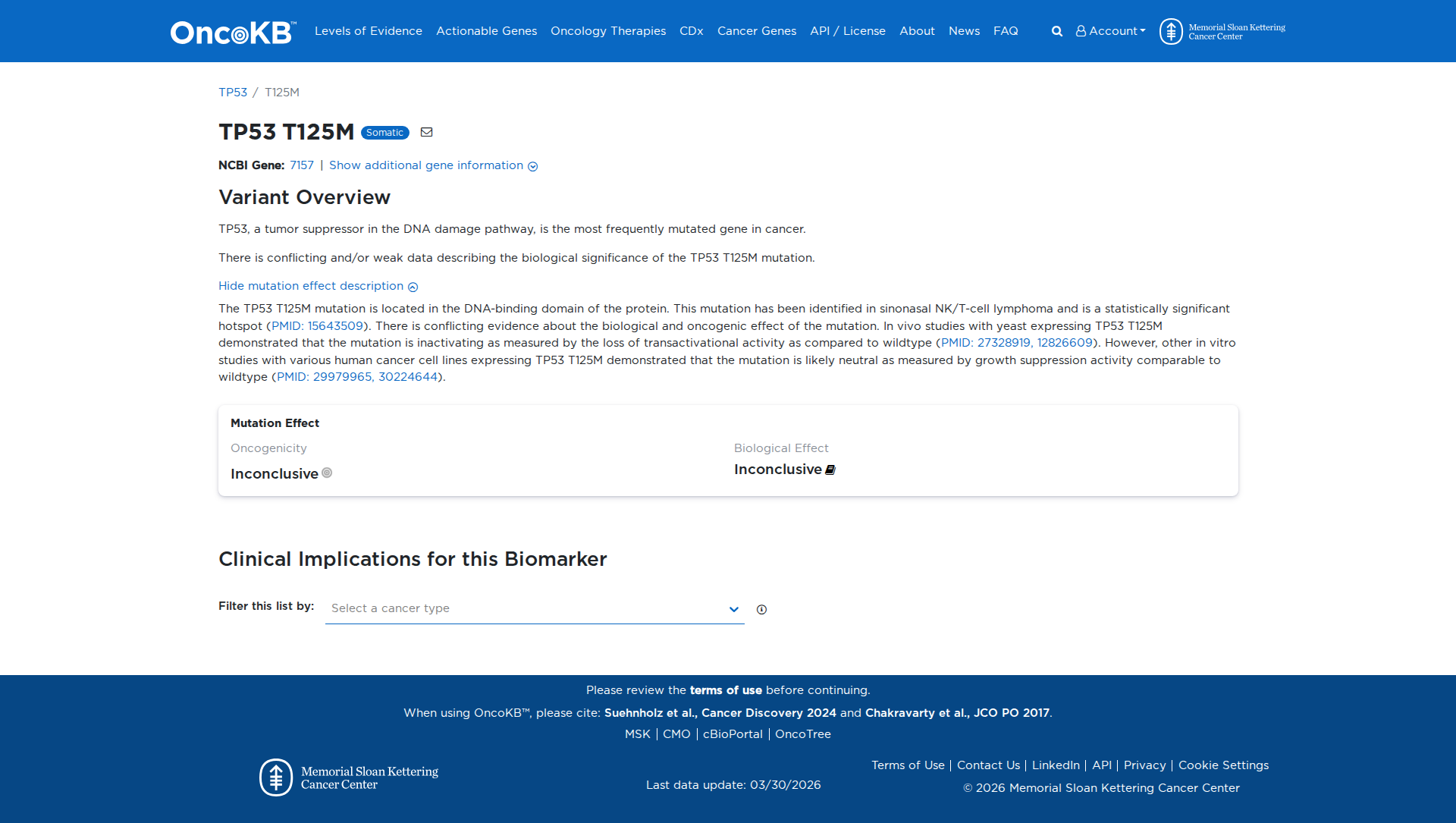
Error in OpenAI Consolidation. OncoKB: TP53T125MTP53T125MSomaticNCBI Gene:7157|Show additional gene information Variant OverviewTP53, a tumor suppressor in the DNA damage pathway, is the most frequently mutated gene in cancer.There is conflicting and/or weak data describing the biological significance of the TP53 T125M mutation.Hide mutation effect description The TP53 T125M mutation is located in the DNA-binding domain of the protein. This mutation has been identified in sinonasal NK/T-cell lymphoma and is a statistically significant hotspot (PMID: 15643509). There is conflicting evidence about the biological and oncogenic effect of the mutation. In vivo studies with yeast expressing TP53 T125M demonstrated that the mutation is inactivating as measured by the loss of transactivational activity as compared to wildtype (PMID: 27328919, 12826609). However, other in vitro studies with various human cancer cell lines expressing TP53 T125M demonstrated that the mutation is likely neutral as measured by growth suppression activity comparable to wildtype (PMID: 29979965, 30224644). JAX-CKB: TP53 T125M lies within the DNA-binding domain of the Tp53 protein (PMID: 15510160). T125M results in subcellular localization similar to wild-type but abnormal splicing in culture and decreased transactivation activity in a reporter assay (PMID: 34675114), and therefore, is predicted to lead to a loss of Tp53 protein function.

Click on previews to view full database entries. External databases may require institutional access.
Computational Analysis
Pathogenicity Predictions
SpliceAISpliceAI Scores
Window: ±500bp| Effect Type | Score | Position |
|---|---|---|
| Acceptor Loss (AL) | 0.04 | 73 bp |
| Donor Loss (DL) | 0.02 | -1 bp |
| Acceptor Gain (AG) | 0.0 | -116 bp |
| Donor Gain (DG) | 0.09 | 199 bp |
VCEP Guidelines
Applied ACMG/AMP Criteria (VCEP Specific)
PS3 (Unknown (Pre-LLM))
From pre-LLM assessment (LLM Failed)
PM2 (Unknown (Pre-LLM))
From pre-LLM assessment (LLM Failed)
PP5 (Unknown (Pre-LLM))
From pre-LLM assessment (LLM Failed)
BP4 (Unknown (Pre-LLM))
From pre-LLM assessment (LLM Failed)