Genetic Information
Gene & Transcript Details
| ID | Status | Details |
|---|---|---|
| NM_007294.4 | MANE Select | 7088 nt | 114–5705 |
| NM_007294.2 | Alternative | 7191 nt | 201–5792 |
| NM_007294.3 | RefSeq Select | 7224 nt | 233–5824 |
Variant Details
Clinical & Population Data
Population Frequency
gnomADClinVar
OpenVariant summary: BRCA1 c.4327C>G (p.Arg1443Gly) results in a non-conservative amino acid change in the encoded protein sequence. Four of five in-silico tools predict a benign effect of the variant on protein function. The variant allele was found at a frequency of 3.2e-05 in 251364 control chromosomes. The available data on variant occurrences in the general population are insufficient to allow any conclusion about variant significance.c.4327C>G has been reported in the literature in individuals affected with Breast and Ovarian Cancer (e.g. Ahmed_2012, Alsop_2012, Castilla_1994, Haffty_2009, Judkins_2005, Trujillano_2014). These reports do not provide unequivocal conclusions about association of the variant with Hereditary Breast and Ovarian Cancer. Co-occurrences with other pathogenic variant(s) have been reported in the BIC and UMD databases respectively (BRCA1 c.3G>T, p.Met1Ile; BRCA1 c.269_281del, p.Ile90SerfsX25), providing supporting evidence for a benign role. Several publications report experimental evidence evaluating an impact on protein function. These results showed no damaging effect of this variant (Bouwman_2013, Carvalho_2007, Sy_2009, Woods_2016, Fernandes_2019). Nine clinical diagnostic laboratories and one expert panel (ENIGMA) have submitted clinical-significance assessments for this variant to ClinVar after 2014 without evidence for independent evaluation (benign, n=3, likely benign, n=6, VUS, n=1). Based on the evidence outlined above, to reflect the emerging consensus towards a benign outcome, the variant was classified as benign.
IARC class based on posterior probability from multifactorial likelihood analysis, thresholds for class as per Plon et al. 2008 (PMID: 18951446). Class 1 based on posterior probability = 2.23E-06
This alteration is classified as likely benign based on a combination of the following: seen in unaffected individuals, population frequency, intact protein function, lack of segregation with disease, co-occurrence, RNA analysis, in silico models, amino acid conservation, lack of disease association in case-control studies, and/or the mechanism of disease or impacted region is inconsistent with a known cause of pathogenicity.
"This variant has been reported in ClinVar as Benign (6 clinical laboratories) and as Likely benign (8 clinical laboratories) and as Uncertain significance (3 clinical laboratories) and as Benign by Evidence-based Network for the Interpretation of Germline Mutant Alleles (ENIGMA) expert panel."
COSMIC Somatic Evidence
Open
Functional Impact & Domains
Functional Domain
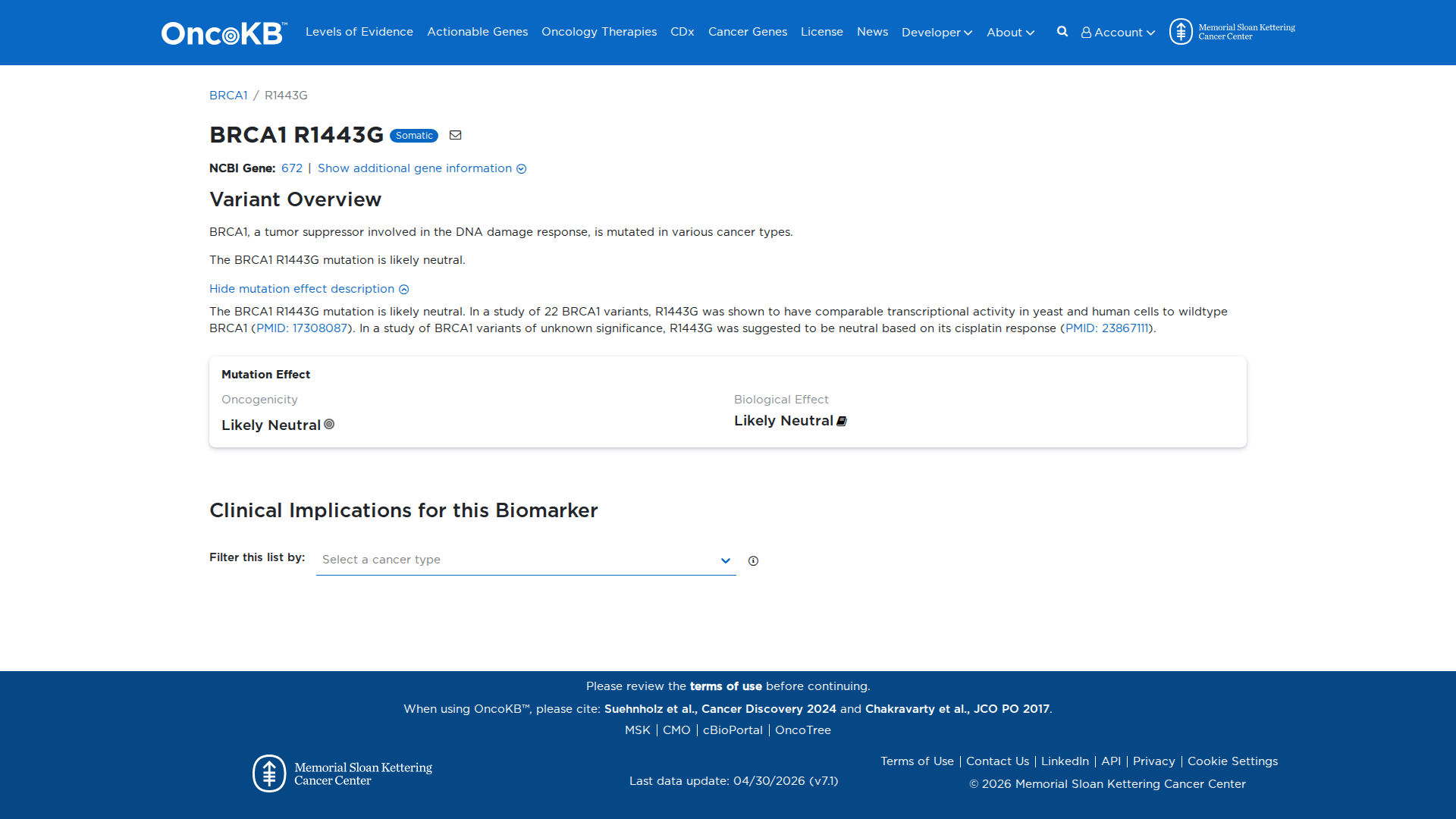
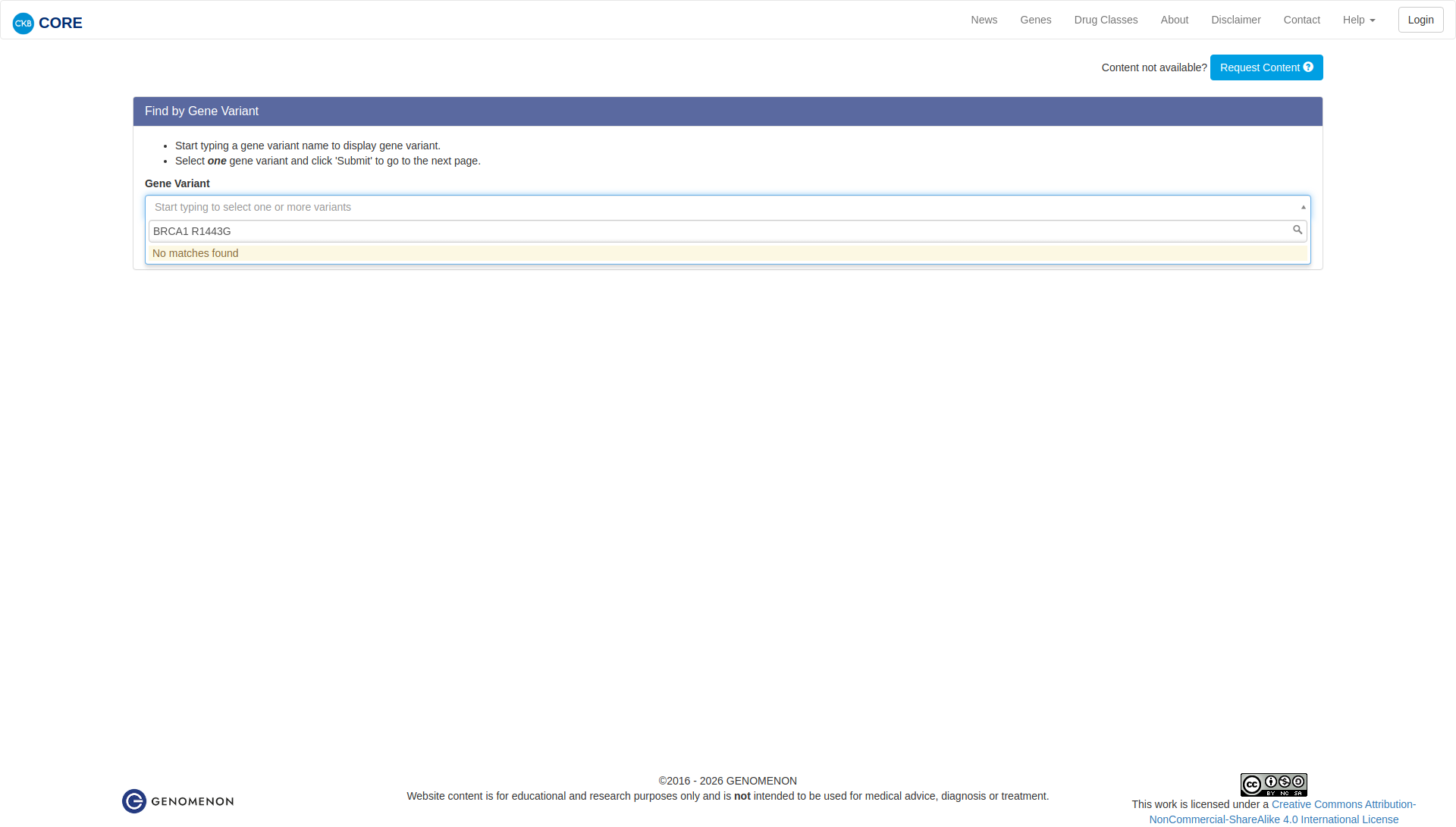
Error in OpenAI Consolidation. OncoKB: BRCA1R1443GBRCA1R1443GSomaticNCBI Gene:672|Show additional gene information Variant OverviewBRCA1, a tumor suppressor involved in the DNA damage response, is mutated in various cancer types.The BRCA1 R1443G mutation is likely neutral.Hide mutation effect description The BRCA1 R1443G mutation is likely neutral. In a study of 22 BRCA1 variants, R1443G was shown to have comparable transcriptional activity in yeast and human cells to wildtype BRCA1 (PMID: 17308087). In a study of BRCA1 variants of unknown significance, R1443G was suggested to be neutral based on its cisplatin response (PMID: 23867111). JAX-CKB: No results found
Click on previews to view full database entries. External databases may require institutional access.
Computational Analysis
Pathogenicity Predictions
SpliceAISpliceAI Scores
Window: ±500bp| Effect Type | Score | Position |
|---|---|---|
| Acceptor Loss (AL) | 0.01 | 138 bp |
| Donor Loss (DL) | 0.0 | -30 bp |
| Acceptor Gain (AG) | 0.0 | 178 bp |
| Donor Gain (DG) | 0.0 | -34 bp |
VCEP Guidelines
Applied ACMG/AMP Criteria (VCEP Specific)
PM2 (Unknown (Pre-LLM))
From pre-LLM assessment (LLM Failed)
BP4 (Unknown (Pre-LLM))
From pre-LLM assessment (LLM Failed)