Genetic Information
Gene & Transcript Details
| ID | Status | Details |
|---|---|---|
| NM_000546.3 | Alternative | 2640 nt | 252–1433 |
| NM_000546.5 | RefSeq Select | 2591 nt | 203–1384 |
| NM_000546.6 | MANE Select | 2512 nt | 143–1324 |
| NM_000546.4 | Alternative | 2586 nt | 198–1379 |
| NM_000546.2 | Alternative | 2629 nt | 252–1433 |
Variant Details
Clinical & Population Data
Population Frequency
gnomADClinVar
OpenIn summary, the currently available evidence indicates that the variant is pathogenic, but additional data are needed to prove that conclusively. Therefore, this variant has been classified as Likely Pathogenic. This sequence change replaces arginine with proline at codon 337 of the TP53 protein (p.Arg337Pro). The arginine residue is highly conserved and there is a moderate physicochemical difference between arginine and proline. This variant is not present in population databases (ExAC no frequency). This variant has been observed in individual(s) with Li-Fraumeni syndrome (PMID: 20426520). ClinVar contains an entry for this variant (Variation ID: 177879). This variant has been reported to affect TP53 protein function (PMID: 12826609, 19454241, 29955864). This variant disrupts the p.Arg337 amino acid residue in TP53. Other variant(s) that disrupt this residue have been determined to be pathogenic (PMID: 10864200, 16033918, 16494995, 21192060). This suggests that this residue is clinically significant, and that variants that disrupt this residue are likely to be disease-causing.
The p.R337P variant (also known as c.1010G>C), located in coding exon 9 of the TP53 gene, results from a G to C substitution at nucleotide position 1010. The arginine at codon 337 is replaced by proline, an amino acid with dissimilar properties. This alteration was identified in a 5 year old patient with acute lymphoblastic leukemia and adrenocortical carcinoma, as well as several family members with cancer (Karakas Z et al. Pediatr Hematol Oncol, 2010 May;27:297-305). This variant is in the oligomerization domain of the TP53 protein and is reported to have loss of transactivation in yeast based assays, and loss of tetramer formation in studies conducted in human cell lines (IARC TP53 database: Kato S et al. Proc. Natl. Acad. Sci. USA 2003 Jul;100:8424-9; Fischer NW et al. J. Natl. Cancer Inst., 2018 12;110:1418-1421). This amino acid position is well conserved in available vertebrate species. In addition, this alteration is predicted to be deleterious by in silico analysis. Based on the majority of available evidence to date, this variant is likely to be pathogenic.
"This variant has been reported in ClinVar as Likely pathogenic (6 clinical laboratories) and as Likely Pathogenic by ClinGen TP53 Variant Curation Expert Panel, ClinGen expert panel."
COSMIC Somatic Evidence
Open
Functional Impact & Domains
Functional Domain
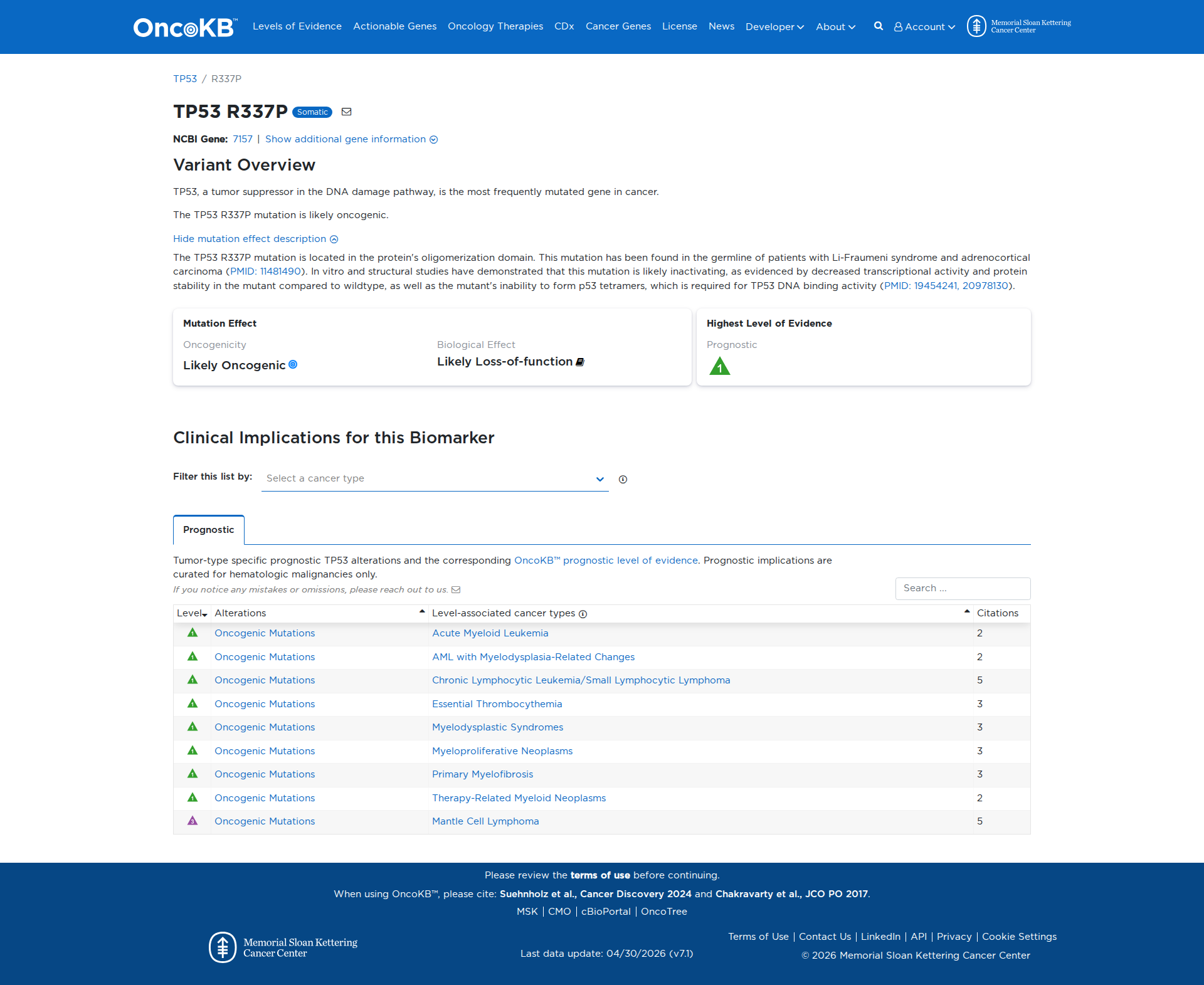
Error in OpenAI Consolidation. OncoKB: TP53R337PTP53R337PSomaticNCBI Gene:7157|Show additional gene information Variant OverviewTP53, a tumor suppressor in the DNA damage pathway, is the most frequently mutated gene in cancer.The TP53 R337P mutation is likely oncogenic.Hide mutation effect description The TP53 R337P mutation is located in the protein's oligomerization domain. This mutation has been found in the germline of patients with Li-Fraumeni syndrome and adrenocortical carcinoma (PMID: 11481490). In vitro and structural studies have demonstrated that this mutation is likely inactivating, as evidenced by decreased transcriptional activity and protein stability in the mutant compared to wildtype, as well as the mutant's inability to form p53 tetramers, which is required for TP53 DNA binding activity (PMID: 19454241, 20978130). JAX-CKB: TP53 R337P lies within the tetramerization domain of the Tp53 protein (PMID: 20978130). R337P results in decreased Tp53 tetramerization and transactivation activity and increased colony formation in cell culture (PMID: 19454241, PMID: 29955864).

Click on previews to view full database entries. External databases may require institutional access.
Computational Analysis
Pathogenicity Predictions
SpliceAISpliceAI Scores
Window: ±500bp| Effect Type | Score | Position |
|---|---|---|
| Acceptor Loss (AL) | 0.0 | 60 bp |
| Donor Loss (DL) | 0.0 | 151 bp |
| Acceptor Gain (AG) | 0.0 | -289 bp |
| Donor Gain (DG) | 0.0 | -414 bp |
VCEP Guidelines
Applied ACMG/AMP Criteria (VCEP Specific)
PS3 (Unknown (Pre-LLM))
From pre-LLM assessment (LLM Failed)
PM2 (Unknown (Pre-LLM))
From pre-LLM assessment (LLM Failed)
PP5 (Unknown (Pre-LLM))
From pre-LLM assessment (LLM Failed)
BP4 (Unknown (Pre-LLM))
From pre-LLM assessment (LLM Failed)