Genetic Information
Gene & Transcript Details
| ID | Status | Details |
|---|---|---|
| NM_006218.2 | Alternative | 3724 nt | 158–3364 |
| NM_006218.3 | Alternative | 9104 nt | 158–3364 |
| NM_006218.4 | MANE Select | 9259 nt | 324–3530 |
Variant Details
Clinical & Population Data
Population Frequency
gnomADClinVar
OpenThis variant has been previously reported as disease-causing and was found twice in our laboratory in individuals with overgrowth, macrocephaly, hemihypertrophy, and polydactyly or syndactyly
The c.2740G>A (p.G914R) alteration is located in exon 19 (coding exon 18) of the PIK3CA gene. This alteration results from a G to A substitution at nucleotide position 2740, causing the glycine (G) at amino acid position 914 to be replaced by an arginine (R). This variant was not reported in population-based cohorts in the Genome Aggregation Database (gnomAD). This alteration was reported as a de novo occurrence and heterozygous in multiple individuals with megalencephaly, overgrowth, vascular malformations and/or other clinical features consistent with PIK3CA-related disorders; this variant was detected in multiple sample types for some individuals (Rivière, 2012; Mirzaa, 2016; DECIPHER). This amino acid position is highly conserved in available vertebrate species. This missense alteration is located in a region that has a low rate of benign missense variation (Lek, 2016; Firth, 2009). This alteration is predicted to be deleterious by in silico analysis. Based on the available evidence, this alteration is classified as pathogenic.
The c.2740G>A (NM_006218.4) variant in PIK3CA is a missense variant predicted to cause substitution of (p.Gly914Arg). This variant is absent from gnomAD v2.1.1 (PM2_Supporting). PIK3CA, in which the variant was identified, is defined by the ClinGen Brain Malformations Expert Panel as a gene that has a low rate of benign missense variation and where pathogenic missense variants are a common mechanism of disease (PP2). This variant resides within the kinase domain of PIK3CA that is defined as a critical functional domain by the ClinGen BMEP (PMIDs: 26637981, 24459181, 27631024) (PM1_Supporting). The prevalence of the variant in affected individuals is significantly increased compared with the prevalence in controls (PS4; identified in 5 individuals with a clinical diagnosis of megalencephaly-polymicrogyria-polydactyly-hydrocephalus syndrome; (MPPH) or megalencephaly-capillary malformation-polymicrogyria syndrome; (MCAP), and in 4 individuals with segmental overgrowth or vascular malformation of a limb or region of the body, it has been shown to significantly increase phosphorylation levels in patient cell lines (PMID: 22729224), and it was identified in 2 tumor samples in COSMIC (PMID: 22729224, PMID: 28151489, PMID: 28502725, PMID: 30231930). This variant has been confirmed de novo and has been identified with variable allelic fractions consistent with a post-zygotic event (PS2_Strong; PMID: 22729224). In summary, this variant meets the criteria to be classified as Pathogenic for mosaic autosomal dominant overgrowth with or without cerebral malformations due to abnormalities in MTOR-pathway genes based on the ACMG/AMP criteria applied, as specified by the ClinGen Brain Malformations Expert Panel: PM2_P, PP2, PM1_P, PS4, PS2; 11 points (VCEP specifications version 1; Approved: 1/31/2021)
"This variant has been reported in ClinVar as Pathogenic (13 clinical laboratories) and as Likely pathogenic (3 clinical laboratories) and as Pathogenic by ClinGen Brain Malformations Variant Curation Expert Panel expert panel."
COSMIC Somatic Evidence
Open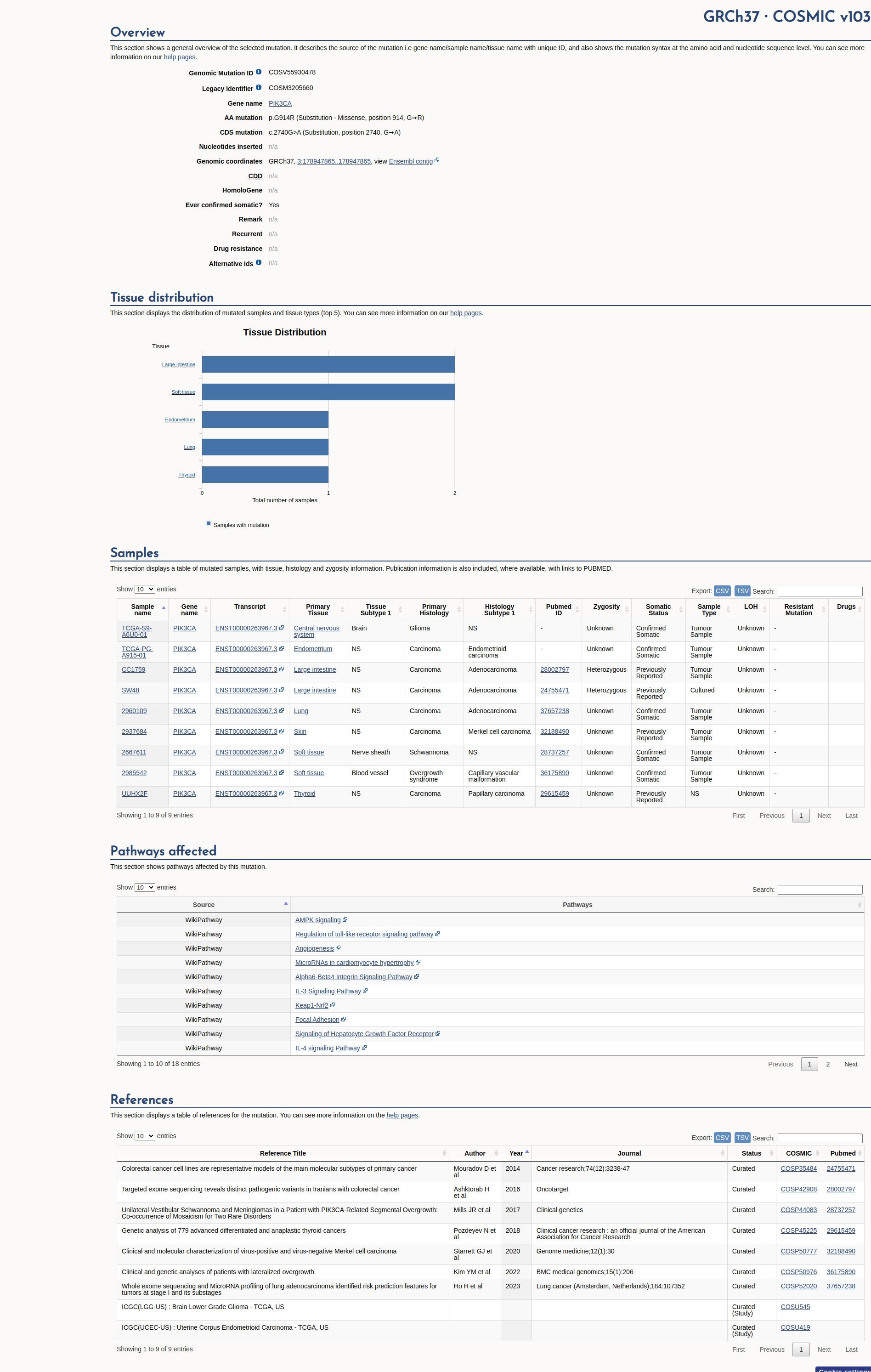
Functional Impact & Domains
Functional Domain
Error in OpenAI Consolidation. OncoKB: PIK3CAG914RPIK3CAG914RSomaticNCBI Gene:5290|Show additional gene information Variant OverviewPIK3CA, the catalytic subunit of PI3-kinase, is frequently mutated in a diverse range of cancers including breast, endometrial and cervical cancers.The PIK3CA G914R mutation is likely oncogenic.Hide mutation effect description The PIK3CA G914R mutation is located in the kinase domain in exon 19 of the protein. This mutation has been found in Megalencephaly-capillary malformation (MCAP) and megalencephaly-polymicrogyria -polydactyly-hydrocephalus (MPPH) syndromes (PMID: 22729224, 22228622). Lymphoblastoid cell lines derived from a patient with megalencephaly harboring a germline PIK3CA G914R mutation showed higher PIP3 staining than cells from an unaffected control, suggesting this mutation is likely activating (PMID: 22729224). JAX-CKB: PIK3CA G914R lies within the PI3K/PI4K domain of the Pik3ca protein (UniProt.org). G914R has been identified in sequencing studies (PMID: 30709910, PMID: 39284955, PMID: 27170661), but has not been biochemically characterized and therefore, its effect on Pik3ca protein function is unknown (PubMed, Nov 2025).


Click on previews to view full database entries. External databases may require institutional access.
Computational Analysis
Pathogenicity Predictions
SpliceAISpliceAI Scores
Window: ±500bp| Effect Type | Score | Position |
|---|---|---|
| Acceptor Loss (AL) | 0.13 | -73 bp |
| Donor Loss (DL) | 0.07 | 50 bp |
| Acceptor Gain (AG) | 0.0 | 161 bp |
| Donor Gain (DG) | 0.0 | -91 bp |
VCEP Guidelines
Applied ACMG/AMP Criteria (VCEP Specific)
PS3 (Unknown (Pre-LLM))
From pre-LLM assessment (LLM Failed)
PM2 (Unknown (Pre-LLM))
From pre-LLM assessment (LLM Failed)
PP5 (Unknown (Pre-LLM))
From pre-LLM assessment (LLM Failed)
BP4 (Unknown (Pre-LLM))
From pre-LLM assessment (LLM Failed)