Genetic Information
Gene & Transcript Details
| ID | Status | Details |
|---|---|---|
| NM_001330437.2 | Alternative | 6085 nt | 166–1959 |
| NM_001330437.1 | Alternative | 6151 nt | 215–2008 |
Variant Details
Clinical & Population Data
Population Frequency
gnomADClinVar
OpenThe p.Q510H pathogenic mutation (also known as c.1530G>C), located in coding exon 13 of the PTPN11 gene, results from a G to C substitution at nucleotide position 1530. The glutamine at codon 510 is replaced by histidine, an amino acid with highly similar properties. This variant as been reported in multiple individuals with PTPN11-related RASopathy (Wakabayashi Y et al. Am. J. Med. Genet. A, 2011 Oct;155A:2529-33; Chinton J et al. Arch Argent Pediatr, 2019 Oct;117:330-337; Kauffman H et al. Pediatr Res, 2021 Aug;90:444-451). It has also been determined to be the result of a de novo mutation in a fetus with features including hydrops fetalis, pleural effusion, cardiomyopathy, and hepatomegaly (Stuurman KE et al. J Med Genet, 2019 Oct;56:654-661). Another variant at the same codon, c.1530G>T (p.Q510H), has been described previously in fetuses with cystic hygroma (Gezdirici A et al. J Matern Fetal Neonatal Med, 2017 Apr;30:938-941). This amino acid position is highly conserved in available vertebrate species. In addition, this alteration is predicted to be deleterious by in silico analysis. This variant is considered to be rare based on population cohorts in the Genome Aggregation Database (gnomAD). Based on the supporting evidence, this alteration is interpreted as a disease-causing mutation.
Variant summary: PTPN11 c.1530G>C (p.Gln510His) results in a non-conservative amino acid change affecting a critical amino acid located in the PTP type protein phosphatase of the encoded protein sequence. Five of five in-silico tools predict a damaging effect of the variant on protein function. The variant was absent in 30972 control chromosomes. c.1530G>C has been reported in the literature in individuals affected with Noonan Syndrome and Related Conditions. These data do not allow any conclusion about variant significance. To our knowledge, no experimental evidence demonstrating an impact on protein function has been reported. Two clinical diagnostic laboratories have submitted clinical-significance assessments for this variant to ClinVar after 2014. One was the "ClinGen RASopathy Expert Panel" which classified this variant as Pathogenic, while the other classified it as "Likely Pathogenic" without evidence for independent evaluation. Based on the evidence outlined above, the variant was classified as pathogenic.
This sequence change replaces glutamine, which is neutral and polar, with histidine, which is basic and polar, at codon 510 of the PTPN11 protein (p.Gln510His). This variant is not present in population databases (gnomAD no frequency). This missense change has been observed in individuals with Noonan syndrome with multiple lentigines (PMID: 21910226, 31263281). ClinVar contains an entry for this variant (Variation ID: 40567). Invitae Evidence Modeling of protein sequence and biophysical properties (such as structural, functional, and spatial information, amino acid conservation, physicochemical variation, residue mobility, and thermodynamic stability) indicates that this missense variant is expected to disrupt PTPN11 protein function with a positive predictive value of 95%. This variant disrupts the p.Gln510 amino acid residue in PTPN11. Other variant(s) that disrupt this residue have been determined to be pathogenic (PMID: 15948193, 24775816). This suggests that this residue is clinically significant, and that variants that disrupt this residue are likely to be disease-causing. For these reasons, this variant has been classified as Pathogenic.
"This variant has been reported in ClinVar as Pathogenic (13 clinical laboratories) and as Likely pathogenic (1 clinical laboratories) and as Pathogenic by ClinGen RASopathy Variant Curation Expert Panel expert panel."
COSMIC Somatic Evidence
Open
Functional Impact & Domains
Functional Domain
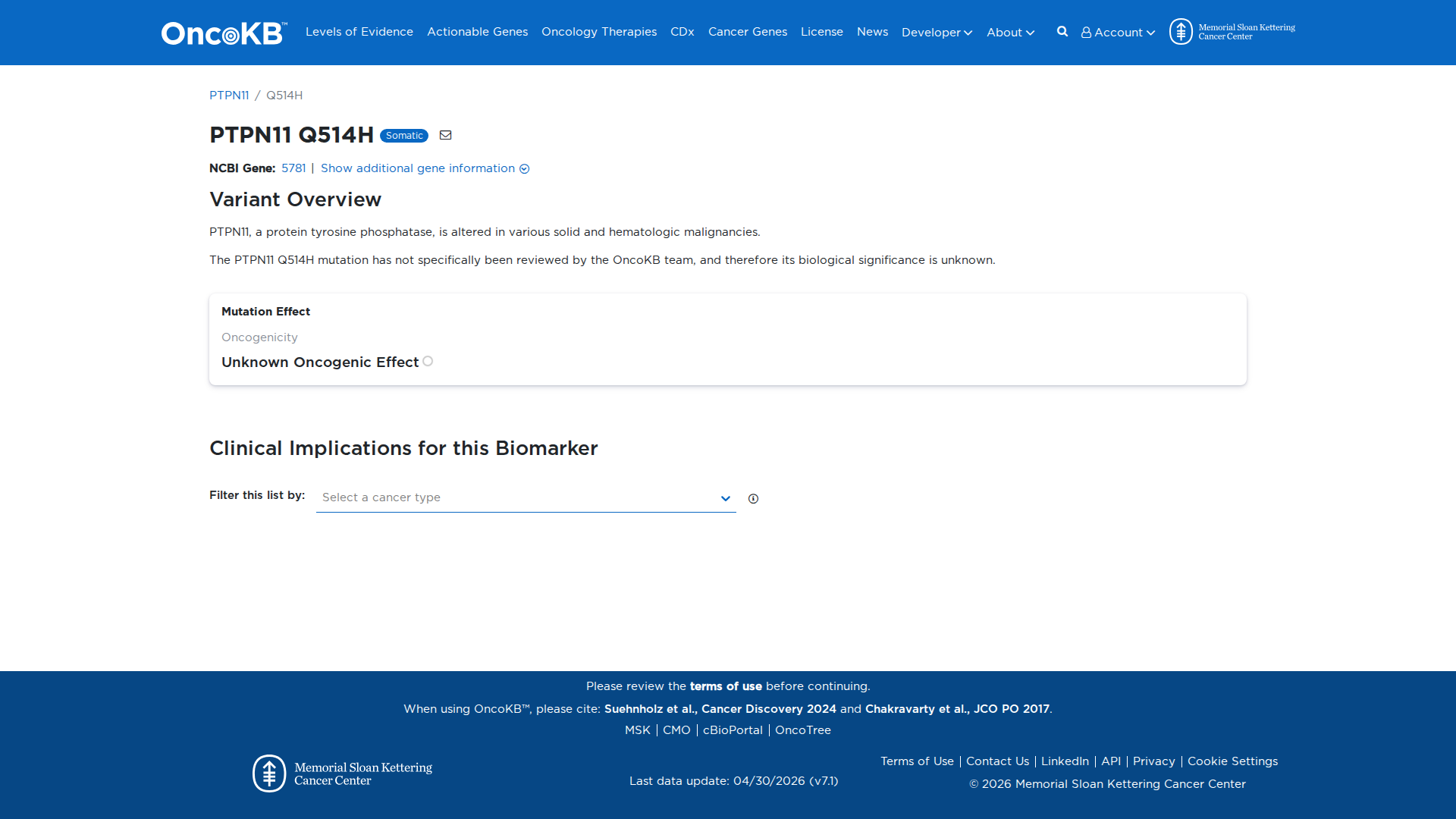
Error in OpenAI Consolidation. OncoKB: PTPN11Q514HPTPN11Q514HSomaticNCBI Gene:5781|Show additional gene information Variant OverviewPTPN11, a protein tyrosine phosphatase, is altered in various solid and hematologic malignancies.The PTPN11 Q514H mutation has not specifically been reviewed by the OncoKB team, and therefore its biological significance is unknown. JAX-CKB: No results found

Click on previews to view full database entries. External databases may require institutional access.
Computational Analysis
Pathogenicity Predictions
SpliceAISpliceAI Scores
Window: ±500bp| Effect Type | Score | Position |
|---|---|---|
| Acceptor Loss (AL) | 0.0 | -44 bp |
| Donor Loss (DL) | 0.0 | -1 bp |
| Acceptor Gain (AG) | 0.0 | -82 bp |
| Donor Gain (DG) | 0.0 | 69 bp |
VCEP Guidelines
Applied ACMG/AMP Criteria (VCEP Specific)
PM2 (Unknown (Pre-LLM))
From pre-LLM assessment (LLM Failed)
PP5 (Unknown (Pre-LLM))
From pre-LLM assessment (LLM Failed)
BP4 (Unknown (Pre-LLM))
From pre-LLM assessment (LLM Failed)